
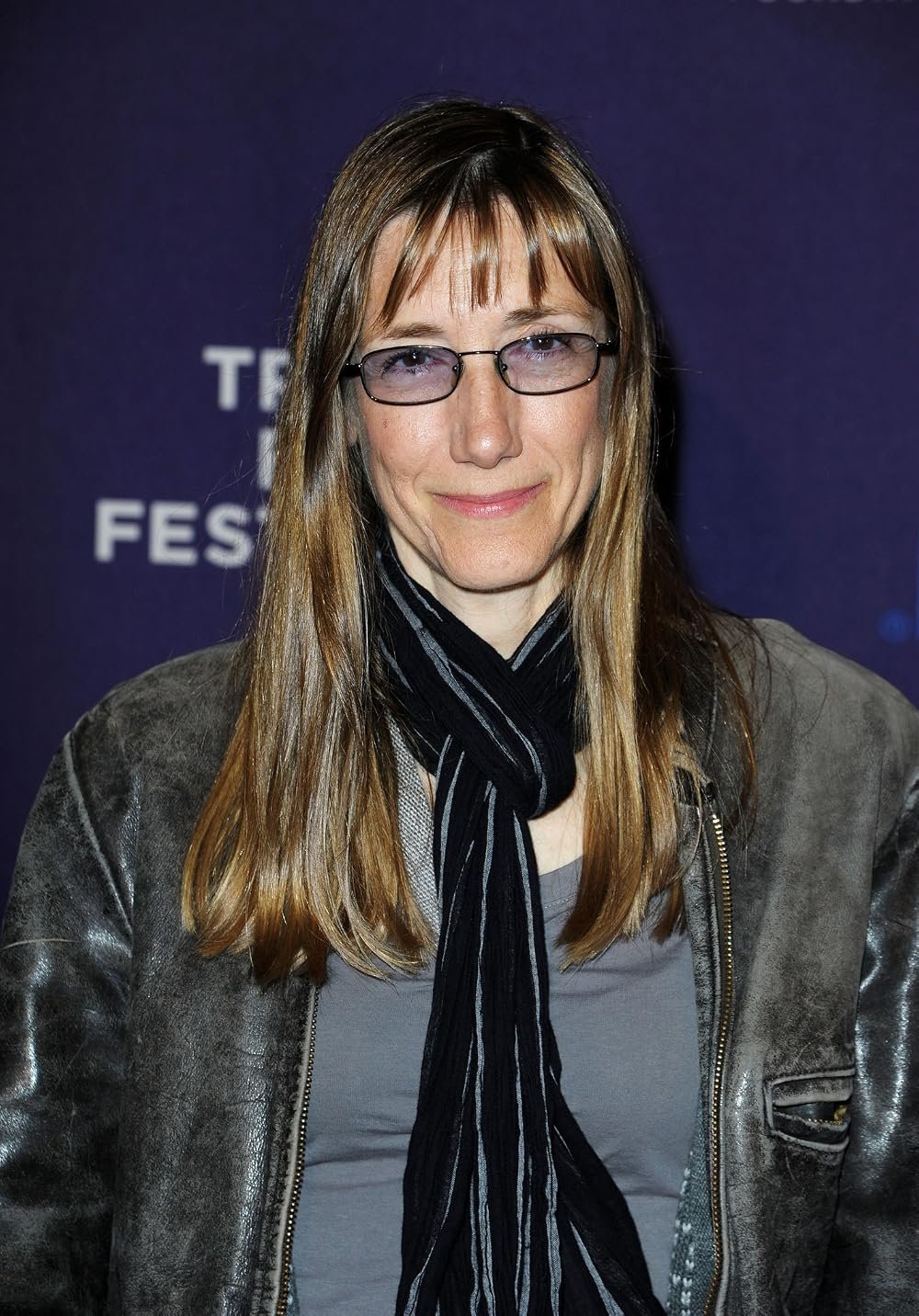
Kimberly Peirce (born 1967) is an American director best known for Boys Don’t Cry, Stop-Loss and the 2013 remake of Stephen King’s Carrie.
Quick Specs
| Born | Kimberly Ane Peirce, September 8, 1967, Harrisburg, Pennsylvania |
| Education | University of Chicago (AB 1990, English and Japanese literature); Columbia University (MFA, film) |
| Features | Boys Don’t Cry (1999), Stop-Loss (2008), Carrie (2013) |
| Shorts | The Last Good Breath (1994); Boys Don’t Cry thesis short (1995) |
| Television | The L Word, Halt and Catch Fire, I Love Dick, Six, Dear White People, Kidding, P-Valley and others |
| Honors | Best Debut Director, National Board of Review; Best New Filmmaker, Boston Society of Film Critics |
| Roles | governor of the Academy of Motion Picture Arts and Sciences; DGA board member; founding member of ReFrame |
Who She Is
Kimberly Ane Peirce was born in Harrisburg, Pennsylvania, on September 8, 1967, to Sherry and Robert A. Peirce, who owned a construction company. The family moved to New York City when she was three and to Miami when she was eleven, and she graduated from Miami Sunset Senior High School. She is of Jewish and Italian descent, and she describes herself as queer and genderqueer.
At the University of Chicago she found a mentor in professor Lauren Berlant, whose class on lesbian feminist theory she calls “a beacon.” Partway through, she spent two years in Kobe, Japan, working as a photographer and teaching English to save money for school. Back in Chicago, she told Berlant she wanted to be an academic. Berlant told her she wasn’t cut out for it, and that she was “really great at reading film.” “She gave me permission to dream,” Peirce says. She graduated in 1990 with a degree in English and Japanese literature and went to Columbia for an MFA in film.
The Work, and What She Did in It
The Last Good Breath (1994), her experimental Columbia short about two lovers in a world war, one of whom always lives while the other always dies, screened in the Leopards of Tomorrow program at Locarno.
Her thesis was going to be about a woman soldier in drag in the Civil War. Then she read a Village Voice article about Brandon Teena, a transgender man from Nebraska who was raped and murdered after his gender history was discovered, and she switched. Her 1995 thesis short on his story was nominated by the Columbia faculty for a Princess Grace Award and won an Astrea Production Grant. Producer Christine Vachon saw it, the feature went into development, and the script went through the Sundance labs in 1997.
Boys Don’t Cry (1999) is the centerpiece. Peirce directed and co-wrote it with Andy Bienen. Beginning in 1994, she went to Falls City, Nebraska, with the activist group Transexual Menace and sat in on the murder trial. She met Lana Tisdel at a convenience store and interviewed her at home. Lana first thought Peirce, with her short hair, was Brandon. Peirce also interviewed Lana’s mother and Brandon’s acquaintances, though not his own family. Over five years she built up thousands of pages of transcripts, clippings and interviews. “The last thing I wanted was to duplicate the violence without understanding it,” she said. “I had to make the violence personal.”
Casting took almost four years. Drew Barrymore was an early candidate, and Peirce auditioned widely in the LGBTQ community, including trans men and drag kings. After about a hundred actors, the little-known Hilary Swank sent a tape. Swank was 22 and said she was 21, Brandon’s age. When Peirce confronted her, Swank said, “But that’s what Brandon would do.” Peirce called it “the first time I saw someone who not only blurred the gender lines, but who was this beautiful, androgynous person with this cowboy hat and a sock in her pants.” Swank lived as a man for a month and got her body fat down to 7 percent. She was paid $75 a day, $3,000 in all, too little to qualify for health insurance. Chloë Sevigny played Lana, Peter Sarsgaard John Lotter and Brendan Sexton III Tom Nissen.
The film shows a double murder. In reality there were three victims: Brandon, Lisa Lambert (Candace in the film) and Phillip DeVine, a Black man dating Lana’s sister, who is not in the film.
The MPAA first rated it NC-17. The rape scenes were trimmed to get an R, but Peirce’s famous objection, made in the documentary This Film Is Not Yet Rated, was about a different scene: the board wanted the sex scene between Brandon and Lana cut back, and called a shot of Lana’s orgasm “too long,” while the brutality of the murder drew no equal objection. She asked whether anyone had ever been hurt by an orgasm that was too long.
Made for $2 million, the film grossed $20.7 million. Swank won the Oscar and the Golden Globe for Best Actress, and Sevigny was Oscar-nominated and won the Independent Spirit Award. It entered the National Film Registry in December 2019, and the Academy is preserving Peirce’s research archive, audition tapes included.
Between features, her only directing credit was an episode of The L Word, “Lifeline” (2006).
Stop-Loss (2008), nine years later, she directed, co-wrote with Mark Richard and produced. Ryan Phillippe, Channing Tatum and Joseph Gordon-Levitt play soldiers home from Iraq, and Phillippe’s sergeant is ordered back under stop-loss, the policy that extends a soldier’s service past his contract, often called a back-door draft. The root was personal. Her younger brother enlisted after 9/11 and served in Iraq at 18, and he brought home soldier-made videos: cameras taped to Humvees and gun turrets, cut to rock music in the barracks. “When I saw those videos,” she said, “they bring you, like, heart and soul right inside the soldiers’ experience.” She started it as a documentary with more than 100 hours of footage. “People want to go to the movies and see a story about human beings,” she said; “they don’t want to be preached to about politics.” It cost $25 million and made $11.2 million.
Carrie (2013) is her horror film. She directed and did not write it; the screenplay is by Lawrence D. Cohen and Roberto Aguirre-Sacasa from Stephen King’s 1974 novel. When the studio came to her in 2011 she was skeptical: “I thought, ‘You guys want to do this because there’s money in it.'” She had been friends with Brian De Palma since Boys Don’t Cry, so she asked him, and in one telling he said, “You gotta do it!” Then she read the novel cover to cover three times.
Her central idea was to make it an origin story. “I wanted to do the film as a superhero origins story about Carrie and her powers,” she said. That meant Carrie had to be bad at her powers at first, so that at the prom she isn’t fully in control. She modernized it, too: the shower humiliation is filmed on a phone and uploaded. And she cast an actual teenager. Chloë Grace Moretz, “15 going on 16,” and Julianne Moore as Margaret White were her first choices. Sissy Spacek had been in her mid-to-late twenties when she played Carrie in 1976.
King’s best-known comment on the remake came in May 2011, before Peirce was attached. He asked why remake a film that was “much better than the book” and said he could get behind it if it went to “one of the Davids: Lynch or Cronenberg.” Peirce’s Carrie cost $30 million and made $84.8 million worldwide. Critics were lukewarm, but the public voted it Favorite Horror Movie at the 2014 People’s Choice Awards, over The Conjuring.
Since then she has directed television steadily: Turn, Manhattan, Halt and Catch Fire, American Crime, I Love Dick, Six, Dear White People, Kidding, and “Scars” for P-Valley (2020). In 2017 she was attached to direct This Is Jane for Amazon, about the Jane Collective, Chicago’s underground abortion service; no film has been released.
Cool Verified Facts
- Sony promoted Carrie with two separate stunts a year apart: the “Call Carrie” phone campaign at New York Comic Con in October 2012, and a hidden-camera video in October 2013, in which an actress “telekinetically” threw a man up a wall in a West Village coffee shop, using a fake wall, a harness and remote-controlled furniture.
- Her dramatic rule: “If you start out with a secret, then obviously, over the course of the movie, that secret will be exposed.”
Signatures, Habits and Behind the Scenes
- Research first, every time: five years and a murder trial for Boys Don’t Cry, a documentary’s worth of footage for Stop-Loss, three readings of the novel for Carrie.
- She falls for her outsiders. “I fell instantly in love with Brandon,” she says, and she describes herself as Brandon’s “adoptive parent.” Of Carrie: “This is a story about a misfit, because we’re all misfits.”
- Inside the protagonist’s head. She wants the audience “inside the protagonist’s point of view as much as possible,” and doesn’t want them crying because “it’s all predetermined for you.”
- Photography first. In Japan she had her first camera and darkroom, studying Man Ray and Cartier-Bresson.
Why She Matters
Boys Don’t Cry put a trans man’s inner life at the center of an American film on a $2 million budget. GLAAD’s Nick Adams called it “a vital and high-profile correction” to the news coverage of the case, and for many trans men it was the first time they had seen themselves on screen. For horror, Peirce is the director who took Carrie back to the book, with a real teenager in the role and the powers recast as a misfit’s one talent. The critics-versus-public split on that film is part of its story. And the director of a Registry film about a murdered trans teenager now sits on the Academy’s board of governors and on the DGA board. “What I really yearn for is a story where I fall in love with the characters,” she has said.