
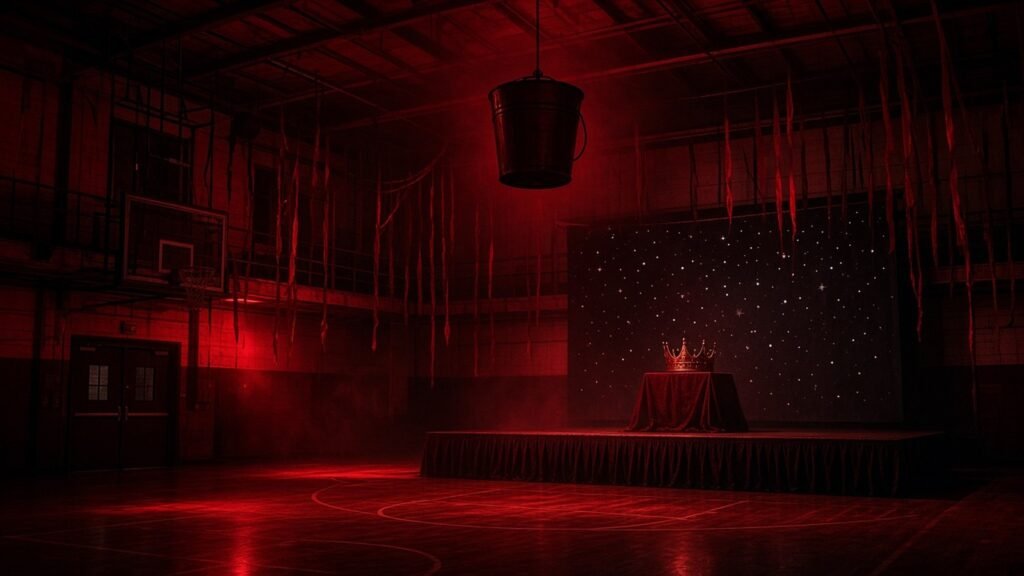
Carrie (1976) is Brian De Palma’s supernatural horror film of Stephen King’s first published novel, and the first King book ever filmed.
Before the clowns and the haunted hotels, there was a shy girl in a gym shower who did not know what was happening to her body. Carrie is the King adaptation every other King adaptation gets measured against: a bullied, telekinetic teenager, a mother who sees sin in everything her daughter becomes, and a senior prom that ends in fire. Sissy Spacek plays Carrie White, Piper Laurie plays Margaret White, and both were nominated for Academy Awards, a rare honour for horror performances. De Palma brings his trademark split-screen; Lawrence D. Cohen’s screenplay keeps King’s story lean and cruel. Made for $1.8 million and released by United Artists in November 1976, it became a major hit, launched the long King-to-screen pipeline, and in 2022 entered the National Film Registry.
At a glance
| Director | Brian De Palma |
| Screenplay | Lawrence D. Cohen |
| Based on | Carrie (1974), the first published novel by Stephen King |
| Producer | Paul Monash; associate producer Louis A. Stroller |
| Starring | Sissy Spacek, Piper Laurie, Amy Irving, William Katt, John Travolta, Nancy Allen, Betty Buckley, P. J. Soles |
| Cinematography | Mario Tosi |
| Editing | Paul Hirsch |
| Music | Pino Donaggio |
| Art direction | William Kenney and Jack Fisk |
| Costumes | Rosanna Norton |
| Production company | Red Bank Films |
| Distributor | United Artists |
| Release date | November 3, 1976 (United States), expanding wide in mid-November |
| Running time | 98 minutes |
| Country and language | United States; English |
| Rating | R |
| Budget | $1.8 million |
| Box office | $33.8 million domestic gross |
Plot
The setting is Bates High School in the town of Chamberlain. Carrie White is the girl nobody sits with. At home she lives with her mother, Margaret, a religious fanatic who treats every sign of growing up as a sign of damnation and locks her daughter in a closet to pray. At school she is the easy target, and the film opens on the moment the target gets hit hardest.
In the girls’ shower after gym class, Carrie gets her first period. She has never been told what menstruation is, and she panics. Her classmates do not help. They pelt her with tampons and towels until the gym teacher, Miss Collins, breaks it up and realises, with real horror of her own, that Carrie genuinely did not know what was happening to her.
The girls are punished. Chris Hargensen refuses the punishment, so she is barred from the prom, and she starts planning revenge with her boyfriend, Billy Nolan. Carrie, meanwhile, discovers in the school library what she can do. She has telekinesis, and the power has arrived with puberty, the same change her mother calls a curse.
Not every girl in that shower is cruel by nature. Sue Snell is ashamed of what she did, and she asks her boyfriend, Tommy Ross, to take Carrie to the prom in her place. Tommy asks, and Carrie goes.
For a few minutes the night is the one she never dared hope for. But Chris and Billy have slaughtered a pig, rigged a bucket of its blood above the stage and fixed the vote for prom king and queen. Carrie is crowned beside Tommy. She is standing in the light, smiling, when the bucket tips and drenches her in pig’s blood in front of the whole school.
Carrie snaps. De Palma splits the screen as her power lets go, and the gym becomes a trap: the doors seal, fire hoses lash the crowd, electrical fire takes the decorations and the rigging comes down. The prom-goers die in the burning hall.
The ending
Carrie goes home to the one person left. Margaret, now certain her daughter is a witch, stabs her in the back with a kitchen knife. Carrie kills her mother in self-defence, telekinetically hurling knives and kitchen implements that pin Margaret to the doorway in a cruciform pose. The house collapses and burns around them, and Carrie dies in the wreckage, cradling her mother’s body in the closet where she was so often locked to pray.
Carrie White does not survive the film, and neither does her mother. The famous last shock belongs to Sue Snell, the one classmate who tried to help. Sue, the sole survivor of the prom, dreams that she lays flowers on the burnt lot where the White house stood, and Carrie’s bloody hand bursts from the ground and seizes her arm. She wakes screaming in her own mother’s arms. The hand is Sue’s nightmare, not a resurrection, and it is one of the most copied endings in horror.
Cast
- Sissy Spacek as Carrie White
- Piper Laurie as Margaret White
- Amy Irving as Sue Snell
- William Katt as Tommy Ross
- John Travolta as Billy Nolan
- Nancy Allen as Chris Hargensen
- Betty Buckley as Miss Collins
- P. J. Soles as Norma Watson
- Priscilla Pointer as Mrs. Snell
- Sydney Lassick as Mr. Fromm
- Stefan Gierasch as Mr. Morton
- Edie McClurg as Helen Shyres
- Michael Talbott as Freddy
- Doug Cox as The Beak
- Cameron De Palma, the director’s nephew, as the boy on the bicycle
Production
King’s novel was published in 1974. De Palma, by his own account in a 1977 interview, read it after a writer friend recommended it and went after the rights while studios were still circling. Paul Monash produced, and Lawrence D. Cohen wrote the screenplay.
The cast is a snapshot of a generation just before it became famous. Spacek, married to the film’s art director, Jack Fisk, leads a young ensemble that includes John Travolta, before Saturday Night Fever, as Billy, Nancy Allen as Chris, Amy Irving as Sue, William Katt as Tommy, P. J. Soles as Norma and Betty Buckley as Miss Collins. Opposite them is the veteran Piper Laurie as Margaret, credited with the line “and Piper Laurie as Margaret White.”
The prom sequence took more than two weeks to shoot. Spacek stayed in the bloodied prom dress for days at a time to keep the blood continuity intact, and the blood itself was karo syrup and food colouring. It is the most famous makeup job in the film and also the stickiest.
Behind the camera, Mario Tosi shot it, Paul Hirsch cut it, and Pino Donaggio wrote the score. Rosanna Norton designed the costumes, and William Kenney and Jack Fisk handled the art direction. That team is why the film looks like a dream sliding into a nightmare, right up to the hard split-screen when the power comes.
Release
Carrie opened in the United States on November 3, 1976, through United Artists, in a limited pattern before expanding wide in mid-November. It runs 98 minutes and carries an R rating.
It was a major hit. Against a budget of $1.8 million, the film took $33.8 million at the domestic box office, more than eighteen times what it cost, and it ranked seventh among the releases of the final quarter of 1976, the season of Rocky and King Kong. Box-office trackers do not agree on the total: one modern database records a North American figure about $7.9 million lower, so $33.8 million is the figure carried in the contemporary record rather than the only one in circulation.
The trade measure of the day was rentals, the distributor’s share of what audiences paid, roughly half the gross. By January 1978 Carrie had earned $14.5 million in theatrical rentals in the United States and Canada, plus $7 million overseas, for worldwide rentals of about $22 million. Rentals and gross are different numbers, and they should never be added together.
Reception
The film’s reputation was strong from the start, and it has only grown. Roger Ebert called it “absolutely spellbinding” and a “true horror story.” On Metacritic it sits in the mid-80s, the range the site labels universal acclaim.
The awards record is the remarkable part. At the 49th Academy Awards, for 1976, Carrie earned two acting nominations: Best Actress for Sissy Spacek and Best Supporting Actress for Piper Laurie. Neither won, but two acting nominations for one horror film is a rare thing, and the film is still cited as one of the very few horror titles to collect multiple Academy Award nominations.
Elsewhere, Spacek won Best Actress from the National Society of Film Critics, the film took the Grand Prize at the Avoriaz Fantastic Film Festival, Cohen’s screenplay was nominated for an Edgar, and Laurie received a Golden Globe nomination.
Legacy
Carrie opened the door that King’s work has been walking through ever since. As the first feature adaptation of a Stephen King book, it set the template: take the small-town cruelty seriously, cast actors who can carry the pain, and let the supernatural arrive as consequence rather than decoration.
The lists keep finding it. It is number 46 on AFI’s 100 Years…100 Thrills, number 86 on Empire’s 500 Greatest Movies of All Time in 2008, and the prom sequence placed eighth on Bravo’s The 100 Scariest Movie Moments in 2004. In 2022 the Library of Congress selected it for the National Film Registry as culturally, historically or aesthetically significant.
The prom and the hand from the grave are among the most referenced and parodied passages in horror. Every bucket over a stage and every hand bursting from the dirt in the last thirty seconds of a horror film owes this one something.
The story has been told again: a sequel, The Rage: Carrie 2 (1999), a 2002 television film and a 2013 theatrical remake. None of them involved De Palma, and none of their facts belong to this film.
Trivia
- King’s novel was his first published novel, not his first written one. He had earlier manuscripts that never made it to print.
- The songs heard in the film, “Carrie” and “Born to Have It All,” have lyrics by Merrit Malloy and are sung by Katie Irving.
- Spacek, not Travolta, is the film’s lead and heads the billing. Travolta plays a supporting role in an early part of his career.