
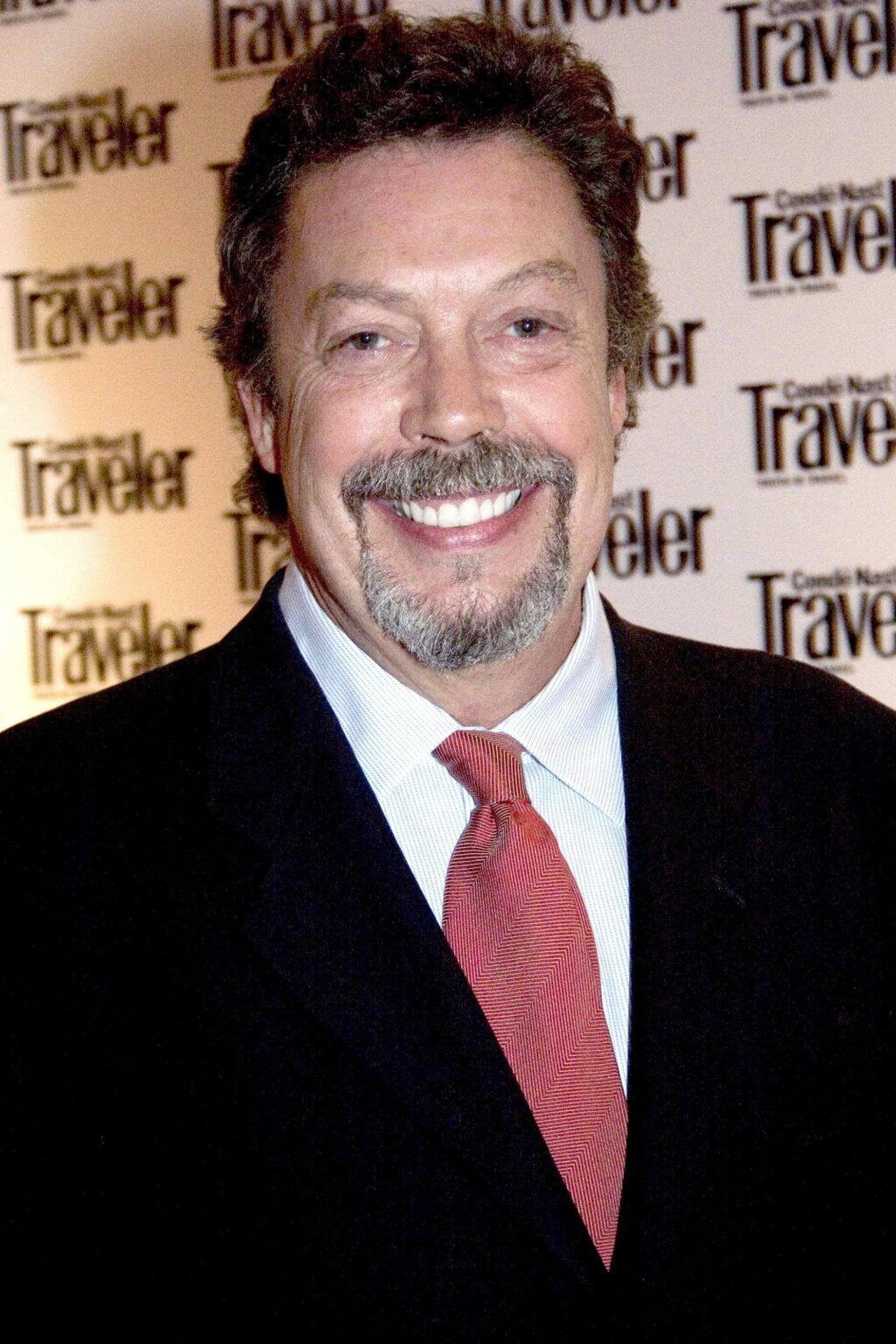
Tim Curry (1946–2026) was an English actor and singer who originated Frank-N-Furter on stage and screen and defined Pennywise for a television generation.
Tim Curry died at his home in Toluca Lake, Los Angeles, on 25 August 2026, aged 80. His longtime manager and friend Marcia Hurwitz confirmed his passing; no cause of death was disclosed. What follows is the record he left behind — one of the most remarkable in horror, because twice, fifteen years apart, Curry created the face of a landmark.
He was a classical stage actor who treated genre material with full technique, a singer with three rock albums, and a voice actor who raised a second generation of children while terrifying the first one. Few performers are simultaneously a midnight-movie ritual, a childhood trauma and a children’s television Emmy winner. Curry was all three.
Quick Specs
Full name: Timothy James Curry
Born: 19 April 1946, Grappenhall, Cheshire, England
Died: 25 August 2026, Toluca Lake, Los Angeles, California (aged 80)
Cause of death: Not disclosed
Education: University of Birmingham — combined BA in English and drama, 1968
Known for: Dr Frank-N-Furter in The Rocky Horror Picture Show, Pennywise in It (1990), Darkness in Legend, Wadsworth in Clue
Honours: Daytime Emmy Award winner (Captain Hook in Peter Pan & the Pirates); three Tony Award nominations; two Laurence Olivier Award nominations
A Chaplain’s Son Who Sang
Timothy James Curry was born on 19 April 1946 in Grappenhall, Cheshire, the son of Patricia, a school secretary, and James Curry, a Royal Navy chaplain. The Navy life defined his childhood: within a year of his birth the family had moved to Hong Kong, and from there to a different British seaside town roughly every eighteen months, following his father’s postings. The family settled in Plymouth when Curry was eleven.
His father suffered a stroke in 1958 and died in hospital of pneumonia, aged 49. The family moved on to South London, and Curry was sent to Kingswood School in Bath, where he sang in church choirs and developed into a talented boy soprano — the first instrument of a career that would lean on his voice as much as his face. He read English and drama at the University of Birmingham, graduating in 1968, and went straight into the original London production of Hair — his first full-time job, in the role of Woof. There he met a young writer named Richard O’Brien. That meeting is the hinge his whole career swings on.
Frank-N-Furter: The Role He Invented
Curry’s own oft-told account of landing the lead: he ran into O’Brien outside a Westminster gym, where O’Brien was looking for, as Curry recalled it, “a muscleman who could sing.” Curry’s reply: “Why do you need him to sing?” The Rocky Horror Show premiered at the Royal Court’s Theatre Upstairs in London on 19 June 1973, and Curry originated Dr Frank-N-Furter — a sweet transvestite from Transsexual, Transylvania, played in fishnets, heels and absolute command.
Even Frank’s voice was Curry’s invention. He told Terry Gross on NPR’s Fresh Air in 2005 that he first rehearsed the part with a German accent and peroxide-blond hair, then tried American, before overhearing an English woman ask, “Do you have a house in town or a house in the country?” — and deciding, in his words, “Yes, Frank-N-Furter should sound like the Queen.” The arched, cut-glass delivery that resulted is now inseparable from the character.
The London production ran for 2,960 performances. Curry took Frank to Los Angeles for a nine-month run in 1974, then to Broadway in 1975 — where the show managed only three previews and 45 performances at the Belasco despite award nominations. The film, The Rocky Horror Picture Show (1975), directed by Jim Sharman and starring Curry opposite Susan Sarandon and Barry Bostwick, was his feature-film debut — and on release, it flopped. What saved it arrived on 1 April 1976, when midnight screenings began at New York’s Waverly Theater and audiences started talking back: costumes, callback lines, shadow casts performing beneath the screen. The film never really closed. It remains the longest-running theatrical release in film history and was selected for the US National Film Registry in 2005. He had taken the part knowing the image might be impossible to shake — as he put it in 1975: “I’ve always thought it wasn’t worth doing unless you took a risk, really. So I just took the risk.”
A Stage Actor Between Films
Rocky Horror made him famous, but the stage kept making him better. In 1975 he played Tristan Tzara in Tom Stoppard’s Travesties in the West End and on Broadway. In 1980–81 he played Mozart in Amadeus on Broadway, earning the first of his three Tony Award nominations. In 1982 he played the Pirate King in The Pirates of Penzance in the West End, earning a Laurence Olivier Award nomination. These were not victory laps between film jobs; they were the foundation — the technique and stamina that let him treat a clown, a devil and a butler with the rigour other actors reserved for Shakespeare.
Rooster, Darkness and Wadsworth
His early-1980s screen villains arrived in a remarkable cluster. In Annie (1982) he played Rooster Hannigan, the scheming brother of Carol Burnett’s Miss Hannigan — his mainstream Hollywood villain calling card. Then, in a single year, he played the two poles of his screen talent. In Ridley Scott’s Legend (1985) he was Darkness, the horned, red-skinned lord of evil, opposite Tom Cruise and Mia Sara.
Darkness is a performance built almost entirely from voice, eyes and posture, because Curry delivered it buried inside a full-body prosthetic created by Rob Bottin’s effects team — three-foot fibreglass horns, cat-like contact lenses, hooves. The makeup was an ordeal by any account: by Curry’s own contemporary telling it took six-and-a-half hours to apply, and production accounts describe applications that began at around eight hours before the routine was cut down to about five-and-a-half. Day after day, for months, he sat down before dawn and let himself be rebuilt into a devil, then acted — gracefully, seductively, terrifyingly — through all of it. Darkness became the benchmark against which acting through prosthetics is still measured.
The same year, in Clue (1985), he played Wadsworth the butler, and gave the opposite masterclass: no makeup, no prosthetics, just speed. The comedy, adapted from the board game, ends with Wadsworth re-enacting the entire night’s murders at a full sprint, racing through the mansion and narrating every killing in character — a finale Curry carries almost single-handedly, in each of the film’s multiple endings. It remains one of the great comic performances of the decade, and it is the perfect counterweight to Darkness: proof that the instrument was never the makeup. The instrument was Curry.
Pennywise: A Smile Gone Bad
In November 1990, Curry delivered the performance that would define him for horror audiences. Stephen King’s It was adapted as a two-part ABC television miniseries — not a cinema film — directed by Tommy Lee Wallace and aired on 18 and 20 November 1990. Curry’s Pennywise the Dancing Clown haunted the Losers’ Club twice over, as children in 1960 and as the adults who must return to Derry in 1990. ABC spent $12 million on the production, double the usual television budget, and roughly 30 million viewers watched across the two nights, making it the network’s biggest success of the year. That is the essential fact of Curry’s Pennywise: there was no cinema age gate and no gore budget to hide behind. He arrived in the living room, in prime time, in front of a generation of children — and he has never left their nightmares since.
On set in 1990, Curry defined the character in five words that have followed the role ever since: “a smile gone bad.” A clown, he explained, “is traditionally a very cozy, comforting kind of cheery image, and Pennywise is none of these things.” His horror philosophy was the same then as his performances suggest: he preferred psychological fear to, as he put it, “a pint of blood and a pound-and-a-half of latex,” because “what is the most horrifying is the moment of decision behind somebody’s eyes when they decide to kill somebody.” After the marathon makeup days of Legend, the Pennywise face was deliberately light — about three hours, largely greasepaint over his own features, developed with makeup artist Bart Mixon and Wallace, the mouth and eyebrows endlessly adjusted across the first five shooting days. Curry’s own punchline about prosthetics, from the same interview: “The most fun, I have to say, is taking it off. The moment they say I’m wrapped, I pull off the nose.”
Two corrections belong in any honest account, and Curry’s record deserves honesty. The miniseries’ Emmy Award went to composer Richard Bellis for his score — not to Curry. And Curry himself largely declined to discuss the role for decades; apart from that 1990 interview, he did not publicly acknowledge Pennywise until a 2015 Moviefone interview, where he called it “a wonderful part.” When Stephen King’s clown was recast for the cinema a generation later, the casting of Bill Skarsgård was framed from the first day as a succession — the new Pennywise measured against Curry’s. Our It hub collects the whole saga.
The Voice That Raised a Second Generation
While his face was frightening one generation, his voice was entertaining the next. Curry’s animation career is a second filmography unto itself. He won his Daytime Emmy Award — his one major competitive acting win — as Captain Hook in Peter Pan & the Pirates (1991). He dripped elegant poison as Hexxus, the pollution spirit in FernGully: The Last Rainforest (1992). From 1998 to 2004 he was Sir Nigel Thornberry in The Wild Thornberrys — five seasons, his longest-running animated role, and for millions of children simply the sound of a kindly, moustached explorer. He voiced Gargoyles‘ Dr Anton Sevarius, Captain Planet‘s MAL, and an Annie Award-nominated Forte in Beauty and the Beast: The Enchanted Christmas. And from 2012 to 2014, in Star Wars: The Clone Wars, he took over Chancellor Palpatine and Darth Sidious after the death of Ian Abercrombie.
The voice was trained, not a trick. The Kingswood boy soprano became the baritone that carried three studio albums — Read My Lips (1978), Fearless (1979) and Simplicity (1981) — performed as the Prosecutor in Roger Waters’s The Wall – Live in Berlin in 1990, and read a shelf of audiobooks, among them a Grammy-nominated performance of Lemony Snicket’s The Bad Beginning. Casting directors used him for elegant menace in voice-only roles for four decades — and after his stroke, the voice is what let him keep working.
Scene-Stealer, Then King Arthur
The 1990s kept him everywhere at once. He was the snooping Concierge, Mr Hector, in Home Alone 2: Lost in New York (1992); a scheming Cardinal Richelieu in The Three Musketeers (1993); and Long John Silver in Muppet Treasure Island (1996), giving the Muppets a genuinely dangerous pirate to play against. On television, his 1993 episode of Tales from the Crypt — in which he played an entire family of hillbillies — earned him a Primetime Emmy nomination. On Broadway, My Favorite Year (1992) brought his second Tony nomination, for the washed-up matinee idol Alan Swann. The pattern across all of it: total commitment at any billing size, the stage actor’s discipline of playing the tenth scene as if it were the lead’s.
His last great stage triumph closed the circle his career began in. In 2005 he originated King Arthur in Spamalot on Broadway — his third Tony nomination — and then reprised the role in the West End in 2006–07, earning his second Olivier nomination. It was his last major stage role, though nobody knew it at the time.
The Stroke, and the Work That Continued
On 13 July 2012, Curry suffered a major stroke while receiving a massage. His masseur noticed something was wrong and called an ambulance despite Curry’s own refusal — an intervention to which, Curry later wrote in his memoir, he probably owed his life. He underwent emergency brain surgery. The stroke left his left side partially paralysed and cost him the use of his left arm; it affected his short-term memory, and he used a wheelchair from then on. He had to relearn to speak — the actor whose entire instrument was his voice, starting again from the beginning.
True to form, he kept it private. The stroke was not reported until May 2013, nearly ten months later, when some early coverage wrongly implied it had only just happened. His agent Marcia Hurwitz corrected the record and gave the update in the same breath: “He absolutely can speak and is recovering at this time and in great humor.” His first major public appearance came in June 2015, at the Actors Fund’s Tony Awards Viewing Party in Los Angeles, where he received an artistic achievement award, attending in his wheelchair. Thereafter, the shape of his working life changed but did not end: voice roles, fan conventions, and appearances where the wit arrived ahead of the chair. In 2016, when Fox remade Rocky Horror for television, Curry appeared as the Narrator — the Criminologist — a passing of the torch inside the very story he had originated, with Laverne Cox inheriting Frank-N-Furter. In October 2020, he reprised Frank himself in a live table reading of Rocky Horror staged as a fundraiser. The voice, retrained and hard-won, was still his.
Vagabond: The Last Word, in His Own Words
Curry’s memoir, Vagabond, was published by Grand Central Publishing on 14 October 2025 — its title taken, as he explained, from the old criminal codes that lumped actors in with thieves and vagabonds. He read the audiobook himself. The memoir is characteristically candid about the work and characteristically firm about everything else: his romantic life, he wrote, was his own. “I have loved and been loved and I hope you have, too” — and the specifics, in his phrase, were nobody else’s business. He never married and had no children, and the silence around his private life was not an omission in his story. It was a decision, maintained with the same discipline as everything else he did.
In September 2025 he appeared as an invited speaker at the Academy Museum of Motion Pictures for the 50th anniversary of The Rocky Horror Picture Show, and spoke plainly about his condition: “I still can’t walk, which is why I’m in this silly chair… I still have real problems with my left leg.” It is worth setting that beside his verdict on Frank-N-Furter, given a decade earlier: “It’s neither a blessing nor a curse. I was lucky to get it.” No self-pity, no mythology — the working actor’s account of his own life, delivered straight. He died the following summer, at home in Toluca Lake, on 25 August 2026. He was 80.
Why Tim Curry Matters
The tributes that followed his death found the same words from different directions. The New York Times praised his “gift for garish eccentricity”; CNN called him a “massively popular cult figure”; Susan Sarandon remembered him as “funny, sexy, original” — and said that what she loved most was his heart. All true, and all somehow smaller than the sum. Curry’s real achievement is structural. He is horror’s great double landmark: the original Frank-N-Furter, the founding saint of horror’s camp-rock wing, in a film that has never left release — and television’s Pennywise, the performance that proved a clown’s smile, delivered with total conviction into 30 million living rooms, could scar a generation more deeply than any amount of gore. Between those two poles stands Darkness, still the standard for acting through prosthetics, and around them a stage career of Mozart, Tzara, the Pirate King and King Arthur, and a voice that carried Captain Hook, Hexxus, Nigel Thornberry and Palpatine.
He treated every one of those parts — the devil, the clown, the butler, the cartoon explorer — as if it deserved the full weight of his training, because he believed it did. That is the whole secret, and it is why the work will outlive us all. Sleep tight, Tim. You were lucky to get it, you said. We were luckier. You’ll find him in our Horror Actors index, where he belongs — near the very top of the page.