
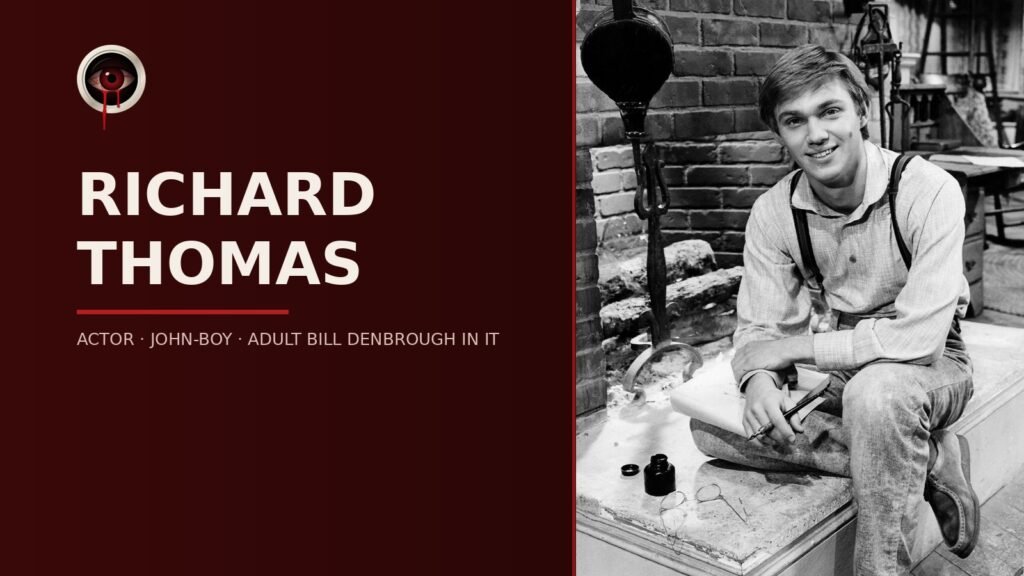
Richard Thomas (born 1951) is an American actor — John-Boy Walton to the world, and the adult Bill Denbrough of Stephen King’s It.
Richard Thomas has been working for nearly seventy years, and the strangest thing about the career is how completely its two poles belong to the same man. At one end: John-Boy Walton, television’s most trusted face, the aspiring writer saying goodnight from a darkened farmhouse. At the other: Bill Denbrough, a bestselling horror novelist riding his childhood bicycle down a Derry street to wake his wife from the deadlights. Thomas turned 75 in June 2026, spent that spring collecting a Tony nomination on Broadway, and is still the working definition of a stage-and-screen lifer. This page is his record — present tense, because he isn’t done.
Quick Specs
Born: June 13, 1951, Manhattan, New York City (full name Richard Earl Thomas)
Known for: John-Boy Walton on The Waltons (1972–1977); the adult Bill Denbrough in Stephen King’s It (1990); Frank Gaad on The Americans; Atticus Finch on tour (2022–2024)
Awards: Primetime Emmy winner, 1973 (The Waltons); Tony nominations 2017 and 2026; Golden Globe nominations 1974 and 1975
Active: 1958–present
Dancers’ Son, Broadway at Seven
Thomas grew up inside the performing arts in Manhattan: his parents, Barbara Fallis and Richard S. Thomas, were both dancers with the New York City Ballet who owned the New York School of Ballet. He has a birthmark on his left cheek; as a boy he was turned down for a television commercial because of it, and in his own telling the casting people warned his father that unless the mark was removed, “his chance for a career is very slim.” The career began anyway, at seven: his Broadway debut came in Dore Schary’s Sunrise at Campobello at the Cort Theatre — joining as a replacement John Roosevelt during the run that had opened January 30, 1958 (he was six at the opening; every biography’s “seven” is the replacement arithmetic). The production was also James Earl Jones’s Broadway debut, and Thomas has recalled Jones joking with him before their shared entrances. Childhood work followed in volume: Ibsen’s A Doll’s House for Hallmark Hall of Fame (1959) with Julie Harris and Christopher Plummer; the New York soaps The Edge of Night and As the World Turns; NBC’s children’s series 1, 2, 3 Go!; and Broadway’s Strange Interlude (1963, the child Gordon Evans, aged 11), The Playroom (1965) and Everything in the Garden (1967). He attended Columbia College — by his own account, a Chinese major — and left in his junior year when The Waltons took him to Los Angeles full-time.
The Homecoming, and John-Boy
The film breakthrough came at 17 and 18, in 1969: Winning, as the son of Paul Newman and Joanne Woodward’s characters, and Frank Perry’s Last Summer, alongside Barbara Hershey and Bruce Davison. Then, on December 19, 1971, CBS aired The Homecoming: A Christmas Story, Earl Hamner Jr.’s tale of a Depression-era Virginia family awaiting its father on Christmas Eve — and Thomas, aged 20, first played John-Boy Walton. The film’s ratings got the series ordered, and Thomas was the carry-over into it.
The Waltons premiered September 14, 1972, and Thomas played John-Boy — eldest of the seven children, the aspiring writer at the story’s centre — for 122 episodes: a series regular for the first five seasons, his final regular episode airing March 17, 1977, with one guest return in season six. He was 21 playing 17 at the start and 25 when he walked away, by his own stated plan: he had decided when he signed that five years was “long enough to be tied up with one project.” The character was later played by Robert Wightman in seasons eight and nine. Two precisions this page insists on: the famous narration — the adult John-Boy’s voice looking back — was Earl Hamner Jr. himself, the show’s creator, not Thomas; and the goodnight ritual that closes nearly every episode, the darkened house and the family’s calls through it, is the piece of the show Thomas’s face owns. He also directed episodes of the series during his tenure. In 1973 he won the Primetime Emmy for Outstanding Continued Performance by an Actor in a Leading Role (Drama Series – Continuing) — the Television Academy’s year and wording, whatever season-year confusion surrounds it — with a second Emmy nomination in 1974 and Golden Globe nominations in 1974 and 1975. He returned as John-Boy in the three 1990s reunion films, and fifty years on he finally did get to narrate: The CW’s The Waltons’ Homecoming (2021) and A Waltons Thanksgiving (2022), where he appears as the adult John-Boy, narrating and introducing, with Logan Shroyer as the young one.
Against Type
The post-John-Boy record is a deliberate demolition job. Even during the Waltons years he played a murderer, Kenneth Kinsolving, opposite Patty Duke in You’ll Like My Mother (1972). He carried Stephen Crane’s The Red Badge of Courage (1974) as Private Henry Fleming, played a teenager shattered by James Dean’s death in September 30, 1955 (1977), and in 1979 headlined the television All Quiet on the Western Front as Paul Bäumer and joined Roots: The Next Generations. Roger Corman gave him a space opera — Battle Beyond the Stars (1980), as Shad, the young farmer recruiting mercenaries to save his planet. He played Hank Williams Jr. in Living Proof (1983), and in Terrence McNally’s Andre’s Mother (1990) he was Cal Porter, the grieving lover of a man dead of AIDS — a performance of empathy and pathos widely praised at the time. The wholesome face kept being used, by its owner, as a lever against the audience’s expectations. That lever is the whole story of his horror casting.
It (1990) — Bill Denbrough
The split is exact, and this page keeps it exact: in Stephen King’s It, young Bill Denbrough — the stuttering boy of 1960 who loses his brother Georgie — is Jonathan Brandis. Thomas, at 39, plays Bill as an adult: the Losers’ founder and leader grown into a bestselling horror novelist living in England, married to the actress Audra, and the man Mike Hanlon’s phone call pulls home to Derry first. When Audra follows him and is taken by It — left catatonic by the deadlights — the miniseries closes on Thomas: Bill riding her down a Derry street on Silver, his childhood bicycle, until she wakes. It is the story’s final image, and it belongs to him.
The casting was design, not accident: the adult Losers — Thomas, John Ritter (his old Waltons castmate, the Reverend Fordwick of the mountain years), Annette O’Toole, Harry Anderson, Dennis Christopher, Tim Reid, Richard Masur, around Tim Curry‘s Pennywise — were deliberately not horror names, chosen, in the production’s reasoning, to draw in viewers who frightened easily. Thomas was himself a King fan and said he related to Bill: he had been an easily frightened kid, with an imagination “so vivid that I could scare myself about just about anything. And I’ve never been particularly fond of snakes.” Directed by Tommy Lee Wallace and aired November 18 and 20, 1990, the miniseries drew some 30 million viewers and became ABC’s biggest success of 1990, on a reported $12 million — producer Jim Green’s figure. The Losers’ Club has its own page; the franchise too. Thomas’s Bill is the centre both stand on.
The Working Decades, and the Late Anchors
Through the 1990s and 2000s the pattern held — prestige television films, series work (hosting PAX’s It’s a Miracle; the legal drama Just Cause, 2001–03), and film roles placed with care: Walter Gaskell in Wonder Boys (2000), the Reverend Don Pettie in Ang Lee’s Taking Woodstock (2009). Then the streaming era found the lever again. On FX’s The Americans (2013–2016) he was Special Agent Frank Gaad, the FBI’s counterintelligence chief — recurring in the first two seasons, main cast in the third and fourth: the steady, by-the-book boss on the American side of a spy tragedy. And on Netflix’s Ozark (2022) he played Nathan Davis, Wendy Byrde’s estranged, heavily religious father, arriving in the final season hunting for news of her dead brother and becoming a threat to the whole family — among the darkest roles of his career, John-Boy’s face used for menace, exactly as he has always liked it used.
The Stage, Always
The theatre never stopped. The Broadway spine runs from the 1958 Campobello through Fifth of July (1980), The Front Page (1986), Democracy (2004) and Race (2009, opposite James Spader) to An Enemy of the People (2012) and You Can’t Take It With You (2014) — where, as a replacement Paul Sycamore, he shared a Broadway stage with James Earl Jones again, fifty-six years after their shared debut. In 2017 he played Horace Giddens in The Little Foxes, opposite Laura Linney and Cynthia Nixon, and earned his first Tony nomination. Then came the Atticus years: the first national tour of Aaron Sorkin’s To Kill a Mockingbird, announced for 2020, postponed by the shutdown, and actually launched March 27, 2022, in Buffalo — Thomas extended through the tour’s third season, about two and a half years as Atticus Finch, with Mary Badham, the 1962 film’s Scout, playing Mrs. Dubose. He played Mr. Webb in the 2024 Broadway revival of Our Town, toured in the title role of Mark Twain Tonight! in 2025, and in April 2026 opened in David Lindsay-Abaire’s The Balusters as Elliott Emerson, the homeowners’ association president — a New York Times Critic’s Pick that brought his second Tony nomination, six days before his 75th birthday. He did not win — he has never won a Tony or a Globe, and this page upgrades nothing — because the nomination, at 75, in his seventh decade of work, is the story all by itself.
Personal Notes
Thomas married Alma Gonzales in 1975; they had four children — a son born in 1976 and triplet daughters born in 1981 — and divorced in 1993. In 1994 he married Georgiana Bischoff, a Santa Fe art dealer; their son was born in 1996, and with her two daughters from previous marriages the combined family numbers seven children. The couple resides in New York. He is an official Kentucky Colonel and, by his own cheerful account, cannot find the certificate. The children of the first marriage appeared with him in 1980s television commercials; the record beyond counts and years is the family’s, and this page leaves it there.
Why He Matters Here
Every horror canon has a trusted face put to dreadful use, and for the Stephen King television era that face is Richard Thomas’s. Bill Denbrough works because John-Boy plays him: the audience’s thirty years of accumulated trust in the actor becomes the character’s authority over the Losers, and the fear he admits to — the vivid imagination, the snakes — becomes Bill’s. At 75, on Broadway, with the Atticus years and a second Tony nomination behind him in this decade alone, Thomas is not a nostalgia entry in this wiki. He is a working actor whose horror anchor happens to be one of the most-watched broadcasts of 1990.