
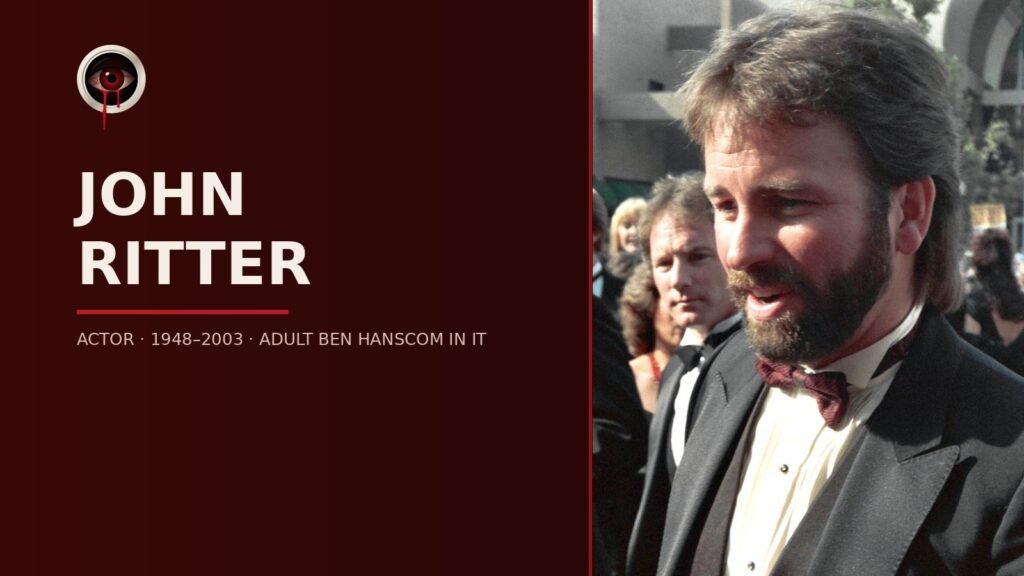
John Ritter (1948–2003) was an American actor and comedian — Jack Tripper to a generation, and the adult Ben Hanscom of Stephen King’s It.
John Ritter’s face was sitcom comfort: the pratfalling Jack Tripper, the dad from 8 Simple Rules, the voice of a very big red dog. Which is precisely why his best horror work lands the way it does. In 1990 the most beloved comic actor in America talked his way into a Stephen King miniseries — he would have played any part, he said, even the girl — and gave the Losers’ Club its warm, wounded centre. Ritter died suddenly in 2003, at 54, in the middle of a career renaissance, in the same hospital where he was born. This page is his record, with the details printed the way the record supports.
Quick Specs
Born: September 17, 1948, Burbank, California (full name Jonathan Southworth Ritter)
Died: September 11, 2003, Burbank, California, aged 54 — aortic dissection
Known for: Three’s Company (1977–1984), Stephen King’s It (1990), Problem Child (1990), Sling Blade (1996), 8 Simple Rules (2002–2003)
Awards: Primetime Emmy and Golden Globe, both 1984, for Three’s Company
Son of a Singing Cowboy
Ritter was Hollywood royalty of the western kind. His father was Woodward Maurice “Tex” Ritter (1905–1974), the singing-cowboy star of more than 70 films who sang the title song of High Noon and was inducted into the Country Music Hall of Fame in 1964. His mother was Dorothy Fay (1915–2003), a B-western leading lady who had made four Monogram westerns with her future husband before marrying him in 1941 and retiring from the screen; John’s middle name, Southworth, is her maiden name. His older brother Tom, born with cerebral palsy, became a lawyer and disability advocate; the brothers co-emceed the United Cerebral Palsy telethon for years. John went to Hollywood High School — student body president — and then USC, entering as a psychology major with political ambitions before switching to theater arts, performing in student productions in the United Kingdom, the Netherlands and West Germany, and taking a B.F.A. in theatre. (References disagree on the graduation year; this page prints none.)
Before Jack Tripper
The early career is a working actor’s ladder: a teenage turn as a contestant on The Dating Game; a first television acting credit on Dan August (1970) opposite Burt Reynolds and his future landlord Norman Fell; a film debut in Disney’s The Barefoot Executive (1971); and four years as the Reverend Matthew Fordwick on The Waltons (1972–1976), a young minister played entirely straight. Around them, the era’s guest-spot circuit — Hawaii Five-O, M*A*S*H, Kojak, The Bob Newhart Show — and film work including Robert Mulligan’s horror film The Other (1972) and Peter Bogdanovich’s Nickelodeon (1976). The straight dramatic minister matters to the later record: the comedy was a choice Ritter made from range, not the limit of it.
Three’s Company
The breakthrough was Jack Tripper: a struggling culinary student sharing a Santa Monica apartment with two women, pretending to be gay so the landlords would tolerate the arrangement, in the American version of Britain’s Man About the House. Three’s Company ran on ABC from 1977 to 1984 — eight seasons, 174 episodes, at or near the top of the ratings — with Joyce DeWitt throughout as Janet, Suzanne Somers (later Jenilee Harrison, then Priscilla Barnes) as the other roommate, and Norman Fell and Audra Lindley, then Don Knotts, downstairs. Ritter’s physical comedy became the show’s engine, and the industry said so formally in 1984: the Primetime Emmy for Outstanding Lead Actor in a Comedy Series (for the series finale, “Cupid Works Overtime,” after nominations in 1978 and 1981) and the Golden Globe for Best Actor in a Television Series, Musical or Comedy — the win the Golden Globes’ own database files under 1984. He stayed with the character one more season in the spin-off Three’s a Crowd (1984–85). Don Knotts — his own television landlord — summed up the reputation in 2002, calling Ritter “the greatest physical comedian on the planet.”
Stephen King’s It — Adult Ben Hanscom
Print the split plainly, because it is the whole casting architecture of Stephen King’s It: the Losers exist in two timelines. Young Ben Hanscom, the overweight new kid of 1960, is Brandon Crane. Ritter plays the adult Ben of 1990 — the boy transformed into a successful, self-assured architect, the weight gone, who answers Mike Hanlon’s call and comes back to Derry. The two casts never share a scene; director Tommy Lee Wallace had the pairs meet so the performances would rhyme.
It was Ritter’s first horror production, and he chased it. A King fan since Carrie, he had tried repeatedly to land a King adaptation — including an attempt to reach George A. Romero about starring in Romero’s planned The Stand — and when It came together he told his manager: “Tell them I’ll play any part they want me to. I’ll play the girl.” Casting began while he was filming The Dreamer of Oz (in which he played L. Frank Baum) and he nearly missed the part entirely. His framing of the genre, from a July 1990 interview, is pure Ritter: “The thing I like about horror is you have to ask: Can I take it? It’s like going on a roller-coaster ride.” Around him: Richard Thomas — his old Waltons colleague — as adult Bill; Annette O’Toole as adult Beverly, cast at Ritter’s suggestion after The Dreamer of Oz; and Tim Curry as Pennywise. The teleplay was shared between Lawrence D. Cohen and Wallace; the miniseries aired November 18 and 20, 1990, drew 30 million viewers, and became ABC’s biggest success of the year. Ben survives it, and marries Beverly — the Losers’ Club‘s one uncomplicated happiness, played by the actor America most trusted to mean it.
The Film Career
The hits were broad ones. In Problem Child (1990) he is Benjamin “Ben” Healy Jr., the too-nice husband who adopts a seven-year-old holy terror; panned on release, it made $72.2 million worldwide against a reported $11 million budget and was Universal’s most profitable film of 1990. His wife Flo is played by Amy Yasbeck — who returned in Problem Child 2 (1991) as a different character, Annie Young; the films also made them a couple off screen (see below). The dramatic turn came with Sling Blade (1996): Vaughan Cunningham, the kindhearted discount-store manager in Karl Childers’ fragile surrogate family — a performance that drew the best dramatic notices of Ritter’s career and a share of the cast’s Screen Actors Guild nomination, in the film that won Billy Bob Thornton the Academy Award for Best Adapted Screenplay. His final live-action film was Bad Santa (2003), as Bob Chipeska, the prim mall manager horrified by Thornton’s store Santa; it was dedicated to his memory. Horror readers will also find him as Police Chief Warren Kincaid in Bride of Chucky (1998), as the title character of the Buffy the Vampire Slayer episode “Ted” (1997) — the too-perfect boyfriend revealed as a murderous robot — and in Terror Tract (2000), alongside the straight work: Real Men, Skin Deep, Noises Off, Stay Tuned, Tadpole.
Series Lead Again — and the Stage
Television kept calling him back to the centre. Hooperman (1987–89) made him a San Francisco detective who inherits a rundown apartment building, and won him the 1988 People’s Choice Award for Favorite Male Performer in a New TV Program. Hearts Afire (1992–95) paired him with Markie Post, with Thornton in the regular cast — the friendship behind Sling Blade. There were TV films (Unnatural Causes, 1986, brought a Golden Globe nomination; The Dreamer of Oz, 1990; Gramps, 1995), guest work from Ally McBeal (an Emmy nomination in 1999) to Scrubs, where he played J.D.’s father, and a Broadway run in Neil Simon’s The Dinner Party (2000–01) opposite Henry Winkler that won him the 2001 Theatre World Award. Then, for a second generation, he became a voice: Clifford on PBS’s Clifford the Big Red Dog (2000–2003), earning four consecutive Daytime Emmy nominations.
8 Simple Rules, and September 11, 2003
8 Simple Rules (2002) put him back on top as Paul Hennessy, a sportswriter turned stay-at-home father guarding his teenage daughters, opposite Katey Sagal. On September 11, 2003 — his youngest child’s fifth birthday — Ritter spent the day rehearsing the show in Burbank. In the afternoon he fell ill: sweating, vomiting, chest pain; he first thought it was food poisoning. He was taken to Providence Saint Joseph Medical Center in Burbank — the same hospital where he had been born — where emergency physicians initially treated him for an assumed heart attack. The actual condition was an aortic dissection, a tear in the wall of the aorta; he was taken into surgery and pronounced dead at 10:48 p.m., aged 54, six days before his 55th birthday. Print it no other way: not a heart attack, and not 55. He had completed three episodes of the show’s second season. ABC paused the series, then returned it on November 4, 2003 with “Goodbye,” in which Paul is said to have collapsed and died in a grocery store; James Garner and David Spade joined, and the show ran until 2005. Ritter received a posthumous Emmy nomination for the role in 2004; Kelsey Grammer, who won the category, paid tribute to him from the stage.
The Case, and the Foundation
In 2004 his widow, Amy Yasbeck — they had married on September 18, 1999, a year after their child Noah was born on September 11, 1998 — sued the physicians and the hospital for herself and the children, alleging a misdiagnosis that earlier detection could have survived. Most claims settled out of court in 2008 for a reported total of $14 million; the remaining case against two physicians, seeking $67 million, went to a jury, which found 9–3 for the doctors. No damages were awarded at trial, and the figures belong in exactly those reported forms. What Yasbeck built from it is the durable legacy: the John Ritter Foundation for Aortic Health, the “Ritter Rules” public guidance on recognising aortic dissection (launched 2010), and the John Ritter Research Program in Aortic and Vascular Diseases at UTHealth Houston, hunting the genetic mutations behind the condition that killed him. His children — Jason, Carly and Tyler Ritter, all performers in their turn, and Noah — grew up alongside that work.
Why He Matters Here
Think Horror keeps his page because of one role, honestly framed: horror did not make John Ritter, and he knew it — he asked to be let in anyway, fan first, and the adult Ben Hanscom he gave the It franchise is the performance that lets a two-timeline ghost story hold together emotionally. Joyce DeWitt’s verdict on the man stands as the record’s last word, attributed to her as it should be: “Impossible to forget. Impossible not to love.” He is interred at Forest Lawn Memorial Park, Hollywood Hills; his mother followed him less than two months later. The films and the foundation both remain.