
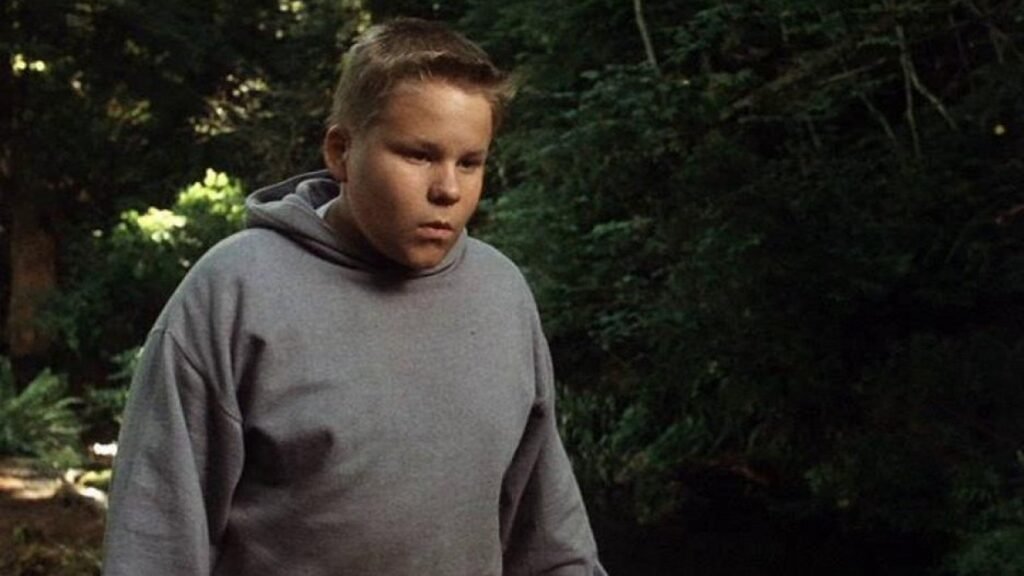
Every Loser got called back to Derry eventually — but only one of them went back to work for himself. In 2019, twenty-nine years after he first faced the clown, Brandon Crane turned up in It Chapter Two not as Ben Hanscom, not even as a grown version of Ben Hanscom, but as an unnamed employee in the grown Ben’s architecture firm, fumbling his way through a meeting for the man he used to be. It is the strangest full circle in the whole Losers Club story, and it belongs to the quietest Loser of the seven. Brandon Crane is the former child actor who played young Ben Hanscom in Stephen King’s It and Doug Porter on The Wonder Years. Between those two poles — the poet of Derry and the kid who walked away from Hollywood at fifteen — sits one of the most honest child-actor stories there is: no comeback tour, no collapse, just a working kid who did the job, left, built a different life, and answered the phone exactly once.
Quick Specs
- Born: February 26, 1976, Oceanside, California, U.S.
- Occupations: Actor; later theater performer, web developer and design-agency operator, podcast host
- Known for: Young Ben Hanscom in Stephen King’s It (1990); Doug Porter on The Wonder Years
- Awards: Young Artist Award winner for The Wonder Years (13th Youth in Film Awards); Youth in Film nominee for It (12th Youth in Film Awards)
The new kid in Derry
Ben Hanscom is the new kid — overweight, bookish, bullied by Henry Bowers, and secretly the Losers Club‘s poet: the one who sends Beverly Marsh an anonymous poem and lets her assume it came from Bill. In Stephen King’s It, the two-part ABC miniseries directed by Tommy Lee Wallace from King’s 1986 novel, that boy is Brandon Crane. The production was television spending like cinema: filmed over three months in Vancouver in mid-1990 on a $12 million budget, double the usual television money of the day, and rewarded with some 30 million viewers across its two November nights — ABC’s biggest success of 1990. Its Emmy went to composer Richard Bellis for his score, and that credit belongs to the production, not to any Loser, young or old.
Now the correction this page will keep making until it sticks: Ben on the call sheet is twelve. Crane was not. Born in February 1976, he had turned fourteen before the cameras rolled and was fourteen when the miniseries aired — a fourteen-year-old playing twelve, which is simply how casting works, however firmly the credit “Ben Hanscom – Age 12” has lodged itself in the trivia pages. The age on the call sheet is the character’s. It was never the actor’s.
The performance had to do double duty, because Ben exists twice in this story, and the two Bens did not look alike. The production brought Crane together with John Ritter, the adult Ben, and matched the two versions of the character through actions and facial expressions — the same boy, thirty years apart, built out of shared mannerisms rather than resemblance. Wikipedia’s account of the casting adds that Crane, like Ritter, connected with the character personally: Crane was raised without a dad and was bullied for being fat at school in real life. That is printed here as the account it is — but watch the performance with it in mind and the quiet scenes stop looking like acting and start looking like recognition. Reviewer Jonathan Storm, writing at the time, called Crane “awkward but adorable” in the first part. The industry noticed too: at the 12th Youth in Film Awards, Crane was nominated for Best Young Actor Starring in a TV Movie, Pilot, or Special, for It. Stephen Dorff won the category. A nomination against that field, for a horror miniseries on network television, is its own kind of win — and it is not the award Crane actually took home. That one came from a different show entirely.
Four Bens, kept separate
Because the internet will not keep them separate for you, this page will. There are four Bens across the adaptations of It, and no sentence about one of them is true of another. In the 1990 miniseries: Brandon Crane plays the young Ben, and John Ritter plays the adult — the successful architect who comes back to Derry when Mike Hanlon calls. In the 2017 and 2019 films: Jeremy Ray Taylor plays the young Ben, and Jay Ryan plays the adult. Crane appears in none of the films as Ben, and when he does appear in one, it is as somebody else entirely — hold that thought for the cameo below.
And one outright error gets corrected here because it keeps travelling: Richard Masur did not play the adult Ben. Masur played the adult Stanley Uris. Ritter is Ben; Masur is Stan. The two men stand side by side in the adult cast, which is presumably how the wires get crossed, but crossed they are, and any page that hands Ben to Masur has taken a Loser away from John Ritter, who earned him.
Doug Porter — by way of Doug Baker
If It is the role horror fans know, The Wonder Years is the role everybody else knows — and by the numbers it is the bigger job. Crane played Doug Porter, Kevin Arnold’s agreeable junior-high friend, across 18 episodes from 1989 to 1991. But get the first appearance right, because the character did not arrive as Doug Porter. In the 1989 episode “Coda,” Crane’s character was credited as Doug Baker; the Porter name settled in afterward. By Crane’s own account that is how the part began, and the credit record agrees with him.
His last episode was “Graduation,” in May 1991 — a fitting title for the end of the run. And it was this role, not the clown, that brought him his award: at the 13th Youth in Film Awards, Crane won Best Young Actor Guest-Starring or Recurring Role in a TV Series for The Wonder Years. One win, one nomination — that is the whole of his awards record, and it needs no inflation. The kid from Derry has a trophy, and it is for playing the nice friend at a junior-high school in the suburbs. Range is not always loud.
The working kid
Crane’s standard biography tells the discovery story the way discovery stories go: a talent scout spotted the four-year-old doing impressions of popular singers at a party, commercials followed, and episodic television came after. Print that as his biography’s account — the anecdotes in submitted bios have a way of smoothing themselves out — because the credit record itself tells a slightly messier and more believable story: a voice credit on the Peanuts special It’s an Adventure, Charlie Brown in 1983, then episodic work stacking up through the decade. Otherworld in 1985. Full House in 1989, as Sheldon. It’s Garry Shandling’s Show the same year. A single episode of Step by Step in 1991, as Sven — a guest spot, one episode, and worth stating plainly because the other Brandon of that era, Brandon Call, was a Step by Step regular, and the two child actors have been conflated by sloppy pages ever since. Crane is not Call. He guested on the show once and went home.
Acting, in his family, was not a novelty act. By Crane’s own account, his grandfather was Fred Crane, who came from Louisiana to act and was cast as Stuart Tarleton — one of Scarlett O’Hara’s beaus, a Tarleton twin — in Gone with the Wind (1939), and a great-aunt had been a silent-film actress. You will also see it said, in the retellings that trail the family story, that Fred Crane spoke the first words of Gone with the Wind. That flourish is printed here the only way it should ever be printed: as attributed family-and-press trivia, not as a settled credit. The Tarleton role is the documented part. The famous first line is the legend that grew on it.
The step away
After 1991, the credits simply stop — and the stop was the story. Crane stepped away from Hollywood while he was still, by any measure, employable, and appeared only sporadically afterward: two short films surface in the record across the whole long gap, Coverage in 2000 and Skal in 2004, and that is nearly all. ScreenRant, writing when the silence finally broke, put it flatly: before the call that ended it, he had not worked in the industry in over a decade.
What he did instead was not nothing. After high school he took singing lessons and turned to musical theater, performing extensively on stages across Southern California. By 2017 he was working as a web developer, and he and his wife run Solid Fuel Creative, a design agency. He is married, with two daughters. The horror world’s long memory eventually came with its own small economy — convention appearances, recorded fan messages — and Crane built a piece of it himself: he hosts The Errorist Podcast, a weekly interview series whose guests have included his old Losers Club castmates, the children of Derry interviewing each other as grown men and women with jobs and mortgages. He also answers to “Mister Culture Bakehouse,” helping his wife’s bakery with photo and video work. There are sadder second acts in the child-actor file. There are not many saner ones.
One scene, twenty-nine years later
Then came the cameo, and it is worth being exact about what it is, because at least one talent roster out there gets it triumphantly wrong. In It Chapter Two (2019), Crane does not reprise Ben. Jay Ryan is the adult Ben of the films, full stop. Crane’s actual screen credit is “Big Guy” — an employee at Ben’s architecture firm, the man fumbling through the presentation in the meeting that introduces Ryan’s Ben to the audience. The original Ben, employed by the new Ben, stumbling over his lines the way young Ben stumbled over his thoughts. As reported accounts of it tell the story, Crane had reached out to director Andy Muschietti before the 2017 film, the two became friends, and when Chapter Two went into production Muschietti offered him the spot — there was earlier thought of placing him among adult Beverly’s employees instead. Crane was 43 when the film opened. He had been fourteen in Derry. The arithmetic of that is the whole Losers Club story in one man’s filmography: you do not get to be Ben again. You get to be in the room while somebody else is.
The documentary with three birthdays
Crane also came back the other way — as himself. He is an on-camera interviewee in Pennywise: The Story of It, the feature documentary about the making of the miniseries, sitting alongside most of the surviving cast to talk about what it was like to be terrified by Tim Curry’s Pennywise for a living; IMDb additionally credits him with a courtesy acknowledgment for his personal photographic archive, which tells you whose snapshots helped build the thing. Now, the fence, because this film needs one: nobody gets to tell you what year it is from. Wikipedia’s It article dates the documentary to 2020. IMDb dates it 2021. Its wide release came on Screambox in 2022, which is when the reviews cluster. Three carriers, three years, and this page prints all three rather than picking a winner — the documentary exists, Crane is in it, and its birthday is an argument the record has not settled.
And the story is not quite closed. Crane has a role in The Witches of the Sands, a British horror comedy listed as in production — no role name is printable from the listing, and none will be invented here. A Loser in a horror comedy, half a century after a clown in a storm drain: if that is where the filmography rests, it rests well. Ben Hanscom was the kid who wrote the poem and never sent it with his name on it. Brandon Crane built a career the same way — good work, quietly signed, and one perfect scene twenty-nine years later where the name in the credits is “Big Guy” and everybody who matters knows exactly who it is.