
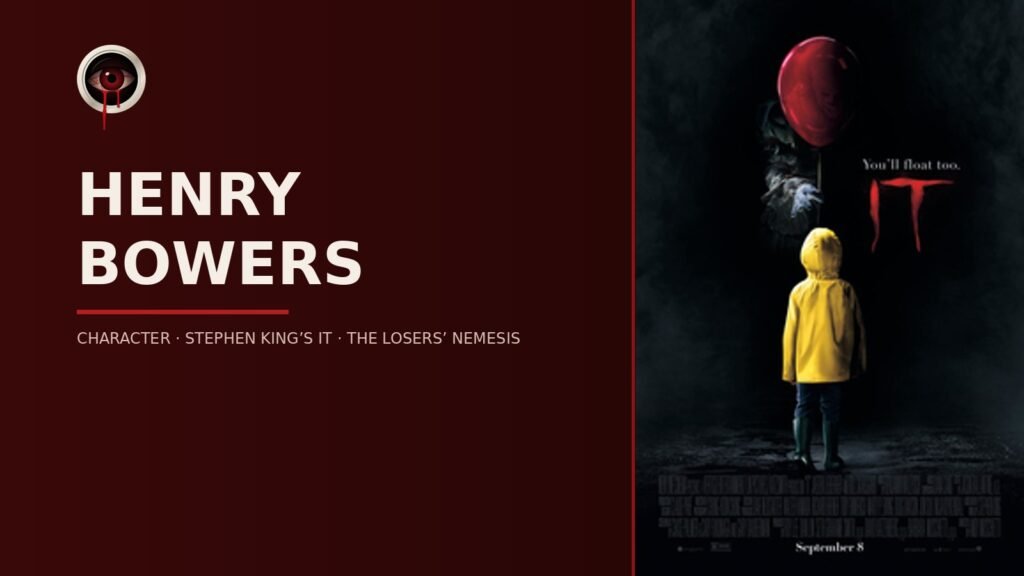
Henry Bowers is the antagonist of Stephen King’s It — leader of the Bowers Gang, and the weapon It aims at the Losers Club.
Pennywise is the monster of It, but Pennywise is weather — ancient, cyclical, almost impersonal. Henry Bowers is personal. He is the threat the Losers can touch: the older, bigger boy who can hold them down in the real world, break bones in the real world, and grow up still meaning to finish the job. King gives the clown a rival instrument in every version of the story — a damaged, violent boy It identifies, aims, and afterward leaves holding the blame for Its own murders. Henry exists in three canons — the 1986 novel, the 1990 miniseries, and the two modern films — and the versions share neither timelines nor deaths. This page keeps them separate, because merging them is how every error about him starts.
Quick Specs
Created by: Stephen King, for the novel It (1986)
Role: leader of the Bowers Gang; the Losers Club‘s arch-rival; It’s instrument in both time periods
Family: son of Oscar “Butch” Bowers
Played by: Jarred Blancard (young, 1990) and Michael Cole (adult, 1990); Nicholas Hamilton (young, 2017/2019) and Teach Grant (adult, 2019)
Appears in: the novel (1986), Stephen King’s It (1990), It (2017), It Chapter Two (2019)
The Performers
Four actors, no cross-casting, stated exactly. In the 1990 miniseries: Jarred Blancard plays the young Henry — a greaser in a brown leather jacket, hair in a jelly-roll ducktail — and Michael Cole plays him grown. Production accounts record that Blancard hated having to use the racial slur his character aims at young Mike Hanlon and kept apologizing to Marlon Taylor, the young Mike, between takes. In the films: Nicholas Hamilton plays the young Henry of 1989, dirty-blond mullet and all, in It (2017) and in flashback in Chapter Two — Hamilton prepared by studying Blancard’s 1990 performance, watching all of his original character’s material, and Blancard spoke with him about the role’s “psychopathic-ness.” Teach Grant plays the adult Henry of 2019: a long-term inmate, incarcerated since 1989 for his father’s murder.
Canon One — The Novel (1986)
The novel’s strands run 1957–58 and 1984–85, and Henry is the secondary antagonist of both. On the page he is a big, strong boy in a pink motorcycle jacket with an eagle on the back, worn engineer boots, a waxed flattop, smelling of sweat and Juicy Fruit gum — and the son of Oscar “Butch” Bowers, the Hanlon family’s neighbour, a violent, abusive farmer whose racist fixation on Mike’s family he passes to his son. Henry grows up on the farm doing its manual labour, his mother gone.
The 1958 campaign opens on the last day of school, when Henry and his gang harass Ben Hanscom, who escapes into the Barrens and falls in with the forming Losers. Angered over summer school — Ben refused to let him cheat on a math test — Henry begins carving his name into Ben’s stomach with his switchblade before Ben gets away; the carving is begun, never finished. His hatred centres on Mike Hanlon: he kills Mike’s dog and chases Mike into the Barrens, where the Losers drive the gang off in the rock fight, and the humiliated Henry escalates all summer — among the verified beats, Eddie Kaspbrak is hospitalized after an attack in which Henry and his friends break his arm. His gang — Victor Criss, Belch Huggins, and the deeply disturbed Patrick Hockstetter — suffers its own losses to the real monster: Beverly witnesses It consume Patrick in the form of a mass of flying leeches, and the Losers find It’s warning written in Patrick’s blood. Patrick’s death is It’s work, in every canon; never Henry’s.
The turn comes once the Losers wound It at the Neibolt house. It deems them a threat and manipulates Henry into murdering his father, then sends him into the sewers after them; there It kills Victor and Belch in front of him, and Henry washes out into a river, broken, and is institutionalized at Juniper Hill — blamed for the town’s child murders. Note the framing, because the adaptations keep it: his verified novel kills are his father and Mike’s dog. The children’s deaths were It’s, and he carries them.
In 1984–85, when the killings resume and Mike calls the Losers home, Henry escapes the asylum with It’s help. He confronts Mike at the Derry Library and seriously injures him — Mike nearly dies in hospital — but he leaves the library alive. On It’s instructions he goes to the Losers’ hotel, the Derry Town House, and attacks Eddie there, breaking the same arm a second time. Eddie kills him with a broken bottle. The library killing belongs to the 2019 film, not the book; this page does not move it.
Canon Two — The 1990 Miniseries
The miniseries moves the strands to 1960 and 1990, and it is a different Henry. The on-screen gang is three: Henry, Victor Criss and Belch Huggins. There is no Patrick Hockstetter, no abusive-father storyline, and no patricide — the adaptation omits Butch’s story entirely, and this page gives the miniseries no Butch plot it doesn’t have. In the 1960 sewers, It kills Belch, having already killed Victor; Henry is left traumatized, his hair shocked white by the deadlights, and afterward confesses to the child killings and is institutionalized — again, taking the blame for It’s murders. In 1990, with Pennywise’s help, he escapes to murder the Losers. He attacks Mike and stabs him — and fatally stabs himself with his own knife when Eddie and Ben rush in to save Mike, who survives. That self-inflicted death belongs to the miniseries alone: not the novel’s bottle, not the films’ axe.
Canon Three — The Films (2017 / 2019)
The films move the childhood strand to the summer of 1989 (Georgie dies in October 1988) and the adult strand to 2016. The gang is four now: Henry, Belch, Victor, and Patrick Hockstetter, older bullies the young Losers run afoul of from the first act. Patrick dies as the novel’s leeches are replaced by a film invention: hunting Ben in the sewers, he is killed by It in the form of the drowned children. Butch Bowers is a different man here than on the page — a Derry police officer (Stuart Hughes), still racist, still abusive — and Henry, driven insane by Pennywise, murders him, then attacks the Losers at the Neibolt house, where Mike pushes him down the house’s well. He survives the fall, is apprehended, and stays institutionalized for the patricide for 27 years. The blade in the films is simply Henry’s own weapon — he cuts Ben with it in 1989; the novel’s moon-gifted switchblade is a novel fact and stays in the novel’s section.
In 2016 It helps him escape. He attacks Eddie first, at the hotel, stabbing him through the cheek; Eddie pulls the knife out, stabs Henry in the gut, and Henry escapes through the window. Then he goes to the Derry library and attacks Mike — and as he is overpowering him, Richie Tozier kills him, an axe to the head. Viewers often assume it was Ben, Bowers’s childhood victim, who struck the blow; the film’s killer is Richie, and this page prints Richie.
What Henry Is Not
The record needs its fences as much as its facts. Henry has nothing to do with Adrian Mellon’s murder — in either the novel or Chapter Two, Adrian is attacked by a separate youth gang (Webby’s, on screen) and killed by It; Henry is institutionalized at the time and never implicated. He cuts no one’s hair in any canon — the famous hair-cutting in this franchise is Beverly’s, cutting her own hair at her bathroom sink in the 2017 film, fleeing her father’s fixation on it. He makes no bargain with It and never serves it willingly: in every version the mechanism is the same shape — It finds the most damaged, violent boy in Derry and aims him, then leaves him blamed for Its crimes. And there is no “apples” scene: the record of all three canons was searched for one, and none exists, so none is invented here.
Why He Matters
Within the It franchise, Henry is the story’s human-scale horror — the proof that Derry’s evil is not only in the sewers. The clown feeds on children; the town produces Henry, feeds him to the clown, and then locks him up for the clown’s murders and calls it justice. Stephen King built the Losers’ courage against two enemies at once, and only one of them could be fought with rocks. Three canons, three Henries, three deaths — bottle, own knife, axe — and one constant: he is the boy It used, and the man every version of Derry agreed to blame.