
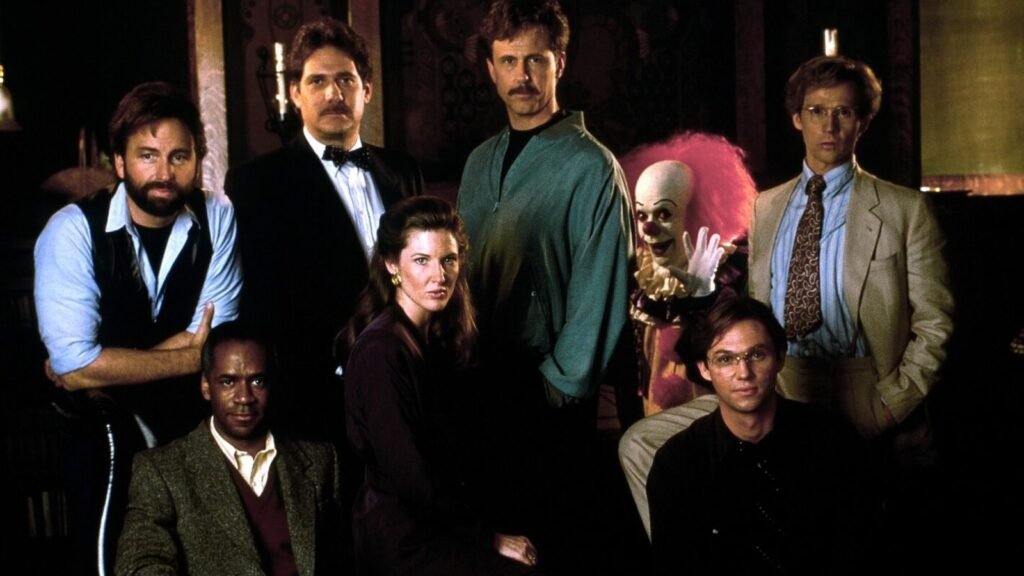
Harry Anderson was the street magician who became Judge Harry Stone on Night Court and the adult Richie Tozier in Stephen King’s It.
Start with the order of operations — he spent a lifetime correcting it: he was never an actor who dabbled in magic. He was a working street magician — shell game, three-card monte, the whole bunko repertoire performed as a demonstration of how the con works — who fell into acting almost by accident, then spent nine seasons as the most beloved judge on American television. To comedy audiences he is Judge Harry Stone forever. To horror fans he is something just as permanent: the grown-up Richie Tozier, one of the seven Losers who went back to Derry in 1990 to finish what they started as children.
Quick Specs
- Born: 14 October 1952, Newport, Rhode Island
- Died: 16 April 2018, Asheville, North Carolina (aged 65)
- Full name: Harry Laverne Anderson
- Occupations: Actor, comedian, magician
- Years active: 1978–2014
- Known for: Night Court (Judge Harry T. Stone), Cheers (Harry “The Hat” Gittes), Stephen King’s It (the adult Richie Tozier), Dave’s World (Dave Barry)
- Emmy record: Three consecutive nominations, Outstanding Lead Actor in a Comedy Series (1985, 1986, 1987) — no wins
The Magician First
Harry Laverne Anderson was born on 14 October 1952 in Newport, Rhode Island, grew up in New York, and moved to Oregon as a teenager — “that’s where I became a hippie,” as he put it himself. He was performing magic on the street as a kid in a string of cities, Chicago, New York, St. Louis and New Orleans among them. After moving to Los Angeles he joined the Dante Magic Club, and at 17 he was working as a street magician in San Francisco; by his own account, San Francisco, New Orleans and Austin taught him the trade.
From 1971 to 1976 he lived in Ashland, Oregon, performing magic and working with the Oregon Shakespeare Festival. His own telling of it: “The Shakespeare Festival at Ashland, Oregon, seemed like a good place to open a magic store… At 18, I was ready for retirement. It didn’t last long, but I was established as the magician.” He ran the store and did magic and special effects for the festival — a teenager with a shop and a trade, a decade before television knew his name.
The act itself matters, because everything after it grew out of it: the shell game and three-card monte performed as a “bunko demonstration” — the insider showing the crowd exactly how the con works while he worked it. He recalled that his only run-ins with the law came over street hustling, and that he was once held for a couple of nights in New Orleans — ironically after he had stopped actually hustling and was running the shell game purely as a demonstration. His summary of the craft, given in 1987, is the man in one line: “I got into magic when I was a child. Unlike most kids, I stayed with it… It made me what I am today — available for weekend employment, parties and bar mitzvahs.”
Right Off the Street
The break came the way breaks are supposed to come in the old stories. Performing his stage act — a stage version of three-card monte and a demonstration of the holdout — at the Magic Castle, Anderson was seen by Ken Kragen, Kenny Rogers’ manager, and hired to open for Rogers in Las Vegas. From Las Vegas he was asked to do Saturday Night Live, where he became a recurring magic-act guest in the early 1980s — “right off the street,” by his own account, at his first appearance. The paperwork and the man disagree on the count, so take both: the credit record lists eight appearances between 1981 and 1985, while Anderson himself remembered “nine or 10 times over the years.” He was also a frequent guest on The Tonight Show Starring Johnny Carson.
Then came the part that made him an actor. On Cheers he recurred as Harry “The Hat” Gittes, a con man — six episodes, four of them in the show’s first two seasons. Keep the two Harrys separate: Gittes is a hustler who drifts through a Boston bar; Judge Harry Stone, who arrives two years later, is a judge. Stone is not Gittes with a gavel. Anderson’s own framing never wavered: “‘Cheers’ was my first acting job, but it was basically the character I had developed on the street.” The producers had wanted a con man as a natural bar character, and the street performer was the character. The Gittes appearances impressed NBC president Brandon Tartikoff — and led directly to Night Court.
Judge Harry Stone
Night Court ran on NBC for nine seasons, 1984 to 1992, with Anderson — 31 when it premiered in January 1984 — as Judge Harold “Harry” T. Stone, the offbeat young judge on a Manhattan courtroom’s night shift. The character, in the Associated Press’s sketch, “professed his love for singer Mel Tormé, actress Jean Harlow, magic tricks and his collection of art-deco ties.” The overlap was not a costume: man and judge genuinely shared the magic, the ties and the Tormé fandom, and when Tormé died in 1999, Anderson was one of his eulogists.
The fit was so exact that people assumed the part had been written for him. It hadn’t — creator Reinhold Weege maintained that he had written Harry Stone as a Harry who loved magic, Mel Tormé and 1940s culture before Anderson was ever approached; the fit was coincidence, not tailoring. Around Anderson stood John Larroquette, Markie Post, Richard Moll, Charles Robinson and Marsha Warfield, and across its run Night Court was nominated for 31 Emmys and won seven. Anderson himself wrote or co-wrote five episodes and directed two.
His Emmy record deserves to be stated flat: Anderson was nominated for Outstanding Lead Actor in a Comedy Series three years running — 1985, 1986 and 1987 — and he never won. The Television Academy’s own records list him as a nominee all three years; the show’s acting wins in that span belonged to John Larroquette, in the supporting category. Three consecutive nominations needs no decoration, and this page offers it none.
The Adult Richie
In November 1990, Anderson took the role this wiki exists to record. Stephen King’s It was a two-part ABC miniseries directed by Tommy Lee Wallace, teleplay by Lawrence D. Cohen and Wallace, from Stephen King‘s 1986 novel. It aired on 18 and 20 November 1990, in November sweeps, and Anderson — 38 years old — played Richie Tozier, the comic relief of the Losers Club.
Get the geometry right. The miniseries runs on two time periods: the Losers first confront It as children in 1960, and they return as adults in 1990 — thirty years later, not twenty-seven. The 1985 date and the 27-year cycle belong to King’s novel; the miniseries does not use them. Anderson plays Richie only as an adult: the 1960 Richie is Seth Green, and the two never swap halves. And the miniseries’ adult Richie is a late-night talk show host who does impressions — not the novel’s radio disc jockey, and not the stand-up comedian of the later films. Three Richies, three jobs, one of them Anderson’s.
The production ran at full stretch: filmed over three months in Vancouver in mid-1990, on a reported production budget of $12 million — double the usual television budget of the day — and the two parts drew a combined 30 million viewers, making it ABC’s biggest success of 1990. Richard Bellis’s score won an Emmy. Anderson was among the adult Losers hand-chosen by Wallace and Cohen, alongside John Ritter, Dennis Christopher and Tim Reid. The production’s oral history records that he improvised around Richie’s one-liners, and that he suggested the closing beat in which all the Losers hug Bill except Richie — Wallace was unsure, the idea was shot anyway, and it plays as intended: Richie the cynic, standing apart after Stan’s death.
Tim Curry‘s Pennywise is the constant across both halves — he confronts the child Losers in 1960 and the adults in 1990, Anderson’s Richie among them — and the childhood confrontations, Richie’s werewolf scare included, belong to the child cast alone. Anderson’s Richie belongs to the adult reckoning: Mike Hanlon, the one Loser who stayed in Derry, calls the others home; Stan Uris dies rather than return; the survivors descend beneath Derry once more and kill It in its spider-like true form, crushing its heart. Eddie Kaspbrak dies in the confrontation. Richie’s story closes with him “cast in a film” as the Losers’ memories of It begin to fade. It is a full co-lead performance, not a cameo — the adult half needs its joker, and needs him to run out of jokes.
Dave’s World and the Long Tail
After Night Court adjourned in 1992, Anderson headlined one more sitcom: Dave’s World, on CBS from 1993 to 1997 — four seasons, with Anderson, 40 at its premiere, as Dave Barry, the Pulitzer Prize-winning Miami Herald humor columnist, in a series built from Barry’s life and columns. In 1996 he stepped into a protected role, playing Elwood P. Dowd — the Jimmy Stewart part — in a television remake of Harvey.
The guest spots around those years have their own horror credentials: he played Jim Korman in a 1990 episode of Tales from the Crypt, “Korman’s Kalamity,” and Professor Henry Crawford in Disney’s 1988 remake of The Absent-Minded Professor. Then the trail thins by his own choice. He had largely retired from acting after a 2002 appearance on Son of the Beach; the exception was the 2008 30 Rock episode built around the cast of Night Court, where he played himself alongside Markie Post and Charles Robinson. His final film role was Professor Kaman in A Matter of Faith (2014).
Back to the Magic
The exit from Hollywood was a homecoming twice over. In the early 2000s Anderson sold his Pasadena home and moved to New Orleans, where he had lived in the 1970s, opening a French Quarter magic shop called Sideshow and performing corporate comedy-magic. The account carried in 2002 had him disenchanted with chasing acting roles into middle age — “I don’t understand why guys have that Don Knotts syndrome of having to be out there” — and settled back to “card tricks and magic.” In 2005 he opened a French Quarter nightclub, Oswald’s Speakeasy, and performed his one-man show there.
After Hurricane Katrina, he relocated to Asheville, North Carolina — the move is dated to 2006 — and lived there for the rest of his life, still touring as a magician. His late self-description, given in 2014, stands as his verdict on the whole career: “I’m a magician, or a performer, by nature, and that’s always what I’ve been… I was never really an actor. I was a magician who fell into a part on ‘Cheers.'”
Harry Anderson was found dead at his Asheville home on the morning of Monday, 16 April 2018. Asheville police responded to a call from the home at 6:41 a.m.; no foul play was suspected, and police released no cause of death at the time. His son Dashiell said he had died of natural causes. His death certificate later listed the cause as a cardioembolic stroke — the heart sending material into the brain’s circulation — with influenza and heart disease as contributing causes, after a bout of influenza in late January 2018 and several strokes; he died in his sleep. He was 65. He is survived by his second wife, Elizabeth Morgan, whom he married in 2000, and by the two children of his first marriage, to fellow magician Leslie Pollack (1977–1999): his daughter Eva and his son Dashiell. The judge adjourned, the Loser went home, and the magician kept his hand in to the end. The rest of the Losers’ story lives on the It franchise page.
Trivia
- Anderson’s two famous Harrys are not the same man: Harry “The Hat” Gittes of Cheers is a con artist, and Judge Harold T. Stone of Night Court is a judge. Different shows, different Harrys.
- He was once held for a couple of nights in New Orleans over the shell game — after he had stopped hustling and was performing it as a demonstration.
FAQ
Did Harry Anderson win an Emmy for Night Court?
No. He was nominated for Outstanding Lead Actor in a Comedy Series three consecutive years — 1985, 1986 and 1987 — and never won. The show’s acting Emmys in those years went to John Larroquette in the supporting category.
Did Harry Anderson play Richie Tozier as a child?
No. Anderson plays Richie only as an adult, in the miniseries’ 1990 half. Seth Green plays the young Richie of 1960, and neither actor appears in the other’s half.
How did Harry Anderson die?
He was found dead at his home in Asheville, North Carolina, on 16 April 2018, aged 65. No cause was released at the time; his death certificate later listed a stroke, with influenza and heart disease as contributing causes.