
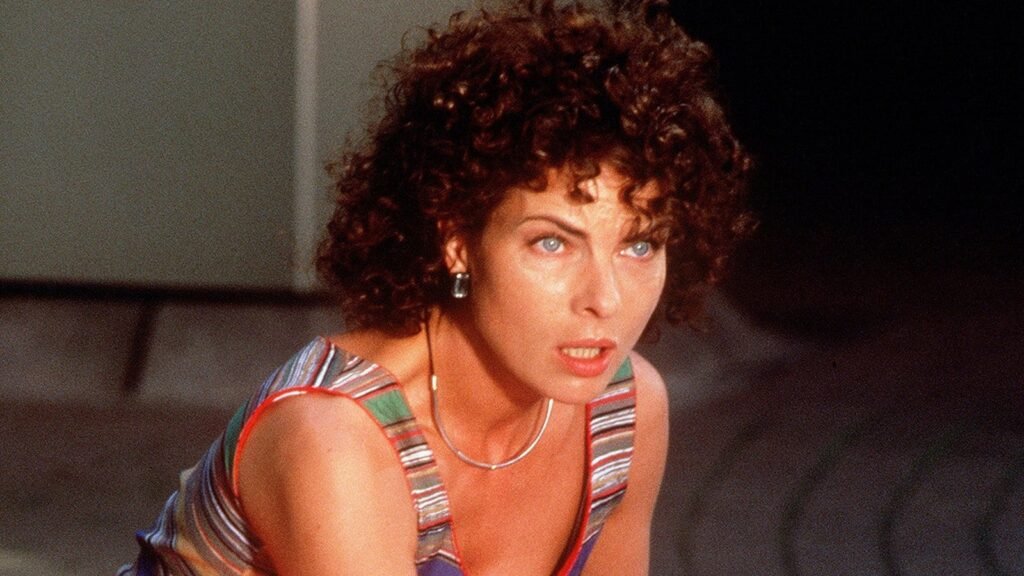
Annette O’Toole is the American actress who played the adult Beverly Marsh in Stephen King’s It (1990), the Losers’ Club’s only girl, grown up. Plenty of performers get one role that follows them around for life. O’Toole went out and collected three: the grown Beverly who answers the call back to Derry, Superman’s sweetheart who came back eighteen years later as Superman’s mother, and — in the strangest line on her résumé — an Academy Award nominee for a folk song about a kiss at the end of a rainbow. If you only know one of those women, you are missing the better half of the story.
Quick Specs
- Born: 1 April 1952, Houston, Texas, U.S.
- Birth name: Annette Toole
- Occupation: Actress, singer, songwriter
- Years active: 1967–present
- Known for: Adult Beverly Marsh in It (1990); Martha Kent in Smallville; Lana Lang in Superman III (1983)
- Awards record: Emmy nominee (The Kennedys of Massachusetts), Golden Globe nominee, Academy Award nominee as co-writer of “A Kiss at the End of the Rainbow”
The call back to Derry
Start where this site starts: with the clown. In November 1990, ABC aired Stephen King’s It across two nights — November 18 and 20 — a two-part miniseries directed by Tommy Lee Wallace from Stephen King‘s 1986 novel, with a teleplay by Lawrence D. Cohen and Wallace. An entire generation watched it through their fingers, and most of them will tell you about Tim Curry‘s Pennywise. Fair enough. But the miniseries only works because the adults are worth coming back for, and the adult Losers are where O’Toole comes in.
She plays Beverly Marsh as a grown woman — say it that way every time, because the role has two halves and they belong to two different actresses. The young Beverly of the 1960 timeline is Emily Perkins. O’Toole is the adult: the Losers’ Club’s only girl, all grown up, who got out of Derry and built a life elsewhere — and who comes back anyway when Mike Hanlon, the one Loser who never left, phones the group home as the killings start again. She was 38 when the miniseries premiered, carrying a character whose childhood was marked by a violent father and whose adult life repeated the pattern in an abusive marriage. The part is written plainly here because that is how it should be handled: those are story facts, and O’Toole plays them without flinching or begging for sympathy, which is exactly why the performance holds up.
Around her, the adult Losers are a roll call worth getting right, because the internet keeps getting it wrong: Richard Thomas as Bill Denbrough, John Ritter as Ben Hanscom, Harry Anderson as Richie Tozier, Dennis Christopher as Eddie Kaspbrak, Richard Masur as Stan Uris, Tim Reid as Mike Hanlon — and Tim Curry under the greasepaint. Seven grown-ups who had to convince you they had once been seven terrified kids, and one monster who had to be worth a thirty-year grudge. O’Toole is the emotional centre of that group precisely because Beverly is the one who had the most to run from — and ran back toward it anyway.
One year, two miniseries
Here is the detail that tells you what 1990 meant in O’Toole’s career: It was not even her only ABC miniseries event that year. In The Kennedys of Massachusetts she played Rose Fitzgerald Kennedy, the family matriarch, and the industry noticed in writing. The role brought her a Primetime Emmy nomination for Outstanding Lead Actress in a Miniseries or Special at the 42nd Primetime Emmys — a nomination, to be precise about it, not a win; Barbara Hershey took the award that year. A Golden Globe nomination for the same performance followed. So in a single year she headlined the Kennedy saga and fought a clown in the sewers of Derry, and if that is not the most 1990 sentence ever written about an actress, it is close.
The Superman loop
Now the party trick. In 1983, O’Toole played Lana Lang in Superman III — Clark Kent’s Smallville sweetheart, by then a single mother to a boy named Ricky, opposite Christopher Reeve. A good role in a film people argue about. Then, in 2001 — eighteen years later — she walked back into the Superman mythos on Smallville, this time as Martha Kent, the hero’s adoptive mother. The sweetheart had become the mother, in the same fictional town, played by the same woman. Casting departments do not plan poetry like that; it just happens, and when it does, you build the page around it.
Keep the edges of it exact, because the loop deserves better than the usual exaggeration. She was Martha Kent as a main cast member for the first six seasons, 2001 to 2007 — not all ten. She returned for guest appearances in seasons nine and ten, and in that late run she also played the Red Queen in two episodes, a separate role that has nothing to do with Martha and should never be blurred into her. Six seasons as the moral centre of the Kent farm, then a stranger in red at the end of the story: that is the shape of it, and it is interesting enough without inflation.
Dance lessons, a dead cockroach, and the long road in
She was born Annette Toole — one T; the O’ came with the profession — on 1 April 1952 in Houston, Texas, the daughter of Dorothy Geraldine Toole, a dance teacher, and William West Toole Jr. She was learning dance from her mother at three. The family moved to Los Angeles when she was thirteen, acting lessons followed, and her first professional job came in 1967, dancing on The Danny Kaye Show. Through the late sixties and seventies she did the working actor’s rounds — My Three Sons, The Virginian, Gunsmoke, Hawaii Five-O, The Partridge Family — plus an uncredited walk-through in Little Big Man in 1970 that does not count as a film career, whatever the listicles say.
Television horror got an early claim on her, too: in The Girl Most Likely To… (1973), an ABC Movie of the Week written by Joan Rivers and Agnes Gallin, she played Jenny in a black little revenge tale built around Stockard Channing. A supporting part — but keep it in mind the next time someone calls It her first brush with the genre.
The break, when it came, was Michael Ritchie’s Smile (1975), a beauty-pageant satire in which she played Doria Houston, a jaded pageant veteran who has seen the whole rigged carnival before. It was her first major film role — not her debut, her break — and by her own much-retold account she landed it after doing an impression of a dead cockroach at the audition. Believe the story or file it under great audition lore; either way, the career after it is documented fact. One on One (1977) put her opposite Robby Benson as tutor Janet Hays. In 1981 she played Tammy Wynette in the television film Stand by Your Man. Then came 1982, twice: Elaine Marshall, Nick Nolte’s girlfriend, in 48 Hrs., and Alice Perrin in Paul Schrader’s Cat People — the genre credit that means this page gets to show her, hair up and eyes wide, in a Schrader nightmare before the clown ever called. Cross My Heart (1987) gave her a romantic-comedy lead opposite Martin Short, and by the end of the decade she was exactly where 1990 found her: ready.
The working decades
After the miniseries years came the steady, unglamorous, excellent grind of a television lead. She played Lisa Bridges on Nash Bridges, starred as bounty hunter Dorothy “Dottie” Thorson in her own series, The Huntress, and turned up years later as Susan Emerson in Halt and Catch Fire. In 2019 she joined The Punisher’s second season as Eliza Schultz, the wealthy, conniving co-leader of Testament Industries alongside Corbin Bernsen’s Anderson Schultz — the couple who hire John Pilgrim to do their killing for them. Netflix and Marvel announced the casting with the character described as cut from the same manipulative cloth as her husband, and she plays her like a woman who has never once been the least powerful person in a room.
That same year, 2019, she took the role she is still playing: Hope McCrea, the mayor of Virgin River — a main role she has held from the premiere through season seven, which arrived on 12 March 2026, with the series renewed for an eighth season and O’Toole in the reported returning cast. Hope is the kind of part a fifty-year career earns: the town’s meddling, big-hearted centre of gravity, played by someone who never has to reach for the effect.
The stage claimed much of her 2010s, too — a sustained New York run that included Southern Comfort at the Public Theater in 2016, where she played Robert, and stops at Hamlet in Bed, Man From Nebraska and The Good Book. One line is all it gets here, because the screen is the spine of this page, but it happened, and it mattered.
The folk singer with an Oscar nomination
And now the résumé line nobody expects. O’Toole is married to actor Michael McKean — they wed on 20 March 1999; her first marriage, to actor Bill Geisslinger, ran from 1983 to 1993 and gave her two daughters, and she became stepmother to McKean’s two sons. The McKean marriage is also a songwriting partnership. For Christopher Guest’s folk-music comedy A Mighty Wind (2003), the two of them wrote three songs together, including the one that outlived the film: “A Kiss at the End of the Rainbow,” performed in the picture by their characters’ folk duo. By McKean’s account, the songwriting began with a tune O’Toole had in her head on a drive from Vancouver to Los Angeles after 9/11 — his words, her melody, and a partnership built out of both.
At the 76th Academy Awards, “A Kiss at the End of the Rainbow” was nominated for Music (Original Song), credited by the Academy to Michael McKean and Annette O’Toole — her nomination, in her own right, the first for each of them. It did not win; “Into the West” did. She has sung with McKean’s Spinal Tap on stage, done a cabaret evening with him at Feinstein’s, and kept performing the song with him over the years — which makes her, as far as this site can tell, the only Loser who can also claim an Oscar nomination for a love song. Range is an overused word. This is what it actually looks like.
Back to King country
Horror, having lent her out to folk music and superheroics, eventually asked for her back. In 2016 she returned to Stephen King material as Edna Price, the boarding-house owner in “The Kill Floor,” an episode of the King miniseries 11.22.63. The same year she appeared in the horror film We Go On, playing Charlotte — a production that reunited her with her Smallville co-star John Glover, which means the Superman loop quietly closed inside a ghost story, the way these things should.
That is the career, and it is a better one than the single line most people carry for her. Dancer at three, professional at fifteen, pageant veteran at twenty-three, Kennedy matriarch and Beverly Marsh in the same year, Lana Lang and Martha Kent in the same lifetime, and an Oscar nomination earned with a melody she was humming in a car. The girl from the Houston dance studio went back to Derry when the phone rang. You would have, too — but you would not have done it as well.