
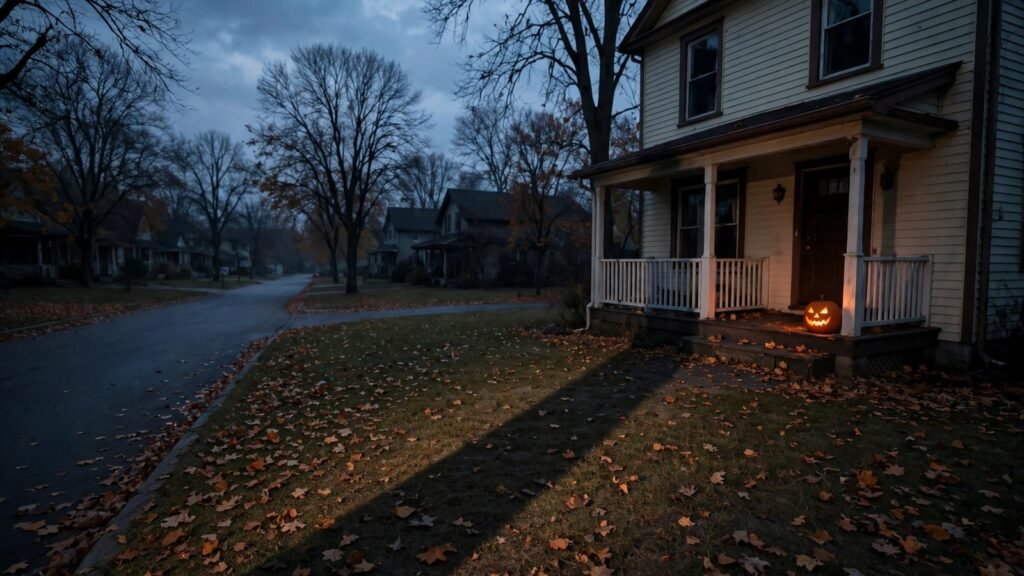
Halloween is a 1978 American independent slasher film directed by John Carpenter, who co-wrote it with Debra Hill and composed its score. Made for somewhere between $300,000 and $325,000, it tells a brutally simple story: on Halloween night 1963, six-year-old Michael Myers murders his teenage sister; fifteen years later he escapes the sanitarium, comes home to Haddonfield, Illinois, and stalks babysitter Laurie Strode while his psychiatrist, Dr. Sam Loomis, hunts him through the streets. Released city by city from a Kansas City premiere on October 25, 1978, it built on word of mouth into the most lucrative independently produced film of its time — roughly $70 million worldwide — and, with The Texas Chain Saw Massacre before it, set the template the 1980s slasher boom ran on: the killer’s-eye camera, the holiday hook, the masked Shape in the shadows, and the resourceful final girl who survives him. It launched a thirteen-film franchise, made a star of Jamie Lee Curtis in her feature debut, and was selected for the National Film Registry in 2006 as culturally, historically and aesthetically significant. Read Harper’s review for the site’s verdict on it.
At a glance
- Director: John Carpenter
- Written by: John Carpenter and Debra Hill
- Produced by: Debra Hill
- Executive producers: Irwin Yablans; Moustapha Akkad (who financed the film)
- Starring: Donald Pleasence, Jamie Lee Curtis, Nancy Kyes (credited as Nancy Loomis), P. J. Soles, Nick Castle as “The Shape”
- Cinematography: Dean Cundey
- Edited by: Tommy Lee Wallace and Charles Bornstein
- Music: John Carpenter
- Production companies: Compass International Pictures, Falcon International Productions
- Premiere: October 25, 1978 (Kansas City)
- Running time: 91 minutes
- Budget: $300,000–$325,000
- Box office: $47.2 million domestic; about $70 million worldwide
- Rating: R
Plot
Halloween night, 1963, Haddonfield, Illinois. Through the killer’s eyes, in one gliding point-of-view shot: a teenage girl, Judith Myers, is alone after her boyfriend leaves; the unseen watcher slips in the back, takes a kitchen knife, climbs the stairs, pulls on a clown mask and stabs her to death. Outside, her parents pull the mask off — and find six-year-old Michael Myers in a clown costume, holding the bloody knife, staring blankly. Michael is committed to Smith’s Grove Sanitarium. His psychiatrist, Dr. Sam Loomis, spends eight years trying to reach him and the rest of his life, as he tells it, trying to keep him locked up: what he saw was a boy “with this blank, pale, emotionless face and the blackest eyes — the devil’s eyes.”
On October 30, 1978, Loomis and nurse Marion Chambers drive through a storm to collect the 21-year-old Michael for a court hearing. Patients are wandering the grounds in the rain; while Loomis checks the gate, Michael drops onto the car, attacks Marion, and drives off in the station wagon. On the road to Haddonfield he kills a mechanic for his coveralls, and in town he steals a white mask, rope and knives from a hardware store. On Halloween day, high-schooler Laurie Strode drops a key at the old Myers house — her realtor father is selling it — and Michael watches her from inside. All day she glimpses him: outside her classroom window, across the street, standing among the laundry in her yard. Her friends Annie Brackett and Lynda van der Klok laugh it off. Loomis, meanwhile, finds Judith Myers’s headstone stolen from the cemetery, and he and Annie’s father, Sheriff Leigh Brackett, stake out the Myers house.
That night Laurie babysits Tommy Doyle at the Doyle house, with Lindsey Wallace dumped on her by Annie, who is babysitting across the street. Annie gets into her car to meet her boyfriend — Michael is waiting in the back seat, and he strangles her and cuts her throat. Tommy, who has seen Michael carrying Annie’s body into the Wallace house, tells Laurie the boogeyman is real; she doesn’t believe him. Lynda and her boyfriend Bob settle into the empty Wallace house; Michael pins Bob to the wall with a knife, then comes to Lynda wearing a sheet and Bob’s glasses, and strangles her with the telephone cord while she is on the phone to Laurie.
Crossing the street to check, Laurie finds the Wallace master bedroom: Annie laid out beneath Judith’s stolen headstone, Bob hanging in the closet, Lynda on the floor. Michael steps out of the dark and slashes her arm. She falls down the stairs, runs for the Doyle house, and — with the children sent upstairs — stabs Michael in the neck with a knitting needle when he comes through the window. He falls. Upstairs she tells the children she killed the boogeyman; Tommy answers: “You can’t kill the boogeyman.” Michael rises behind her. In a bedroom closet, cornered, Laurie straightens a wire clothes hanger and stabs him in the eye, then stabs him with his own fallen knife, and he collapses a second time. She sends the children to a neighbour’s to call the police. Loomis, seeing them run from the house, goes in as Michael attacks Laurie upstairs — and shoots him six times. Michael falls from the balcony to the lawn. “It was the boogeyman,” Laurie says. “As a matter of fact, it was,” Loomis answers. Then he looks over the balcony: the body is gone. The film ends on the quiet houses of Haddonfield, and Michael’s breathing on the soundtrack.
Cast
- Donald Pleasence — Dr. Sam Loomis
- Jamie Lee Curtis — Laurie Strode, in her feature film debut
- Nick Castle — Michael Myers, credited as “The Shape”
- Tony Moran — Michael Myers unmasked
- Will Sandin — Michael Myers, age 6
- Nancy Kyes (credited as Nancy Loomis) — Annie Brackett
- P. J. Soles — Lynda van der Klok
- Charles Cyphers — Sheriff Leigh Brackett
- Kyle Richards — Lindsey Wallace
- Brian Andrews — Tommy Doyle
Production
The film began as a commission. Independent producer Irwin Yablans and financier Moustapha Akkad had seen Carpenter’s Assault on Precinct 13 at the Milan Film Festival and hired him to direct a film about a psychotic killer stalking babysitters — Yablans wanted, he told Fangoria, “a picture that had the same impact as The Exorcist.” Akkad advanced $300,000 (a contemporary trade report put the budget at $320,000, and the trackers carry $325,000 — the honest figure is the range). Carpenter’s deal is the stuff of independent-film legend: $10,000 for directing, writing and composing, plus ten percent of the profits. Hill and Carpenter wrote the script in a matter of weeks — accounts vary between ten days and three — splitting the work, Hill writing the girls and Carpenter writing Loomis and Michael.
Where the title came from is genuinely contested, and the record deserves stating straight. Carpenter has said the draft was called The Babysitter Murders and that Yablans suggested moving the action to Halloween night and renaming it; Yablans himself has told the same story on the franchise’s official site. Yablans has also, in Netflix’s The Movies That Made Us, dismissed the Babysitter Murders title as an urban myth and said the film was always meant to be called Halloween. The commission itself is undisputed; the working title is not, and this page leaves it where the sources leave it.
The shoot took 20 days across about four weeks in spring 1978 — which meant faking autumn: the crew painted paper leaves in fall colours, scattered them before each scene and gathered them up afterwards to reuse, and struggled to find pumpkins in spring. South Pasadena stood in for Haddonfield — the Myers house was a nearly century-old, church-owned house on Meridian Avenue — with the Sierra Madre cemetery and Orange Grove Avenue in Hollywood for the climax houses, and Dean Cundey framing carefully around Southern California’s palm trees. The famous opening shot, a single continuous point-of-view take of roughly four minutes, was filmed with Panavision’s then-new Panaglide stabiliser on the last and most complex day of the schedule — and the small hands the camera shows are not a child’s: they are Debra Hill’s.
There was no money for a custom mask, so production designer Tommy Lee Wallace — who was also co-editor, art director and location scout — bought a Captain Kirk mask modelled on William Shatner for $1.98 at a costume shop on Hollywood Boulevard, widened the eye holes, altered the hair and spray-painted it a bluish white; the script had called for “the pale features of a human face.” His alternative, a droopy hobo-clown mask patterned on Emmett Kelly, was rejected. Casting ran on the same scale: Loomis was offered to Peter Cushing and Christopher Lee, who declined (Lee later called it his biggest career mistake); Donald Pleasence, the third choice, took $20,000 for five days — the film’s biggest salary — reportedly because his daughter had praised Assault on Precinct 13. Jamie Lee Curtis was paid $8,000, championed by Hill and cast partly for the Psycho connection as Janet Leigh’s daughter; she bought Laurie’s wardrobe herself at J. C. Penney for around a hundred dollars. And “Michael Myers” was worn by several people: Nick Castle, a friend of Carpenter’s, as the Shape; Tony Moran for the unmasking; Will Sandin at age six; and Wallace and Carpenter themselves for individual scenes.
The score was a rescue job. After an unscored screening failed to scare an executive — “that’s not scary” — Carpenter scored the film himself. The main theme is in 5/4 time, built on a childhood exercise: his father, a music teacher, had bought him bongos at thirteen and taught him five-four time. Carpenter’s account is that he composed the score in three days, the theme in about an hour; the recording account puts completion at a couple of weeks, recorded at Sound Arts Studios in Los Angeles with Dan Wyman assisting, not to picture. On screen the music is credited to the “Bowling Green Philharmonic” — a name Carpenter invented, after his Kentucky hometown.
Release and reception
Compass distributed the film itself after the major studios passed. It premiered in Kansas City on October 25, 1978 — the first Friday’s takings were poor, a few hundred dollars per theatre, and within a week daily grosses had multiplied on word of mouth. Los Angeles followed on October 27, then a city-by-city rollout; it screened as an invited entry at the Chicago International Film Festival, where Carpenter received a Special Silver Plaque. The early reviews were not the uniform panning of legend: Variety praised Carpenter’s feel for timing and thrills, David Ansen in Newsweek called it “a superb exercise in the art of suspense,” and the Village Voice‘s Tom Allen championed it — while Pauline Kael’s New Yorker review in February 1979 was scathing. The review that mattered most came a full year after release: Roger Ebert’s four stars in 1979. “Halloween is a visceral experience,” he wrote — “we aren’t seeing the movie, we’re having it happen to us.”
The film finished with $47.2 million domestic (the two major trackers differ by about $114,000) and about $70 million worldwide — in inflation-adjusted terms, roughly $180 million in today’s dollars — making it the highest-grossing independent film ever made at that time, a standing it held for two decades, until The Blair Witch Project in 1999. It was nominated for the 1979 Saturn Award for Best Horror Film and won the Critics Award at the Avoriaz festival. Its television afterlife produced footage of its own: NBC’s network premiere aired October 30, 1981 — the very night Halloween II opened in theatres — and because the 91-minute film was short for the slot, Carpenter shot some twelve minutes of new scenes during the sequel’s production, including Loomis finding the word “Sister” carved in Michael’s abandoned cell. Those scenes belong to the sequel’s retcon, not to this film: in the 1978 Halloween, Laurie Strode is not Michael’s sister, and nothing in it suggests otherwise.
Legacy
The AFI’s summary is that Halloween, together with The Texas Chain Saw Massacre (1974), “initiated the 1980s horror/slasher craze in the U.S.” — with the honest caveat, standard in the scholarship, that several of its devices were not invented here but became standard slasher tropes through it: the babysitter setting, the killer’s point-of-view camera, the holiday hook, the lone surviving heroine. That heroine has a name in film studies: the “final girl,” a term coined by Carol J. Clover in Men, Women, and Chain Saws (1992), with Laurie Strode as the archetype the term is most widely attached to — she codified the figure rather than being its first example. The film launched the Halloween franchise — thirteen films between 1978 and 2022 — though Carpenter directed none of the sequels; he co-wrote and co-produced the 1981 follow-up and returned four decades later as executive producer and composer for the 2018 film, which is a direct sequel to this one alone. In 2006 the film was selected for the National Film Registry by the Library of Congress.
Trivia
- The closing credits bill Tony Moran’s Michael as “age 23.” By the film’s own timeline — six years old in 1963, escaped in 1978 — he is 21.
- Nick Castle was paid $25 a day, by the production’s own oft-repeated account — against Donald Pleasence’s $20,000, the top salary on the film.
- The film’s Chicago connection is a festival screening and a plaque for Carpenter — not a premiere; the premiere was Kansas City.
- In 2006, reels of the film’s original camera negative — including the 1981 television-version footage — were found in storage and acquired by Synapse Films, as reported by Fangoria at the time.
Related links
- Halloween (2007)
- Halloween II (2009)
- Halloween II (1981)
- Halloween (2018)
- Halloween franchise
- Michael Myers
- John Carpenter
- Jamie Lee Curtis
- Rob Zombie
- Movies index