
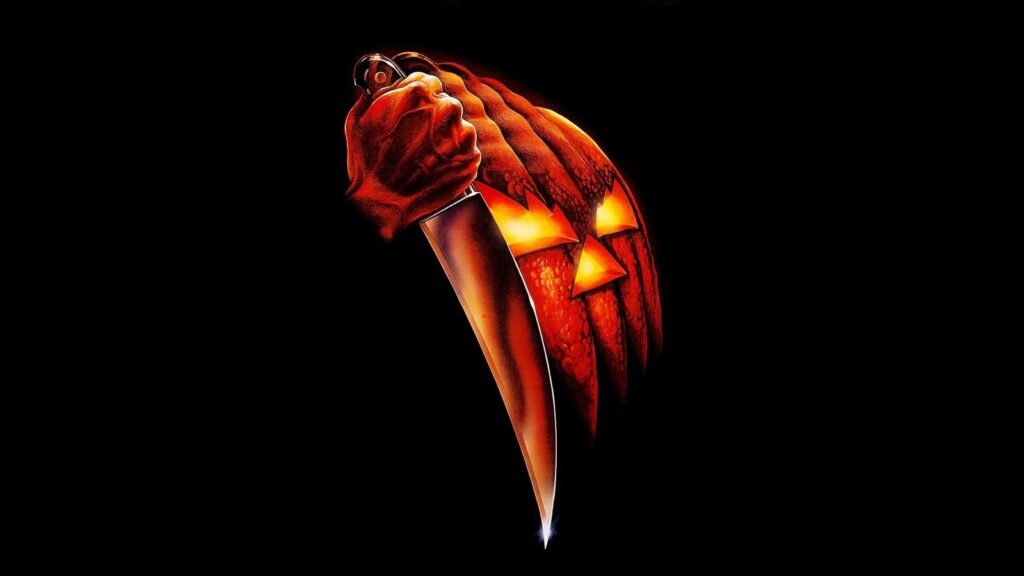
Most franchises ask you to keep one story straight. This one hands you five stories, a William Shatner mask and a kitchen knife, and wishes you luck. Halloween is John Carpenter and Debra Hill’s slasher franchise — thirteen films, five timelines, one masked killer named Michael Myers. Between 1978 and 2022 the series killed its heroine in one branch, crowned her in another, and once made a film with no Michael Myers in it at all. Critic Scott Mendelson calls it the “‘Choose Your Own Adventure’ of horror movie franchises,” and he is not wrong. This page is the map: every film, every timeline, every mask.
Quick Specs
- Creators: John Carpenter and Debra Hill
- Original film: Halloween (1978)
- Films: 13 theatrical releases, 1978–2022 — no direct-to-video era
- Setting: Haddonfield, Illinois; every film is set primarily on Halloween
- The killer: Michael Myers, billed in the credits as “The Shape”
- Owner: Trancas International Films (the Akkad family’s company)
- Continuities: five mutually incompatible timelines
- Biggest film: Halloween (2018) — $159.3 million domestic, about $255.5 million worldwide
- Most recent film: Halloween Ends (2022)
One night in Haddonfield
It starts in 1963. In Haddonfield, Illinois, six-year-old Michael Myers murders his sister Judith on Halloween night and is committed to Smith’s Grove Sanitarium. Fifteen years later he escapes and comes home, stalked in turn by his psychiatrist, Dr. Sam Loomis. The film around that premise was built for almost nothing: producer Irwin Yablans and financier Moustapha Akkad approached John Carpenter after Assault on Precinct 13, Akkad fronted a budget of about $300,000, Carpenter took no directing fee, and the whole thing was shot in 21 days in the spring of 1978, mostly in South Pasadena, California. Carpenter’s own score — a piano melody in 5/4 time — did the rest.
The return on that about-$300,000 was about $47 million domestic and about $70 million worldwide (the carriers give variants; the honest form is the round one). The film became the template for the slasher cycle that followed, and adjusted for inflation the series is ranked the highest-grossing American horror franchise at the US box office. One cheap night in Haddonfield rebuilt the genre; everything after is the industry trying to go back to it.
The thirteen films
All thirteen are theatrical releases — this franchise never had a direct-to-video era. In release order:
- Halloween (1978) — Carpenter directs; Jamie Lee Curtis makes her film debut as Laurie Strode, Donald Pleasence is Loomis, Nick Castle is The Shape. Loomis shoots Michael off a balcony; the body vanishes. About $47 million domestic.
- Halloween II (1981) — Rick Rosenthal directs from a Carpenter and Hill script. The same night continues at Haddonfield Memorial Hospital — and this film invents the twist that Laurie is Michael’s sister. $25,533,818 domestic — a figure all three trackers agree on.
- Halloween III: Season of the Witch (1982) — Tommy Lee Wallace directs. No Michael, no Laurie, no Loomis, no Haddonfield: the story of Silver Shamrock Novelties, whose Halloween masks are rigged to kill the children wearing them. $14,400,000 domestic.
- Halloween 4: The Return of Michael Myers (1988) — Dwight H. Little directs. After a six-year gap, a comatose Michael wakes to hunt his niece, Jamie Lloyd (Danielle Harris). Laurie is written out, dead in a car accident. $17,768,757 domestic.
- Halloween 5: The Revenge of Michael Myers (1989) — Dominique Othenin-Girard directs, one year later — the fastest turnaround in the series. A near-mute Jamie has a psychic link to her uncle; a mysterious Man in Black plants the thread the sixth film must pay off. $11,642,254 domestic, the lowest of the thirteen.
- Halloween: The Curse of Michael Myers (1995) — Joe Chappelle directs. The supernatural explanation arrives: the Curse of Thorn compels Michael to kill his bloodline, steered by Dr. Wynn’s cult. J. C. Brandy takes over as Jamie; Paul Rudd makes his feature debut as an adult Tommy Doyle; it is Pleasence’s final film. The trackers disagree on the domestic gross — $15,116,634 (Box Office Mojo) against $15,126,948 (The Numbers) — and the film survives in two cuts after a troubled post-production.
- Halloween H20: 20 Years Later (1998) — Steve Miner directs. Curtis returns after 17 years as “Keri Tate,” a headmistress who faked her death. Hold the ending loosely: she beheads Michael with a fire axe — except the next film in this line reveals she killed a paramedic Michael had swapped clothes with and silenced. Domestic $55,041,738; the worldwide figure is contested — $75,041,738 (Wikipedia’s table) against $64,854,900 (The Numbers).
- Halloween: Resurrection (2002) — Rosenthal returns. The H20 line pays its debt in the opening: Michael kills Laurie at the asylum. Then a student reality-show crew livestreams from the Myers house. Budget and grosses all conflict — budget $13 million vs $15 million; domestic $30,354,442 vs $30,259,652; worldwide $37,664,855 vs $37,924,315.
- Halloween (2007) — Rob Zombie writes and directs a remake-prequel: Michael’s childhood at length, then the 1978 night retold, with Laurie established as his sister from the start and Tyler Mane behind the mask. $58,272,029 domestic (Box Office Mojo).
- Halloween II (2009) — Zombie’s sequel: a disintegrating Laurie, a Michael living rough, and endings that differ between the theatrical and director’s cuts. $33,392,973 domestic.
- Halloween (2018) — David Gordon Green directs; Carpenter returns as executive producer and composer. Forty years on from 1978 — and only from 1978 — Laurie, who is not Michael’s sister in this line, has spent them preparing. The franchise’s biggest film by a wide margin: $159,342,015 domestic and about $255.5 million worldwide on a $10 million budget.
- Halloween Kills (2021) — Green again. Minutes after the 2018 film ends, firefighters free Michael from Laurie’s burning house; Haddonfield’s survivor mob — “Evil dies tonight” — is butchered almost to a person. Delayed a year by the pandemic and released day-and-date on Peacock, it still took $92,002,155 domestic and set the record opening for a day-and-date release at $49.4 million.
- Halloween Ends (2022) — Green closes his trilogy. Four years on, much of the film belongs to Corey Cunningham, a pariah drawn into Michael’s pattern; Michael’s body ends in an industrial shredder before the whole town. $64,079,860 domestic — a figure earned while the film was simultaneously free to Peacock subscribers, which is the context any comparison with 2018 must carry. Its budget conflicts: $33 million (Wikipedia) against $20 million (The Numbers).
Five timelines, no master key
Take the series as five separate shelves, not one long story. Films are shared between branches; a film’s place on one shelf says nothing about the others.
The original line — the “Thorn” line: 1978 → II → 4 → 5 → Curse. Halloween II invents the sibling twist, Laurie is written out as dead, and her daughter Jamie Lloyd carries 4 and 5 until Curse lands the Cult of Thorn explanation: an ancient curse compels Michael to kill his own bloodline.
The anthology entry: Halloween III stands alone, connected to nothing — in its world, the 1978 film is simply a movie that plays on a bar television.
The H20 line: 1978 → II → H20 → Resurrection. Twenty years on, Laurie has faked her death and lives as Keri Tate; the Jamie and Thorn films are never acknowledged. This is the only branch where Laurie dies at Michael’s hands — at the start of Resurrection, after the retcon that undoes her H20 victory.
The Zombie remake line: 2007 → 2009. A remake and reimagining in one: Michael’s childhood expanded, Laurie established as his sister — “Angel Myers” — from the start, and an ending in which Laurie kills Michael and takes his psychosis on herself.
The 2018 line: 1978 → 2018 → Kills → Ends. The boldest cut of all: every sequel is ignored, including II. Michael was arrested in 1978 and held for forty years; Laurie is not his sister here, a point the line states outright; and her daughter Karen and granddaughter Allyson stand with her across all three films.
And the sibling rule, stated plainly: Laurie is Michael’s sister only in the lines that descend from Halloween II — the original line, the H20 line and Zombie’s. The 1978 film contains no such relationship, and the 2018 line discards it on purpose.
The film with no Michael in it
Halloween III: Season of the Witch deserves its own room, because it is the franchise’s great act of nerve. Carpenter and Hill, who considered the Myers story finished with II, agreed to return only on the condition that the third film was NOT a Myers sequel — the plan was an anthology. What Wallace made from that brief is a bleak techno-occult thriller: Conal Cochran’s Silver Shamrock masks, each carrying a fragment of a stolen Stonehenge rock, set to kill every child wearing one when the company’s commercial airs. It ends on Tom Atkins screaming into a telephone.
Two precision points, because the trivia usually mangles both. The 1978 film exists as fiction inside III’s world — a bar TV plays an advertisement for it. And Jamie Lee Curtis IS in the film, as an uncredited voice: the curfew announcer and a telephone operator. “Nobody from the first films is in it” fails on both counts. Audiences in 1982 wanted Michael and stayed away; the anthology plan died, and Michael returned in 1988. Time has been kinder: the film has since been substantially re-evaluated into cult standing, and on this site it is treated the way its makers intended — the anthology entry, different on purpose.
The mask, and the eight men inside it
The most famous face in horror began as a joke-shop purchase. Production designer Tommy Lee Wallace built Michael’s mask from a William Shatner — Captain Kirk — Halloween mask bought for $1.98: spray-painted white, eye holes widened, features stripped away. In the credits he is billed as “The Shape.”
Eight principal performers have worn that mask across the lines. Nick Castle originated it in 1978 (Tony Moran is the unmasked face; Will Sandin plays the six-year-old Michael). Dick Warlock took it for II. George P. Wilbur played Michael in 4 and again in Curse, with Don Shanks between them in 5. Chris Durand wore it in H20 and Brad Loree in Resurrection. Tyler Mane played Michael across both of Zombie’s films (Daeg Faerch plays the child). And in the 2018 trilogy the principal Michael is James Jude Courtney — Castle’s part in those films is shared and cameo work, including a voice credit in Ends.
The music, briefly. Carpenter composed the scores for the first three films; Alan Howarth co-composed II and III and carried the sequels that followed; and when the series came home in 2018, Carpenter came with it, scoring the whole trilogy.
The people who carry it
Jamie Lee Curtis is Laurie Strode in seven films — 1978, II, H20, Resurrection, 2018, Kills and Ends — plus that uncredited voice cameo in III. In the original line’s middle films she does not perform at all: Laurie is written out as killed in a car crash, and 4, 5 and Curse belong to Jamie Lloyd — though keep the record exact: a photograph of Laurie appears in Halloween 4. A photograph, not an appearance; Curtis’s absence from those three films as a performer is total. Her Laurie’s fates are branch property, never franchise fact: killed by Michael in the H20 line, alive and done with him at the end of the 2018 line. Curtis has stated that Ends is her final Halloween film.
Donald Pleasence is Dr. Sam Loomis in five films — 1978, II, 4, 5 and Curse — the original line’s second pillar. Pleasence died on 2 February 1995, seven months before Curse was released; the film is dedicated to his memory. Later Loomises are recreations, not Pleasence: his voice imitated by Tom Kane in H20, voiced by Colin Mahan in the 2018 line — with Tom Jones Jr. on screen in prosthetics, no CGI, in Kills’ flashback — and played by Malcolm McDowell in Zombie’s two films.
Danielle Harris holds the franchise’s strangest double entry: Jamie Lloyd in 4 and 5, then — a generation later — Annie Brackett in Zombie’s 2007 and 2009 films. Two roles, never to be merged; and Jamie in Curse is J. C. Brandy, a recast, stated as a fact and nothing more.
Behind the camera, the shape is two families and one return. Hill produced II and III; her involvement ends there. Carpenter’s hands-on work ends with III in 1982 — and does not resume until 2018, thirty-six years later, when he returned as executive producer and composer for the whole Blumhouse trilogy. He did not direct those films; David Gordon Green did, all three, co-writing with Danny McBride. The other constant is the Akkads: Moustapha financed the original, and his son Malek produces from the later sequels through the Zombie and Blumhouse eras.
The money, honestly
This hub prints per-film figures with their trackers attached, and it does not print a franchise total — because no two carriers agree on the numbers a total would be built from. Where the record conflicts, you have seen both figures: Halloween III’s budget ($2.5 million against $4.6 million), H20’s worldwide, Resurrection’s budget and grosses, Halloween Ends’ budget ($33 million against $20 million). Nothing here has been averaged.
What can be said plainly: the 2018 film is the commercial peak, and the 1978 original’s return remains the founding money story of modern horror. And era comparisons carry an asterisk: Kills and Ends earned their theatrical grosses while streaming free to Peacock subscribers on the same day, a handicap no earlier film in the series faced.
What the critics made of it
The reception story has a clean shape. The 1978 original is the peak — 97% on Rotten Tomatoes from 93 reviews, per RT’s own page. The 2018 film, at 79% from 385 reviews, is the only sequel in fresh territory. Between and beneath those two points the line sags to a floor of 8% for The Curse of Michael Myers, the critical bottom of the series. Halloween III sits at about half — its score has drifted between carriers by a point. One table oddity: Resurrection’s opening audiences polled warmer (a B+ CinemaScore) than its 10% Tomatometer suggests.
Where the franchise stands
Halloween Ends (2022) is a finale with three limits, and all three travel with it: it closes David Gordon Green’s trilogy, it closes the Blumhouse run — the film rights reverted to Malek Akkad afterwards — and it closes Jamie Lee Curtis’s Laurie. It is not “the last Halloween film”: Miramax holds the television rights, won in October 2023, and a series is in development there — described in March 2024 as a creative reset spinning out of the original film. In development; nothing dated.
The Shape, meanwhile, has changed mediums. Halloween: The Game — IllFonic’s asymmetrical multiplayer horror game, with a single-player story mode reimagining the 1978 night, developed with Trancas and Miramax — launched digitally on 8 September 2026 for PS5, Xbox Series X|S and PC, with physical editions following on 6 October; IllFonic announced over a million players within the month, and its first DLC drop lands 27 October 2026. It is not the franchise’s first game — that honour belongs to the 1983 Atari 2600 cartridge. The franchise turned 48 in 2026, with the 50th anniversary due in 2028 — and Haddonfield has not finished choosing its own adventure. More franchise hubs live on the index.