
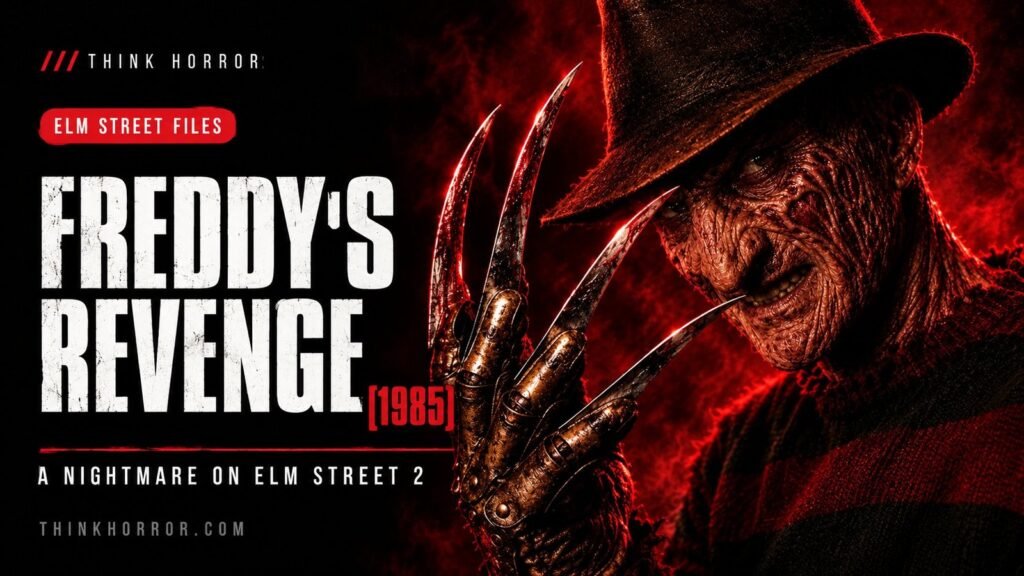
A Nightmare on Elm Street 2: Freddy’s Revenge is the 1985 sequel where Freddy Krueger possesses Jesse Walsh to kill in the waking world.
One year after A Nightmare on Elm Street turned a burned dream-stalker into a phenomenon, New Line Cinema wanted more Freddy, fast. What it got was the strangest sequel in the Elm Street franchise: a film directed by Jack Sholder, written by David Chaskin, and built on a premise that breaks the original’s central rule. Freddy Krueger does not wait for Jesse Walsh to fall asleep. He climbs inside him, wears him, and kills through his body in broad waking daylight — at a pool party, in front of a crowd of awake teenagers.
That rule-break is why the film spent decades as the franchise’s black sheep, and why it has spent the last fifteen years being reassessed as something else entirely: a cult film with a second life, a documentary of its own, and an argument about what is actually on its screen that its own makers still do not agree on. This page sticks to the record — including the places where the record argues with itself.
Quick Specs
Director: Jack Sholder
Written by: David Chaskin; based on characters created by Wes Craven
Producer: Robert Shaye
Starring: Mark Patton, Kim Myers, Robert Englund, Robert Rusler, Clu Gulager, Hope Lange, Marshall Bell
Music: Christopher Young
Production companies: New Line Cinema, Heron Communications, Smart Egg Pictures
Released: November 1, 1985 (limited, Halloween weekend), New Line Cinema
Runtime: 87 minutes in most listings; some list 85
Rated: R
Budget: Reported at $3 million (Variety, 1985); later trade charts give $2.5 million
The Cast
Mark Patton is Jesse Walsh, the teenager Freddy chooses as his vessel — the first male lead in a series built on final girls. Kim Myers is Lisa Webber, Jesse’s girlfriend and the film’s second center of gravity; director Jack Sholder has said she was cast partly because she resembled a young Meryl Streep. Robert Englund is Freddy Krueger — though, as the production section below records, he very nearly was not. Robert Rusler plays Ron Grady, Jesse’s best friend; Clu Gulager and Hope Lange are Jesse’s parents, Ken and Cheryl Walsh; Marshall Bell is Coach Schneider, the gym teacher whose death is the film’s first; and Sydney Walsh plays Kerry Hellman, Lisa’s friend. Studio head Robert Shaye appears unbilled as the bartender in the leather bar Jesse wanders into — a role Sholder gave him after refusing him the part he actually wanted, Grady’s father; Shaye later recalled that his leather outfit came from the Los Angeles store The Pleasure Chest. One absence defines the cast list: Nancy Thompson does not appear. Heather Langenkamp sat this one out entirely, and Nancy returns only in Dream Warriors.
The Plot
Five years after Freddy’s apparent defeat, the Walsh family has moved into Nancy Thompson’s old house on Elm Street, and teenage Jesse has taken over her room. His nightmares begin immediately — the film opens with one, a school bus driven by Freddy that veers off the road into a desert abyss. Jesse and Lisa find Nancy’s diary in his room, and her account of her own dreams matches his with uncomfortable precision. Around the house, small fires break out, culminating in the family’s pet birds bursting into flames. In his dreams, Freddy gives Jesse his instructions: kill for me. Jesse tries everything to stay awake, fails, and starts wandering the streets at night.
One of those wanderings takes him into a leather bar, where he is caught by Coach Schneider, who punishes him with after-hours laps at school. Afterward, in the gym showers, Freddy emerges: Schneider is stripped by an invisible force, bound, whipped with towels and slashed — and Jesse comes back to himself horrified, with the glove on his own hand. Police escort him home after he is found wandering naked. He and Lisa visit the abandoned factory where Freddy once worked and find nothing. The next night, at Lisa’s pool party, Jesse kisses her — and his body begins to change. He panics and runs to Grady’s house, confesses to Schneider’s killing, and begs Grady to watch him while he sleeps. Grady falls asleep instead. Freddy bursts out of Jesse’s body — the film’s signature effect, a chest-bursting transformation — and kills Grady with Jesse trapped inside watching.
Jesse flees back to Lisa’s house, transforms again in front of her, and Freddy — finding he cannot harm Lisa, because Jesse’s feelings for her blunt him — goes outside instead, into the pool party, in the waking world, and slaughters several partygoers before vanishing. “You are all my children now,” he tells them. Lisa drives to the abandoned factory, masters her own fear — the film’s logic is that terror feeds him — and confronts Freddy there. She pleads with Jesse to fight, tells him she loves him, and kisses the thing wearing him. Jesse does fight back. Freddy combusts into ash, and Jesse emerges from it alive. It reads like an ending. It is not one. Days later, riding the school bus with Lisa and Kerry, Jesse sees the nightmare’s geometry repeating and panics; Kerry reassures him it is all over, and Freddy’s clawed arm bursts through her chest. Freddy laughs as the bus drives off into the field, exactly as it did in Jesse’s first dream.
Production
The sequel moved fast: pre-production began in April 1985, photography that June, with Sholder — who had made Alone in the Dark for New Line — brought on only five weeks before filming started. By his own account he had very little time to prepare, on a film loaded with special effects, none of which he knew how to do. The bus nightmare that opens the film was itself a leftover: Wes Craven had fought against Freddy appearing in person as a driver in the first film’s epilogue, and the compromise was to save the idea for a sequel that would not involve Craven’s characters.
Craven’s absence was his own choice. Robert Shaye offered him the director’s chair again; he declined, citing serious problems with Chaskin’s script — a possessed parakeet he found ridiculous, and Freddy merging with the hero and manifesting in reality at a pool party, killing teenagers bigger than Englund, which he believed would diminish Freddy. His later verdict, given in 1988, did not soften: “I didn’t like the second script. I thought it was a silly script… You want Freddy to be always threatening and overpowering. But when he’s running around a swimming pool with a bunch of teenagers who are all bigger than he is, he starts to look really silly.” Craven did leave fingerprints on the finished film: on his suggestion, Chaskin rebalanced the script toward Lisa, taking her from a late-film handoff to something close to a co-lead.
Englund nearly lost the role to economics. New Line first tried to save money by putting an unnamed extra in the mask, treating Freddy like Jason or Michael — a shape anyone could wear. The footage disappointed: the extra moved, in the production’s own retrospective telling, like a dimestore monster next to Englund’s classically trained physicality, and Englund was quickly rehired for the rest of the film and the series. Some of the extra’s footage survives in the finished film, in Schneider’s shower scene, obscured by steam. The effects themselves were split between two of the era’s defining shops: Kevin Yagher headed Freddy’s design, and Mark Shostrom built the transformation effects — Freddy coming out of Jesse — after David Miller, the original film’s makeup creator, proved unavailable, busy on Cocoon and My Science Project. Christopher Young scored the film.
The Subtext
No account of this film is honest without the argument, and the argument cannot be settled here, because the people who made it do not agree. What is on screen is not in dispute: Jesse’s encounter with Schneider at a fetish club; his flight to his male friend’s bedroom after trying to make out with Lisa; a bedroom dance sequence; Freddy stroking Jesse’s face while telling him, “You’ve got the body, I’ve got the brain”; a monster who quite literally comes out of the hero. What it means, and whether it was meant, is where the record splits — so here are the positions, from the people who hold them.
David Chaskin denied any gay subtext for years, at one point suggesting Patton had simply played the part “too gay.” In 2010, in the documentary Never Sleep Again, he admitted the choice had been deliberate: homophobia was skyrocketing, he said, and he had thought about “our core audience — adolescent boys — and how all of this stuff might be trickling down into their psyches”; tapping into that angst, he reasoned, would give the horror an extra edge. In a 2007 interview he had framed the design as “intended to play homophobic rather than homoerotic” — dreams that make a teenage boy “question their own sexuality seemed like a slam dunk to me.” Years later, confronted by Patton in the documentary Scream, Queen!, Chaskin apologized and agreed the gay content was intended all along.
Sholder’s account is different. In 2020 he said he never discussed a gay subtext with Chaskin or anyone at New Line during production; his film, as he understood it, was about “repressed sexual angst that every teenager experiences,” which “can express itself in the question: Am I gay?” His conclusion: “some of it was intentional and some of it was stuff that people added that fed into that idea.” Englund, in 2010, left no ambiguity about his own reading: the film “is obviously intended as a bisexual themed film,” with Jesse’s wrestling over his desires “manifested by Freddy.” Producer Sara Risher, for her part, has said the producers were completely oblivious — to the undertones and to having cast a closeted gay actor — and that any homoerotic charge was incidental, visible only in retrospect.
Patton lived the consequences. “It just became undeniable,” he said in 2016, describing subtext he believed grew through rewrites while the filmmakers knew he was gay and closeted. The role, stacked on his performance the year before in Come Back to the 5 & Dime, Jimmy Dean, Jimmy Dean, typecast him; he has said he felt betrayed, blamed Chaskin, and left acting for interior decorating under the stress of it. His own final nuance cuts against every simple version: “I don’t think that [Jesse] was originally written as a gay character. I think it’s something that happened along the line by serendipity.” All of those accounts are on the record. This page reports them; it does not referee them.
Release and Reception
The film opened November 1, 1985, in limited release on the Halloween weekend, on roughly 522 to 530 screens. Its money is a genuine three-way argument, and this page prints it that way rather than picking a winner. The budget was reported at $3 million by Variety in 1985, with later trade charts giving $2.5 million. The opening weekend produced four figures: Daily Variety first reported $3,865,475 — an overstatement, after a New Line staffer reported projected grosses instead of results — then corrected to $3,220,348 on 522 screens; The Numbers lists $2,865,475, and Box Office Mojo’s tally sits near $2.9 million. The second weekend took $1,819,203 for a ten-day total of $5,569,334, and on a per-screen basis the film outperformed everything else in the top ten. The total gross splits three ways: $30 million in the later trade charts and Box Office Mojo’s lineage; $23,060,033 in the Hollywood Reporter‘s February 1986 tally, which noted the sequel had surpassed the first film to become New Line’s biggest grosser to that date; and $21,163,999 at The Numbers. Every figure above is real. They simply do not agree, and any single number presented alone would be a small lie.
The contemporary reviews were better than the film’s reputation suggests. Janet Maslin, in The New York Times, was outright positive, praising “clever special effects, a good leading performance and a villain so chatty he practically makes this a human-interest story,” and noting that Englund “actually turns Freddy into a welcome presence.” Variety singled out the effects, calling the emergence sequence “a grisly chest-burster setpiece.” People dissented completely, dismissing the film as a “tedious, humorless mess.” The aggregates have drifted over the years as reviews accumulate — older snapshots put the Rotten Tomatoes figure at 41% — but as of a September 2026 retrieval it stands at 49% from 37 reviews, with a consensus that reads: “An intriguing subtext of repressed sexuality gives Freddy’s Revenge some texture, but the Nightmare loses its edge in a sequel that lacks convincing performances or memorable scares.” Metacritic has it at 43 out of 100, mixed or average.
Legacy
The reassessment took a generation. The film that 1985 received as an aberration — too fast and loose with its own universe’s rules, as purists had long complained — has been reclaimed as a cult classic, its reputation rebuilt largely on the very themes its makers argued about. At the time of its release, one publication had already called it “the gayest horror film ever”; in the twenty-first century it became a cult film for gay audiences outright. Jesse’s place in slasher history is now stated as a first: the series’ first male protagonist, a “final boy” in a genre built on final girls, with Patton described as arguably the first male scream queen.
Patton eventually told his own version. Scream, Queen! My Nightmare on Elm Street (2019), directed by Roman Chimienti and Tyler Jensen, follows his reckoning with the film — the legacy, the industry that nearly erased him, and the on-camera confrontation with Chaskin at its center. It was acquired by Virgil Films and reached Shudder during Pride Month in 2020; Patton also wrote Jesse’s Lost Journal, a continuation of Jesse’s story. The franchise itself walked the rule-break back: later sequels returned Freddy to the dream world, and the next film, A Nightmare on Elm Street 3: Dream Warriors, brought back both Craven and Langenkamp. Which leaves Freddy’s Revenge exactly where it has always been: the one sequel that refused to play by the rules — and the one people are still arguing about forty years later, because the argument was the point all along, whether its makers meant it to be or not.