
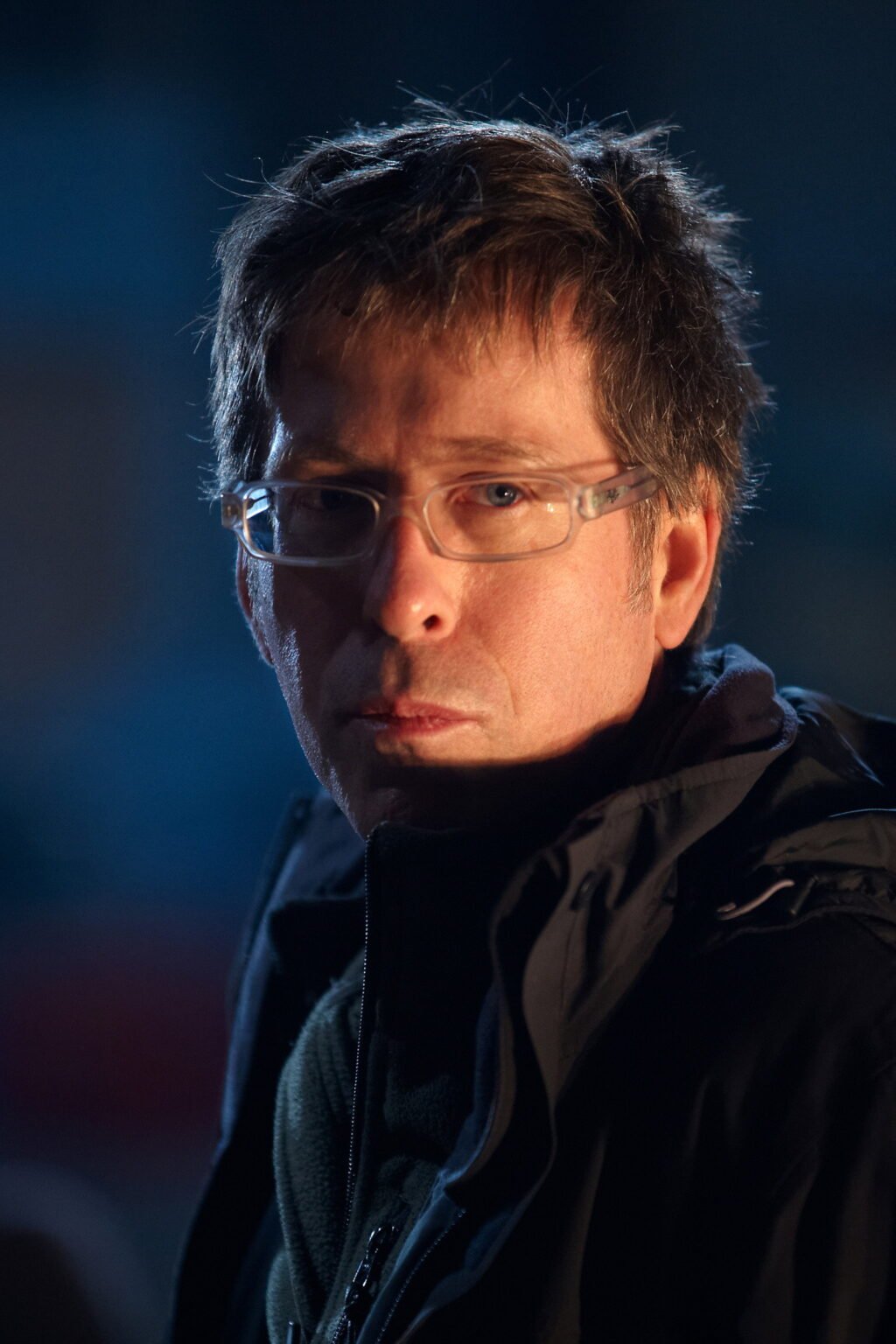
Kevin Greutert (born 1965) is the American editor of the first five Saw films and director of Saw VI, Saw 3D and Saw X.
Quick Specs
| Born | Kevin Henry Greutert, March 31, 1965, Pasadena, California |
| Pronounced | GROY-tert |
| Editor | Saw (2004), Saw II (2005), Saw III (2006), Saw IV (2007), Saw V (2008), The Strangers (2008), The Collection (2012), Jigsaw (2017), Umma (2022), Cobweb (2023) |
| Director | Saw VI (2009), Saw 3D (2010), Jessabelle (2014), Visions (2015), Jackals (2017), Saw X (2023) |
| Director and editor | Jessabelle, Visions, Jackals (co-editor) and Saw X |
| Also | executive producer of Leatherface (2017) and Spiral (2021); creative consultant on His House (2020) and Barbarian (2022) |
Who He Is
Kevin Henry Greutert was born in Pasadena, California, on March 31, 1965. The surname is spelled G-R-E-U-T-E-R-T and pronounced “GROY-tert,” and it is misspelled constantly in print. He is married to the actress Elizabeth Rowin.
He came up through the cutting room, not film school or the set. He spent years as an assistant editor before his first feature credits, and he has called those years the most valuable preparation he had for directing, because the editing room is where every part of a production comes together. His first tiny editing job was the low-budget comedy The Shot (1996). A rung further up, he was associate editor on Disney’s George of the Jungle 2 (2003), where he also voiced the character Tookie. Saw, he said later, was “the first real editing job that I got.”
The Work, and What He Did in It
Saw (2004) is the founding credit. James Wan directed Leigh Whannell’s screenplay on a shoestring budget and an even tighter schedule, and the shoot left gaps everywhere: missing coverage, missing transitions, scenes that did not join. In post-production Wan and Greutert invented the film’s hyper-kinetic style to fill them, cutting to surveillance-camera feeds, newspaper clippings and still photographs, and speeding up stills to imply movement that had never been filmed. The style was born, in Greutert’s words, “out of necessity.” He has said cheerfully that his own first cut “was a mess”; the finished style was the fix. He was 39 when the film opened, and the frantic, information-dense trap montage he co-created became the franchise’s trademark.
On Saw II (2005), Darren Lynn Bousman directed with roughly four times the first film’s budget, and editor and director deliberately kept the improvised style rather than smoothing it out, because it worked. That decision is the moment an accident became a house grammar, with Greutert as its keeper. He went on to edit Saw III (2006) and Saw IV (2007), carrying the series through its commercial peak and through John Kramer’s on-screen death, keeping the middle sequels’ nested timelines legible.
Alongside the franchise he edited Room 6 (2006), The Thirst (2006) and Journey to the End of the Night (2006), and he was title designer on House of the Dead 2 (2005). The important one is The Strangers (2008), Bryan Bertino’s home-invasion film, released when he was 43: proof that the Saw montage man could cut for slow dread and restraint just as well as for frenzy.
He returned to edit Saw V (2008) on one condition: that he would direct Saw VI (2009). The handover was the deal. Newcomer Andrew Coutts replaced him as editor on Saw VI, and Coutts also cut Saw 3D, so Greutert edited neither of the two films he directed in the original run.
Saw VI opened on October 23, 2009, when he was 44, his debut as a feature director. Patrick Melton and Marcus Dunstan wrote it, Mark Burg and Oren Koules produced, and it was David Armstrong’s last Saw film as cinematographer. It is the franchise’s most pointed film. The main game targets William Easton (Peter Outerbridge), a health-insurance executive who co-wrote the formula his company uses to deny coverage, including to John Kramer himself. Easton is forced through a chain of traps in which he must decide, physically, which of his own employees live and die, until the final choice is taken from him by Tara and Brent, the family of a man he denied, who kill him with a hydrofluoric-acid trap. Greutert also closed the series’ longest arcs, with Jill Tuck (Betsy Russell) testing Hoffman (Costas Mandylor) in a modified Reverse Bear Trap. A week before filming, Lionsgate told him the film would be converted to 3D; he objected that he had planned a 2D film, and the idea was dropped for lack of time. The film grossed about $68 million worldwide on a budget of about $11 million, the series’ commercial low at that point, beaten at Halloween by the first Paranormal Activity.
That defeat led directly to his next film. After Saw VI, Paramount hired Greutert to direct Paranormal Activity 2, set for the same Halloween as the next Saw. Twisted Pictures exercised a contractual option in his Saw contract and forced him off the Paramount film, roughly two weeks before Saw 3D (2010) was due to shoot, installing him over the previously announced David Hackl. Tod Williams directed Paranormal Activity 2. It was compulsion, not preference.
Saw 3D opened on October 29, 2010, when he was 45. It is the seventh Saw film and goes by three names, Saw 3D, Saw VII and Saw 3D: The Final Chapter, for one production. It was meant to end the series, which is where the subtitle comes from, and it did not. Greutert built it around Bobby Dagen, a self-help guru who has made a career lying about surviving Jigsaw and is put through a real game, and closed the original run’s Gordon thread, in a story condensed from two planned films into one after Saw VI’s disappointment. “I think it is the last Saw movie. But it’s absolutely my last Saw movie,” he said at the time. History proved both halves wrong. The film grossed about $136 million worldwide on a budget of about $17 million, the series’ biggest budget to that point.
The episode had a better ending than it might have. Jason Blum, the producer who lost him on Paranormal Activity 2, brought him back. Greutert said the affair “didn’t burn any bridges,” and Blum produced his next three films. The first was Jessabelle (2014), released on November 7, 2014, when he was 49, written by Robert Ben Garant and starring Sarah Snook and Mark Webber. It is a Southern Gothic ghost story: Jessie (Snook), who has lost her fiancé and the use of her legs in a car crash, returns to her childhood home on the Louisiana bayou and finds videotapes her dead mother left for her, and something in the house that wants her there. He deliberately inverted his Saw manner. The scariest scenes, he said, “rely on the tiniest sound to trigger a scare or you see a shadow move in the background.” He shot it entirely on location in an isolated plantation house and edited it himself.
Visions (2015), also for Blum, which he again directed and edited, stars Isla Fisher as Eveleigh Maddox, pregnant and off her antidepressants after a car accident, who reopens a Paso Robles vineyard with her husband David (Anson Mount) and begins to see things she believes are supernatural. Gillian Jacobs, Jim Parsons, Joanna Cassidy and Eva Longoria surround her. It is a second character-first supernatural thriller built on unreliable perception, with the visions’ true nature as the twist.
Jackals (2017), which he directed and co-edited from Jared Rivet’s script, is a siege film set in 1983. Stephen Dorff plays Jimmy Levine, a cult deprogrammer hired by the Powell family to snatch their son Justin back from a murderous cult and deprogram him at a remote cabin, until the cult surrounds the house and demands him back. Deborah Kara Unger and Johnathon Schaech co-star. It is the home-invasion cycle he once edited, turned inside out. “If you don’t get a scene the way you want it, there isn’t an opportunity to go back,” he said of its tight schedule.
The same year he went back to the cutting room for the franchise, editing Jigsaw (2017), the eighth Saw film, directed by the Spierig Brothers, at 52, and he was an executive producer on Leatherface (2017). Between the Saw films he had also edited The Collection (2012), Marcus Dunstan’s sequel to The Collector.
He stayed one of horror’s in-demand editors into the 2020s, including for filmmakers a generation younger. He was a creative consultant on His House (2020) and Zach Cregger’s Barbarian (2022), and he edited Umma (2022), Cobweb (2023) and Divinity (2023).
Spiral (2021) came close to being the first Saw film without him. A scheduling conflict meant he was not meant to be involved. “Sorry, I’m not part of this one!” he said in 2019. He was then brought on late in production to help with the editing and received an executive producer credit. He is not Spiral’s editor or director; Darren Lynn Bousman directed it.
Saw X (2023) is the return. Announced in August 2022 and released on September 29, 2023, when he was 58, it was written by Pete Goldfinger and Josh Stolberg and produced by Burg and Koules. It is set between Saw (2004) and Saw II (2005): John Kramer (Tobin Bell), given months to live, travels to Mexico for an experimental cancer cure, discovers the clinic is a scam preying on the terminally ill, and turns his apparatus on the con artists, with Amanda Young (Shawnee Smith) at his side. Greutert directed and edited it, the first Saw film he both directed and cut, and, by his own account, shot far more coverage than the early films allowed so he would have options in the edit. He re-centred the series on Kramer as protagonist, giving Bell more of the film than in any previous entry. At 118 minutes it is the longest film in the franchise. It became the best-reviewed film in the franchise, the first and only Saw entry to be Certified Fresh on Rotten Tomatoes, at around 80%, after nine films that had all scored Rotten there. It was made on a budget of about $13 million, with worldwide grosses counted at between about $112 million and $125 million. It was the tenth Saw film, and his tenth Saw credit.
He was confirmed in February 2024 to direct a follow-up from a Dunstan and Melton script that picked up, in producer Oren Koules’s phrase, “about 30 seconds after Saw X.” It never got made. Melton said the project had made “zero progress,” held up by “inter-squabbling between producers and Lionsgate,” and Koules said he and Burg “couldn’t agree on the execution.” The film came off the schedule, and Twisted Pictures’ stake in the franchise was sold to Blumhouse, with James Wan and Leigh Whannell returning to guide the series. There is no Greutert Saw XI.
Cool Verified Facts
- The Saw editing style was improvised to cover missing footage, then kept on purpose when the money arrived.
- He edited neither of the two Saw films he directed in the original run; Andrew Coutts cut both.
- Saw 3D, Saw VII and Saw 3D: The Final Chapter are one film, and it was not the final chapter.
- He was forced off Paranormal Activity 2 by his Saw contract, and the producer he lost, Jason Blum, hired him four years later.
- His only Spiral credit is executive producer, after a late editing assist.
- Saw X is the longest film in the franchise, at 118 minutes, and its best reviewed, the only Certified Fresh Saw film on Rotten Tomatoes.
- Saw X was his tenth Saw film, made nineteen years after he cut the first.
Signatures, Habits and Behind the Scenes
The style was an accident he chose to keep. On Saw, the cutting to feeds, stills and sped-up photographs papered over coverage the budget never shot; on Saw II, with four times the money, he and Bousman kept it, and it became the brand. His stated rule is pace: the films are edited “as aggressively as possible,” on a commitment “to never be boring,” with new information arriving moment to moment.
He edits what he directs, after the two films where he could not. From Jessabelle onward he cuts his own films, working alone on a first cut and then screening it for as many viewers as he can gather, inside and outside the production, and revising from what they tell him. Saw X is the synthesis: the franchise’s founding editor finally directing and cutting the same Saw film, and making its best-reviewed entry.
The Paranormal Activity 2 affair is the industry story, and his conduct is the lesson in it. Forced off a rival franchise’s sequel by a contract clause, displacing a colleague who had worked on the series since the start, with two weeks to prepare, he later described the episode without rancour. Blum’s arc closes the circle twice: the producer who lost him in 2010 hired him in 2014, and the company that acquired Saw in 2025 is Blum’s.
Why He Matters
Kevin Greutert is the Saw franchise’s connective tissue, the one filmmaker who has shaped it from nearly every chair. He edited the first five films and Jigsaw, directed VI, 3D and X, and was an executive producer on Spiral. Wan created Saw and Whannell wrote it, but no one else matches his span across ten films and two decades: the man who co-invented its editing grammar in a cutting room in 2004 directed and edited its critical high point in 2023.
Saw X is a real late-career vindication: a 58-year-old editor turned director, back thirteen years after being forced to make the series’ supposed final chapter, delivering its first well-reviewed entry and a worldwide gross past $100 million. And his second career makes the case for the first. The restraint of The Strangers, the quiet of Jessabelle, the consulting on Barbarian and the edit of Cobweb show the same hands at work in every register of modern horror. The industry kept hiring him between Saw films because he was never only the franchise’s man.