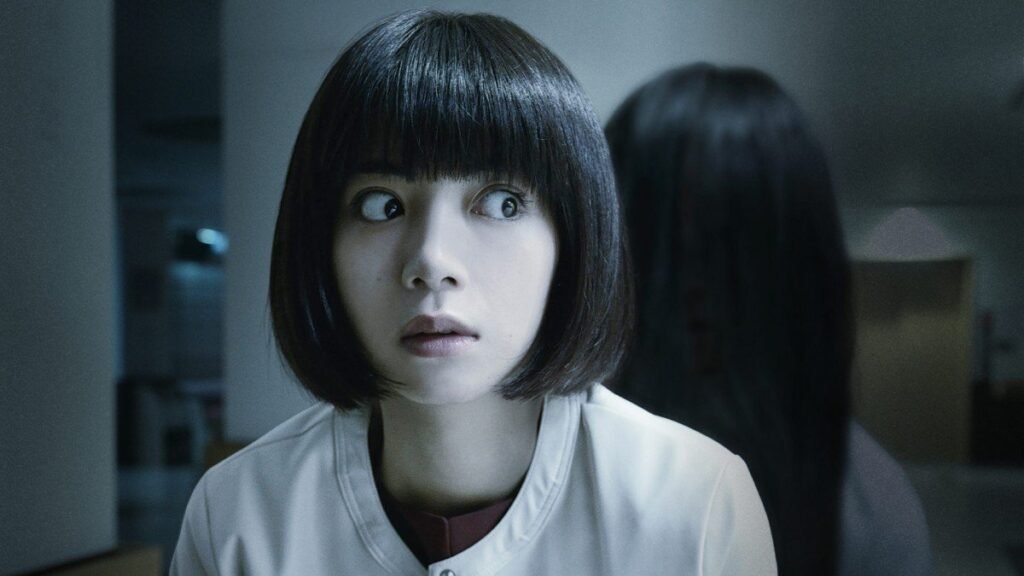
Sadako Yamamura is the vengeful ghost at the heart of Koji Suzuki’s Ring novels and the Japanese Ring films, the long-haired figure in a white dress who crawls out of a television seven days after you watch her cursed videotape. Hideo Nakata’s 1998 film Ring (released in North America as Ringu) made her a global horror icon and helped start the J-horror wave. Her American counterpart, Samara Morgan, carried the story to a new audience in The Ring (2002) and is covered on this page too.
At a glance
| Franchise | Ring (novels and Japanese films); American Ring series (as Samara Morgan) |
| First appearance | Novel Ring (1991); film Ring (Ringu, 1998). Samara Morgan: The Ring (2002) |
| Creator | Koji Suzuki (novels). The 1998 film was directed by Hideo Nakata from a screenplay by Hiroshi Takahashi. Samara was adapted by screenwriter Ehren Kruger and director Gore Verbinski. |
| Portrayed by | Rie InÅ (Ring, 1998; Ring 2, 1999) Yukie Nakama (Ring 0: Birthday, 2000) Elly Nanami (Sadako vs. Kayako, 2016) Bae Doona (as Park Eun-suh, The Ring Virus, 1999, South Korea) Daveigh Chase (Samara, The Ring, 2002) Kelly Stables (Samara, The Ring Two, 2005) Bonnie Morgan (Samara, Rings, 2017) |
| Method | A cursed videotape: anyone who watches it dies seven days later unless they copy the tape and show it to someone else. In the novels the curse is a virus; Samara also burns images into minds and objects. |
Origin story and backstory
Every version agrees on the core: Sadako was a young psychic who was murdered and thrown into a well, and her rage became a curse. The details depend on which version you read or watch.
The novels: In Suzuki’s 1991 novel, journalist Kazuyuki Asakawa investigates the simultaneous deaths of his niece and three other teenagers, finds the tape at a resort in Izu and traces it to Sadako, the daughter of the psychic Shizuko Yamamura. Sadako could project images onto film and electronic media, a power known in Japanese as nensha (thoughtography). She was assaulted and thrown into a well at a sanatorium, and her power fused with a disease to create the curse. The sequels Spiral and Loop take the story into science fiction, recasting the curse as a “ring virus.”
The 1998 film: Nakata’s Ring makes the reporter a woman, Reiko Asakawa (Nanako Matsushima), and trims the backstory. Sadako is implied to have an inhuman father, and it is Dr. Ikuma who throws her into the well. Her face is never shown clearly apart from one terrible eye.
Samara Morgan: the American version
Gore Verbinski’s The Ring (2002) moves the story to the Pacific Northwest. Journalist Rachel Keller (Naomi Watts) traces the tape to Samara, a girl adopted by horse breeders Richard and Anna Morgan on Moesko Island, Washington. Samara’s powers tormented her adoptive mother, who eventually attacked her and dropped her into a well, where she survived for seven days. The Ring Two (2005) and Rings (2017) expand her history further. Unlike Sadako, Samara’s face is shown clearly, and her victims are found with disfigured faces.
Iconic moments
- The tape (1998): A string of disjointed, grainy images ending with a well. The phone rings right after. It is a simple setup that still unnerves.
- Out of the screen (1998): Sadako climbs out of the well on a television, then out of the television itself and into the room. British critic Mark Kermode named it one of his scariest film moments, and it placed sixth in Channel 4’s 100 Greatest Scary Moments.
- The eye (1998): The film saves Sadako’s face for a single close-up of one staring eye.
- “Seven days” (2002): In The Ring, Rachel picks up the phone after watching the tape and hears a whisper telling her how long she has left.
- The ferry (2002): On Rachel’s crossing to Moesko Island, a horse aboard the ferry panics and leaps overboard, one of the remake’s most unsettling set pieces.
- The twist (1998 and 2002): Both films let their heroes believe they have broken the curse before revealing the real rule: you survive only by passing the tape on.
Appearances
Japanese films in release order
- Ring: Kanzenban (1995, TV film)
- Ring (1998), released alongside Spiral (1998), a sequel later sidelined
- Ring 2 (1999)
- Ring 0: Birthday (2000), a prequel with Sadako as the main character
- Sadako 3D (2012) and Sadako 3D 2 (2013), which follow on from Spiral
- Sadako vs. Kayako (2016), a crossover with Ju-On
- Sadako (2019)
- Sadako DX (2022)
Novels, remakes and TV
Novels: Ring (1991), Spiral (1995), Loop (1998) and later books including S. Remakes: South Korea’s The Ring Virus (1999) and the American films The Ring (2002), The Ring Two (2005, directed by Hideo Nakata) and Rings (2017). TV: the Japanese series Ring: The Final Chapter retells the story with many changes. Sadako has also been a playable character in the game Dead by Daylight since March 2022.
Trivia and behind-the-scenes facts
- Sadako’s famous unnatural walk came from a simple trick. Rie InÅ, a trained kabuki performer, was filmed walking backward in jerky, exaggerated movements, and the footage was played in reverse.
- The long hair in Ring was InÅ’s own; she wore no wig or extensions.
- Nakata and Takahashi watched the 1995 TV adaptation while preparing their script. The 1998 film and Spiral were shot back to back and opened together in Japan on January 31, 1998.
- Sadako draws on two famous ghosts of Japanese folklore: Okiku, the servant thrown down a well, and Oiwa, with her single misshapen eye.
- Suzuki’s character was partly inspired by real early-20th-century psychics studied by Tomokichi Fukurai, including Sadako Takahashi, who claimed to practice thoughtography.
- On August 10, 2002, Sadako was given a mock public funeral at the Laforet Museum in Harajuku, Tokyo, to promote a Ring exhibit and the release of The Ring. Koji Suzuki attended.
- The Ring opened modestly in October 2002 but became a sleeper hit, grossing about $129 million in the U.S. and $249 million worldwide, and its success led Hollywood to remake other Asian horror films such as The Grudge and Dark Water.
- Daveigh Chase won the MTV Movie Award for Best Villain in 2003 for playing Samara.