The Shining (1980) Review — Kubrick’s Overlook
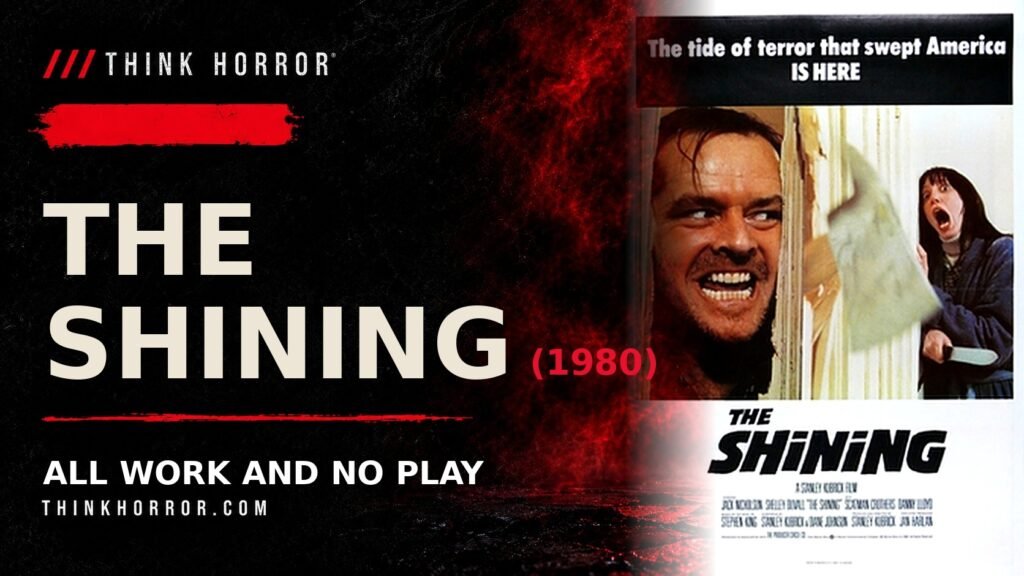
The Shining (1980) — Harper's review.
The Overlook Hotel is hiring a winter caretaker, and the job sounds like a dream: five months of snowed-in silence, an empty palace of a hotel, all the time in the world to finally write that novel. There’s just one thing the manager mentions on the tour, almost as an afterthought. The last caretaker chopped up his wife and daughters in these halls. You’d take the job anyway. That’s the trap Stanley Kubrick sets in The Shining — and forty-six years later, nobody has built a better one.
Good evening, fiends. Harper Nevar here, and tonight we check into the most famous haunted hotel in horror. Our full wiki entry on The Shining keeps the film’s complete record; this is the review — why the Overlook still gets under your skin like no other address in the genre.
Watch the Trailer
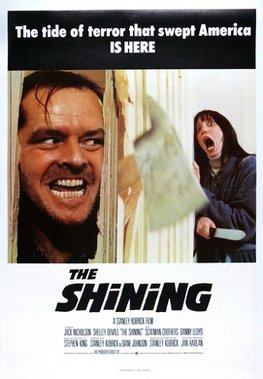
Quick Specs
Director: Stanley Kubrick
Screenplay: Stanley Kubrick and Diane Johnson, from the novel by Stephen King
Starring: Jack Nicholson, Shelley Duvall, Danny Lloyd, Scatman Crothers
Release Date: May 23, 1980 (United States)
Runtime: 144 minutes (US theatrical cut)
Rating: R
Budget: $19 million
Box Office: A reported $44 million worldwide in its original release
Harper’s Verdict: 5 skulls — Buried with honors
The Review
The setup is the oldest one we’ve got. Jack Torrance — recovering alcoholic, blocked writer, a man already held together with tape — takes the winter caretaker job at the Overlook Hotel and brings his wife Wendy and young son Danny along for the season. Danny has a gift that chef Dick Hallorann calls “shining” — and the hotel, Hallorann warns, shines too. Then the snow closes the road, the radio dies, and the Overlook starts its long, patient work on Jack.
Kubrick strips Stephen King’s machinery down to the studs. Most American fans know the 144-minute US cut; Kubrick trimmed about 25 minutes for Europe, and that leaner international cut is finally coming home alongside it. What’s left is less a ghost story than a pressure cooker — one that scares you not with what jumps out, but with how completely it convinces you this hotel, this winter and this man were always going to end the same way.
What Works
The camera, first and always. The Steadicam work glides an 18mm lens inches from the walls. Danny’s tricycle runs — roaring across hardwood, falling silent on carpet — turn the hotel’s corridors into a bloodstream, and the maze sequences stalk their prey at walking pace, which is worse than running. The Overlook is the film’s true lead character, and the camera is how it looks at you.
Nicholson. His Jack teeters from the very first interview, all teeth and eyebrows, and Kubrick simply removes everything that was holding him up. King objected that the performance leaves Jack no distance to fall — as adaptation notes go, fair enough — but as horror, Nicholson is the engine: charming, funny, and curdling by degrees into the thing Wendy has clearly been afraid of for years.
Which brings us to Shelley Duvall, the film’s nerve endings. Every ounce of terror the audience feels is registered on her face first, and time has ruled entirely in her favor: the worst-actress nomination she was once handed has since been taken back (more on that in the trivia, fiends). Her Wendy isn’t a screamer pasted into the frame — she’s a woman doing math in a burning building, and she never stops trying to save her son.
And the sound. The score is built from modernist music — Ligeti, Bartók, Penderecki — under a synthesized Dies Irae that tolls over the opening drive like a funeral bell for a family that hasn’t died yet. Nothing in this film jumps out of the dark. It accumulates, corridor by corridor, until a river of blood pouring out of an elevator feels less like a shock than a confession.
What Doesn’t
King’s grievances, stated as his — and he has them — land in one place: as an adaptation, this is a hostile takeover. The novel’s Jack is a decent man losing a war with himself, and that tragedy is gone here; the novel’s capable Wendy is diminished into someone King described as “basically just there to scream and be stupid, and that’s not the woman that I wrote about.” He’s right about what was traded away. The film decided the trade was worth it, and it was — but readers who come looking for King’s book will find the furniture rearranged and the heart relocated.
The pacing is the other honest toll. The Shining is deliberately, almost defiantly slow — 1980 critics punished it for exactly that — and first-timers raised on jump scares may find the first hour glacial. It pays compound interest, but you do pay it. And Hallorann’s long journey home ends so abruptly that the film’s one great warmth is spent in a single swing; it’s the one cut where Kubrick’s coldness feels like carelessness.
The strangest part of this film’s record is that none of that mattered. It opened to mixed reviews and two nominations at the very first Razzie Awards, and then it outlasted everyone. Audiences rate it 93% on Rotten Tomatoes against the critics’ 84% — a split that tells the whole story — and in 2018 the Library of Congress preserved it in the National Film Registry. King, who has never made peace with it, called it “a big, beautiful Cadillac with no engine inside it.” Fiends, he can keep the engine. The Cadillac is parked in the National Film Registry.
Full disclosure, fiends: this is a desk verdict — built from the verified record of the film’s production, its divided first reception, and its long climb since, not a fresh screening with the lights off. Some records whisper; this one shouts, in every decade, and it all points the same way.
💀💀💀💀💀 5 skulls — Buried with honors.
Trivia & Facts
- The film was among the first half-dozen to use the Steadicam, after Bound for Glory, Marathon Man and Rocky (all 1976). Inventor Garrett Brown operated it personally and developed his two-handed technique on the shoot; a precision speedometer on the tricycle rig let takes repeat at identical tempo.
- “Heeeere’s Johnny!” was improvised by Jack Nicholson, borrowed from Ed McMahon’s introduction of Johnny Carson on The Tonight Show. Kubrick, long based in England, didn’t know the reference and nearly used another take.
- The bathroom door Jack axes through was a real door — Nicholson, who had worked as a volunteer firefighter, tore through the lightweight prop door far too quickly.
- Danny Lloyd was protected throughout the shoot and believed he was filming a drama, not a horror movie.
- Kubrick shot the “All work and no play” typewriter pages in several languages, each version substituting a local idiom, for the film’s international releases.
- At the first-ever Razzie Awards in 1981, the film was nominated for Worst Director (Kubrick) and Worst Actress (Duvall). In March 2022 the organization rescinded Duvall’s nomination, stating it had “since discovered that Duvall’s performance was impacted by Stanley Kubrick’s treatment of her throughout the production.” Kubrick’s nomination was not rescinded.
- The first audiences saw two extra minutes — a hospital epilogue where Ullman tells Wendy Jack’s body was never found — before Kubrick cut it a week into the run and projectionists physically snipped it from release prints.
- Kubrick’s daughter Vivian, then 17, shot the behind-the-scenes documentary Making The Shining during the production.
- Guinness World Records has credited two different scenes with the all-time retake record — the staircase baseball-bat scene at 127 takes, updated in 2020 to the Danny-and-Hallorann “shining” talk at 148 — a record Kubrick scholar Lee Unkrich flatly disputes. Perfectionism, at least, is not in dispute.
- It opened on just 10 screens the same weekend as The Empire Strikes Back and posted what was then the third-highest per-screen average in history. Outtakes from its opening aerial shoot later turned up at the end of the original cut of Blade Runner.
Harper’s Extras
Pair it with Doctor Sleep (2019), where Mike Flanagan built a bridge between King’s novel and Kubrick’s film — King himself said that “everything that I ever disliked about the Kubrick version of The Shining is redeemed for me here.” Booking a marathon instead? Our Halloween Watch Guide will slot the Overlook into your October. And for a masterclass in the other great stalking camera of the era, compare Kubrick’s glide with Carpenter’s in our Halloween (1978) review. Then read King’s novel — a different, sadder machine; the rare case where book and film can both be the best version.
Where to Watch
As of this writing (checked October 30, 2026), The Shining is streaming on HBO Max and AMC+, or to rent or buy on Amazon Video, Apple TV and Fandango At Home. Lineups shuffle like hotel guests, so confirm before you check in.
Frequently Asked Questions
Is The Shining based on a true story?
No. It’s adapted from Stephen King’s 1977 novel, which King wrote after a stay at the Stanley Hotel in Estes Park, Colorado. The film itself was shot in England: interiors are Elstree sets modeled on Yosemite’s Ahwahnee Hotel, exteriors are Oregon’s Timberline Lodge.
Why does Stephen King dislike the film?
In King’s own telling: Jack Torrance has “no arc” on screen, Nicholson’s casting gives the madness away from the start, Wendy is diminished from the woman he wrote, and the hotel’s evil is turned inward. In 1997 he produced a faithful three-part miniseries version of his own to prove the point.
Which cut should I watch?
The 144-minute US theatrical cut is the fullest version and the one canonized over the decades. The 119-minute international cut is leaner and drops most of the material set outside the hotel; the new Criterion set puts both in 4K side by side for the first time, so you can finally compare them properly.
What does “redrum” mean?
It’s Danny’s warning, and Wendy only understands it when she sees it reversed in the bathroom mirror: MURDER, written backwards. It’s the film’s whole method in one word — the horror was spelled out in front of everyone the entire time.
Is there a sequel?
Yes — Doctor Sleep (2019), directed by Mike Flanagan from King’s 2013 novel. It follows the adult Danny Torrance and, against all odds, answers to both the novel and Kubrick’s film. Our wiki entry linked above gives it the full treatment.
All work and no play makes Harper a dull host, so I’ll leave you in the Gold Room — the drinks are on the house, and they’ve been expecting you. Until next time, fiends…
— Harper Nevar