The Exorcist (1973) Review
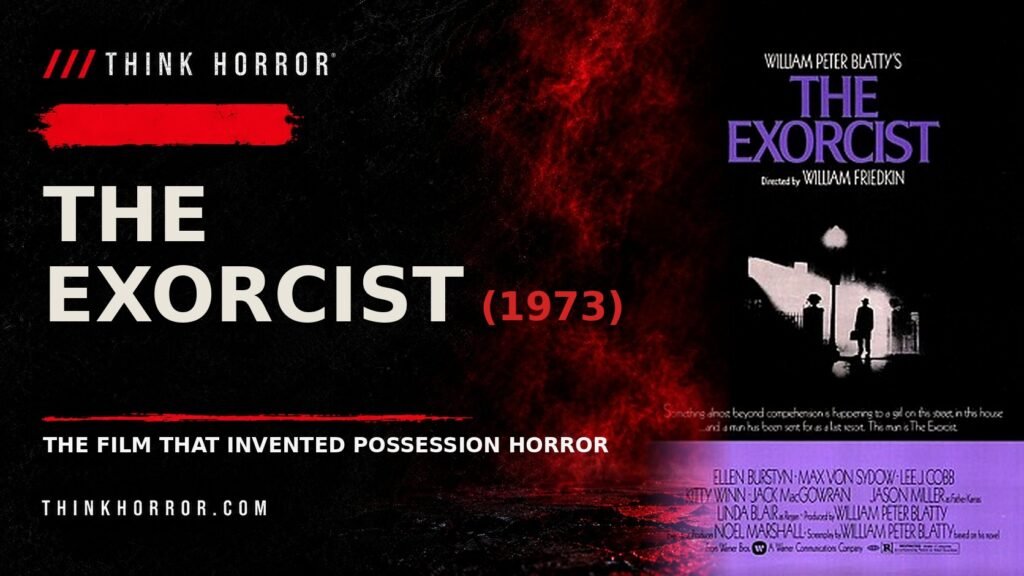
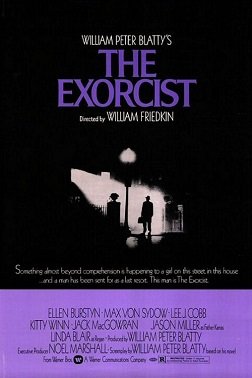
Featured card built on the official theatrical poster art by Bill Gold.
The Exorcist is the most decorated horror film ever made: the possession masterpiece that terrified 1973 and went to the Oscars.
You’re in the upstairs hall of a quiet Georgetown house, and the sound coming through the bedroom door is wrong — a voice arguing with itself in a language a 12-year-old girl never learned, in registers no child’s throat should reach. Downstairs, her mother has already heard everything modern medicine has to offer. Medicine is out of answers. So the Church sends for the one man who has done this before — an old priest with a suitcase, who knows exactly what it costs.
Welcome back to the crypt, fiends. Tonight we open the file on the heavyweight — the film that put horror on the Academy’s ballot, emptied theater lobbies into the street, and set the mark every possession movie since is measured against. The Exorcist. Handle with holy water.
Watch the Trailer
Quick Specs
- Director: William Friedkin
- Writer: William Peter Blatty (screenplay; based on his 1971 novel)
- Producer: William Peter Blatty
- Cast: Ellen Burstyn, Max von Sydow, Jason Miller, Linda Blair, Lee J. Cobb
- Studio: Hoya Productions
- Distributor: Warner Bros.
- Release Date: December 26, 1973
- Runtime: 122 minutes
- Rating: R
- Budget: $12 million
- Box Office: $430.9 million (lifetime, worldwide)
- Harper’s Verdict: 4.5 skulls — one razor blade short of perfection
The Review
William Peter Blatty took a real 1949 exorcism case — a Maryland boy, Jesuit priests, a family that had run out of explanations — and turned it into a 1971 bestseller. Two years later he adapted his own novel, produced it himself, and handed it to William Friedkin, fresh off an Oscar for The French Connection. The shoot became legend before the film did: scheduled for 85 days, it ground past 200; a fire gutted the house sets — all but Regan’s room, because of course — and the budget climbed to $12 million. Warner Bros. opened it the day after Christmas to lines around the block in the freezing cold.
Chris MacNeil (Ellen Burstyn) is shooting a film in Georgetown when her daughter Regan (Linda Blair), fresh off a spirit-board friendship with “Captain Howdy”, starts to change — violent outbursts, impossible strength, a voice that isn’t hers. The film spends its long middle where a lesser horror movie wouldn’t dare: in hospitals. Tests, specialists, an angiography sequence so clinically real that audiences fainted during the medicine, not the devilry. When the doctors run dry, they suggest the Church. Enter Father Damien Karras (Jason Miller), a Jesuit psychiatrist whose faith is already bleeding out after his mother’s death — and, once Karras proves the case, Father Lankester Merrin (Max von Sydow), the veteran exorcist the demon has been waiting for.
What Works
- The slow burn is the special effect. Friedkin shoots Georgetown like a documentary — real locations, flat daylight, ordinary life — so when the impossible arrives, it lands on solid ground. The horror isn’t the levitation; it’s watching every rational door close, one by one, until only the oldest door is left.
- The cast plays it dead straight. Burstyn’s unraveling is a masterclass in maternal panic. Blair carries work no child should have been asked for (see Trivia, and wince). Playwright Jason Miller — no movie star — makes Karras’s guilt and doubt the film’s real battlefield. And von Sydow, in his mid-40s under Dick Smith’s makeup, aged some thirty years, gives Merrin the stillness of a man who has seen how this ends.
- The sound does the haunting. It won the Academy Award for Best Sound, and you can hear why in a dark room. The demon’s voice bed is bees, dogs, hamsters and pigs, under Mercedes McCambridge’s ruined, magnificent rasp — she voiced Pazuzu; see Trivia. The score mostly isn’t there at all: the film trusts silence and one haunted theme, Mike Oldfield’s “Tubular Bells”, until your nerves do the orchestrating.
- It means it. Under the effects, this is a drama about faith and guilt that happens to contain the devil. Karras’s crisis — a priest who cannot forgive himself — is the engine; the exorcism is where it burns hottest. That’s why it outclasses its imitators: they copy the pea soup and skip the soul.
What Doesn’t
- The medicine is slow on purpose — but it is slow. The middle act’s hospital procedural runs long, and viewers raised on faster possession films may check a watch before the Church finally gets the call. It pays off. It still runs long.
- The detective thread sags. Lee J. Cobb’s Kinderman is played beautifully and goes almost nowhere — Blatty’s novel had room for the investigation; the film keeps the character and thins his purpose to a device for one late, crucial introduction.
- A few seams show. The head-turning dummy never quite leaves the uncanny valley it invented. In 1973 it was a miracle. In 2026 it plays, for one beat, as craft instead of curse.
The ledger: a Metacritic score of 83 — universal acclaim, not one negative review in the count — an 87% Rotten Tomatoes audience score that has survived fifty years of horror fans trying to knock it down, four Golden Globes including Best Motion Picture – Drama, the National Film Registry, and ten Academy Award nominations with two wins — the first horror film ever nominated for Best Picture. Rotten Tomatoes’ critics stand at 78% — the contemporary reviews were genuinely divided, and we’d rather print the real number than a rounded-up legend.
Full disclosure, fiends, because Harper keeps an honest crypt: this is a desk verdict — built from the verified record, the box-office ledger, the awards shelf and the critical consensus, not a fresh team screening. Nobody on the Think Horror crew re-screened the film for this review, and we won’t pretend otherwise. The record on this one is simply too big to argue with.
Harper’s verdict: 4.5 skulls — one razor blade short of perfection.
Trivia & Facts
- The curse question, answered by the author. The documented ledger: Burstyn says the harness take used in the film fractured her coccyx, troubling her back for life; Blair fractured her lower spine on the thrashing bed and developed scoliosis; two crew members lost digits to accidents; and Jack MacGowran and Vasiliki Maliaros both died before the film opened. A curse? Blatty’s own verdict: “There is no Exorcist curse. I am The Exorcist curse!” He also noted the arithmetic — shoot something for a year, and people are going to get hurt. We print the incidents. We decline the curse.
- That voice. Oscar winner Mercedes McCambridge voiced the demon, tearing her voice down with — by her own account — raw eggs, cigarettes and whiskey, then was left off the credits until the Screen Actors Guild arbitrated her back on. A great vocal performance, nearly anonymous.
- The vomit was porridge. Dyed to look like pea soup and pumped through a hidden tube, it was rehearsed to hit Jason Miller in the chest. It hit him in the face. That disgusted, betrayed expression is not acting.
- The spider walk was real. Regan scuttling down the stairs upside-down was shot, cut before the premiere, and argued over for decades as fan legend — until critic Mark Kermode found the footage in the Warner archives in the 1990s. Restored for the 2000 extended cut, performed by stuntwoman Ann Miles, uncredited for decades.
- Britain kept it off the shelf. Passed for UK cinemas, the film was withdrawn from home video in 1988 after the censors’ chief vetoed a video certificate — and stayed legally unavailable on UK video until it was passed uncut in 1999.
- The plumber had a standing appointment. Toronto’s University Theatre ran four sold-out shows a day, and its manager reported: “We have a plumber practically living here now.” Some theaters kept ambulances on call. And the scene audiences fainted at most? The angiography — a needle, a neck, and medicine at its most real.
- The steps are still there. The Georgetown staircase where Karras falls is real, and a tourist pilgrimage. In 2015 the city installed a plaque, unveiled the day before Halloween with Blatty and Friedkin in attendance — author and director, back at the top of the stairs.
Harper’s Extras
- The Exorcist (1973) — the full wiki file: cast, credits and the complete production history, in the depth a crown jewel deserves.
- The Exorcist III (1990) — the wiki file: when the sequel machine disappointed him, Blatty adapted his own novel Legion and directed this one himself. The faithful call it the true sequel.
- Halloween (1978) — Harper’s review: the other untouchable. Five years later, a man in a painted mask did with a knife and a babysitter what Merrin needed a ritual and a lifetime for.
- Crank it: Mike Oldfield’s “Tubular Bells” was an obscure album track until Friedkin pulled the record out of the studio’s music library looking for something with “a kind of childhood feel”. It became the sound of dread for a generation — and made Oldfield’s career.
Where to Watch
As of October 30, 2026, it’s streaming on HBO Max and Philo, plus AMC via TV Everywhere; rent it on Amazon or Fandango At Home, or buy it on Amazon, Apple TV or Fandango At Home — and the full seasonal board lives in our Halloween Watch Guide. Possession ages well; streaming rights don’t.
Frequently Asked Questions
Is The Exorcist based on a true story?
Inspired by one. Blatty built the novel on the documented 1949 exorcism of a Maryland boy by Jesuit priests — a case he first heard of as a Georgetown student. Names, characters and the Georgetown setting are his invention. The seed is real.
Was The Exorcist really the first horror film nominated for Best Picture?
Yes — one of ten Academy Award nominations in 1974, and it took home two Oscars: Blatty’s adapted screenplay, and Best Sound. No horror film had been nominated for the top prize before it.
Who actually voiced the demon?
Mercedes McCambridge — an Oscar-winning actress whose voice is the sound strangling out of Regan in the confrontation scenes. Eileen Dietz provided the demon’s face under the makeup; McCambridge provided the voice, and the Screen Actors Guild got her the credit.
Should I watch the theatrical cut or “The Version You’ve Never Seen”?
Start with the 1973 theatrical cut — 122 minutes, the version that changed everything. The 2000 extended version adds about eleven minutes, including the spider walk; it’s a fascinating supplement, not a replacement. Harper’s call: original first, extended cut as dessert.
What about the sequels?
A mixed bag with one jewel. Skip the notorious Exorcist II: The Heretic unless morbid curiosity calls, and go straight to Blatty’s The Exorcist III (1990), the sequel the faithful defend. The Exorcist: Believer attempted a fresh trilogy launch in 2023.
Until next time, fiends — keep the lights low, keep the pea soup in the kitchen, and if the bed starts shaking, you know who to call. Harper will leave the stair light on for you.
— Harper Nevar