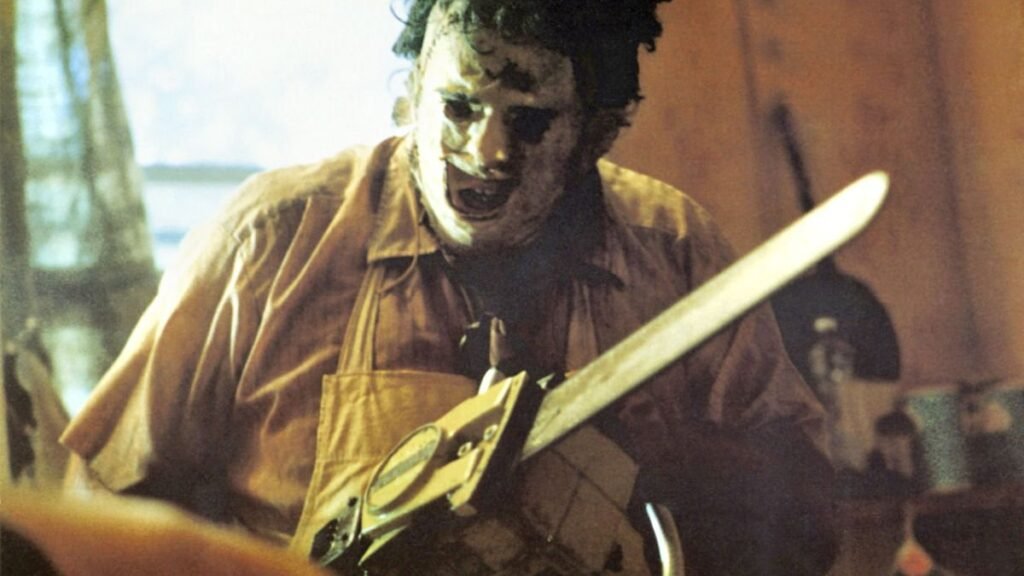
Leatherface is the hulking, chainsaw-wielding killer of The Texas Chain Saw Massacre (1974). He wears masks made from human skin and lives with a family of rural Texas cannibals. Created by director Tobe Hooper and co-writer Kim Henkel, and first played by Gunnar Hansen, he barely speaks, kills out of fear and on his family’s orders, and helped set the template for the silent, masked slasher that Michael Myers and Jason Voorhees would follow. He is the only character to appear in all nine films in the franchise.
At a glance
| Franchise | The Texas Chain Saw Massacre |
| First appearance | The Texas Chain Saw Massacre (1974) |
| Creators | Tobe Hooper and Kim Henkel |
| Portrayed by | Gunnar Hansen (The Texas Chain Saw Massacre, 1974) Bill Johnson (The Texas Chainsaw Massacre 2, 1986) R. A. Mihailoff (Leatherface: The Texas Chainsaw Massacre III, 1990) Robert Jacks (Texas Chainsaw Massacre: The Next Generation, 1995) Andrew Bryniarski (The Texas Chainsaw Massacre, 2003; The Beginning, 2006) Dan Yeager (Texas Chainsaw 3D, 2013) Sam Strike (Leatherface, 2017) Mark Burnham (Texas Chainsaw Massacre, 2022) |
| Weapon of choice | A chainsaw above all, plus a sledgehammer and meat hooks; masks made from his victims’ faces |
Origin story and backstory
In the 1974 original, Sally Hardesty, her brother Franklin and three friends drive into rural Texas to check on her grandfather’s grave after reports of grave robbing. After they pick up a disturbing hitchhiker, the group stops near an old farmhouse. One by one, they run into Leatherface and the family he lives with: the Hitchhiker, the Old Man (the family’s cook) and the nearly dead Grandpa. The film never explains much. Leatherface is mentally disabled, can’t speak in words, and wears different masks to play different roles in the household. He kills not out of hate but out of panic and obedience.
Hooper said the idea came from his disgust at the casual violence he saw on the news in the late 1960s and early 1970s, and his sense that “man was the real monster.” The skin masks trace back to Wisconsin murderer Ed Gein. Hooper grew up hearing stories about the crimes from relatives, though he said he didn’t know they were about Gein until after the film came out. He also cited a college Halloween party where a medical student showed up wearing a cadaver’s face. The chainsaw came to him while he was stuck in a crowded hardware store, imagining a faster way through.
One killer, many names and timelines
The franchise has rebooted Leatherface more often than almost any other slasher, and even his real name changes with the timeline. The Texas Chainsaw Massacre 2 (1986) continues the original and calls him “Bubba” Sawyer. The third and fourth films treat the family loosely, with different relatives each time. Platinum Dunes’ 2003 remake and its 2006 prequel start over, renaming him Thomas Hewitt and giving him a skin disease and a backstory. Texas Chainsaw 3D (2013) ignores every sequel, follows on directly from 1974, and names him Jedidiah “Jed” Sawyer. The prequel Leatherface (2017) shows Jedidiah’s youth in a mental hospital. Netflix’s Texas Chainsaw Massacre (2022) is another direct sequel to the 1974 film, bringing back an elderly Leatherface and an older Sally Hardesty. Only the 1974 film is common to every continuity.
Iconic moments
- The steel door (1974): Kirk wanders into the farmhouse, Leatherface appears without warning, and a sliding steel door slams shut. The suddenness, not the gore, is what audiences remember.
- The chase (1974): Leatherface pursues Sally through the dark woods with his chainsaw roaring, in one of horror’s longest, most exhausting chase sequences.
- The dinner (1974): The family ties Sally to a chair at their dinner table while Leatherface, in a made-up “dinner” mask, serves. It’s the film’s most nightmarish scene, and almost nothing violent happens on screen.
- The chainsaw dance (1974): As Sally escapes in the back of a pickup, Leatherface swings his chainsaw in the road at sunrise. Hansen said the moment was partly improvised.
- The radio station (1986): In Hooper’s darkly comic sequel, Leatherface corners DJ “Stretch” Brock and, instead of killing her, is clearly smitten.
- The remake (2003): R. Lee Ermey’s sadistic sheriff and a grimy new Leatherface brought the franchise back to the box office.
Appearances
Films in release order
- The Texas Chain Saw Massacre (1974), directed by Tobe Hooper
- The Texas Chainsaw Massacre 2 (1986), directed by Hooper
- Leatherface: The Texas Chainsaw Massacre III (1990)
- Texas Chainsaw Massacre: The Next Generation (1995; wide release 1997), written and directed by Kim Henkel
- The Texas Chainsaw Massacre (2003), remake
- The Texas Chainsaw Massacre: The Beginning (2006), prequel to the remake
- Texas Chainsaw 3D (2013)
- Leatherface (2017), prequel
- Texas Chainsaw Massacre (2022), Netflix
Games and what’s next
Leatherface is a playable killer in Dead by Daylight (added in 2017) and appears in Gun Media’s asymmetrical game The Texas Chain Saw Massacre (2023). In February 2026, A24 confirmed it had won the franchise’s film and TV rights after a bidding war. It is developing a series directed by JT Mollner, with Glen Powell among the producers, and a separate reimagined film that Obsession director Curry Barker will write and direct. Neither has a release date.
Trivia and behind-the-scenes facts
- The original was made for less than $140,000 and was marketed as a true story. In fact, only Leatherface and a few details were inspired by Gein; the plot is fiction.
- Hooper hoped for a PG rating by keeping on-screen gore low. The film got an R, but is far less bloody than its reputation.
- Hansen worked up to 16-hour days, seven days a week, in the Texas summer heat. He was kept apart from the other actors so their fear would be real.
- The mask’s small eyeholes made it hard for Hansen to see, and he accidentally gave actor William Vail a black eye while filming Kirk’s death.
- Hooper and Henkel cited the cartoon character Baby Huey, a huge, childlike duckling, as a model for Leatherface’s behavior.
- Britain’s film board refused to certify the film for decades. It was finally passed uncut in 1999.
- The film is in the permanent collection of New York’s Museum of Modern Art and was added to the U.S. National Film Registry in 2024.