
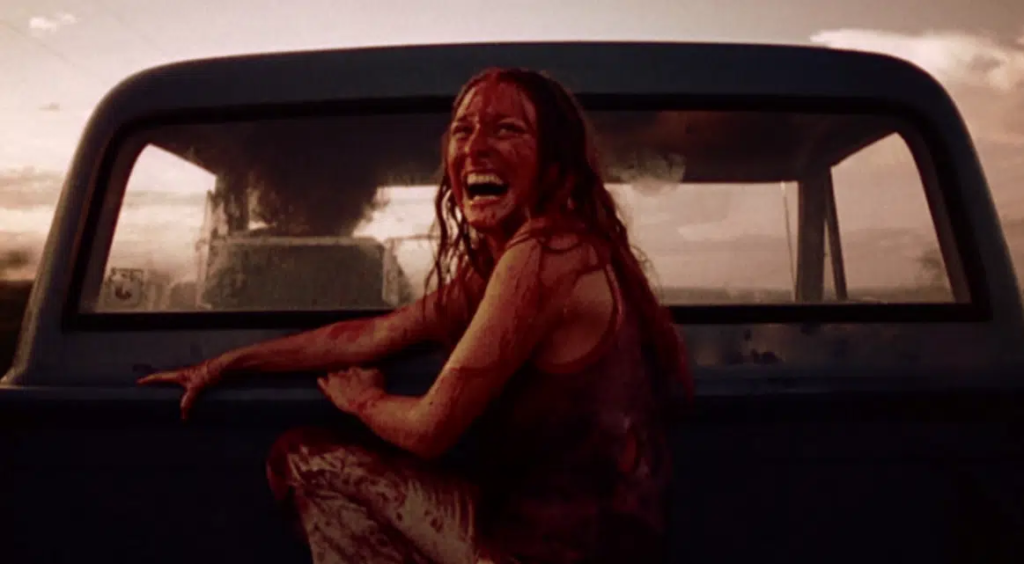
Sally Hardesty is the sole survivor of The Texas Chain Saw Massacre — the original final girl, who endures, runs, and never fights back.
She is a fictional character, and after 1974 her story has no single continuation: the sequels give her four different fates that cancel each other out, and this page states each one with its film’s name attached, never merged into one life. In the film that matters most she is a young woman on a Texas road trip who watches everyone she loves die, is tortured at a cannibal family’s dinner table, and escapes at dawn in the bed of a pickup truck, laughing. What was done to her performer to get that performance is part of the record too, and it is labelled as real-world fact wherever it appears.
Quick Specs
- Created by: Kim Henkel and Tobe Hooper
- First appearance: The Texas Chain Saw Massacre (1974)
- Played by: Marilyn Burns (1974); Olwen Fouéré (2022)
- Travels with: Brother Franklin, boyfriend Jerry, friends Pam and Kirk
- Status: Sole survivor of 1974 — later fates differ by film, below
The 1974 Film: The Massacre
On 18 August 1973, in the film’s own dating, Sally Hardesty drives through rural Texas in a van with her brother Franklin — who is paraplegic and uses a wheelchair — her boyfriend Jerry, and friends Pam and Kirk. After a wave of local grave robberies, the group has come to check the grave of Sally and Franklin’s grandfather at a cemetery near the fictional town of Newt, in Muerto County, and to visit the abandoned Hardesty family homestead nearby. They pick up a hitchhiker who slashes Franklin with a straight razor and is thrown out; running low on gas, Kirk and Pam, then Jerry, wander to the neighbouring house looking for fuel and are killed by Leatherface — Kirk by hammer blows, Pam impaled on a meat hook, Jerry after finding Pam’s body in a chest freezer. At dark, Sally pushes Franklin’s wheelchair through the woods calling for Jerry, and Leatherface ambushes them and kills Franklin with the chainsaw in front of her. Sally flees through thorn brush to the neighbouring house — Leatherface’s own — finds an ancient, seemingly dead man and a woman’s corpse upstairs, and jumps through a second-floor window to escape. At the gas station, the proprietor pretends to rescue her, then beats and binds her, stuffs her in a sack in his pickup and drives her back to the house, where the Hitchhiker is revealed as the grave robber and Leatherface as his brother. The 1974 film gives these men no surnames — “Sawyer,” and the names Drayton and Nubbins, are later-film naming applied backwards, and this page does not back-port them into 1974.
Then the dinner scene, the franchise’s defining image of her: bound to a chair at the family table, Sally watches the ancient Grandpa brought down, watches the family cut her finger so he can suck her blood, and faints. The next morning the family tries to have Grandpa kill her with a hammer over a bucket; too weak, he keeps dropping it, and in the chaos Sally breaks free and jumps through a second window. The escape has three trucks in it and retellings routinely pick the wrong one, so here it is precisely: on the road, an oncoming cattle truck runs over and kills the Hitchhiker; its driver wounds Leatherface with a wrench and flees on foot; and Sally, covered in blood, flags down a separate passing pickup and climbs into its bed, laughing hysterically as it carries her away and Leatherface dances with his chainsaw against the sunrise. She never fights, wounds or out-guns the killer at any point. She endures, runs, and seizes her chance. Status at the end of the 1974 film: alive, the sole survivor. The film was marketed as a true story; its plot is largely fictional, with Leatherface and minor details inspired by Ed Gein’s crimes, and no real Sally Hardesty exists.
Four Fates, Four Films
There is no “what happened to Sally” — there are four, and they contradict. In The Texas Chainsaw Massacre 2 (1986) Sally does not appear at all: no appearance, no performance by Marilyn Burns, only the opening narration, which calls her by a surname used nowhere else — Sally Hardesty-Enright — and reports that she was picked up “blood-caked and screaming,” told her tale of the cannibal family, and then sank into catatonia, while a month-long manhunt found nothing and officially the massacre never happened. Her uncle in this layer only, former Texas Ranger Lefty Enright (Dennis Hopper), carries the film’s revenge plot. In Leatherface: The Texas Chainsaw Massacre III (1990), which ignores the second film, Sally again does not appear: its opening text crawl disposes of her in two sentences — she was the sole survivor of that night of terror, and “she died in a private health care facility in 1977.” That is the crawl’s layer only; 1977 is four years after the 1973 events, not three, and the crawl is not franchise fact. In Texas Chainsaw Massacre: The Next Generation (produced 1994, released in the US in 1995), Marilyn Burns is wheeled past the heroine Jenny on a hospital gurney in a non-speaking cameo — credited only as “patient on gurney.” Writer-director Kim Henkel‘s stated intent was an emotional connection between Sally and Jenny, “a kind of perverse passing of the torch,” and the patient is widely read as Sally; the credits do not name her, and she could, strictly, be a different character. This page carries the attribution and states neither flat form.
Texas Chainsaw 3D (2013), a direct sequel to 1974 that ignores the intervening films, shows Sally only in its opening, which restages the immediate aftermath at the family house: she is played there by archive footage of Burns from 1974 and by stunt performer Elena Sanchez (uncredited) in the new material. Burns’s actual role in the 2013 film is Verna Carson, the family matriarch whose estate the new heroine inherits — she does not “return as Sally,” and no later fate for Sally is stated inside that layer. The 2003 remake and its 2006 prequel contain no Sally at all: their survivor is Erin (Jessica Biel), a new character of the separate Hewitt-family continuity, whose surname is never given on screen — “Erin Hardesty” is draft-and-promotion material, not canon. Leatherface (2017), a prequel set years before Sally’s trip, likewise has no Sally; its only Hardesty thread is a brief character named Ted, identified off screen by its writer as Sally and Franklin’s father in a scene that was cut — writer intent, never canon, and no released film names her father.
The 2022 Return
Texas Chainsaw Massacre (2022), directed by David Blue Garcia and released on Netflix on 18 February 2022, is a direct sequel to the 1974 film only, disregarding every intervening sequel, remake and prequel. Its Sally — played by Olwen Fouéré, the role recast after Burns’s death — is a retired Texas Ranger. After 1974 she dedicated her life to hunting Leatherface and searched fruitlessly for decades without finding him; as the film itself notes, it is hard to hunt a man in a mask. Her line on returning is carried in the film’s reviews: “Fifty years I’ve been waiting for this night.” In the bought-out town of Harlow she shields the young newcomers Melody and Lila, confronts Leatherface alone, and asks if he remembers her; he gives no sign that he does. He drives the chainsaw through her stomach, lifts her on it, and throws her body into a pile of garbage. She survives long enough to fire a shot that saves Lila and to give Lila her doctrine — “Don’t run. If you run, he’ll never stop haunting you” — urging her to stand and kill him rather than be haunted for life as Sally was. Then she dies. Unlike the legacy-sequel returns of her contemporaries that season, Sally’s return does not end in survival, and nothing from the other sequels’ fates — not the catatonia, not the 1977 death — happened inside this film’s timeline.
Marilyn Burns: The Performance and Its Price
Sally was created by Kim Henkel and Tobe Hooper, and played by Marilyn Burns — born Mary Lynn Ann Burns on 7 May 1949 in Erie, Pennsylvania, raised in Houston, a 1971 drama graduate of the University of Texas at Austin who had worked as a stand-in on Lovin’ Molly, where she met Henkel and Hooper. She was 24 during the summer 1973 shoot and 25 at the film’s release on 11 October 1974 — her real ages, never to be imported as Sally’s, whose age no film states. The production, shot in central Texas on a budget reported under $140,000, filmed seven days a week, up to 16 hours a day, in heat that peaked at 110°F; the farmhouse set was dressed with real animal remains, uncooled and barely ventilated; Gunnar Hansen wore the same unwashed Leatherface costume for a month. The dinner sequence was shot in one marathon session reported at 27 hours, driven by the Grandpa make-up its actor refused to undergo twice, with Burns bound to the chair under hot lights. And the dinner scene’s most infamous detail is real: the rig meant to supply fake blood for the finger-cut kept failing, the finger was really cut, and the blood Grandpa sucks on screen is Burns’s own. Hansen’s own account in his book Chain Saw Confidential is that he secretly removed the protective tape and cut her after the failed takes — “at this point, we were insane” — and this page names the hand only with that attribution. Burns ended the shoot exhausted, her costume so drenched in stage blood it was virtually solid, and was called back days after wrapping to reshoot the truck escape when the original footage failed. Her verdict on the famous final laugh, carried by Hansen: “When I was crazy at the end of the movie, laughing hysterically, that wasn’t acting… that was me, having to go back and do it one more time.”
Burns returned to the franchise only as the gurney patient and as Verna Carson, was inducted into the horror hall of fame at the Phoenix Film Festival in 2009, and died on 5 August 2014 in Houston, aged 65; the cause of death was not specified in the record this page relies on, and obituary phrasing beyond that is reported, not established. With Burns gone, the 2022 film cast Irish actress Olwen Fouéré — noted for Mandy — whose Sally is built as the photographic negative of 1974: still where Burns ran, armed where Burns was empty-handed, hunting where Burns fled.
The Iconography
The dinner table is the centre: Sally bound to a chair built with human arms, under a bone chandelier, while Hooper’s camera pushes into extreme close-ups of her eyes — darting, bloodshot, filling the frame — the film’s visual signature for her terror, singled out across the criticism. She never turns: her 1974 survival kit contains no weapon and no counter-attack, only running, climbing, two window jumps, endurance at the table, and a seized chance on the road. Scholarship’s formulation, James Rose’s, is that she “never turns upon her aggressors and attacks them; instead, she simply endures, runs from them and, by chance, seizes an opportunity to escape.” The dawn escape is the second image: blood-soaked, in the pickup bed, laughing — terror and triumph indistinguishable, the ambiguity of that laugh a whole strand of the scholarship by itself. And where later final girls are defined by a line or a weapon, Sally is defined by sustained, unbroken screaming and flight across the film’s final thirty minutes, carried almost entirely by Burns — a performance the production record shows was made at the genuine end of the performer’s endurance, which audiences now read as part of the image itself.
Why She Matters
Carol J. Clover coined “final girl” in Men, Women, and Chain Saws (1992), and the critical line built on it starts with Sally: she is consistently named the first final girl, the prototype against whom Laurie Strode, Nancy Thompson and Alice Hardy are measured — the standard scholarly table of the trope runs Sally (1974) to Laurie (1978) to Nancy (1984). The literature also argues about her, and this page prints the argument rather than a slogan. David Roche holds that Sally and Laurie “have very little in common, apart from the fact that both characters survive,” calls Sally “not especially heroic,” and reads her endurance — “the most resisting body” — as the film’s real subject rather than a feminist triumph. James Rose answers that her endurance “reconfigured the genre and created, as Clover has termed it, the character of the Final Girl,” while conceding she never attacks and is finally saved by a passing driver. A third strand, from female audiences, claims her precisely for survival without weapons: proof that you can come through hell battered and bloodsoaked but alive. Clover’s later final girls progressively take up the killer’s weapon; Sally never does, which makes her the trope’s limiting case — the final girl as witness and survivor, not avenger — and exactly why the 2022 film’s decision to finally arm her, legacy-sequel style, and then kill her for it, landed as a deliberate break of the pattern. Uniquely among the classic final girls, her performer never got a sequel showcase: Laurie and Nancy returned as fighters, while Sally’s story was disposed of by narrations and crawls until another actress inherited it nearly fifty years on. That absence is part of what Sally Hardesty means now.
Keep it locked on Think Horror — and if a pickup stops for you at dawn, get in.