Welcome back to the dark — Harper Nevar here.
The fair is for children, and there are no children. You wake up outside the town line with blood in your hair and no name in your mouth — not yours, not anyone’s — and behind you Springwood is hanging bunting for the Springwood Fair, the same fair it hangs every year, in a town where every swing set stands empty and every classroom gathers dust. The adults smile the way people smile at
a photograph of the dead. A woman with no children beams at you and offers you a child’s prize. A man with no children asks why you are not in school. You have been thrown out of this town by the thing that emptied it, and the terrible part is not that it wants you back inside. The terrible part is that it cannot leave on its own. It needs a ride, fiend. It needs somebody with a pulse and a driver’s licence and Krueger blood — and it has already picked your driver. She just doesn’t know her real name yet.
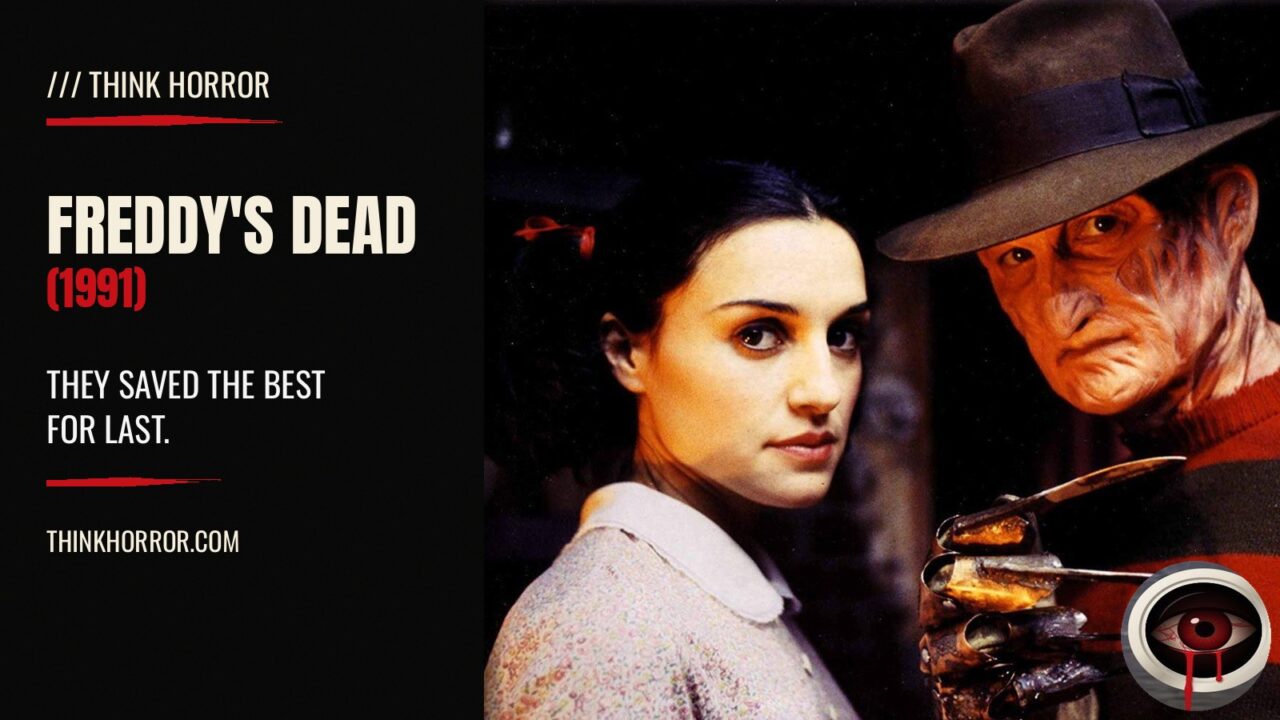
Freddy’s Dead: The Final Nightmare (1991) is the intended finale of the original Elm Street series, closing Freddy Krueger’s story with his own daughter.
They really meant to bury him. New Line opened this one on Friday, September 13, 1991 — an actual Friday the 13th — with a mock funeral for Freddy at Hollywood Forever Cemetery, a mayoral proclamation declaring it Freddy Krueger Day in Los Angeles, and a poster that printed his dates like a headstone: born November 2, 1984, died September 13, 1991. The studio that Freddy built was ready, in Robert Shaye’s own words, “to move on.” And the ungrateful corpse responded with the biggest opening of the series to that day — $12,966,525, number one two weeks running — on his way to $34,872,033, more than half again what The Dream Child had managed. The reported budget ran between nine and eleven million dollars. The finale was a carnival: cartoon physics, a 3-D last reel, and Freddy recast as master of ceremonies at his own wake. Whether it is also a horror film is the argument of this review. Harper’s answer is yes — a strange, softened, grieving one, hiding inside the jokes.
The premise is the series’ bleakest dressed as its silliest. Ten years on, Freddy has killed nearly every child in Springwood and cannot cross the town line himself. His door out is John Doe, the last teenager, an amnesiac who lands on the couch of a youth-shelter therapist named Maggie Burroughs — and Maggie, adopted, amnesiac in her own way, is the door’s other half. Freddy had a child. The town took her when they took him, renamed her, hid her — and his whole career of child-murder is reframed in one stroke: he took their children because they took his. Now he rides inside his daughter’s mind toward the border, whispering the franchise’s most quietly terrifying line: every town has an Elm Street. To kill him for good, Maggie has to do what no heroine before her managed — go inside his mind, through the beaten child and the murdered wife and the dream demons who keep him burning, and drag him out into the real world where things can die.

Quick Specs
- Director: Rachel Talalay
- Screenplay: Michael De Luca
- Starring: Lisa Zane (Maggie Burroughs), Robert Englund (Freddy Krueger), Shon Greenblatt (John Doe), Lezlie Deane (Tracy Swan), Ricky Dean Logan (Carlos Rodriguez), Breckin Meyer (Spencer Lewis), Yaphet Kotto (Doc)
- Music: Brian May
- Cinematography: Declan Quinn
- Editor: Janice Hampton
- Producers: Robert Shaye and Aron Warner
- Production Company: New Line Cinema
- Distributor: New Line Cinema
- Released: September 13, 1991
- Runtime: 89 minutes
- Rating: R
- Budget: $9–11 million (The Numbers lists $9 million)
- Box Office: $34,872,033 (all domestic; no separate international figure published)
- On This Site: A Nightmare on Elm Street (1984) in the wiki · Freddy Krueger · Robert Englund
The Review
Give the director her flowers first, because nobody in this series earned the chair like Rachel Talalay. She was an assistant production manager on the 1984 original, production manager on Freddy’s Revenge, line producer on Dream Warriors, producer on The Dream Master — and in between she produced Hairspray and Cry-Baby for John Waters. Freddy’s Dead is her feature directorial debut, and per Gizmodo’s accounting she remains the only woman to have directed an entry in any of the major slasher franchises. Given the finale, she made two decisions that define it. She dropped the series prefix from the title — this is Freddy’s film, billing and all. And she put the humour back in on purpose, judging that The Dream Child had gone too solemn, with Twin Peaks in the air that season teaching everyone how a small town’s madness could be played as deadpan surrealism. The result is the strangest tonal object in the series: a grief-stricken ghost town photographed like a cartoon.
And Springwood is where the film’s heart actually beats. The emptied town is the finest horror idea in the back half of this franchise: adults keeping up a fair for children who are all dead, a childless Roseanne and Tom Arnold (billed, gloriously, as Mrs. and Mr. Tom Arnold) doting with deranged tenderness on any young face that wanders in, an orphanage keeper still keeping her post. That is not comedy decorating horror; that is horror wearing comedy’s coat — a whole town that chose denial because grief was unsurvivable. Into it walks Lisa Zane’s Maggie, the series’ most adult heroine, a professional rescuer of damaged kids who turns out to be the most damaged kid of all. When the film remembers that its villain is a murdered daughter’s revenge and its heroine is the daughter, Freddy’s Dead stops being a lark and becomes the only Elm Street film about what the parents’ fire actually cost. The flashback passages inside Freddy’s mind — the taunted child, the foster father’s fists (Alice Cooper, billed as Edward Underwood), the wife who found the secret room — give Robert Englund scenes without the makeup, and Janet Maslin, in the friendliest major review, singled exactly that out: Englund “sustains Freddy’s peculiar charm even when appearing without ghastly makeup in scenes of Freddy’s early years.”
Now the other side of the coffin lid. As a machine for fear, this is the weakest of the Englund sequels, and it is not close. Talalay stages the kills as Hanna-Barbera gags — a bed of spikes dragged under a falling boy like a Wile E. Coyote prop, and the famous video-game death, Spencer controlled by Freddy wielding a Power Glove parody, “Now I’m playing with power,” a line lifted straight from the Nintendo advertising of The Wizard. As pop culture it is immortal; as horror it is weightless, and the film knows the difference less often than it should. John Doe is a plot coupon wearing a person’s coat. Carlos’s hearing-aid death reaches for cruelty the surrounding cartoon cannot support. The 3-D finale — the last ten minutes in “Freddyvision,” cued when Maggie puts on the glasses in-story, New Line’s first 3-D release — was a genuine event in 1991 and is a charming fossil now, restored on the recent 4K set after decades of flat home-video versions. Owen Gleiberman’s Entertainment Weekly pan lands the era’s coldest verdict: “The joke is on the filmmakers: By taking the finality out of death, they’ve already robbed the horror genre of its giddy sting.” He wrote it as an epitaph for the series. The series’ accountants, watching that opening weekend, may be forgiven for laughing last.
So the ledger, plainly. What works: Springwood itself, mad with grief under its bunting; the daughter premise, which reaches back and gives even the silliest scenes a buried engine of real sorrow; Talalay’s certain hand and the series’ debt to her finally collected behind the camera; Englund, charming and terrible with and without the burns; and a genuine ending — this continuity really does close, with the demons flying out of a corpse that cannot be revived. What doesn’t: dread, mostly — cartoon physics keep rescuing the audience from every scene built to hurt; a male lead who is a device; and comedy that too often plays at the victims instead of through them. Freddy’s Dead is the franchise’s wake, and like most wakes, it is funnier and sadder than the funeral had any right to be, and not very frightening at either.
Spoiler Section
Spoilers settle here, fiends — the ending is discussed plainly.
The shelter kids die in ascending order of invention. Carlos first, at the old Elm Street house: Freddy restores and amplifies the hearing his mother’s beatings damaged, and the glove’s screech — a nail dragged down a chalkboard — bursts him from inside the sound. Spencer next, stoned and dreaming, pulled into a video game of his own life and played by Freddy like a character, battered down a staircase into a bottomless pit. John Doe last and saddest: having learned at the orphanage that Freddy had a child, he is certain the child is him — and Freddy, dragging a bed of spikes beneath the falling boy mid-dream, corrects the record as he kills him: his child is a girl. John dies passing the truth to the one person it can save. Maggie finds her adoption papers. Katherine Krueger. The therapist has been the target all along — Freddy rode out of Springwood inside her mind the moment she crossed his border dreaming, and at the shelter, where nobody but dream-disciplined Doc even remembers the dead boys existed, he starts unpacking for a new town.
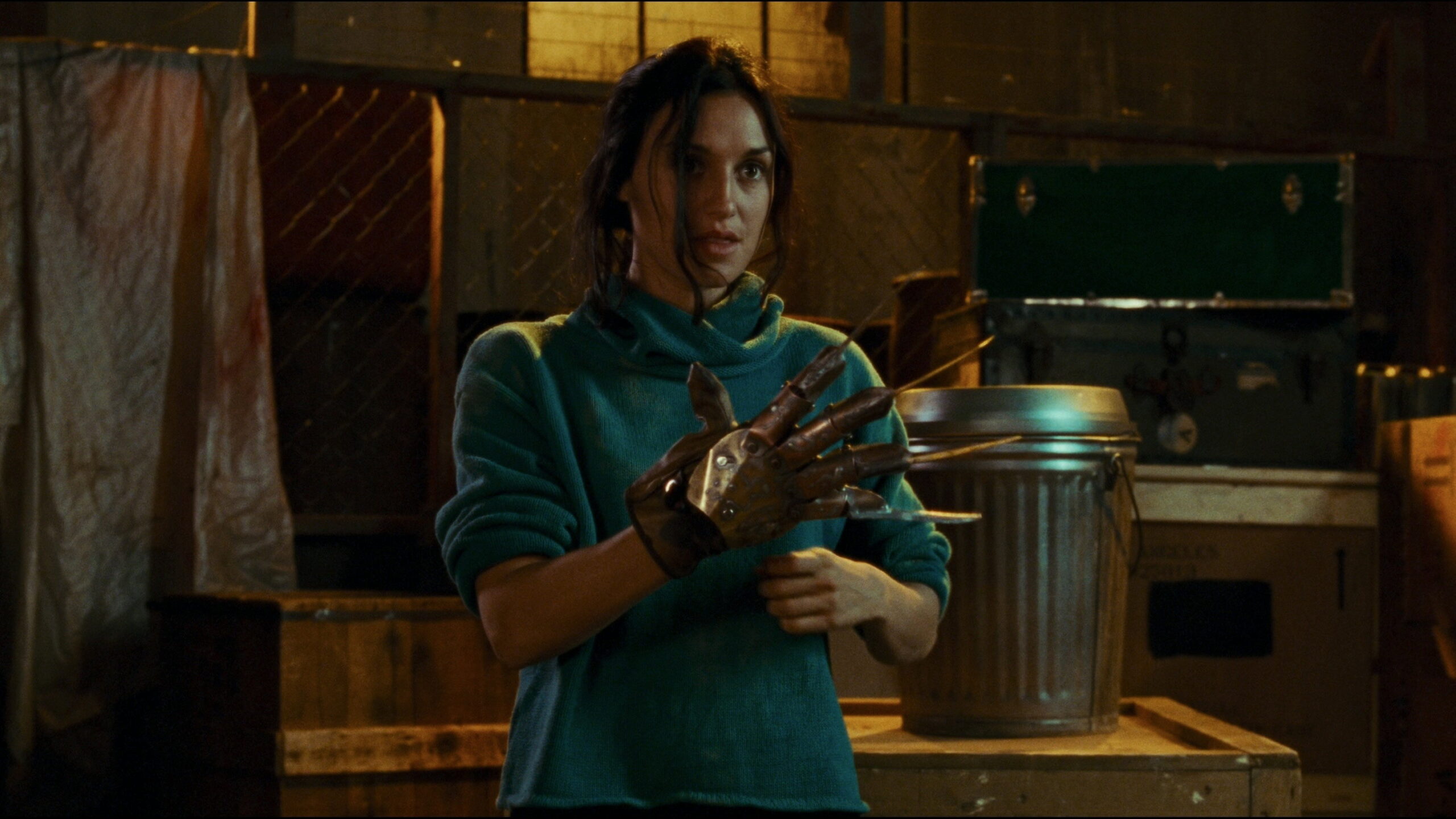
The ending earns its billing. Doc discovers the dream demons — the fiery things that keep resurrecting Freddy — and the one rule that matters: pulled into the real world, Freddy can die in it. Maggie volunteers to go into his mind and haul him out, Doc’s 3-D glasses on her face. Inside, she walks his whole biography: the asylum-born child taunted as the son of a hundred maniacs, the foster father’s belt, the teenage self-harm, Loretta’s murder in the secret room, the fire, the demons’ bargain. Then she drags him through into waking life and fights him with the confiscated weapons of the shelter’s own patients — pins him with a thrown knife, tears off his glove and stabs him with it, and finishes the argument by putting a pipe bomb in his chest. The explosion is real-world final: the three dream demons spill out of him with nobody left to revive, and Maggie, Tracy and Doc stand in the quiet while Maggie says the two words the whole series was built to reach. “Freddy’s dead.” Roll the montage of six films under Iggy Pop, and close the book — for three years, until a man named Wes Craven reopened it from the other side. But that is another review.
Trivia
- Johnny Depp, whose screen debut was dying in the 1984 original, cameos here as a teen on TV in a parody of the “this is your brain on drugs” PSA — Freddy knocks him out with a frying pan. He is not playing Glen Lantz, and he is not uncredited: the cast list bills him under the joke pseudonym “Oprah Noodlemantra.”
- Before Talalay’s version, Peter Jackson wrote an unused Freddy’s Dead: teenagers who no longer feared Freddy took sleeping pills to hunt him in his own world, while a comatose police officer stood permanent guard inside it. The discarded house script was stranger still — Alice killed early, her son Jacob as the hero, and dead Dream Warriors returning to help him.
- The marketing treated the death as fact. New Line staged Freddy’s mock funeral at Hollywood Forever Cemetery with series cast in attendance, Mayor Tom Bradley proclaimed release day Freddy Krueger Day in Los Angeles — over public criticism that the city was honouring a murderer — and the poster ran the tagline “They Saved the Best for Last” beneath Freddy’s birth and death dates.
- During the 3-D processing of the finale, the lab accidentally sent the production two seconds of footage from a film nobody had seen yet: Terminator 2: Judgment Day, still unreleased at the time.
- Lisa Zane submitted her own James Bond-style ballad, “The Worst Is Over,” to sing over the end credits. Talalay used Iggy Pop’s “Why Was I Born? (Freddy’s Dead)” instead — which then earned the film its only awards nomination, a Golden Raspberry nod for Worst Original Song. It lost to MC Hammer’s “Addams Groove.”
- The composer, Brian May, is the Australian who scored Mad Max and The Road Warrior (1934–1997) — not the Queen guitarist of the same name, who has never scored an Elm Street film.
- Barq’s root beer attached coupons to the 3-D glasses handed out at screenings, so the audience cue for the Freddyvision finale doubled as a soda promotion. The standard VHS and Blu-ray versions later dropped the 3-D entirely; the 2025 4K collection restored it, glasses included.
- Sharp eyes at the Springwood end of the film can spot the Ticket Seller — played by Robert Shaye, New Line’s founder and the film’s producer, selling passage out of the town his studio built. Elinor Donahue of Father Knows Best appears at the orphanage, about as far from her television kitchen as an actress can get.
Where to Watch
As of November 20, 2026, in the US: Freddy’s Dead: The Final Nightmare streams on AMC+. Rent or buy it on Amazon Prime Video, Apple TV Store and Fandango At Home — and note that Warner’s seven-film 4K collection (2025) is the way to see the 3-D Freddyvision finale as 1991 audiences did, glasses included. Listings rotate — check before you settle in.
The Verdict
Three ravens for the wake. Freddy’s Dead is the least frightening of the Englund sequels and, scene for scene, possibly the most fun — a cartoon carnival staged in a town destroyed by grief, closing the original series with the one idea big enough to end it: Freddy’s own daughter, turning his glove on him in the real world where deaths stick. He did not stay dead, of course. They never do; there is a remake and a hockey mask in his future, and a new film in development even now. But for one Friday the 13th in 1991, with a funeral, a holiday and a pipe bomb, they buried him properly. They saved the best for last, the poster said. They did not, quite. They saved the strangest — and Harper will take strange over safe every night of the week.
Rating: 3 ravens out of 5.
The weekly roundup
One letter a week, from the crypt.
- New reviews, with the ravens
- New wiki entries and news
- Cool stuff worth your night
Weekly. No spam, unsubscribe in one click.