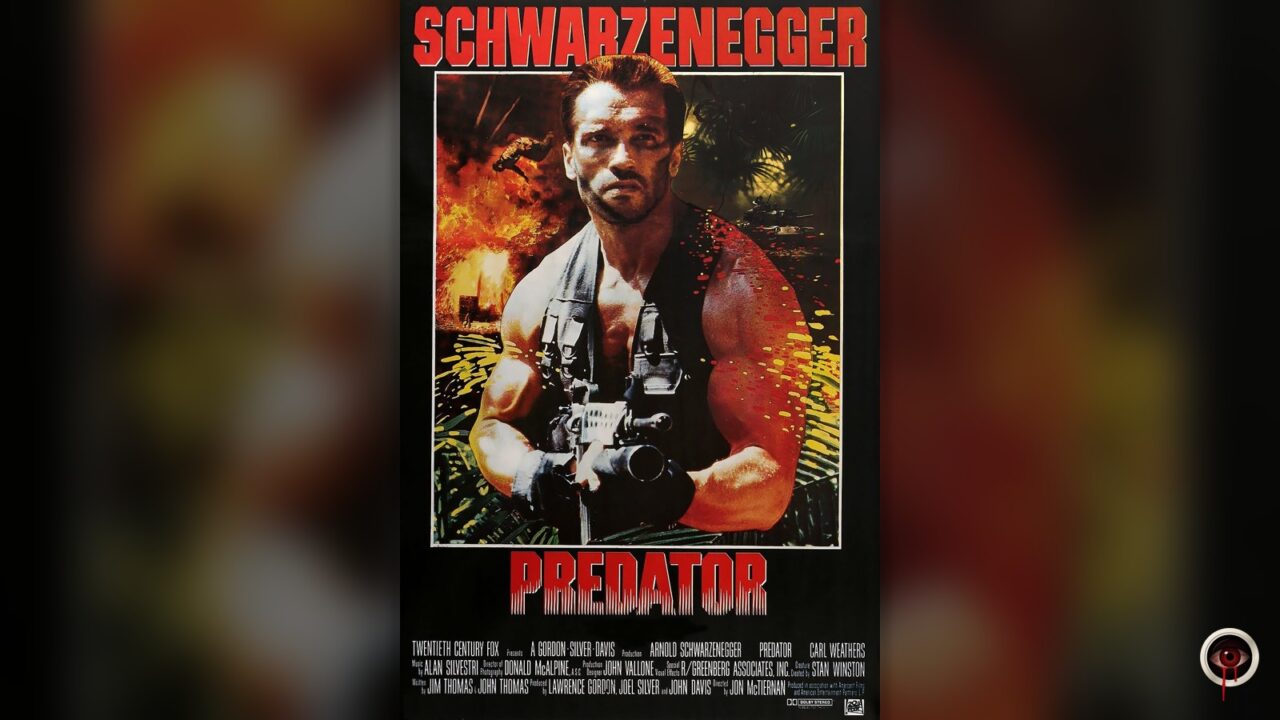
Welcome back to the dark — Harper Nevar here. The jungle has gone quiet, and you have been in-country long enough to know that quiet is a sound with a meaning. The birds stopped first. Then the insects. Now there is only the heat coming off the leaves in waves and the feeling — animal, undeniable, rising up the back of your neck — that the trees are looking at you. You are the best rescue team the Agency has, seven men who could walk into any war on Earth and walk out carrying it. Something above the canopy has been counting your heartbeats since the helicopter. It is not afraid of you. It is deciding which one of you it wants first.
Predator is John McTiernan’s 1987 jungle hunt, where Schwarzenegger’s rescue team becomes the trophy quarry of an invisible alien sportsman.

The Review
Every great monster movie is two films wrestling, and Predator is the rare one where both win. The first film is the most confident action picture of its decade: a crack rescue team — Arnold Schwarzenegger’s Dutch, Carl Weathers’ Dillon, Bill Duke’s Mac, Jesse Ventura’s Blain, Sonny Landham’s Billy, Richard Chaves’ Poncho, Shane Black’s Hawkins — dropped into a Central American jungle on a mission that turns out to be a CIA lie, played out under Alan Silvestri’s pounding, primitive score. The second film, hiding inside the first’s ribcage, is a slasher movie shot from the killer’s side of the trees: something invisible is watching these men the way they watch everything, as heat and habit, and it begins collecting them one at a time. Director John McTiernan — making his first studio film, not his debut, whatever the legend says — understood that the two films needed the same grammar. The commandos are filmed like prey animals from the first reel: framed through foliage, caught in long lenses, their magnificent physiques presented the way a hunter presents a herd. By the time the team unloads every weapon they own into an empty treeline at an enemy they cannot see, the movie has quietly reversed the food chain, and it never reverses back.
The creature nearly sank it. What audiences now know as the Predator — seven feet of dreadlocked, mandibled nightmare — is the film’s second monster, built in an emergency. The original, constructed by Richard Edlund’s Boss Film Studios, was an ungainly insectoid thing with a dog-like head that Schwarzenegger remembered as “a lizard with the head of a duck”; Jean-Claude Van Damme spent a brief, miserable stint performing inside a red version of it the crew called the lobster. Why Van Damme left depends entirely on who is telling the story — his own account has him refusing a dangerous jump; Bill Duke remembered him repeatedly passing out in the suit; others tell of a smashed creature head and an on-the-spot firing — and the honest record keeps all the tellings and settles none. What is settled: the design was scrapped, production shot around the absence, and Stan Winston’s company took over the effects in February 1987, four months before release. Winston later recalled sketching ideas on a plane beside James Cameron, who said he had always wanted to see a creature with mandibles. Around the tallest performer available — Kevin Peter Hall, 7’2″ and fresh from playing the sasquatch in Harry and the Hendersons — Winston built an icon. Hall rehearsed blind inside the mask, memorised his marks, and gave the thing a hunter’s patience that no amount of latex could fake. The optical work around him — the bending-light cloak, achieved with a red-suited Hall keyed out against a wider-lensed empty take, and the thermal-vision photography shot on an infrared scanner because film stock could not register body heat — earned the film an Academy Award nomination for Best Visual Effects, shared by Joel Hynek, Robert M. Greenberg, Richard Greenberg and Winston. It lost to Innerspace. History has since overruled the Academy.
The middle of the film is a masterclass in attrition. McTiernan kills his cast the way the jungle would: Hawkins first, snatched mid-joke (Shane Black, the hottest young screenwriter in town off Lethal Weapon, was cast partly in the hope he would punch up the script on set; he declined, acted, and died early — the film’s screenplay belongs to Jim and John Thomas alone). Blain falls without ever seeing what hit him — Ventura, whose “I ain’t got time to bleed,” growled at Poncho over a wound, became the title of his autobiography and a permanent piece of American slang. Then the film’s centre of gravity shifts to Duke’s Mac, unravelling magnificently, whispering to a friend who is no longer there; to Billy’s lone stand on the log bridge; to Dillon, the company man, redeemed in the only currency the film honours. And running under all of it is the discovery that turns a firefight into a thesis: the creature spares the unarmed Anna. It hunts sport, not war. Dutch’s answer is the most famous line in the film and its whole philosophy in eight words: “If it bleeds, we can kill it.”
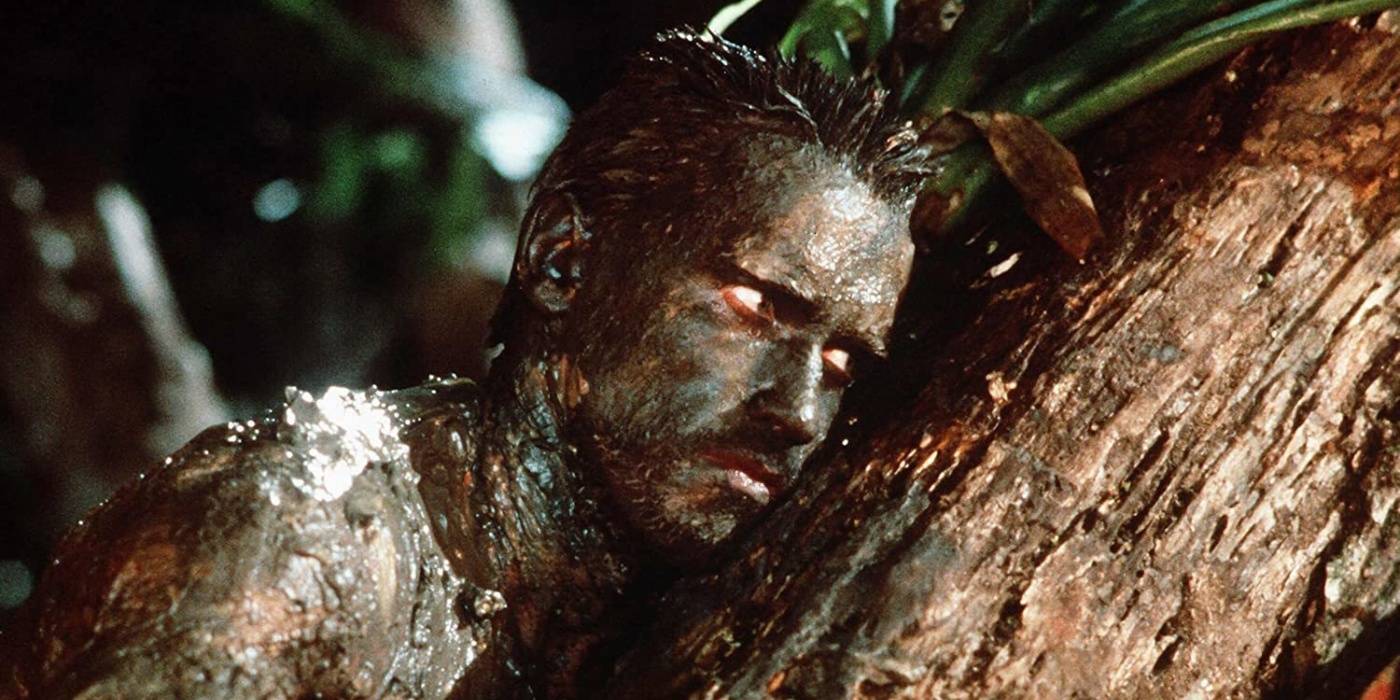
Contemporary critics, it must be said, mostly missed it. Janet Maslin found it “grisly and dull, with few surprises”; Variety allowed it was a “slightly above-average actioner”; the Los Angeles Times’ Michael Wilmington called the script arguably “one of the emptiest, feeblest, most derivative scripts ever made as a major studio movie.” Roger Ebert dissented in the direction of posterity: the film “moves at a breakneck pace… and supplies what it claims to supply: an effective action movie.” The audience was with Ebert — it opened at number one, $12,031,638 on its first weekend, and finished with $59,735,548 at home — and time has finished the argument. Empire’s Chris Hewitt speaks for the settled verdict: a film that “has gradually become a sci-fi and action classic.” On this site it sits in the horror canon without apology, because its last forty minutes are pure survival horror: one man, stripped of his team, his technology and finally his species’ advantages, painting himself in river mud and learning to be prey correctly.
So the ledger, plainly. The construction works: no wasted scene, every death repricing the odds, a monster withheld until withholding has made it mythic. The performances work — Schwarzenegger’s finest hour is his quietest, and the ensemble’s physical credibility does what exposition never could. What doesn’t work, if we’re honest, is only the era’s furniture: a first act that takes its time flexing, and a politics-of-the-jungle plot that exists to be discarded. Neither matters by the riverbank. The sequels, crossovers and reboots that followed spent nearly forty years trying to re-enter this jungle. None of them found the quiet.
Spoiler Section
Full spoilers from here. The team is spent by ones and twos: Hawkins taken first, Blain killed and his body stolen, Mac and Dillon dead hunting the thing on its own ground, Billy making his stand alone, Poncho killed in the trap line. Dutch sends the unarmed Anna on to the helicopter — the creature’s code spares her — and goes over a cliff into the river, washing up caked in mud that hides his body heat from its thermal sight. Alone, he becomes the thing the film has been promising: bow, spear, fire, mud, patience. He wounds the creature, knocks out its cloak and its plasma caster, and when it finally removes its mask and weapons to meet him hand to hand — the hunter’s respect, and the film’s ghastliest reveal — Dutch goads it toward his trapped tunnel. The creature reads the trap, circles it, and Dutch springs the counterweight himself, crushing it. Dying, it laughs — with Billy’s laugh, with all their voices — and starts the countdown on its wrist. Dutch outruns the blast by heartbeats. The rescue helicopter that lifts him and Anna out at dawn is piloted, unmasked and unbilled in the joke, by Kevin Peter Hall himself.
Trivia
- Kevin Peter Hall plays two roles: the Predator, and — unmasked, in the final scene — the helicopter pilot who flies Dutch out.
- Exactly two cast members went on to become state governors: Jesse Ventura (Minnesota, 1999–2003) and Arnold Schwarzenegger (California, 2003–2011). Sonny Landham ran for governor of Kentucky in 2003 and lost.
- Production shut down on April 25, 1986 so Schwarzenegger could fly home and marry Maria Shriver the next day; filming resumed on May 12 after a three-day honeymoon.
- The Thomas brothers wrote the script in 1984 under the title Hunter; much of the shoot was still clapper-boarded under that name.
- The Predator’s voice effects were performed, uncredited, by Peter Cullen — the voice of Optimus Prime.
- The same Academy Awards year that nominated Predator’s creature work as a visual effect, Rick Baker won Best Makeup for Harry and the Hendersons — a performer in a suit with a mechanical head, played by the very same Kevin Peter Hall.
Where to Watch
Streaming by subscription on Hulu; also available to rent or buy on Amazon Video, Apple TV and Fandango At Home (checked November 10, 2026).
The Verdict
The hunters become the hunted, and the greatest action cast ever assembled gets picked off like a slasher roster — that is the whole trick, and it has never stopped working. Predator is the rare blockbuster that improves as it sheds: fewer men, fewer guns, less noise, until all that’s left is a man in mud, a thing in the trees, and the oldest story there is. Get to this one. It’s essential.
Rating: 4.5 ravens out of 5.
Quick Specs
- Director: John McTiernan
- Screenplay: Jim Thomas and John Thomas
- Starring: Arnold Schwarzenegger, Carl Weathers, Kevin Peter Hall, Elpidia Carrillo
- Music: Alan Silvestri
- Cinematography: Donald McAlpine
- Editor: John F. Link and Mark Helfrich
- Producers: Lawrence Gordon, Joel Silver and John Davis
- Production Company: Silver Pictures, Davis Entertainment and Gordon Company
- Distributor: 20th Century Fox
- Released: June 12, 1987
- Runtime: 107 minutes
- Rating: R
- Budget: $15–18 million (reported as about $15 million in some sources; The Numbers lists $18 million)
- Box Office: $59,735,548 domestic; about $98.3 million worldwide (Box Office Mojo $98,268,458; The Numbers $98,267,558)
- On This Site: Predator, The Predator, Stan Winston
The weekly roundup
One letter a week, from the crypt.
- New reviews, with the ravens
- New wiki entries and news
- Cool stuff worth your night
Weekly. No spam, unsubscribe in one click.