
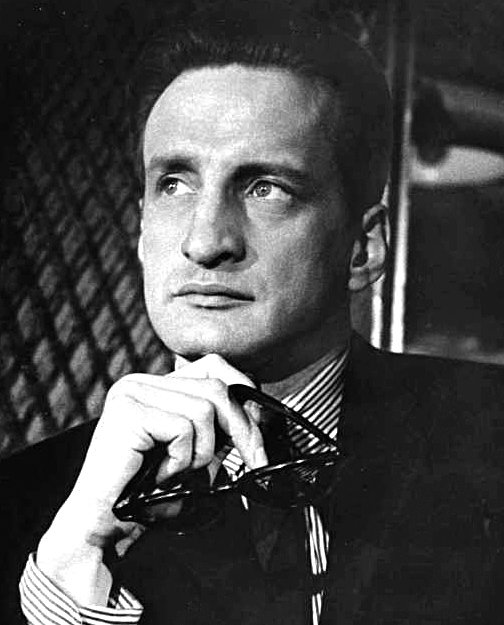
George C. Scott (1927 to 1999) was the American actor who starred in The Changeling and The Exorcist III and refused his Patton Oscar.
Quick Specs
| Born | George Campbell Scott, October 18, 1927, Wise, Virginia; raised in Detroit |
| Died | September 22, 1999, Westlake Village, California, aged 71, of a ruptured abdominal aortic aneurysm |
| Buried | Westwood Village Memorial Park Cemetery, Los Angeles |
| Service | United States Marine Corps, 1945 to 1949, reaching sergeant |
| Horror | John Russell in The Changeling (1980); John Rainbird in Firestarter (1984); Lt. William Kinderman in The Exorcist III (1990) |
| Defining role | General George S. Patton in Patton (1970) |
| Oscar record | four nominations; won Best Actor for Patton and refused the award |
| Emmys | won for The Price (1971) and 12 Angry Men (1997) |
| Stage | five Tony nominations, from Comes a Day (1959) to Inherit the Wind (1996) |
| Family | five marriages to four women, including Colleen Dewhurst twice and Trish Van Devere; father of actor Campbell Scott |
Who He Is
George Campbell Scott was born in Wise, Virginia, on October 18, 1927. The “C.” is Campbell, his middle name. He grew up in Detroit, where his father, George Dewey Scott, was an executive with the Buick Motor Company. His mother, Helena Agnes Scott, died when he was seven, shortly before his eighth birthday.
He joined the Marines in 1945 and served until 1949, rising to sergeant. His postings included the ceremonial 8th and I Barracks in Washington, D.C., with honour-guard and funeral duty at Arlington National Cemetery, and teaching English literature and radio speaking and writing at the Marine Corps Institute. Afterwards he went to the University of Missouri to study journalism, took a degree there, and was pulled sideways into acting by student theatre.
His private life was crowded and is part of the record. He married five times, to four women: Carolyn Hughes (1951 to 1955), Patricia Reed (1955 to 1960), the actress Colleen Dewhurst (1960 to 1965, and again from 1967 to 1972), and from September 1972 until his death the actress Trish Van Devere, who became his most frequent co-star. He had seven children, among them the actress Devon Scott and, with Dewhurst, the actor Campbell Scott (born 1961), who has his own separate career. Dewhurst called him “G.C.” His obituaries described a life marred by drinking and brawling, and a mid-1960s relationship with Ava Gardner, during the interval between his two marriages to Dewhurst, belongs to the same record.
The Work, and What He Did in It
He was a stage actor first, and he never stopped being one. His New York debut, as Richard III for the New York Shakespeare Festival in 1957, announced him. Over the next four decades he earned five Tony nominations, for Comes a Day (1959), The Andersonville Trial (1960), Uncle Vanya (1974), Death of a Salesman (1975, playing Willy Loman and directing) and Inherit the Wind (1996), his last New York stage appearance.
His film debut was The Hanging Tree (1959), supporting Gary Cooper. His second film brought an Oscar nomination: in Otto Preminger’s Anatomy of a Murder (1959) he is Claude Dancer, the needling, theatrical big-city prosecutor brought in to face James Stewart’s defence. In The Hustler (1961) he is Bert Gordon, the smiling backer who owns a percentage of Paul Newman’s Fast Eddie Felson and treats people as stakes, opposite Jackie Gleason’s Minnesota Fats. Gordon’s menace is bookkeeping, not violence, and Scott made him the film’s cold centre. He was nominated again, asked the Academy in advance to withdraw his name, was kept on the ballot anyway, and lost.
In Stanley Kubrick’s Dr. Strangelove (1964) he is General “Buck” Turgidson, gum-chewing and eager for war. The standard account, told in matching outline in the Kubrick literature, is that Scott wanted to play Turgidson straight, and Kubrick had him do broader takes as “practice,” assured him they would not be used, and then used them. After Abraham in The Bible: In the Beginning… (1966) and Dr. Archie Bollen opposite Julie Christie in Petulia (1968) came the role that defined him.
Patton (1970), directed by Franklin J. Schaffner from a script by Francis Ford Coppola and Edmund H. North, opens with Scott standing before an enormous American flag, delivering the general’s speech straight to camera. It is the most famous entrance in the history of the biopic. He then played the whole man, profane, mystical, insubordinate and doomed, not the monument, after preparing by reading widely on Patton, studying film of him and talking to men who had known him. The film won seven Oscars from ten nominations.
The Oscar story needs its mechanics. Before the nominations, Scott again asked to be removed from consideration, calling the ceremony “a two-hour meat parade, a public display with contrived suspense for economic reasons.” The Academy kept his name on the ballot, and on April 15, 1971, at the 43rd Academy Awards, he won Best Actor. He was not there; by his own account he was at home watching hockey. Producer Frank McCarthy accepted the statuette on his behalf, and the next day, at Scott’s direction, McCarthy returned it to the Academy. That made Scott the first actor to refuse an Academy Award he had won, and he remains, in the Academy’s record, the winner of the Best Actor Oscar for 1970. The following year the Academy nominated him again anyway, for Paddy Chayefsky’s The Hospital (1971), as Dr. Herbert Bock, a chief of medicine coming apart.
The same year he played Justin Playfair, the widowed judge who believes he is Sherlock Holmes, opposite Joanne Woodward’s Dr. Watson in They Might Be Giants (1971), the gentlest performance of his career. He directed too: the acclaimed 1970 television production of The Andersonville Trial, and the features Rage (1972), in which he starred, and The Savage Is Loose (1974; some listings say 1975). The working-star years ran through The Day of the Dolphin (1973), The Hindenburg (1975), Islands in the Stream (1977) and Movie Movie (1978). In Paul Schrader’s Hardcore (1979) he is Jake Van Dorn, a Calvinist businessman from Grand Rapids who goes into the Los Angeles porn underworld looking for his runaway daughter: a rigid moral man walking into an evil he cannot prosecute his way out of, and a rehearsal for his horror years.
The Changeling (1980) is the first of his horror centrepieces. Directed by Peter Medak for a Canadian production, from a script by William Gray and Diana Maddox based on a story by Russell Hunter, it casts Scott as John Russell, a New York composer whose wife and daughter are killed in a road accident in the opening minutes. He retreats to Seattle and, through Claire Norman of the local historical society (Trish Van Devere), rents a historic mansion that turns out to be occupied. The presence is Joseph Carmichael, a sickly child murdered in the house decades earlier and replaced by a healthy substitute, the changeling of the title, who grew up to be Senator Joseph Carmichael (Melvyn Douglas).
What Scott did with Russell is play grief without a single horror-film shortcut. Russell investigates the haunting the way a reasonable man would, through archives, a séance built on automatic writing and a playback of the session tape, and plain refusal to be frightened out of his own house. The famous effects are small, a child’s ball bouncing down the stairs, an empty wheelchair moving, and they work because his reactions stay adult. One review called it “a superior haunted house thriller.” It won eight Genie Awards, including Best Canadian Feature, and the Golden Reel Award as the top-grossing Canadian film of its year; Scott won the Genie for Best Foreign Actor and Van Devere for Best Foreign Actress. The story derives from events Russell Hunter said happened to him in a Denver house in the late 1960s.
After General Harlan Bache, the academy commandant whose cadets take him literally, in Taps (1981), he played his outright horror villain. In Firestarter (1984), Mark L. Lester’s film of the Stephen King novel, he is John Rainbird, the Shop’s assassin, who befriends young Charlie McGee (Drew Barrymore) in disguise in order to deliver her, and who wants, at the end, to look into her fire at the moment of his own death. Rainbird is the dark twin of John Russell: the same stillness, all of it malice. The same year he played Ebenezer Scrooge in Clive Donner’s television film A Christmas Carol (1984), still counted among the finest screen Scrooges.
The Exorcist III (1990) is the second centrepiece. William Peter Blatty wrote and directed it from his 1983 novel Legion, his own sequel to The Exorcist that ignores Exorcist II: The Heretic. Scott takes over Lt. William Kinderman, the Georgetown homicide detective Lee J. Cobb played in 1973; Cobb had died in 1976, and part of the film’s weight is a new actor inheriting a dead man’s part. Kinderman’s friend Father Dyer is recast too, with Ed Flanders, while Jason Miller returns as Damien Karras, or as the “Patient X” who may contain him.
Scott, 62 when it opened, plays Kinderman as the franchise’s tired conscience, years on from the Karras case, investigating murders that carry the signature of the Gemini Killer (Brad Dourif), executed long ago and modelled in part by Blatty on the Zodiac case. Long stretches of the film are dialogue duels, with Dyer about faith and with Dourif’s Gemini in the cell scenes, and Scott does the work of a stage actor inside a studio horror sequel. The studio, Morgan Creek, then fought its author: it imposed a reshot climax with an exorcism, bringing in Nicol Williamson as Father Morning, and retitled Blatty’s Legion as The Exorcist III. Scream Factory assembled a director’s cut close to Blatty’s version from surviving materials in 2016. The same year as Kinderman he did a real voice role, the poacher Percival C. McLeach in Disney’s The Rescuers Down Under (1990).
The last decade brought Malice (1993), Angus (1995) and, on television, Juror 3 in 12 Angry Men (1997), another Lee J. Cobb role, which won him a Primetime Emmy to go with the one he won for The Price (1971). His final screen work all came out in 1999: Gloria, the TV film Rocky Marciano, and a television Inherit the Wind as Matthew Harrison Brady, the role he had played on Broadway three years before.
He had a series of heart attacks in the 1980s. On September 22, 1999, he died at his home in Westlake Village, California, of a ruptured abdominal aortic aneurysm, aged 71.
Cool Verified Facts
- He tried to refuse an Oscar nomination twice before he refused the Oscar itself: for The Hustler, then for Patton. Both times the Academy ignored the request.
- He explained the refusal as principle, not temper: every dramatic performance is unique and cannot be compared with others, and his request was “in no way intended to denigrate my colleagues.”
- He inherited two Lee J. Cobb roles, Kinderman in The Exorcist III and Juror 3 in 12 Angry Men.
- Trish Van Devere co-starred with him in The Last Run (1971), The Day of the Dolphin, The Savage Is Loose, Beauty and the Beast (1976), Movie Movie and The Changeling.
- Brando’s refusal of his Godfather Oscar in 1973 came two years after Scott’s, which set the terms.
Signatures, Habits and Behind the Scenes
The instrument was a raspy growl, a much-broken nose and a craggy face, and in horror it was the whole kit. Russell and Kinderman frighten nobody physically. Both performances run on a voice that sounds like it has already seen the worst and a face that believes what it is hearing.
He prepared heavily. Patton was built on reading, newsreel and conversations with men who had known the general.
He kept going back to the stage at the height of his film fame: Willy Loman in 1975, directed by himself, Sly Fox, Present Laughter in 1982, which he also directed, and Inherit the Wind in 1996. Movie stars visiting Broadway do not direct revivals of Noël Coward. Stage actors do.
His recurring problem with directors is in the Strangelove story: sometimes they got his best work at a pitch he would have censored himself.
Why He Matters
For horror, George C. Scott gave the genre two lead performances of a weight almost nobody of his stature ever offered it. The Changeling works because its investigator refuses, for nearly two hours, to be anything but rational, and it is now routinely ranked among the great haunted-house films. The Exorcist III runs on his weariness: a sequel whose horror is theological argument conducted by a policeman. Add Rainbird’s quiet evil in Firestarter and his horror record is a trilogy, not a footnote.
Beyond horror, Patton is one of the handful of performances that define screen acting, and the refusal that followed made him the first actor to refuse an Academy Award, fixing the terms in which actors and prizes are still discussed. And from Richard III in 1957 to 12 Angry Men in 1997 he was the classical American stage actor working in film. Horror, through Medak and Blatty, got the full benefit of that in his fifties and sixties, when the industry had largely stopped building films around men like him.