Ghostface
Ghostface is the masked killer of the Scream films, a store-bought ghost mask and black robe with a different murderer underneath in every film.
The phone rings. A stranger asks what your favourite scary movie is, and he already knows too much about your house, your friends and your evening. That call is where Ghostface lives. Kevin Williamson created the character for Scream (1996), and Wes Craven put him on screen, but the design of the thing is the genius: Ghostface is not a man, he is an outfit. Anybody can buy the mask, pull on the robe and pick up the phone — which means anybody in the movie can be under there, and the audience spends every film doing the same maths the characters are doing. Thirty years and seven films into the Scream franchise, the face has never changed. The person behind it always does.
Quick Specs
First appearance: Scream (1996)
Created by: Kevin Williamson
Voice: Roger L. Jackson (every film)
Mask designed by: Brigitte Sleiertin for Fun World
Costume name in the films: “Father Death”
Signature weapon: A hunting knife modelled on the Buck 120
Films: Seven — Scream (1996), Scream 2 (1997), Scream 3 (2000), Scream 4 (2011), Scream (2022), Scream VI (2023), Scream 7 (2026)
Named killers: Fifteen across the seven films — the newest three stay unmasked on this page
The Mask
Here is the detail that makes Ghostface different from every other slasher icon: the most famous mask in horror was not designed for the movies at all. Brigitte Sleiertin created it for the costume company Fun World, which developed it for novelty stores across the 1991 and 1992 Halloween seasons as part of its “Fantastic Faces” line — where this drooping white face was sold, wonderfully, as “The Peanut-Eyed Ghost.” Fun World’s vice president Allan Geller approved the final design, and the shape itself was adapted from a “wailer” ghost mask prototyped by artist Loren Gitthens. It sat in shops for years, one cheap ghost among hundreds, waiting for a film to find it.
Producer Marianne Maddalena found it in a house while scouting locations for Scream, and the production knew at once. Wes Craven later clarified that he had misremembered finding it himself — it was Maddalena’s eye that caught it. There was a detour: before the deal with Fun World closed, effects house KNB made a custom lookalike mask, and Craven rejected it — but scenes already shot with the stand-in stayed in the film, so if you watch the Casey Becker murder or Principal Himbry’s scenes closely, you are looking at the understudy. Fun World’s licensing director, R.J. Torbert, gave the mask its name in 1996: GhostFace, because it looked like a ghost in pain. Fun World still owns the design and the name outright, separately from the films — a fact that shapes everywhere the face can legally appear.
Everyone compares the mask to Edvard Munch’s painting The Scream, and Sleiertin has been clear that she never used it as a source. Her own description of the expression is better than any comparison: “It’s a horrible look, it’s a sorry look, it’s a frantic look.” The rest of the costume followed the same accidental logic. Inside the films, the outfit is sold in packaging labelled “Father Death.” In reality, that outfit barely existed as a product — the mask was sold on its own, and the robes were made for the production, heavy black cloth threaded with reflective fibre, handmade at an estimated $700 a cloak. Williamson’s script had imagined the robe white, like a proper ghost. Maddalena argued for black, and she was right: the white mask floats out of the dark precisely because everything under it disappears.
The Voice
A mask anyone can wear needs a voice everyone recognises, and Ghostface has the most consistent one in horror. On the phone, the killers speak through a voice changer, and the voice that comes out the other end belongs to Roger L. Jackson — in every film, no matter whose hand is holding the knife. Jackson also supplies the grunts and effort sounds, so even Ghostface’s silences sound like the same person. In the flesh, the killer almost never speaks at all; across seven films, Ghostface talks out loud only a handful of times, always when a reveal is close and the voice itself has become a clue.
Wes Craven understood exactly what he had. “I can’t imagine Scream without Ghostface,” he said. “Roger Jackson’s voice is very remarkable, it’s got an evil sophistication.” The name itself arrives casually inside the first film: Tatum, cornered by a costumed figure she thinks is a joke, calls him “Mr. Ghostface,” and horror had its name. Craven also wore the costume himself once, during the opening sequence, and lead stunt performer Dane Farwell wore it most often across the first, second and fourth films — it was Farwell who invented the gesture every fan copies, the slow wipe of the blade clean after a kill. Skeet Ulrich wore the costume once. Matthew Lillard, who played one of the original killers, never wore it at all.
Who Was Behind the Mask (Spoilers)
This is the section the whole page exists for, so the warning is sincere: the killers of the first six films are named below. The newest film stays under the mask — this page does not unmask a film still fresh in theatres’ shadow. Read on only if you are caught up — or if you like your endings first.
Scream (1996): Billy Loomis (Skeet Ulrich) and Stu Macher (Matthew Lillard). Billy’s father had an affair with Sidney’s mother, Maureen Prescott, and when his own mother walked out, Billy built a revenge out of it. Stu, asked for his motive, gives the most honest answer in the series: “peer pressure.”
Scream 2 (1997): Mickey Altieri (Timothy Olyphant) and Nancy Loomis (Laurie Metcalf), hiding in plain sight as pushy reporter “Debbie Salt.” Mickey is hunting fame and a trial where he can blame the movies. Mrs. Loomis is hunting the girl she blames for her son.
Scream 3 (2000): Roman Bridger (Scott Foley), working alone — the only solo Ghostface of the series. Sidney’s half-brother, discarded before he was born, who quietly set the original Woodsboro murders in motion and then directed his way back for the sequel only he wanted.
Scream 4 (2011): Jill Roberts (Emma Roberts) and Charlie Walker (Rory Culkin). Sidney’s cousin wants the one thing Sidney has and she doesn’t: a survivor’s fame. So she manufactures the massacre that will make her famous for surviving it.
Scream (2022): Richie Kirsch (Jack Quaid) and Amber Freeman (Mikey Madison), superfans of the Stab films who decide the franchise needs better source material and start providing it. This is the film that kills Dewey Riley, and it does not flinch.
Scream VI (2023): Detective Wayne Bailey (Dermot Mulroney) and his children Ethan (Jack Champion) and Quinn (Liana Liberato) — three killers, a family act, taking revenge for Richie on Sam Carpenter. The two copycat wannabes slaughtered in the opening minutes are not this film’s Ghostfaces; they are the warm-up act, killed by the real ones.
Scream 7 (2026): Three killers wear the mask this time — and their names stay off this page. The calls are gone — this time the taunts arrive as deepfake videos of dead killers, which is its own kind of progress to be depressed about. Kevin Williamson directed this one himself, the first time the man who invented Ghostface has stood behind the camera for him, with Sidney back in the centre of it, a daughter of her own to protect, in the town of Pine Grove, Indiana.
Count them and you get twelve named Ghostfaces across the first six films — boyfriends, mothers, cousins, half-brothers, detectives, superfans — with three more waiting under the newest mask. The mask never provides the monster. It just provides the mirror.
Iconic Moments
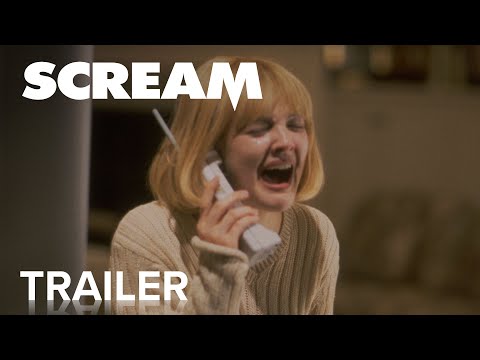
The opening call (1996): Drew Barrymore’s Casey Becker, the film’s biggest star, answers the phone — “Do you like scary movies?” — and does not survive the opening scene. Killing the star first told audiences that anything could happen, and everything since has been measured against it.
The rules (1996): At a house party, video-store clerk Randy lays out the rules for surviving a horror movie while, room by room, Ghostface closes in on the people breaking them.
The garage door (1996): Tatum, trapped in the garage, tries to escape through the pet door in the garage door itself — one of the series’ most talked-about deaths, built out of tension rather than gore.
The movie theatre (1997): Scream 2 opens at a preview screening of Stab, in an audience full of people wearing Ghostface masks, cheering at a murder they think is a stunt. It is not.
The bodega (2023): Scream VI takes the mask to New York and gives it a shotgun in a corner store — the moment the series proved Ghostface could stalk a city that never sleeps and still be the scariest thing in it.
The Numbers
The original Scream opened on December 20, 1996 — a date nobody schedules a slasher for — and made about $173 million worldwide, reviving a genre the industry had left for dead. Williamson had developed the script under the title Scary Movie, which the parody film later cheerfully stole. Three decades on, the series passed $1 billion worldwide during Scream 7‘s opening run in February 2026, making it the highest-grossing slasher franchise in film history, and Scream 7 itself passed $200 million to become the biggest single film in the series. The little Halloween-store mask outperformed every icon the genre built on purpose.
Beyond the Films
Television had to work around the face. The Scream series that ran on MTV in 2015 and 2016 could not use the mask at all — the rights sit with Fun World, not with the show — so it invented a different masked killer and a different voice, supplied by Mike Vaughn. When the series moved to VH1 for its third season, Scream: Resurrection in 2019, the original mask and Jackson’s voice came home, hunting a new cast through killers Beth and Jamal “Jay” Elliot.
Games ran into the same rights wall and climbed it the same way. Dead by Daylight added Ghost Face in June 2019 under a licence for the mask alone, so the game invented its own man underneath: Danny Johnson, a small-town journalist who murders his own news stories and files them under the pen name Jed Olsen. The face, meanwhile, has turned up everywhere a Halloween event needs one — a Call of Duty operator with Jackson voicing it, a Mortal Kombat 1 fighter, a Fortnite skin, an Among Us costume, a Hunt: Showdown event. And the parody is immortal in its own right: Scary Movie (2000) built its killer from Ghostface and handed the mask to Doofy, the one Ghostface nobody has ever feared.
Why Ghostface Lasts
Freddy has his face, Jason has his, Michael has the shape of his. Ghostface has a product — something manufactured by the thousand, sold in a plastic packet and owned, to this day, by a party-supply company. That should make him the cheapest of the icons, and instead it makes him the most honest one. Every generation of Scream gets the Ghostface its moment deserves: a spurned boyfriend, a fame-hungry film student, a bitter half-brother, a toxic fan, a grieving father, a deepfake. The mask is the one constant because the mask is the accusation — that the call is always coming from somebody who knows your name, your house and your favourite scary movie. Pick up the phone.
Test Your Knowledge: Ghostface Trivia
Results