
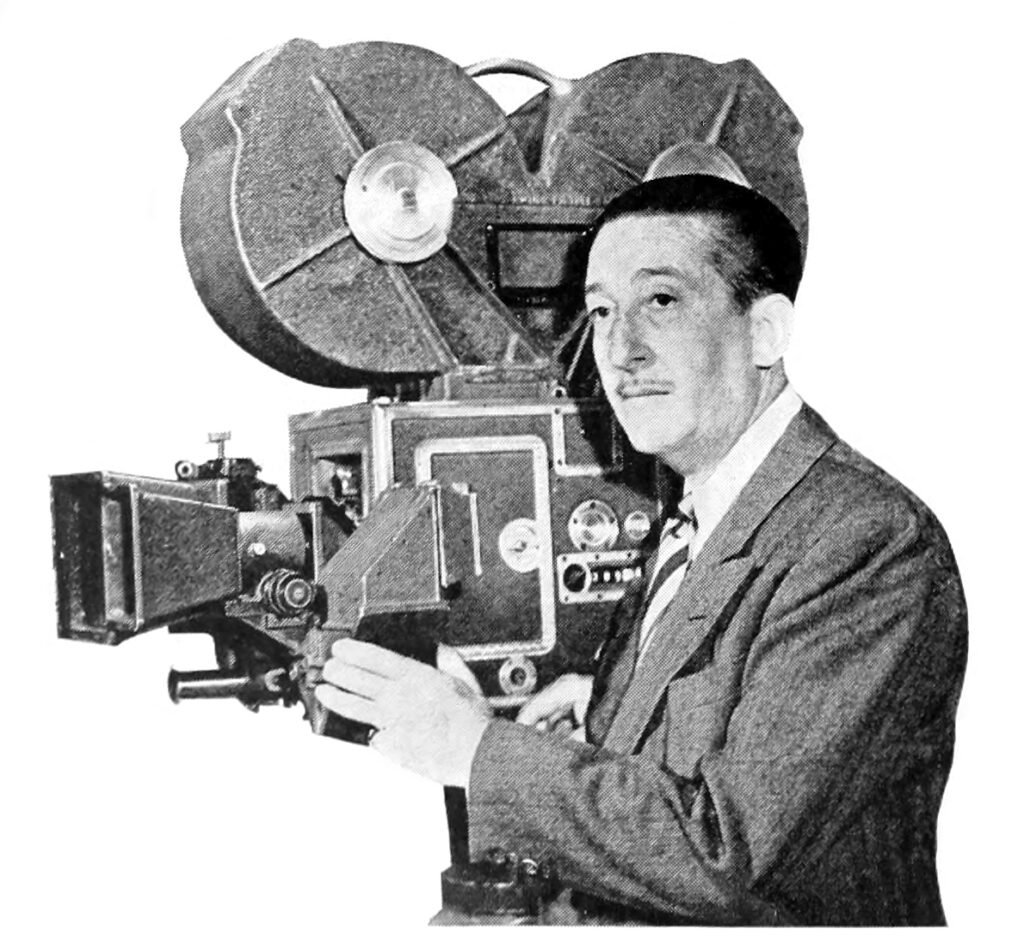
Karl Freund (1890–1969) was the German cinematographer who unchained the camera — strapped it to his chest, lowered it down wires, set it swinging — and in doing so helped invent the moving camera language every horror film since takes for granted. Then he carried Weimar’s light into Universal horror, photographed Dracula, directed The Mummy, won an Oscar, and in his sixties rebuilt the visual grammar of television comedy for I Love Lucy. Three careers, any one of which would be enough. He had all of them, in sequence, and the middle one is ours.
Projectionist at Fifteen
Karl W. Freund was born on 16 January 1890 in Dvůr Králové — Königinhof in the German of the time — in Bohemia, then part of Austria-Hungary and now in the Czech Republic. His family moved to Berlin when he was eleven. In 1905, aged fifteen, he was hired as an apprentice projectionist for Alfred Duskes’ films; by 1907 he was working as a cameraman and newsreel photographer, with newsreel work for Pathé in 1908 and Sascha-Film in Vienna in 1910 in the reference record, after an apprenticeship to a rubber-stamp manufacturer. No film school. The trade itself, learned from the projection booth up.
He was drafted into the Imperial Austrian Army in the First World War and released after only about three months — the record supports nothing beyond that, and this page states nothing beyond that. By the end of the war he was also operating a film processing laboratory, which he ran from 1919 to 1926. Keep the laboratory in mind: the technician’s grounding — a man who did not just use the technology of cinematography but kept manufacturing parts of it — runs under everything that follows. He died on 3 May 1969 in Santa Monica, California, aged 79.
The Unchained Camera
His foundational horror credit came early: The Golem (1920), Paul Wegener’s Der Golem, wie er in die Welt kam, where the reference filmography lists Freund as co-cinematographer — a shared photography credit, and it is printed here as shared, because that is what it was.
Then the film that made his name. On F. W. Murnau‘s The Last Laugh (1924), Freund and Murnau developed the elaborate camera movements later named the entfesselte Kamera — the unchained camera. The methods were physical, almost athletic: a camera strapped to Freund’s chest as he rode a bicycle into an elevator and out to the street; a camera sent down a wire from a window to the street, the shot reversed in editing; the camera worn on his stomach as he walked, or mounted on carts, tracks and cranes. Marcel Carné’s verdict on the result: the camera “glides, rises, zooms or weaves where the story takes it… becomes a character in the drama.” Credit-sharing discipline matters even here: the innovation belongs to the Murnau–Freund collaboration, on writer Carl Mayer’s conception. Freund’s own late-life claim — that he did it all while Murnau never looked through the camera — is his side of an old argument, disputed on the record by the film’s set designers, and it is printed here as his claim, not as the fact of the matter.
The mid-twenties were his UFA peak: E. A. Dupont’s Varieté (1925), Murnau’s Tartuffe (1926), and an oddity — an acting appearance in Carl Theodor Dreyer’s Michael (1924), his only known acting credit, on a film he also co-photographed. In 1927 came Metropolis, Fritz Lang’s film and his best-known German credit, and in the same year he co-wrote and photographed Walter Ruttmann’s Berlin: Symphony of a Great City, developing a high-speed film stock that made night exteriors without artificial light feasible. He served as production head of Fox-Europa from 1926 to 1928, then colour-process experiments took him first to New York and then to Hollywood. He emigrated to the United States in 1929 — a professional move, years before the Nazi seizure of power; do not let anyone retrofit a refugee-escape story onto a 1929 career decision. He signed with Universal for 1930–35, then MGM, then Warner Bros.
Universal Horror: Behind the Camera, Then in the Director’s Chair
Now the passage where this page earns its keep, because Freund’s horror credits swap jobs so often in sloppy sources that the swap itself is the trap. State them one at a time.
Dracula (1931): cinematographer. The director was Tod Browning. There is a legend — repeated in the Wikipedia lineage itself, in the form that Browning left Freund to take over during much of the filming, making him “something of an uncredited director” — and it is printed here as exactly what it is: an attributed legend, resting on retrospective claims, not on the film’s credits or the contemporary record. The directed-by credit of record is Browning’s. What is Freund’s, beyond dispute, is the photography: the chiaroscuro that the Film Reference essay calls, of this film and Murders in the Rue Morgue, “the perfect showcase for Freund’s abilities with chiaroscuro lighting.” He photographed the look of Universal horror. That needs no legend to inflate it.
Murders in the Rue Morgue (1932): cinematographer. Robert Florey directed; Bela Lugosi starred. Same discipline, same answer.
The Mummy (1932): director — his first film as director in the standard reference record, and his Hollywood directorial debut. Boris Karloff played Imhotep, and what Freund made was a cinematographer’s film: slow, dreamlike, visually driven, built on stillness, ritual and the famous resurrection sequence rather than on the shock mechanics of the other Universal horrors. He directed a string of Universal films across genres over the following two years — musical comedy, espionage, comedies — a real but generalist directing career, none of it matching The Mummy.
Mad Love (1935), at MGM at Irving Thalberg’s instigation, was his last film as director — stated identically across every serious lineage in the record. Peter Lorre’s Hollywood debut, as Dr. Gogol, in a remake of Robert Wiene’s Orlac’s Hände, with Colin Clive among the cast. And savour the irony, because it is the best sentence in his filmography: the great cameraman’s most expressionist Hollywood film was photographed by somebody else — Gregg Toland, the next great cameraman. Freund directed Mad Love; he did not photograph it.
MGM, the Oscar, and the Meter Business
After Mad Love he returned to full-time cinematography under his MGM contract (1935–47): two Greta Garbo films, Camille (1936) among them, plus Golden Boy (1939), Pride and Prejudice (1940), Tortilla Flat (1942), A Guy Named Joe (1943) and The Seventh Cross in the reference lists. The summit of those years: The Good Earth (1937), Sidney Franklin directing, Irving Thalberg’s last production — for which Freund won the Academy Award for Best Cinematography. A win, not a nomination; the distinction is the whole point, and the TCM awards record, filmportal.de and the International Dictionary of Films and Filmmakers all state it the same way. His Warner Bros. years (1947–50) brought Key Largo (1948) for John Huston, and his last feature as cinematographer was Bright Leaf (1950).
In parallel, the inventor’s habit went commercial. In the early 1940s — the founding year is given as 1941 in one respectable lineage and 1944 in two others, so this page prints the range rather than choosing — he founded the Photo Research Corporation in Burbank, to manufacture exposure and light meters: the Norwood Director direct-reading incident meter, developed with Donald W. Norwood and later produced under the Spectra name, and television cameras besides. The meter work earned him Academy recognition for technical achievement in the 1950s. The man who lit the monsters ended up building the instruments the whole industry measured light with.
The Third Act: I Love Lucy
In 1951, Desi Arnaz persuaded him to become the cinematographer for I Love Lucy at Desilu. His title there is given as supervising photographer in the reference record, and as Director of Photography in the show’s credit and his own SMPTE journal account — either framing is sourced; what he was not was the show’s director or producer. What he did was the technical core of his second career.
He designed the “flat lighting” system for multi-camera sitcoms: an overhead system covering the set in even light, eliminating shadows, extended by painting walls and costuming actors in grey tones — so that three moving cameras could shoot without relighting between shots. And he did not invent the three-camera system; he perfected it — that exact formulation, perfected not invented, is the sourced one — for use with film cameras in front of a live audience. The rig, from his own SMPTE account: BNC Mitchell cameras on dollies with T-stop calibrated lenses, the centre camera taking the wider shots and the other two at 75 to 90 degrees for close-ups, overhead lighting on catwalks keeping cables off the floor so the dollies could move freely, editing on a Moviola. He and his team also worked on other Desilu sitcoms, including Our Miss Brooks and December Bride, across 1951–59. He retired in 1960, to his farm in the San Fernando Valley, where — per filmportal.de’s coda — he continued his research projects and taught cinematography seminars in Hollywood.
How He Worked
The through-line is physicality. The unchained camera was not a metaphor: chest-strapped bicycle rides, a camera lowered on a wire and the footage reversed, a camera worn on his stomach, cameras on carts and cranes. Freund’s body was part of the apparatus, from The Last Laugh to the dolly-mounted rigs of Desilu. Then the principle under the physicality: chiaroscuro for horror, flat light for comedy — opposite lighting philosophies from the same man, one rule underneath both. The lighting serves the machine of the scene, never decoration. For Dracula’s crypt, shadow. For Lucy’s living room, shadow abolished, because the format needed light that never changed.
Screenwriter Richard Brooks told the most flavourful story about his set wisdom — Brooks’ anecdote, attributed to Brooks: before Brooks’ directorial debut, Freund gave him reels of his own 1922 films as “Lesson Number One,” and the lesson was that agonising over camera placement is secondary. “Lesson Number One. Get to the point.” From the man who moved the camera more than anyone alive, that lands exactly as it should.
Why Freund Matters to Horror
He photographed the look of Universal horror — Dracula and Murders in the Rue Morgue are the chiaroscuro foundation of the monster style, shot by an Expressionist master imported from UFA. He directed two of the era’s defining horror films: The Mummy, the dreamiest of the Universal classics, and Mad Love, the most openly Expressionist American horror film of its decade — a directing filmography with essentially two horror titles, both canonical. And he is the bridge figure in person: The Golem, The Last Laugh, Metropolis on one side; Dracula, The Mummy, Mad Love on the other. No other single craftsman personally carries the camera language of Weimar cinema into the Universal monster cycle — and then, for an encore, into American television comedy.
Trivia
- His only known acting credit is in Dreyer’s Michael (1924) — a film he also co-photographed.
- Mad Love, his most expressionist Hollywood film as director, was photographed by Gregg Toland. Freund did not shoot his own best directing showcase.
- He ran a film processing laboratory from 1919 to 1926 — years before fame, he was already building parts of the industry’s technology, a habit that ended with Photo Research’s light meters.
- The Berlin: Symphony of a Great City night scenes were possible because he developed a high-speed film stock that worked without artificial light.
FAQ
Did Karl Freund direct Dracula?
No. Tod Browning directed Dracula (1931); Freund was its cinematographer. The story that Browning left much of the shoot to him is a later legend, printed on this page as a legend — the directing credit of record is Browning’s. Freund’s actual Universal directing debut is The Mummy (1932).
Did Freund invent the three-camera system for I Love Lucy?
No — he perfected it, for film cameras in front of a live audience. What he designed was the flat-lighting system that made the three-camera method work. “Perfected, not invented” is the sourced formulation, and it is impressive enough.
Did Freund win an Oscar?
Yes. He won the Academy Award for Best Cinematography for The Good Earth (1937) — a win, not a nomination — and later received Academy recognition for technical achievement for his light-meter work in the 1950s.
Did Freund photograph Frankenstein or The Invisible Man?
No. Those credits circulate in low-grade web biographies and are not his — Frankenstein (1931) was photographed by Arthur Edeson. Freund’s Universal horror photography is Dracula and Murders in the Rue Morgue; his directing is The Mummy and Mad Love.