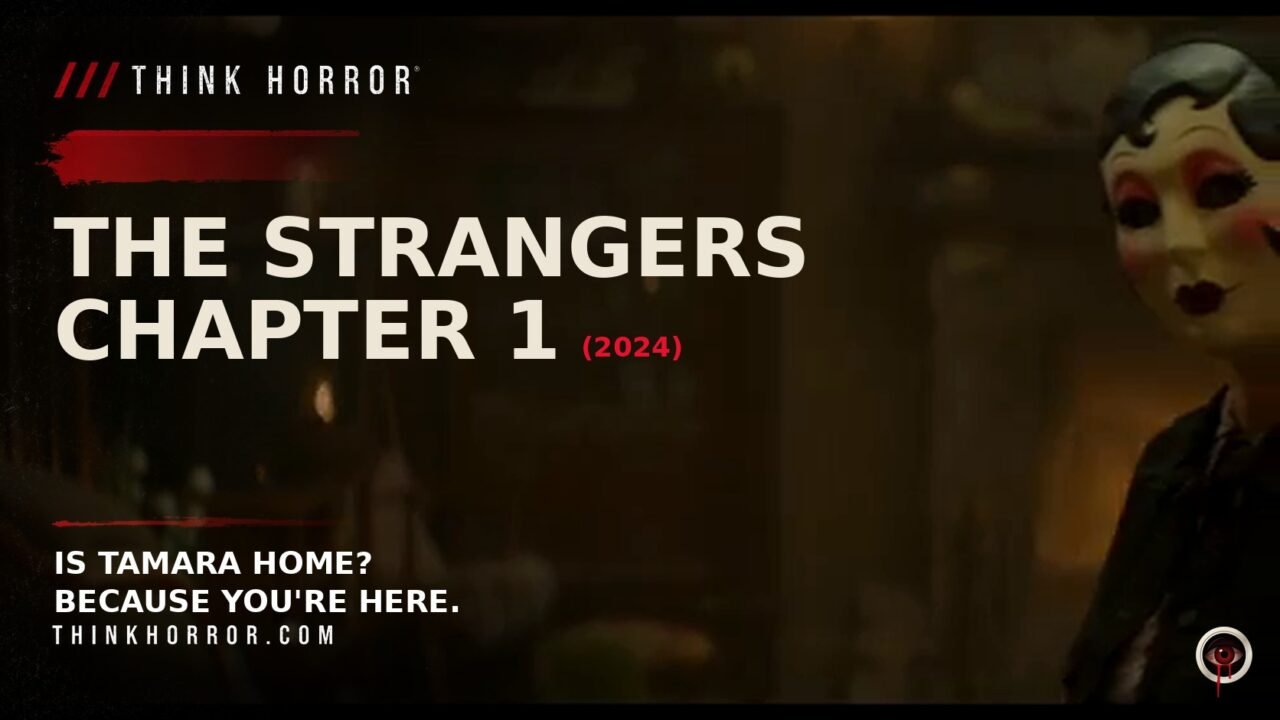
The Strangers: Chapter 1 is a beat-for-beat retread of the 2008 home-invasion classic, shot as act one of a trilogy nobody asked for.
It begins, as it had to, with the knock. A young woman at a cabin door at night, lit by the porch light, asking the coldest question in modern horror: “Is Tamara home?” In 2008, that question — and the answer that eventually followed it, “because you were home” — made The Strangers into the defining home-invasion film of its generation: three masks, one house, no motive, no mercy, and a silence where the score should be. Sixteen years later, the knock comes again, in a new cabin, with a new couple behind the door. Tonight’s file asks the only question that matters about The Strangers: Chapter 1 — if the knock is the same, why doesn’t it scare us the same way?
Welcome back to the crypt. The Strangers: Chapter 1 opened on May 17, 2024, directed by Renny Harlin for Lionsgate, from a screenplay by Alan R. Cohen and Alan Freedland and a story by Bryan Bertino, who wrote and directed the original. It is the first instalment of a trilogy shot all at once — three films, fifty-two days, one shoot in Bratislava, Slovakia — an industrial gambit as ambitious as anything horror attempted this decade. The desk admires the gambit. The desk has now seen what the gambit produced first, and the report is what follows.
Watch the Trailer

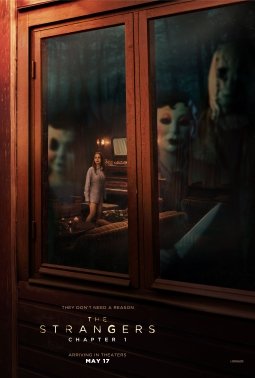
Quick Specs
- Director: Renny Harlin
- Writers: Screenplay by Alan R. Cohen and Alan Freedland; story by Bryan Bertino
- Cast: Madelaine Petsch, Froy Gutierrez, Ema Horvath, Richard Brake
- Producers: Courtney Solomon, Mark Canton
- Distributor: Lionsgate
- Release Date: May 17, 2024 (United States)
- Runtime: 91 minutes
- Rating: R
- Budget: $8.5 million
- Box Office: $48.2 million (worldwide gross)
The Review
Before the knock, an overture the original never needed: in 2017, in the woods outside Venus, Oregon, a businessman named Jeff Morell is ambushed and axed by three masked figures. Then the film proper. Maya (Madelaine Petsch) and Ryan (Froy Gutierrez) are driving cross-country to Portland and a new life, five years together, when their car gives out in Venus — a town that receives them with the warm hospitality of a held stare. The mechanic will fix the car by morning. The waitress, Shelly (Ema Horvath), drives them to a secluded Airbnb cabin. And that night, a girl knocks on the door asking for Tamara.
What follows is the 2008 film, re-performed with more machinery and less air. The knock repeats. Maya showers while a masked man watches from the doorway’s edge. The power dies. A dead chicken hangs from the ceiling, throat slit. The couple hides in the crawl space; Maya’s hand finds a nail. Ryan gets hold of a shotgun and, firing at footsteps on the porch, kills Joe — the cabin’s owner, the one innocent man in the county. The masked three run the couple off the road, take them in the woods, and tie them to chairs in the cabin for the ritual the audience has been waiting ninety minutes to hear again. Ryan, bleeding, proposes; Maya accepts; and when she demands to know why, Pin-Up Girl gives her the updated scripture: “Because you’re here.” Maya survives — barely, and alone — and wakes in a hospital bed to find Scarecrow lying in it beside her. End of chapter. Literally: the film stops the way a streaming episode stops, mid-gesture, because its makers have two more films already in the can.
Here is the thing the desk cannot get past. The 2008 film is a marvel of subtraction: two people, one house, three intruders, and a director patient enough to hold on empty rooms until the emptiness itself becomes frightening. Chapter 1 keeps the floor plan and renovates everything else. The killers get a prologue, which turns motiveless evil into a practice with a history. The town gets a conspiracy of glares, which imports a folk-horror menace the film never cashes. The couple gets a five-year anniversary, a job interview, a proposal — biography where the original put two people who could have been anyone, which was precisely the terror of it: it could happen to anyone because it was happening to no one in particular. Harlin has said the trilogy is neither a remake nor a reboot, and that all three films are one four-and-a-half-hour movie of which this is the first act. The desk believes the second claim entirely, and it explains the first one’s failure: an act is not a film, and a first act that replays a complete earlier film is a photocopy with a mortgage.
And yet the photocopy is handsomely made. José David Montero’s photography gives the Slovakian woods (standing in for Oregon) a wet, green depth, the cabin interiors are lit like a held breath, and the sound design understands that the knock must be the loudest thing in the world. Petsch, who also executive-produced, plays Maya without a single false note of franchise awareness — she is frightened the way people are actually frightened, which curdles into something feral and fine in the last act. There are two minutes, here and there, where a masked figure stands in a background the camera refuses to underline, and the old charge runs down the wire. Then the machinery starts again, and the moment is filed under setup for a sequel.
What Works
- Madelaine Petsch carries the whole film on her face. Maya is written thin and played full: the irritation of the stranded traveller, the social embarrassment of the first knock, the slow arithmetic of realising the night is not going to end — Petsch tracks all of it without ever playing to the balcony. When the film finally lets her fight, she is entirely convincing. If the trilogy has a reason to exist, she is most of it.
- The craft is real. Whatever its script is doing, Chapter 1 is a professionally frightening-looking film: deep-shadow photography, a cabin that feels genuinely isolated, and sound work that treats silence as an instrument. Harlin has been directing action and horror for four decades, and the set pieces — the crawl space, the truck ramming the escape car — are staged with a veteran’s economy.
- The masks have not lost their power in stillness. Scarecrow in the shower doorway, Dollface simply present at a room’s edge — the iconography Bertino built still works when the film stops explaining it. The two or three shots that trust the masks to do nothing are the scariest in the picture, and they’re a standing rebuke to everything around them.
- The industrial gamble is genuinely interesting. Three features, shot interleaved over fifty-two days, chapters swapped morning to afternoon — as a production story it is the most interesting thing about Chapter 1, and Harlin’s account of the continuity headaches is a better tale than the one on screen. The desk reports this under What Works because the ambition deserves recording, even when the first fruit of it doesn’t.
What Doesn’t
- It is a remake that insists it isn’t. The knock, the question, the shower, the closet, the chairs, the answer — the film restages the 2008 picture’s every signature beat in order, with the serial numbers of sequel and prequel filed off and “first act” stamped on the crate. A remake can be a fine thing; several of this site’s favourites are remakes. But a remake too proud to say its name gets the obligations of both forms and the freedoms of neither.
- Every addition subtracts. The 2017 prologue tells us the killers have done this before, on schedule, which is information the audience should never be given — the original’s horror is that there is nothing to know. The hostile town promises a conspiracy the film forgets. The dead chicken is escalation as decoration. Each new element moves the Strangers closer to being characters, and every step in that direction makes them smaller.
- Ryan’s shotgun is the film’s one new idea, and it goes nowhere. The accidental killing of Joe is a genuinely dark invention — the couple’s rescue weapon turned on the only rescuer — and the film raises it, registers it, and drops it within a scene, because the beat sheet requires the chairs by a certain page. In a braver film, that accident is the hinge. Here it is a footnote with a body in it.
- It doesn’t end; it pauses. The hospital stinger — Scarecrow in the bed — is a trailer for Chapter 2 wearing an ending’s clothes. Audiences who bought a ticket to a film are entitled to a film; what they received was a deposit. Whatever the merits of the four-and-a-half-hour whole, Chapter 1 judged alone is a beginning in search of its middle, and beginnings are not supposed to need defending.
The ledger, as ever, is cheerfully indifferent to the criticism. Chapter 1 cost $8.5 million and took $48.2 million worldwide — $35.2 million of it in the United States and Canada — opening in third place with $12 million. By the arithmetic of the business, the bet was won before the reviews arrived: three films in the can for a modest outlay, the first of them profitable on its own. Both sequels are now released — Chapter 2 in September 2025, Chapter 3 in February 2026 — and the four-and-a-half-hour sentence Harlin described is fully written, for whoever wishes to read it end to end. The desk’s advice is to read the 2008 original twice instead. It is shorter, it is complete, and the knock still works.
Full disclosure, because Harper keeps an honest crypt: this is a desk verdict — built from the verified record, the production history and the consensus — not a fresh team screening. The desk has answered that knock before, in a better film, and the memory stood in the doorway all through this one.
Harper’s verdict: 2 ravens — on life support.
Trivia & Facts
- Three films, fifty-two days, one shoot. The whole trilogy was filmed in Bratislava, Slovakia, from September to November 2022, with the production alternating between chapters sometimes within a single day. Harlin called it “the challenge of a lifetime” — shooting the second chapter on a Monday morning, the first on Monday afternoon, the third on Tuesday — with continuity of make-up, wardrobe and performance tracked across all three at once.
- “One 4.5-hour movie.” Harlin’s own description of the trilogy: a single story arc in which the first film is a first act — setting up the characters, the terror and the killers, and a heroine who survives to carry the next two chapters across the four days that follow her first night. It is the most honest account of Chapter 1’s shape ever given, and its director gave it.
- The answer got shorter. In 2008, asked why, the killers answered: “Because you were home.” Chapter 1 updates the scripture by one word’s deletion — “Because you’re here.” Bertino has said the original grew out of the Manson murders and a childhood memory of strangers knocking on doors in his neighbourhood, asking for someone who didn’t live there. The knock has been travelling for half a century. It reached Venus, Oregon, eventually.
- The trilogy is complete. Chapter 2 followed on September 26, 2025, and Chapter 3 closed the arc on February 6, 2026 — the site’s news desk covered the finale’s home release. Maya’s story, whatever one thinks of its first act, is now a whole that can be judged as Harlin intended: end to end.
Harper’s Extras
- The Strangers (2008) — the wiki file: the original case — Bertino’s knock, Tyler and Speedman, and the night that defined a subgenre.
- The trilogy ends — our Chapter 3 news file: the desk’s own report on the final chapter’s arrival on 4K and digital.
- Crank it: “Trouble” by Cage the Elephant — the trailer’s pulse; it never actually plays in the film — the record the strangers put on is the Moody Blues’ “Nights in White Satin,” which is somehow worse. Play it on a road trip. Check the rear-view mirror twice.
Where to Watch
As of November 7, 2026, it’s streaming on Starz in the US; rent or buy it on Amazon Video, Apple TV Store or Fandango At Home.
Frequently Asked Questions
Is The Strangers: Chapter 1 a remake or a prequel?
Officially, neither: the filmmakers describe the trilogy as a new story in the same continuity as the original films, and Harlin has been firm that it is not a remake or a reboot. On screen, Chapter 1 replays the 2008 film’s structure and signature scenes — the knock, the Tamara question, the chairs, the answer — with a new couple, so most viewers experience it as a remake in all but name. Its sequels move the story into genuinely new territory.
Do I need to watch the 2008 film first?
No — Chapter 1 assumes nothing and explains itself as it goes. But if you watch only one version of this story, the desk recommends the 2008 original: it is the leaner, colder and more frightening film, and it is a complete story in a single sitting. Our wiki file on the original has the full case history.
Does Chapter 1 have a proper ending?
It has a stopping point and a stinger. Maya survives the night; the hospital coda sets up Chapter 2 directly, and the story continues across Chapters 2 and 3, which follow her over the next four days. Both sequels are now released, so the complete trilogy can be watched end to end — which is how its director has always said it should be judged.
Are the killers the same as in the original?
The same three figures — Dollface, Pin-Up Girl and the Man, here called Scarecrow — in the same masks, with the same ritual and the same refusal of motive. The trilogy treats them as a constant of its world rather than characters with an origin; Chapter 1’s 2017 prologue shows them at work years before Maya’s night, and pointedly explains nothing about who they are.
Until next time, fiends — if the knock comes and you’re not expecting anyone, don’t answer it, and if they ask for Tamara, she doesn’t live there. She never did. Harper will keep a candle lit for you. It’s by the door, where he can watch it.
The weekly roundup
One letter a week, from the crypt.
- New reviews, with the ravens
- New wiki entries and news
- Cool stuff worth your night
Weekly. No spam, unsubscribe in one click.