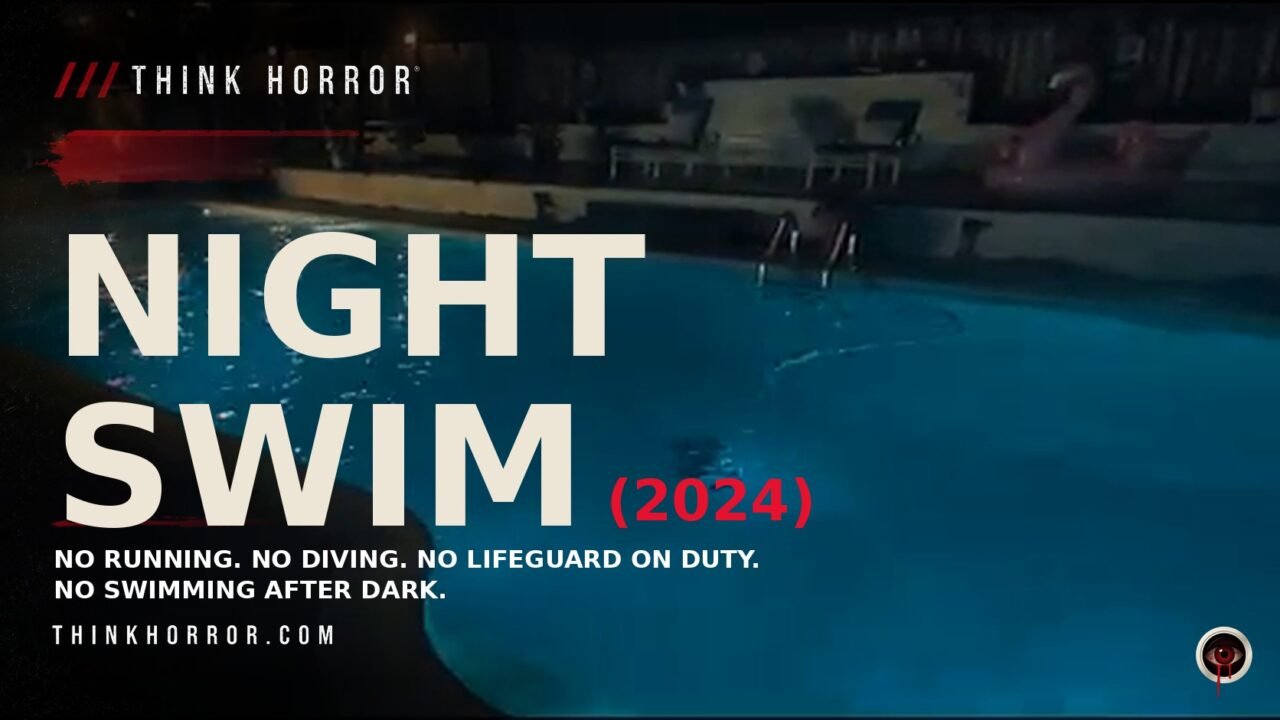
Night Swim is a haunted-house movie where the house is a swimming pool, and the water heals a dying ballplayer — at a price.
It opens in 1992, at night, with a little girl padding out to the family pool in her nightdress to fish her sick brother’s toy boat out of the water. The boat keeps drifting just past her fingers. Something in the deep end is patient, and the pool takes her the way a held breath takes a swimmer — quietly, and completely. It is the best scene in the film. Keep it in mind. The film will spend ninety minutes trying to be worthy of it.
Welcome back to the crypt. Tonight’s file is a recent one: Night Swim, which opened on January 5, 2024, from writer-director Bryce McGuire, expanding the five-minute short he made with Rod Blackhurst in 2014 into a feature for producers Jason Blum and James Wan — the first film released after their Blumhouse and Atomic Monster companies merged. Universal Pictures put it in the January slot, the traditional dumping ground where horror goes to be forgiven. Some January pictures earn the forgiveness. This one earns about half of it.
Watch the Trailer

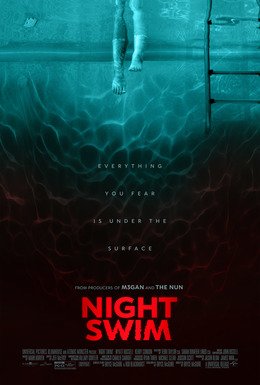
Quick Specs
- Director: Bryce McGuire
- Writer: Screenplay by Bryce McGuire; story by Bryce McGuire and Rod Blackhurst, based on their 2014 short film
- Cast: Wyatt Russell, Kerry Condon, Amélie Hoeferle, Gavin Warren, Jodi Long, Nancy Lenehan
- Producers: Jason Blum, James Wan
- Distributor: Universal Pictures
- Release Date: January 5, 2024 (United States)
- Runtime: 98 minutes
- Rating: PG-13
- Budget: $15 million
- Box Office: $54.8 million (worldwide gross)
The Review
Ray Waller (Wyatt Russell) was a major-league ballplayer until multiple sclerosis took the game, and then started taking everything else. The Wallers — Ray, his wife Eve (Kerry Condon), teenage Izzy (Amélie Hoeferle) and young Elliot (Gavin Warren) — buy a suburban house with a backyard pool, partly because the water is supposed to be therapy for Ray. The pool turns out to be self-sustaining, fed by an underground spring. And the water works. Ray’s strength comes back. His symptoms retreat. He is getting better every day, in a house where, in 1992, a girl named Rebecca Summers went into the same water and never came out.
The film’s engine is an old bargain in new water: the spring heals, and the spring collects. Eve slowly pieces together the house’s history of disappearances, and a visit to Rebecca’s mother, Lucy (Jodi Long), delivers the mythology in one long, late speech — an ancient healing spring, a guardian that demands a life in exchange for its gift, and a mother who once paid the price with her daughter to save her son. By then the entity has its hooks into Ray, and the last act becomes a fight for the children in and around the water, ending with Ray giving the pool the only payment it will accept from him.
Let’s be fair to the water first. The premise is a genuine find — a haunted swimming pool sounds like a joke until you remember being nine years old, alone at the deep end at dusk, suddenly certain the drain had intentions. McGuire, who grew up in Florida and has spoken about fearing his own family’s pool as a boy, understands that the fear is real and specific: clear water, total visibility, and still the feeling that something is rising. Cinematographer Charlie Sarroff and underwater cinematographer Ian Takahashi shoot the pool wet-for-wet, with older, wider lenses chosen to make nine feet of water feel oceanic, and for stretches the film achieves it. The Marco Polo sequence — Izzy in the water at night, calling the game to an empty yard, and hearing an answer — takes the short film’s whole situation, a swimmer alone in the dark with something else in the water, and stretches it to feature scale. It works exactly once, beautifully, because it trusts the game to be the scare.
The trouble is the arithmetic. A five-minute short is one situation and one turn; a ninety-eight-minute feature needs a middle, and this one’s middle is mostly repetition with the volume turned down: another coin glinting at the bottom, another figure at the pool’s edge, another family conversation that circles the same drain. The mythology, when it finally arrives, arrives all at once and raises more than it settles — the guardian’s rules bend to whatever the next scene requires, and a grounded family drama about illness keeps colliding with a fairy-tale price list it never quite absorbs. Russell and Condon do honest, unshowy work — Condon, fresh off an Academy Award nomination, carries the film’s fear almost entirely in her face — but the script gives them a marriage to play in the first hour and a mechanics problem in the last, and the mechanics win.
What Works
- The pool itself is a real movie star. Shot at night, lit from within, steaming at the edges, the water is the most expressive presence in the film. The production used a real nine-foot backyard pool in Altadena and a thirteen-foot Olympic pool in Chatsworth, filled the frame with actual water instead of digital simulation, and it shows: every splash lands, every underwater shot has weight and murk. When the film simply lets the pool be beautiful and wrong, it is onto something.
- Condon and Russell play it straight. Neither actor winks at the premise. Russell charts Ray’s recovery as a man falling in love with his own returning body — which makes his corruption by the water a seduction, not a switch — and Condon does the film’s real horror work, registering each new wrongness half a beat before the film says it out loud. A weaker cast sinks this premise in the first reel.
- Mark Korven’s score comes from under the water. Korven — the composer behind The Witch and The Black Phone — builds the music out of drowned, choral textures. McGuire described wanting music that felt “like some drowned choir rising from the depths,” and Korven delivers exactly that: a score that sounds like hymns heard through the deep end. It frightens more reliably than the entity does.
- The prologue honours the short. The 1992 opening — a girl, a toy boat, a patient pool — is lean, cruel and complete. It is the 2014 short’s DNA at its purest, and proof that the idea, at the right length, is a small classic of its kind.
What Doesn’t
- Ninety-eight minutes is a long time to tread water. The short film had one idea and five minutes. The feature has the same idea and adds a mythology, a marriage and a medical drama — and still visibly pads the middle with variations of scenes it has already played. You can feel the premise’s natural length, and it is not this.
- The rules arrive late and bend early. What the guardian can do — leave the water, ride a host, demand a specific child — shifts from scene to scene, and the explanation, when Lucy finally delivers it, is a single speech doing the work of an hour of storytelling. Horror survives on rules the audience can dread. Here, the dread keeps getting renegotiated.
- The scares were all in the trailer. The Marco Polo beat, the coins, the diving board, the thing at the bottom — the campaign showed the film’s whole hand, and the feature adds volume rather than new cards. If you saw the trailer in the winter of 2023, you have seen the film’s best self; what remains is the waiting between its moments.
- The ending pays a debt the film didn’t build. Ray’s final choice should be the picture’s emotional detonation. But because the middle hour kept the family at arm’s length — plot first, people second — the sacrifice lands as mechanics: the correct move, correctly executed, at a fraction of the power the prologue promised this story could hold.
The ledger is a study in modest arithmetic. Night Swim cost $15 million, opened in second place with $12 million, and finished with $54.8 million worldwide — a profit, and not a small one, for a film that arrived in the year’s coldest slot as the first release of the newly merged Blumhouse and Atomic Monster. The machine worked. The movie it was selling, by the consensus of nearly everyone who bought a ticket or a critic’s seat, mostly didn’t — and yet the machine will do it again next January, because the arithmetic says it should. That, fiends, is the most honest horror story in this whole file.
Full disclosure, because Harper keeps an honest crypt: this is a desk verdict — built from the verified record, the production history and the consensus — not a fresh team screening. The desk’s quarrel was never with the premise. It was with the clock.
Harper’s verdict: 2 ravens — on life support.
Trivia & Facts
- The short was shot in a pop star’s backyard. McGuire and Blackhurst made the original five-minute Night Swim in 2014 in musician Michelle Branch’s backyard, with Megalyn Echikunwoke in the lead — the character who became Izzy. It went viral on YouTube, Atomic Monster executive Judson Scott flagged it to James Wan, and Wan bought the feature rights. The girl in the feature’s prologue is the short, remembered.
- The director’s homework is a horror syllabus. McGuire has named his influences on this film: Poltergeist, Creature from the Black Lagoon, Jaws, Christine, The Night of the Hunter and The Abyss. He has said he saw Jaws at ten years old and spent that summer treading water in the family pool, certain the nine-foot-deep water was an abyss with something rising in it. Night Swim is that certainty, filmed.
- It was shot wet, on purpose. The production avoided simulating water with computer animation, filming “wet for wet” — thirty-four days beginning April 11, 2023, split between the Altadena house’s real pool and the Chatsworth Olympic pool. McGuire’s own summary of the method: “Shooting in water is twice as slow, twice as expensive and twice as dangerous as shooting on land.”
- It moved up to the gallows slot. Night Swim was first scheduled for January 19, 2024, then moved up to January 5 — the first weekend of the year, horror’s traditional proving ground — and was streaming on digital platforms eighteen days later, on January 23.
Harper’s Extras
- James Wan — the wiki file: the producer who bought a five-minute short and built it a pool of its own.
- Creature from the Black Lagoon — the wiki file: McGuire’s first influence — the original beautiful thing in dark water, from 1954.
- Crank it: Mark Korven’s score — play “Marco Polo” and “The Deep Water” in the dark, near any body of water you own. Then drain the pool.
Where to Watch
As of November 7, 2026, it’s streaming on Peacock Premium and Peacock Premium Plus in the US, or free with ads on Fandango At Home; rent or buy it on Amazon Video, Apple TV Store or Fandango At Home.
Frequently Asked Questions
Is Night Swim based on a true story?
No. It’s fiction with a home-movie origin: Bryce McGuire and Rod Blackhurst’s 2014 short film of the same name, expanded by McGuire into this feature. The healing-spring mythology is invented folklore — though McGuire has said the fear underneath it, of deep water and what rises in it, comes straight out of his own Florida childhood.
Is Night Swim connected to M3GAN or the other Blumhouse films?
No shared universe and no crossover — it’s a standalone story. The connection is industrial: it was produced by Jason Blum’s Blumhouse and James Wan’s Atomic Monster, and it holds one genuine footnote in the record books as the first film released after the two companies merged on January 2, 2024.
Is there a Night Swim 2?
No sequel has been announced. The film made its money — $54.8 million worldwide on a $15 million budget — but it closed its own loop: the story ends with the pool filled in and the bargain settled. If the water ever rises again, the news desk will file it here first.
Until next time, fiends — check the deep end twice, never swim alone after dark, and if the water starts healing you, ask what it’s healing you for. Harper will keep a candle lit for you. It floats.
The weekly roundup
One letter a week, from the crypt.
- New reviews, with the ravens
- New wiki entries and news
- Cool stuff worth your night
Weekly. No spam, unsubscribe in one click.