
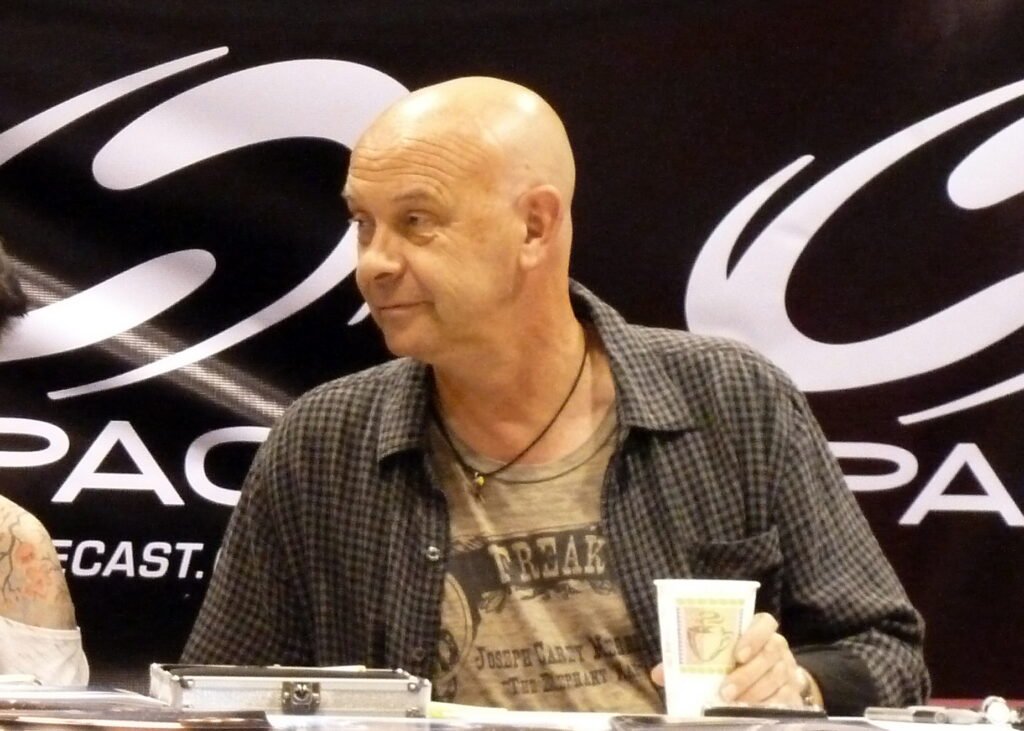
Doug Bradley (born 1954) is the Liverpool theatre actor who became Pinhead — eight Hellraiser films as the Lead Cenobite, horror’s most literate monster.
The slasher era’s monsters were mostly silhouettes — stuntmen behind masks, interchangeable by design. Doug Bradley is the great exception. He came to the most famous mask of the 1980s from a Liverpool school play and a decade of shoestring theatre with his friend Clive Barker, and he played the Lead Cenobite the way a stage actor plays a priest: stillness, diction, patience — menace you have to lean in toward. Eight films across eighteen years. Three productions have since replaced him; none has replaced what he did. And four decades on, when the franchise needed Pinhead’s voice again, there was exactly one place the knowledge of how that voice was made still existed: in Bradley’s memory, because nobody had ever written it down.
This is the biography of horror’s most literate monster — the schoolboy actor who chose the Cenobite over the mattress, took direction in two words (“do less”), and turned a $900,000 independent film into a fifty-year collaboration.
Quick Specs
Full name: Douglas William Bradley
Born: 7 September 1954, Liverpool, England
Family: Married to Steph Sciullo; they live in Pittsburgh
Known for: The Lead Cenobite — “Pinhead” — in the first eight Hellraiser films (1987–2005), Captain Elliot Spencer in Hellbound and Hellraiser III, Dirk Lylesberg in Nightbreed (1990), the voice of the Sith Emperor Vitiate in Star Wars: The Old Republic
Honours: Lifetime Achievement Award, New York City Horror Film Festival
Quarry Bank, 1969: The School Play
Douglas William Bradley was born on 7 September 1954 in Liverpool, England — not Portsmouth, not Sheffield, not 1952, whatever the content farms print — and the decisive event of his career happened when he was fourteen or fifteen. At Quarry Bank High School in Allerton, reporting for rehearsals for the school play in 1969, he met his fellow cast members. One of them was Clive Barker. “I’d known Clive since we did a play together at high school in Liverpool,” Bradley says, and the friendship became a working partnership that outlasted most marriages.
Through the 1970s the two worked in independent theatre in Liverpool and London, culminating in the Dog Company, performing original plays by Barker: Bradley played, among others, the Devil in The History of the Devil and Dr Frankenstein in Frankenstein in Love — a young actor rehearsing, role by role, for the monsters to come. The circle around them included Peter Atkins, who would later write the Hellraiser sequels. The company disbanded in 1982 (sources split on a founding year, so this page gives none), and Bradley worked in provincial repertory theatre. One early screen credit is listed for him — King Herod in Salome (1973) — on thin sourcing, so this page keeps it to exactly this line. Then, in 1985 by his recollection, Barker came to him: he was trying to put together an independent, low-budget British horror film, and thought there might be a part in it.
Hellraiser: The Choice, the Chair, and “Do Less”
The part came with a fork in it. For Hellraiser (1987), Barker’s directorial debut, adapted from his novella The Hellbound Heart — “our $900,000 movie,” in Barker’s own figure — Barker offered his old friend a choice: the Lead Cenobite, or one of the removal men moving furniture in the Cotton house. Bradley’s account is the founding anecdote of the performance: “because Hellraiser was my first movie, I thought it might be a good idea to be seen on screen as myself. But it was a brief conversation. There was no doubt in my mind that this unnamed guy with the pins in his head had a certain je ne sais quoi that a mattress-delivery guy didn’t.”
The name needs its fence, because the record is precise. In the finished film he is credited simply as the Lead Cenobite — early drafts called the character “Priest.” “Pinhead” was a nickname coined by the makeup crew on set; it stuck, but Barker had no say in it and thought it undignified. His later preferred name for the character is the Hell Priest; the man’s human identity, revealed in the sequel, is Captain Elliot Spencer. The Pinhead character page carries the full history; what matters here is that the most famous name in the film is one its creator never chose and its actor was never credited under in 1987. Bradley also inherited the film’s voice by accident of design: the lines scripted for Chatterer and Butterball proved unplayable under their makeups, and much of their dialogue was redistributed to the Lead Cenobite — one reason the character dominates a film in which he is not the lead.
The makeup took five or six hours to apply at first, eventually cut to three or four. “The first time I wore it, I sat in front of the mirror trying to make friends with this new face, playing some lines and seeing where they took me,” Bradley recalls. “Most of my decisions about playing Pinhead were made there and then.” A second telling adds the timescale: “for all the hours I’d spent with the screenplay, I think Pinhead came to me in about ten or fifteen minutes.” Barker’s only repeated direction across the shoot completed the method: “You have no idea how amazing this looks on camera. But do less.” The makeup was so powerful, Bradley understood, that he didn’t need to sell it. Understatement became the performance — measured, courtly, never raised, opposite Kirsty Cotton and the rest of the Cenobites, with Christopher Young’s score doing the screaming for him. The wrap party taught him the cost of the disguise: crew members walked straight past him. “It took me a while to realise it was simply that they had never seen me without the make-up on. They had no idea who I was…” The anonymity of the man behind the mask became a lifelong subject — it is what his book is about.
Eight Films, and the Man Inside Them
Hellbound: Hellraiser II (1988) gave the Cenobite his human origin: Captain Elliot Spencer, the Great War officer who solved the Lament Configuration and became what Bradley already was — the actor now played both the priest and the man he’d been, and did again in Hellraiser III: Hell on Earth (1992), the film in which a character first addresses him as “Pinhead” on screen. Between sequels came Barker’s Nightbreed (1990), with Bradley as Dirk Lylesberg among the monsters of Midian — Lylesberg, whatever the farm spellings say; the passage belongs to Clive Barker’s page, and the credit is his. Then the run that fixes the count, stated as a list because the count is the point: Hellraiser: Bloodline (1996), Inferno (2000, the first direct-to-video entry), Hellseeker (2002), Deader (2005) and Hellworld (2005) — eight films in total, 1987–2005, ending at Hellworld. Not nine, not “all of them.” (Students of the credits will also find an assistant make-up artist named “Bill Bradley” on some of these films. That is Doug Bradley under his middle name — one man, two credits, no namesake.)
The Voice Nobody Wrote Down
After filming Hellraiser, Bradley was called into De Lane Lea Studios in Soho to loop all of Pinhead’s lines so they could be electronically treated — the treated voice is the one in the film. In his own account, when he returned for Hellbound, the studio admitted it had taken no notes on how the effect had been built — words to the effect of, “We wish we’d known there was going to be a sequel when we did this before, because we’d have taken notes.” His conclusion: “the voice has never been the same in any two movies,” the back-to-back Deader and Hellworld possibly excepted. The signatures survived anyway, because they live in the delivery — Barker’s lines made liturgy by that measured calm: “We have such sights to show you.” “No tears, please. It’s a waste of good suffering.” A priest, not a barker, in every sense.
Nearly forty years later the missing notebook became a job. For Clive Barker’s Hellraiser: Revival (2026), Bradley returned to voice Pinhead in a game — the developers confirmed the 1980s process had never been documented anywhere, and the effect was rebuilt from his memory, with Bradley coaching the sound team. He had already returned to the role in Dead by Daylight (2021). Barker’s reported verdict on the reunion is the shortest review the performance will ever get: “Doug is Pinhead and Pinhead is Doug.”
The Succession: Three Films He Is Not In
State them plainly, because aggregators blur exactly this. Hellraiser: Revelations (2011): Bradley was approached, read the script, and declined — in the horror-press account, judging the rushed, rights-retaining production a cash grab; the role went to Stephan Smith Collins on screen, voiced by Fred Tatasciore. Hellraiser: Judgment (2018): director Gary J. Tunnicliffe approached him, and Bradley balked at an NDA carrying a million-dollar liability before he had even read the screenplay; Paul T. Taylor played the role. The 2022 reboot: Jamie Clayton as the Hell Priest, a different interpretation entirely. Bradley appears in none of the three, in any capacity — his later Pinheads are the two games, and the distinction between the filmography and the voice returns is the whole discipline of this section.
The Second Career: A Voice for Hire, a Reader by Habit
The post-Pinhead acting career is steady independent horror — The Prophecy: Uprising (2005), Pumpkinhead: Ashes to Ashes (2006), the Barker adaptation Book of Blood (2009) as Tollington, Wrong Turn 5: Bloodlines (2012) — but the voice built the second career. He is the Sith Emperor Vitiate in Star Wars: The Old Republic; Joe Chill, the murderer of Bruce Wayne’s parents, in Gotham Knights (2023); narrator, on Cradle of Filth’s Existence Is Futile (2021), of “Suffer Our Dominion” and the bonus track “Sisters of the Mist.” And he reads Barker, naturally: the verified anchor is his narration of Barker’s novel Mister B. Gone (2007 audio edition) — the demon-narrated book read by Barker’s own Hell Priest. (He did not narrate The Hellbound Heart; its full-cast audio drama casts Evie Dawnay as the Lead Cenobite.) His own long-running audio series, Doug Bradley’s Spinechillers (from 2009), collects classic horror stories and poems read aloud by him — Poe, Lovecraft, M. R. James among them, with guest readers including Robert Englund and Jeffrey Combs — and in 2020 he took the same habit to a YouTube channel of readings. He is also the author of a book on horror acting and the history of masks in society and the horror film, drawn from the Hellraiser experience and profiling the men behind Chaney, Karloff and the other classic monsters — the unrecognised man of the wrap party writing the profession’s defence of the unrecognised.
Why Doug Bradley Matters
He proved a horror icon can be an acting performance rather than a silhouette. The slasher era’s monsters were mostly stuntmen behind masks, interchangeable by design; Pinhead is the opposite construction — a theatre actor’s stillness, diction and patience held under five hours of makeup across eight films and eighteen years, its menace rhetorical. Barker wrote a priest; Bradley’s restraint is what made audiences lean in instead of flinching away. He is also the surviving half of one of horror’s great partnerships: a 1969 school-play rehearsal at Quarry Bank produced a fifty-year collaboration — Dog Company stages, the Devil and Dr Frankenstein, then a $900,000 film that redirected the genre — with the sequels’ writer and a fellow Cenobite drawn from the same Liverpool circle. And the succession record is the measure of him: three productions replaced him, and when the franchise wanted its voice back in 2026 it did not hire an impersonator — it asked Bradley to teach a sound team how the effect worked, because the knowledge existed nowhere else. The recognition on record is a Lifetime Achievement Award from the New York City Horror Film Festival: one verified honour, no invented ledger. You’ll find him in our Horror Actors index, where the masked performances are measured against the quietest one of all.