
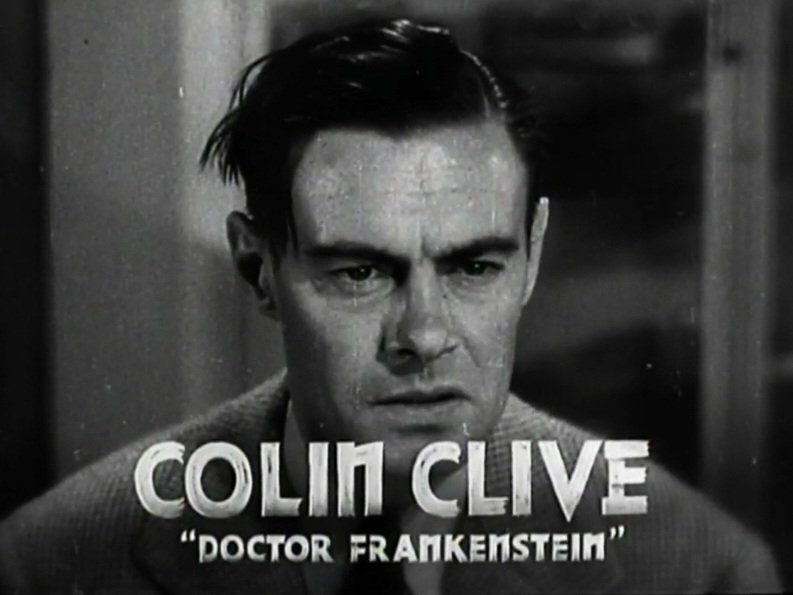
Colin Clive (1900-1937) was the English actor who played Henry Frankenstein for James Whale and gave horror its founding cry, “It’s alive!”
Quick Specs
| Born | Colin Glenn Clive-Greig, January 20, 1900, Saint-Malo, France |
| Died | June 25, 1937, Los Angeles, aged 37 |
| Stage breakthrough | Captain Stanhope in Journey’s End (Savoy Theatre, London, 1929) |
| Horror | Henry Frankenstein in Frankenstein (1931) and Bride of Frankenstein (1935); Stephen Orlac in Mad Love (1935) |
| Director partnership | four films with James Whale |
| Final film | The Woman I Love (1937), as Captain Thelis |
| Famous line | “It’s alive!”, with “Now I know what it feels like to be God!” at No. 49 on AFI’s 100 Movie Quotes |
Who He Is
Colin Glenn Clive-Greig was born in Saint-Malo, France, on January 20, 1900, to Colin Philip Greig and Caroline Margaret Lugard Clive. He went to Stonyhurst College and then to Sandhurst, aiming for the army. As a cadet he was thrown from a horse that then fell on him, breaking both his knees and ending any military future.
He turned to the stage instead, spending three years with the Hull Repertory company before his London career began in 1925. He married Evelyn Taylor in 1922; she died on April 9, 1929. On June 29, 1929, he married the actress Jeanne de Casalis. By 1935 they were living apart, he in Los Angeles and she in London.
He drank heavily, and it is well documented. On the Frankenstein films he napped on set and sometimes had to be held upright for over-the-shoulder shots. Whale fought to cast and keep a man the studio saw as a risk. Clive died on June 25, 1937, at Cedars of Lebanon Hospital in Los Angeles, aged 37, of complications of tuberculosis; contemporary coverage reported pneumonia, and chronic alcoholism was a contributing factor. More than 300 mourners came to his Episcopal funeral on June 29, and Peter Lorre was a pallbearer. He was cremated.
The Work, and What He Did in It
James Whale made him. Whale directed R. C. Sherriff’s Great War play Journey’s End, first in two Stage Society performances at the Apollo Theatre in December 1928, in which Laurence Olivier played the young commander Stanhope. When the play moved to the Savoy Theatre on January 21, 1929, Olivier was committed elsewhere, and Clive took over. The production ran 593 performances, and his Stanhope, an officer cracking under the strain, made his name. He played the part again in Whale’s film of Journey’s End (1930).
Universal’s Frankenstein (1931) is his centerpiece. In the film the scientist is Henry Frankenstein; Victor Moritz is his friend, played by John Boles. Clive was Whale’s choice, imposed over studio alternatives, among them Leslie Howard; Bela Lugosi’s documented attachment had been to the Monster, which went to Boris Karloff. Whale wrote to him, “It is a grand part and I think it will fit you as well as Stanhope… I know you are absolutely right for it.” With Dwight Frye as his assistant Fritz, Clive brings the creature to life and screams, “It’s alive! It’s alive!” and then, “In the name of God! Now I know what it feels like to be God!” Censor boards in Massachusetts, Pennsylvania and New York cut the “be God” line in 1931, and it was later removed from the reissue negative, the splice covered by a thunderclap, before being restored from a surviving sound disc. The film was first meant to end with Henry dying after his fall from the windmill. The happy ending was shot after previews using stand-ins, because Clive had already left for England.
Between the horror films he was the title character opposite Katharine Hepburn in Christopher Strong (1933), Sir Gerald in Whale’s One More River (1934), which the Literary Digest called “properly savage,” and Edward Rochester in Jane Eyre (1934). In Clive of India (1935) he played Captain Johnstone; Ronald Colman played Robert Clive.
He returned as Henry in Bride of Frankenstein (1935), shot from January 2 to March 7, 1935, at a final cost of $397,023. He broke his leg shortly before filming began, which is why most of his scenes are played seated or lying down. The same year, in Mad Love (1935), opposite Peter Lorre, he played Stephen Orlac, the concert pianist whose hands are replaced with a murderer’s. After History Is Made at Night (1937), his last film was The Woman I Love (1937), in which he played Captain Thelis.
Cool Verified Facts
- “Now I know what it feels like to be God!” ranks No. 49 on AFI’s list of the 100 greatest movie quotes, despite being cut for years.
- Olivier played Stanhope first, for two nights. The Broadway Stanhope was Colin Keith-Johnston, not Clive.
- In 1934 Ayn Rand wrote him a fan letter. His reply, dated October 23, 1934, survives in the Ayn Rand Archives.
- He rehearsed for Lancer Spy but does not appear in it.
Signatures, Habits and Behind the Scenes
Valerie Hobson recalled that Whale kept Clive despite his worsening drinking because of his “hysterical quality.” That frayed, feverish intensity is the performance. His Frankenstein co-star Mae Clarke remembered him as “the handsomest man I ever saw, and also the saddest.” Katharine Hepburn, asked about him decades later, said: “I played with Colin. He was a lovely actor. I did not really know him at all.”
Very little survives in his own words, essentially one 1931 newspaper interview and the letter to Rand. The man who delivered the most quoted line in horror left almost nothing of himself on paper.
Why He Matters
“It’s alive!” is the genre’s founding cry, and it belongs to Colin Clive. His Henry Frankenstein, feverish, guilt-ridden, aristocratic and coming apart, set the template for every screen mad scientist since. Karloff’s Monster is the face of Frankenstein; Clive is its voice and its nerves.
Across four films with James Whale, he played the same quality Whale first saw in Stanhope: a gentleman cracking in real time. His film career lasted barely seven years, and he was dead at 37. Horror’s first great leading man burned out at the speed his Henry Frankenstein worked.