
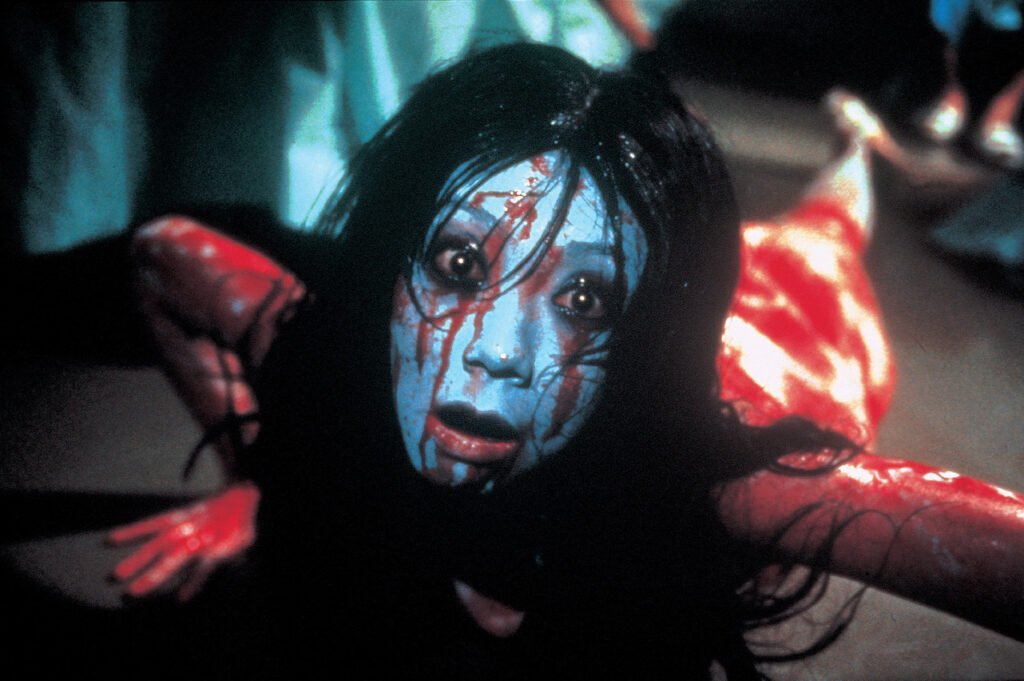
Kayako Saeki is the onryō haunting Ju-On and The Grudge — a murdered wife whose rage became a curse that claims every visitor.
Character: Kayako Saeki (née Kawamata)
Franchise: Ju-On / The Grudge
Created by: Takashi Shimizu
Portrayed by: Takako Fuji (1998–2006); also Aiko Horiuchi, Misaki Saisho, Runa Endo and Junko Bailey
First appearance: Katasumi (1998)
Family: Takeo Saeki (husband), Toshio Saeki (son)
Overview
Kayako is an onryō, the vengeful female ghost of Japanese folklore: a woman killed in a state of overwhelming rage whose spirit stays where she died and turns the place itself into a weapon. Shimizu built the whole Ju-On idea out of one rule. When someone dies in the grip of a powerful rage, a curse is born in the place where they died — and anyone who encounters it dies too, carrying the curse on to somewhere new. There is no puzzle at the centre of it and no ritual that lifts it. Sadako gives her victims seven days and a riddle; Kayako gives you nothing. You walked into the wrong house, and that is the entire offence.
What makes her frightening is how ordinary the house is. The Saeki home is a normal suburban house on a normal street in Tokyo, and Kayako is not a demon or a monster — she is a dead housewife in a white dress, her long black hair falling over a face fixed in the moment of her murder, crawling down the stairs on all fours with her head at angles a living neck would never survive. Her voice is gone. In its place is a throaty, rattling croak, the sound of a crushed throat still trying to speak — the sound of her own death, played on loop.
A Life, a Diary and a Murder
In life, Kayako was quiet, lonely and married to the wrong man. Her one private outlet was a diary, and in it she poured out her feelings for another man — her son Toshio’s teacher, Kobayashi, in the Japanese films; in the American version he becomes Peter Kirk, a professor she had known at university. The feelings were hers alone, written down and never acted on. Her husband Takeo found the diary, read obsession as betrayal, and in a jealous fury beat her and broke her neck. Toshio witnessed his mother’s murder; Takeo then drowned the boy in the bathtub, along with Toshio’s pet cat, Mar, and hid the bodies in the house. Kayako’s spirit took the first revenge — Takeo was found hanged, with her hair as the noose.
That is the engine of everything that follows. Kayako does not distinguish between the guilty and the merely present. Social workers, schoolgirls, detectives, whole families who buy the house years later — the curse takes them all, and then it follows the survivors home. Her son is bound to the haunting with her, a pale little boy who sits in wardrobes and on stair landings and opens his mouth to let out a cat’s meow.
The Films
Kayako first appeared in Katasumi, a three-minute short Takashi Shimizu made for the 1998 television anthology Gakkō no Kaidan G, broadcast in Japan on September 27, 1998. Its companion piece, 4444444444, introduced Toshio. Shimizu has called the two shorts “almost like the true prequel” of the story rather than rough drafts of it, and Takako Fuji played Kayako from the very first frame.
Shimizu expanded the haunting into features with the direct-to-video films Ju-On: The Curse and Ju-On: The Curse 2 (both 2000), which tell the house’s story in shuffled, non-linear chapters — a structure that became the series’ signature. The theatrical breakthrough came with Ju-On: The Grudge, which premiered at the Screamfest festival on October 18, 2002 before opening in Japanese cinemas in January 2003, and Ju-On: The Grudge 2 in 2003. Following care worker Rika through a chain of connected victims, the first theatrical film gave Kayako her defining sequence: the slow, spider-like descent down the stairs, body bent wrong, croak building.
Hollywood came calling, and unusually, it kept her intact. The Grudge (2004) was directed by Shimizu himself, written by Stephen Susco and produced by Sam Raimi’s Ghost House Pictures, and it simply moved American characters into Kayako’s Tokyo rather than moving Kayako. Fuji returned as Kayako, alongside Yuya Ozeki as Toshio and Takashi Matsuyama as Takeo — the original ghosts, in the original house, now haunting Sarah Michelle Gellar. Made for about $10 million, it took more than $187 million worldwide. Fuji played Kayako one last time in The Grudge 2 (2006).
After Fuji stepped away, the role passed on rather than ending. Aiko Horiuchi played Kayako in The Grudge 3 (2009); Misaki Saisho took over for the Japanese reboots Ju-On: Beginning of the End (2014) and Ju-On: The Final Curse (2015); and Junko Bailey played her in the Tokyo-set opening of The Grudge (2020), a side-story to the 2004 film. Five actresses have worn the white dress and the wig across the franchise — but there is only one Kayako most viewers picture.
Sadako vs Kayako
In 2016 the two great curses of J-horror were finally put in the same room. Sadako vs Kayako, directed by Kōji Shiraishi and released in Japan on June 18, 2016, began life as an April Fools’ joke in 2015 — the reaction was so strong that Kadokawa made it for real. Runa Endo plays Kayako, and the plot’s desperate logic is pure fan argument made flesh: the only way to survive one curse is to aim the other one at it. It ends, inevitably, with the two ghosts colliding and fusing into a single entity, Sadakaya. Read our full account of the crossover in Sadako vs Kayako, and meet the other half of the fight in our profile of Sadako Yamamura.
Behind the Character
Kayako is inseparable from the woman who first played her. Takako Fuji was a stage actress with the Ein theatrical company, trained in modern ballet and dance, and a genuine contortionist — and that training is the special effect. The crawling, the limbs folding the wrong way, the head rolling through positions that look computer-generated: that is Fuji’s own body, working without wires or digital help, in film after film. Shimizu has said he knew she was his ghost the moment he saw her on stage.
The commitment was total and long. Fuji played Kayako in seven productions across eight years — the shorts, both video films, both Japanese theatrical films and both of Shimizu’s American ones. By the end she admitted in interviews that she had grown tired of the role and found it hard to stay motivated, though she said she would have kept playing Kayako for as long as Shimizu wanted her. When she finally declined, the series recast — nobody pretended it was the same.
Why She Endures
Kayako, with Sadako of Ringu, is one of the two faces of the J-horror wave that changed global horror at the turn of the century — the moment Hollywood stopped remaking its own past for five minutes and started importing dread. The image is burned in: the hair, the white face, the croak in a quiet room. She has been parodied (in Scary Movie 4), fused with her great rival, and imitated by a generation of contorting, long-haired ghosts.
But the reason she lasts is underneath the iconography. Kayako’s curse is domestic violence that never leaves the house. Her rage is not random and it is not evil for its own sake; it is the specific, earned fury of a woman murdered by her husband in her own home, and the films never let you forget that the scariest thing in the Saeki house happened before anybody died. Every victim after Takeo is collateral — which is exactly the point. A grudge does not care who deserves it. That is why it is called one.