
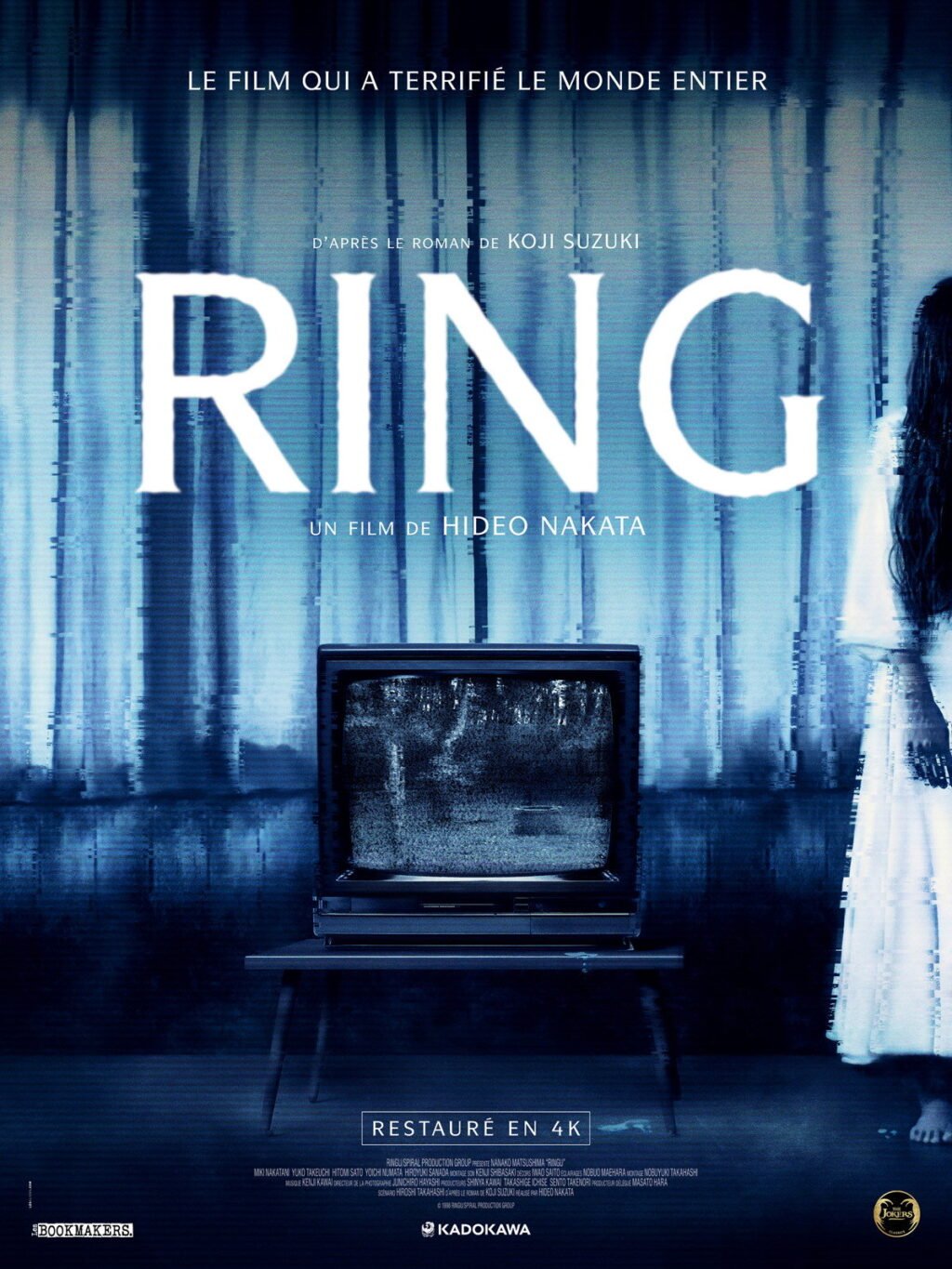
Ringu (リング, Ring, 1998) is a Japanese supernatural horror film directed by Hideo Nakata and written by Hiroshi Takahashi, based on Koji Suzuki‘s 1991 novel. A journalist investigates an urban legend about a videotape that kills anyone who watches it seven days later. The trail leads her to the vengeful spirit of Sadako Yamamura. The film was released in North America as Ringu. It became the highest-grossing horror film in Japan up to that time and led a global boom in Japanese horror. Hollywood remade it as The Ring in 2002.
At a glance
| Release date | January 31, 1998 (Japan) |
| Director | Hideo Nakata |
| Writer | Hiroshi Takahashi (screenplay) |
| Based on | Ring (1991 novel) by Koji Suzuki |
| Starring | Nanako Matsushima, Miki Nakatani, Hiroyuki Sanada, Rie InÅ (Sadako) |
| Runtime | 95 minutes |
| Budget | $1.5 million (as reported by Nakata) |
| Box office | ¥1.7 billion in Japan (about $13 million) |
| Franchise | Ring franchise: Japanese sequels Spiral (1998) and Ring 2 (1999); US remake The Ring (2002) |
Plot summary
At a sleepover, two schoolgirls trade an urban legend about a videotape that kills viewers seven days after a strange phone call. One of them, Tomoko, admits that she and her friends watched such a tape a week ago. Moments later, the television turns itself on, and she dies. Her aunt, the journalist Reiko Asakawa (Nanako Matsushima), learns that Tomoko’s three friends died at the same moment. She tracks the tape to a resort cabin in Izu. It is a string of disjointed, unsettling images ending on a shot of an old well. When she finishes it, the phone rings.
Believing she has a week to live, Reiko turns to her psychic ex-husband, RyÅ«ji Takayama (Hiroyuki Sanada). Their investigation takes them to ÅŒshima island and the story of Shizuko Yamamura, a woman with psychic powers, and her daughter Sadako. The stakes rise when their young son, YÅichi, watches the tape too.
Spoiler section: the ending
Reiko and RyÅ«ji find a sealed well beneath the cabin, where Sadako was thrown by Dr. Ikuma, the researcher who had an affair with her mother. They find her remains, and when Reiko’s deadline passes, they believe the curse is broken. The next day, RyÅ«ji’s television switches on by itself. Sadako climbs out of the well on the screen, crawls out of the TV and kills him. Reiko realizes why she was spared: she made a copy of the tape and showed it to someone else. To save YÅichi, she drives off to show a copy to her own father.
Production and behind the scenes
Publisher Kadokawa Shoten adapted the novel after its moderate success. Takahashi and Nakata worked on the script after reading the book and watching Fuji Television’s 1995 TV film adaptation. They made the hero a divorced woman, Reiko, with a son, instead of the novel’s married male journalist with a daughter. Suzuki had liked Nakata’s earlier Ghost Actress (1996) and asked for him to direct. Nakata kept the horror restrained, avoiding showing the victims’ deaths even when the producers questioned whether that would work. He cited Robert Wise’s The Haunting (1963), which he watched at least five times before shooting, along with kabuki theater and the ghost story Yotsuya Kaidan.
With a budget of $1.5 million, the production took nine months, including five weeks of shooting. The cursed tape was shot on 35 mm film, and a lab then used a computer to add grain. Sound was just as important. Nakata worked with composer Kenji Kawai and the effects team, mixing four different telephone sounds for the ringing and using around 50 tracks each for background sound and effects. Ring was shot back to back with a sequel, Spiral, which used much of the same cast but neither Nakata nor Takahashi, and Toho released both films together.
Release and reception
Ring opened in Japan on January 31, 1998, and became the country’s highest-grossing horror film. Its rentals of Â¥1 billion put it among the top ten Japanese films of the year, and its total gross reached Â¥1.7 billion. In Hong Kong it was the biggest film of the first half of 1999, ahead of The Matrix. It also won best Asian feature at the 1999 Fantasia Film Festival.
It holds a 98% approval rating on Rotten Tomatoes, whose consensus says it combines the supernatural with “anxieties about modern technology.” In Sight & Sound, Mark Kermode praised its “timeless terror,” although Empire Online found it “throttled by its over complexity.” The Guardian ranked it the 12th best horror film of all time, and in 2010 Empire placed it No. 69 on its list of the best films of world cinema. Critics have read Sadako as the classic Japanese yÅ«rei, or vengeful ghost, reborn through technology. The videotape works like a virus, spreading the curse from viewer to viewer.
Legacy and influence
Ring launched a revival of Japanese horror, followed by Pulse, Ju-On: The Grudge and Nakata’s own Dark Water. In the West, it helped popularize the label “J-Horror.” Coming after years of slasher-dominated Hollywood horror, its restraint helped shift the genre toward slow, atmospheric dread. Gore Verbinski’s remake, The Ring (2002), was a box-office No. 1 and even grossed slightly more in Japan than the original, Â¥1.75 billion to Â¥1.7 billion. South Korea had already remade the story as The Ring Virus (1999). The poorly received Spiral was effectively replaced by Ring 2 (1999), a new direct sequel. Later came the prequel Ring 0: Birthday (2000) and the crossover Sadako vs. Kayako (2016). Sadako climbing out of the television is now one of horror’s most recognizable images.
Trivia
- Rie InÅ, who plays Sadako, trained in kabuki. She was filmed walking backward with jerky movements, and the footage was then played in reverse.
- The title has several readings: the endless cycle of the curse, the phone call that rings for each victim, and the circle of light seen from the bottom of the well.
- Sadako draws on two famous ghosts of Japanese folklore: Okiku, the servant thrown down a well, and Oiwa of Yotsuya Kaidan.
- In the Philippines, the film had limited releases as Ring: Circle of Evil to coincide with the American remake.
- In Hong Kong it earned HK$31.2 million, a record for a Japanese-language film there until Stand by Me Doraemon broke it in 2015.
- Tomoko, the first victim seen on screen, is played by Yuko Takeuchi.
Related links
- Sadako Yamamura (character)
- Ring franchise
- The Ring (2002), Ring 2 (1999) and Spiral (1998)
- Hideo Nakata (director) and Hiroshi Takahashi (writer)
- Koji Suzuki (author)
- Nanako Matsushima and Hiroyuki Sanada (cast)