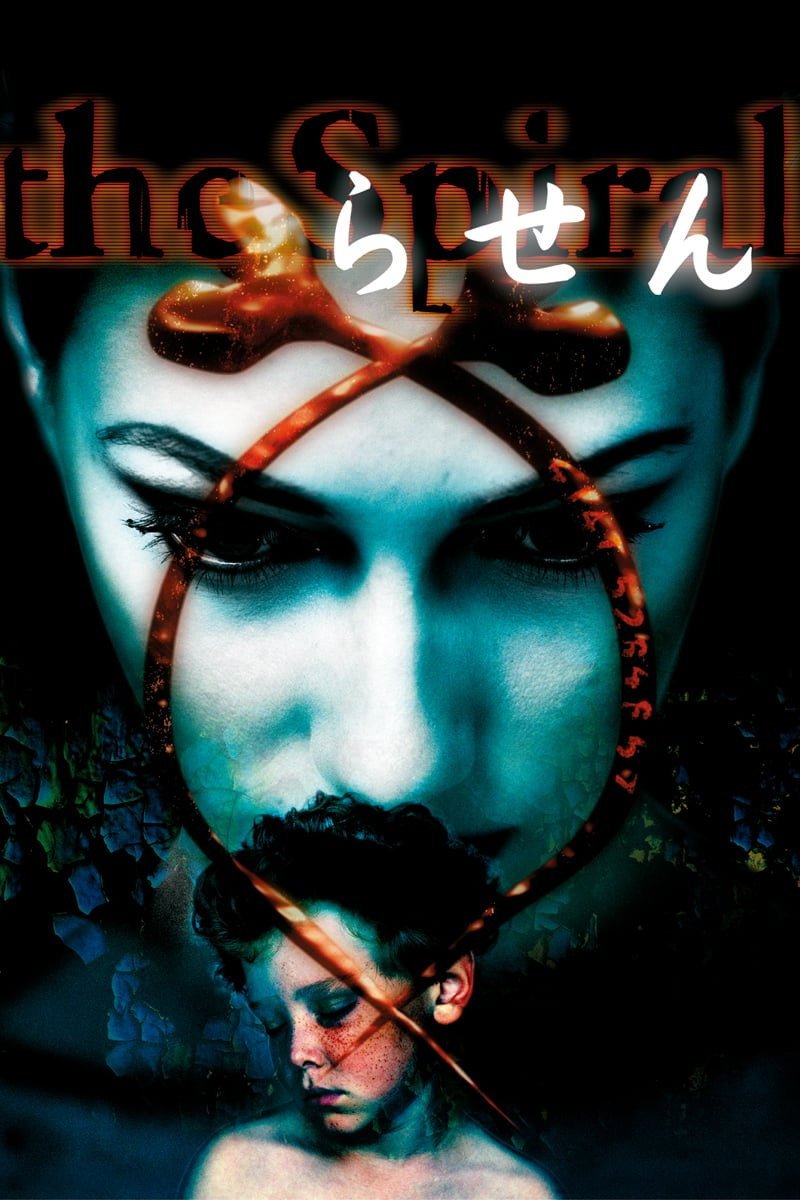
Spiral (Rasen, 1998) is a Japanese supernatural horror film written and directed by George Iida. It is based on Koji Suzuki‘s novel of the same name and is a direct sequel to Ring (1998). Pathologist Mitsuo AndÅ (KÅichi SatÅ) performs the autopsy on RyÅ«ji Takayama (Hiroyuki Sanada), his old friend and rival. The case leads him to the cursed videotape and to Sadako Yamamura, who has plans of her own. Toho released the two films together on January 31, 1998, with the same production team and some of the same cast. Ring became a huge hit, and Spiral flopped, becoming known as the “forgotten sequel.” Hideo Nakata and Hiroshi Takahashi then made Ring 2 (1999), which replaced it and ignored its story. In English it has been released as The Spiral and, in North America, as Rasen.
At a glance
| Release date | January 31, 1998 (Japan) |
| Director | George Iida |
| Writer | George Iida (screenplay) |
| Based on | Spiral by Koji Suzuki |
| Starring | KÅichi SatÅ, Miki Nakatani, Hinako Saeki, Shingo Tsurumi, Shigemitsu Ogi, Hiroyuki Sanada |
| Music | La Finca |
| Runtime | 98 minutes |
| Distributor | Toho |
| Franchise | Ring: sequel to Ring (1998); replaced by Ring 2 (1999); followed loosely by Sadako 3D (2012) |
Plot summary
After the events of Ring, pathologist Mitsuo AndÅ examines the body of RyÅ«ji Takayama (Hiroyuki Sanada), his friend and rival. AndÅ is still grieving the drowning of his young son and has suicidal thoughts. Inside Takayama’s stomach he finds a cryptic note. Soon Reiko Asakawa, Takayama’s former wife, and their son, YÅichi, are also found dead. AndÅ hears about a cursed videotape said to kill viewers one week after they watch it. With help from Takayama’s student, Mai Takano (Miki Nakatani), he looks into Takayama’s past and the murdered young woman behind the tape, Sadako Yamamura (Hinako Saeki).
Reiko’s boss, Yoshino (Yutaka Matsushige), has her diary. It records how she and RyÅ«ji researched the tape. She believed copying it had broken the curse, but YÅichi died a week after watching it, like his father. Yoshino dies too, though he insists he never watched the tape. AndÅ destroys the remaining copies, intending to be the last victim, and spends the night with Mai. Tests show that the virus that killed Yoshino is different from the one that killed Takayama and his son.
Spoiler section: Sadako reborn
AndÅ survives his week. Then Mai is found dead, having apparently given birth, with no sign of a baby. Back at work, AndÅ meets “Mai” again. She is Sadako, reborn and calling herself “perfectly dual-gendered.” AndÅ learns that Takayama had been helping Sadako all along, and that Reiko’s diary, not the tape, killed Yoshino, AndÅ’s friend Miyashita and many others. Sadako offers to bring back AndÅ’s son in return for his help. He accepts and brings back both his son and Takayama. As he leaves, Takayama tells him, “Many years will pass before our world will be at peace.”
Production and behind the scenes
Toho shot Ring and Spiral back to back and released them together, hoping to boost revenue, since Suzuki’s story was already a successful novel and a 1995 TV film. The two films had the same production team and producers, including Takashige Ichise, but different writers and directors. Nakata directed Ring from Takahashi’s script, while Iida wrote and directed Spiral. Iida had also written the 1995 TV adaptation. Writing for Den of Geek, Padraig Cotter noted small continuity differences between the films, such as where Takayama’s body lies and how Sadako originally died, as if “there clearly weren’t a lot of notes passing between them.”
The two films differ most in tone. Ring is a ghost story that leaves its mysteries unexplained. Spiral plays more like a clinical, science-fiction detective story and sets out to explain the curse, which it links to a smallpox-like virus. Cotter also pointed to how differently it portrays Sadako. In Ring she is a silent figure whose face is never seen. In Spiral she is a talkative seductress planning her own rebirth, and she even has a sex scene.
Release and reception
Toho released Spiral in Japan on January 31, 1998. It got a limited release in the Philippines as The Spiral on February 25, 2004. DreamWorks released it direct to DVD in the US on August 23, 2005, as Rasen. Arrow Video later released it on Blu-ray and video on demand in the US, Canada, the UK and Ireland as Spiral, and included it in its Ring Collection box set.
While Ring became a phenomenon, Spiral “quietly died upon release,” Cotter wrote. He suggested many viewers didn’t realize it was a sequel, since the titles differ and the two films look and feel so unlike each other. He judged that as a sequel it “straight up doesn’t work.” He still called it a “curious alternate reality sequel,” and concluded it was “neither as poor as its reputation suggests or a long lost gem.” Collider called it a “gonzo sequel” that “doesn’t hold itself together as well as its predecessor” but “should not be forgotten.”
Legacy and influence
After Ring took off, the producers made a new direct sequel, Ring 2 (1999), with Nakata and Takahashi. It was not based on Suzuki’s books and sets aside Spiral entirely. The series later came back to this film’s continuity. Sadako 3D (2012), a loose adaptation of Suzuki’s novel S, follows Takanori AndÅ, son of this film’s hero. S is a sequel to the novel Spiral. Suzuki’s third novel, Loop (1998), was never filmed, which leaves a gap between the two films.
Trivia
- Miki Nakatani and Hiroyuki Sanada play the same roles they played in Ring.
- Hinako Saeki plays Sadako here. Rie InÅ played her in Ring.
- Ring’s heroine, Reiko, dies off-screen in a car crash.
- Den of Geek called the autopsy hallucination, in which Takayama’s corpse opens its eyes and taunts AndÅ, the film’s best scare.
Related links
- Sadako Yamamura (character)
- Ring franchise
- Ring (1998), Ring 2 (1999) and The Ring (2002)
- Koji Suzuki (author of the novels)