
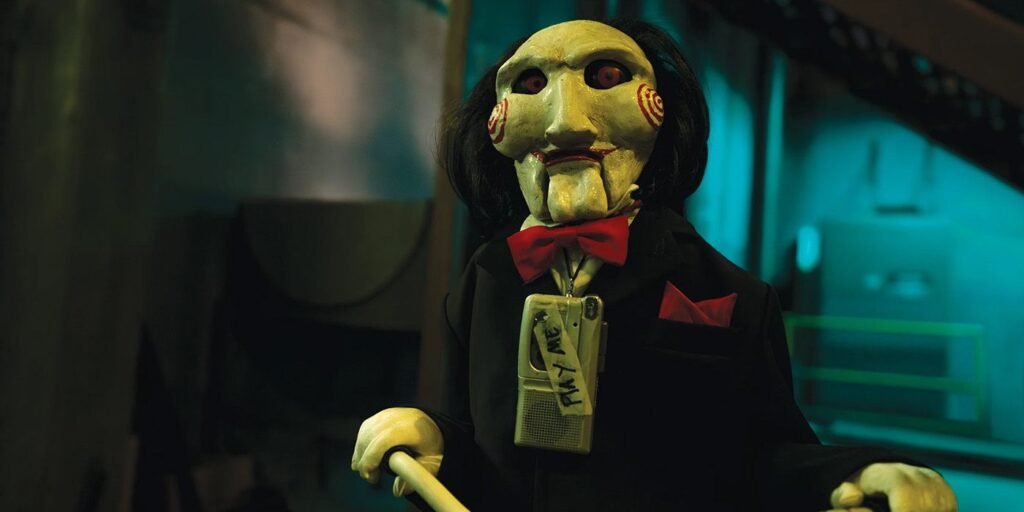
Billy the Puppet is Saw’s ventriloquist-style messenger — John Kramer’s recorded voice in a tuxedoed dummy, and the franchise’s face.
Two disciplines govern everything on this page. First: Billy is not alive. He is a mechanical puppet, never possessed, never supernatural, in any film — every word he “speaks” is a recording made by a human being, and every movement is puppetry, remote control or editing. Second: Billy is not Jigsaw. Jigsaw is John Kramer, the man who built him and speaks through him. Viewers misidentify the puppet as the killer constantly; this page never does.
Quick Specs
- Type: Ventriloquist-style puppet (a prop)
- Built by (in story): John Kramer
- Created by (real world): James Wan and Leigh Whannell
- Voiced by: Tobin Bell — Kramer’s recordings
- First appearance: The Saw short (2003)
What He Is
Billy is the avatar Kramer uses to communicate with the subjects of his “games”: a puppet who delivers recorded messages explaining the trap the subject is in and how they can survive — usually on a television screen or videotape, occasionally in person, arriving on an old-fashioned red tricycle. His jaw moves to suggest speech. The recorded voice is Kramer’s own — in the real world, Tobin Bell‘s — presented disguised and distorted on the tapes; the only sound that originates from the puppet itself is an electronic cackle, like a Halloween toy’s. Billy has no other voice and no dialogue that is not a human’s recording. His function is distance and deniability: he lets an unseen, then dying, then dead man instruct, taunt and congratulate victims without being present, locatable or interruptible, in a fixed ritual — a greeting by name, “I want to play a game,” the subject’s alleged failing, the trap’s rules, the time limit. The name itself is a production artifact: no character ever says “Billy” in any Saw film. The name was the production’s own for the prop, credited to co-creator James Wan, and later adopted by fans and merchandise. Who operates him changes by era, and the honesty of his messages changes with the operator. Kramer built, painted, recorded and deployed him personally in the first films. His apprentice Amanda Young ran games in which Billy still delivered fair-sounding rules that Amanda had secretly rigged to be unwinnable — the dishonesty is Amanda’s, delivered through Kramer’s avatar; the puppet neither knows nor decides anything. After Kramer’s death, Mark Hoffman continued the games in his name, and Billy continued with them, the dead man’s authority borrowed by whoever holds the puppet.
The Gideon Origin
The films give the prop a tragic provenance, shown in Saw IV‘s flashbacks. Before he was the Jigsaw Killer, Kramer made a smaller, gentler early version of the puppet as a gift connected to his unborn son, Gideon, and gave that early version to his wife Jill Tuck. Jill miscarried Gideon after Cecil, a patient at her clinic, slammed a door into her stomach. The prototype was for Gideon; Billy as victims know him is the post-loss reinvention — the gentler toy’s sinister successor, built to lecture people Kramer judged to be wasting the lives his son never got. Precision matters here, because a superseded version circulates: the 2005 comic Saw: Rebirth presented Billy as one of John’s creations from a toy factory where he worked, and Saw IV negated that backstory. The comic’s origin is comics continuity, not the films’. Equally: there is no single “the” puppet, in story or in production. The story itself contains prototypes, multiple puppets and spare heads, a Billy rigged to explode and a Billy blown up — the type is rebuilt by Kramer and his successors, and that is the honest way to write about him.
Film by Film
Billy debuted in Wan and Whannell’s 2003 pitch short, explaining the Reverse Bear Trap to its wearer on a small television and riding in on his tricycle to congratulate him on surviving — a scene the feature remade as Amanda Young‘s test. In Saw (2004) he tells Amanda the trap’s rules on a television, then rides in to congratulate her after she cuts the key from her sedated cellmate — the franchise’s defining puppet entrance — while elsewhere his cackle sounds in Adam’s dark apartment before the abduction, and detectives uncover Billy himself under a blanket in Kramer’s hideout: the only “face” of the killer the audience gets for most of the film. Saw II uses him sparsely — opening the film on screen for Michael Marks, then rolling into view at the top of the caged staircase, laughing, as the officers climb into the lair. Saw III shows Kramer in flashback constructing and painting Billy for Amanda’s game, delivers the rigged Troy and Kerry messages on videotape, and lays him beside his tricycle as a taunt in Jeff Denlon’s game, laughing until Jeff beats him silent. Saw IV makes him a weapon: found seated among candles in a schoolroom, a microcassette at his neck, his face explodes as Agent Perez leans in, driving shrapnel into her face and neck, the laugh sounding as she collapses. Saw V puts Hoffman’s hand under him — the Seth Baxter pendulum game is Hoffman’s revenge killing dressed as a Jigsaw test — and shows a small prototype Billy on a workbench in the flashback of Kramer mentoring Hoffman: the succession, staged in props. Saw VI steps him off the screen: franchise references mark it as the first film where Billy delivers test details in person rather than only on tape — hanging from a noose to force William Easton’s choice between two employees — though he had physically ridden in as early as 2004. Saw 3D gives him the opening public trap in person, blood-spattered when it kills, shows multiple Billy heads and unfinished iterations in Hoffman’s hideout, and ends his run there with Hoffman blowing the hideout up, Billy inside. Jigsaw (2017) recreates him pristine, with illuminated red eyes, riding in with a “Confess” envelope — the borrowed authority Logan Nelson’s recreation of a decade-old Kramer game requires; the glowing eyes are that film’s puppet, not the 2004 design. Spiral (2021) retires him entirely: Billy appears only as a photograph, and the copycat’s puppet is Mr. Snuggles, a pig-faced marionette dressed as a police officer — director Darren Lynn Bousman explained that trading out Jigsaw meant changing out the doll as well, because there will never be another Tobin Bell. Mr. Snuggles is not Billy, and Spiral is not a Billy performance. Saw X (2023), an interquel set between the first two films with Kramer alive and running the game personally, brings him back in full: entering on his tricycle wheeling a tray of surgical tools and a “Play Me” tape, larger and more hastily assembled, as befits a Kramer working in a hurry.
The Real Puppet
In the real world Billy was created by Wan and Leigh Whannell, and Wan designed and hand-built the original for the 2003 short. His account of the construction is the famous one: the face was clay and papier-mâché, the eyes black ping-pong balls with the red irises painted in, paper-towel rolls served inside the body under the tuxedo, and to move him the puppeteers pulled him along on a fishing line. The sequels rebuilt him film by film: Saw II gave him mechanical, remote-controlled features — the unhinged jaw and the eyes; Saw III‘s prop crew found the original deteriorated and unfit for work, and recreated him with a waterjet-cut foam body, plates to hold him together, magnets to attach him to his tricycle and a removable back of head for animatronics access; Saw IV refined the same build with metal rods and stronger magnets. After Saw 3D was made as the intended finale, the production’s props were reportedly sold off — the original Billy reportedly among them — so Jigsaw had to recreate him; that sale is reported, not documented, and no verified price or buyer exists. In September 2025, Propstore’s Entertainment Memorabilia auction offered an animatronic Billy from Saw III, from Bousman’s personal collection, estimated at $30,000–$60,000 — a listed lot with that estimate; whether it sold, and for what, is not part of the verified record. As a mascot he long ago outgrew the films: Jigsaw‘s campaign put five costumed-Billy character posters at its centre under the tagline “He is everywhere,” and for Saw X, Lionsgate built a parody of AMC’s Nicole Kidman theatre ad with Billy on his tricycle in the Kidman role — widely shared, then taken down at AMC’s request.
The Other Billy
One namesake must be fenced off plainly. In Dead Silence (2007), Wan and Whannell’s own follow-up film, the ventriloquist dummy delivered to Jamie Ashen — one of the dead ventriloquist Mary Shaw’s dolls — is also named Billy. The two Billys are entirely separate characters in separate films by the same creators: Dead Silence‘s belongs to a supernatural ghost story, where the haunting is the premise; Saw‘s is a machine in a story with no supernatural element at all. They share a name, a tuxedoed dummy’s design language and their creators. That is the whole connection, and no page on this site will pretend otherwise.
The Signatures
The face is the franchise’s most copied mark: white face, protruding brow and cheeks, red spirals painted on both cheeks, red lips in a grin, black eyes with red irises, messy black hair — worn with a black tuxedo, white shirt and gloves, red bow tie and red shoes. The formality is the joke and the menace: a child’s dummy dressed for an occasion, arriving to officiate. The tricycle ride-in is his entrance signature across twenty years, and the grainy television frame is half the iconography — Billy most often exists as a video image, head slightly too large for the screen, which is why the physical entrances land as violations. The greeting is Kramer’s line, most often heard from Billy’s recorded mouth: “I want to play a game” — never the fan corruption “Do you want to play a game?” — with its companion closer, “Live or die, make your choice.” And the cackle, the one sound that is his own, punctuates the messages: in Adam’s apartment, over the staircase traps, mocking Jeff, playing over Perez’s collapse. The message ends; the laugh confirms a machine delivered it.
Why He Matters
Billy is the killer who isn’t there. Saw withholds its killer’s identity and face for nearly its whole running time, and Billy is the device the film invents to solve that: a proxy who can be looked at, filmed close and remembered while the man behind him stays invisible. The device outlived the twist — across ten films Billy lets dead, dying, imprisoned and successor killers all speak with one face and one ritual, which is how the franchise survived its protagonist’s death in its third film and kept going for two more decades. He is also the mascot inversion: franchise mascots are usually the monster, but Billy is the monster’s stationery, and he displaced the man — it is Billy’s face, not Bell’s, on the posters, the costumes, the licensed replicas and the parodies, to the point where viewers call the puppet “Jigsaw” and the record has to keep correcting them. His authority in horror history rests partly on how cheaply he was made: clay, papier-mâché, ping-pong balls and paper-towel rolls, pulled on fishing line, against everything he became — the seams are the point. And uniquely for a mascot, the films gave the prop a tragic provenance in Gideon, so every appearance carries Kramer’s dead child behind it — the grief is the maker’s, never the puppet’s, and that distinction is the character. When Spiral wanted to declare independence, the thing it had to replace was not a trap or a killer but the puppet. There is no clearer evidence in the record of what Billy is to this franchise.
Keep it locked on Think Horror — game over? Not while the tricycle still rolls.