
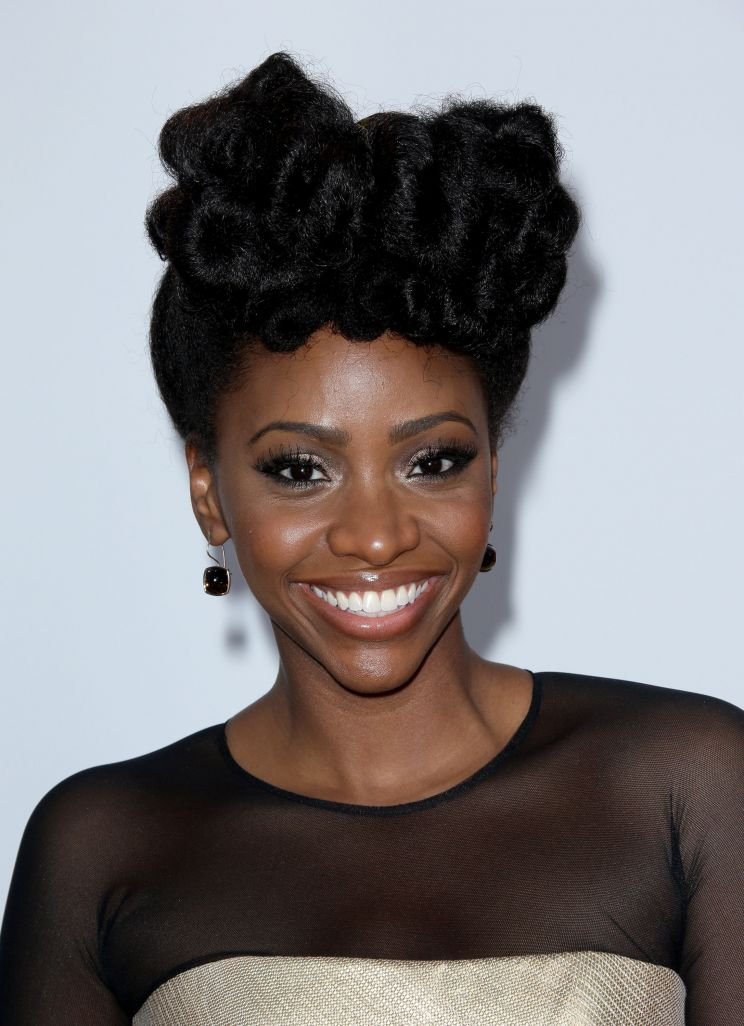
Teyonah Parris (born 1987) is the American actress who played Brianna Cartwright in Candyman (2021) and Monica Rambeau for Marvel.
Quick Specs
| Born | September 22, 1987, Hopkins, South Carolina |
| Pronunciation | tee-ON-ə |
| Training | South Carolina Governor’s School for the Arts and Humanities; the Juilliard School (BFA) |
| Horror | Brianna Cartwright in Candyman (2021) |
| Signature roles | Dawn Chambers in Mad Men (2012 to 2015); Coco Conners in Dear White People (2014); Lysistrata in Chi-Raq (2015); Ernestine Rivers in If Beale Street Could Talk (2018); Monica Rambeau in WandaVision (2021) and The Marvels (2023); Yo-Yo in They Cloned Tyrone (2023) |
| Stage | Broadway debut in A Free Man of Color (2010); originated Kaneisha in Slave Play, off-Broadway (2018) |
| Honours | Black Reel Award for Outstanding Breakthrough Performance, Female, for Dear White People; AAFCA Best Actress and Black Reel Outstanding Actress for Chi-Raq; NAACP Image Award nomination |
| Business | Founder of the hair-extensions line blūm by Teyonah (2024) |
Who She Is
Teyonah Parris was born on September 22, 1987, in Hopkins, South Carolina, a small community outside Columbia, and grew up there, the middle child and only girl between two brothers. She credits her parents for the career: her mother set the terms, work hard and be disciplined, and her father drove her to every rehearsal.
She came to performing through beauty pageants and modelling competitions. On her own account she won often, and was frustrated that the girls on stage were not allowed to speak; she wanted the lines, not just the walk. By the long-form account of her life, at ten she had a plan in order: be an actor, go to Juilliard, be in the movies. She attended Lower Richland High School until her sophomore year, then won a place at the South Carolina Governor’s School for the Arts and Humanities in Greenville, a public residential arts high school, for her last two years. She has called it “a very intense performing arts high school” that prepared her for Juilliard. She was accepted at the Juilliard School in 2005, at 17, and graduated with a BFA.
She is married to James Parris, and the couple keep the marriage private. They announced a first pregnancy in September 2022, and on March 6, 2023, she announced that their daughter had been born about a month earlier at home, after a late switch from a planned hospital birth to a midwife and doula. She was 35. On August 22, 2024, she launched blūm by Teyonah, a line of clip-ins, wigs and bundles in natural textures, built on a gap she had found as a customer in the luxury market.
The Work, and What She Did in It
Juilliard paid out at once. In 2010, at 23, she made her Broadway debut at Lincoln Center in John Guare’s A Free Man of Color, a Pulitzer Prize finalist set in 1801 New Orleans, directed by George C. Wolfe, in a company led by Jeffrey Wright and Mos Def. The screen start was slower: a guest role as Melinda Gossett on The Good Wife (2010) and a small part as Riva in James L. Brooks’s How Do You Know (2010). After moving to Los Angeles she found only small roles and, by the long-form account, was planning to give up and move back to New York when the Mad Men audition arrived.
Mad Men (2012 to 2015) was the breakthrough. She played Dawn Chambers, Don Draper’s secretary, recurring across seasons five to seven: the first major African American character on the series and the first Black employee of Sterling Cooper Draper Pryce, hired in the season-five premiere into an all-white 1960s Madison Avenue office. Dawn is competent, composed and watchful inside an office whose casual racism the show had spent four seasons recording from the other side. She was 24 at the March 2012 premiere, and the ensemble was nominated by the Screen Actors Guild in 2013. She was never a series regular, and that shaped everything, as she explains below.
Dear White People (2014) was her film breakthrough. Justin Simien’s debut satirises race at the fictional, mostly white Winchester University, and Parris plays Colandrea “Coco” Conners, the aggressively assimilated student trying to turn a campus controversy into a reality-television career, the sharpest study of code-switching and ambition in an ensemble led by Tessa Thompson. The film won a Special Jury Award for Breakthrough Talent at Sundance, where she was 26, and she won the Black Reel Award for Outstanding Breakthrough Performance, Female. She plays Coco in the film only, not the later Netflix series.
She spent four seasons as Missy Vaughn on the Starz comedy-drama Survivor’s Remorse (2014 to 2017), executive-produced by LeBron James: the wife of RonReaco Lee’s Reggie, the cousin and confidant of a sudden basketball millionaire, and the woman from money who translates the family’s new world for them. Then Spike Lee made her a title lead. In Chi-Raq (2015), Lee’s reworking of Aristophanes amid Chicago gang violence, she plays Lysistrata, the girlfriend of Nick Cannon’s gang leader, who, after a stray bullet kills an eleven-year-old girl, organises the women of both gangs to withhold sex until the men end the violence. She carried the film in Lee and Kevin Willmott’s rhyming verse, at 28, and won the African-American Film Critics Association’s Best Actress award and the Black Reel for Outstanding Actress, with her first NAACP Image Award nomination.
Her only producer credit is precise: she starred as the singer Miki Howard, and produced, the TV One biopic Love Under New Management: The Miki Howard Story (2016), which brought a Black Reel nomination for Outstanding TV Movie or Limited Series. She was a recurring detective on Empire (2017). In Barry Jenkins’s If Beale Street Could Talk (2018), from James Baldwin’s novel, she is Ernestine Rivers, the resourceful, strong-willed older sister of KiKi Layne’s Tish, the family’s operator, the one who researches, schemes and finds the lawyer, beside Regina King and Colman Domingo as their parents. She was 31. The same season she originated Kaneisha, the lead of Jeremy O. Harris’s Slave Play, in its world premiere at New York Theatre Workshop, directed by Robert O’Hara, opening on December 9, 2018; she did not go with it to Broadway. Charm City Kings and The Photograph (both 2020) followed.
In 2021 the scale changed twice. WandaVision, Marvel Studios’ first Disney+ series, premiered on January 15, 2021, with Parris as the adult Monica Rambeau, announced at San Diego Comic-Con on July 20, 2019. The child Monica of Captain Marvel (2019) was Akira Akbar, daughter of Lashana Lynch’s Maria. Parris’s Monica is a S.W.O.R.D. captain pulled into Wanda Maximoff’s sitcom reality as the neighbour “Geraldine,” expelled for remembering the real world, who forces her way back through the Hex barrier, an act that rewrites her cells and gives her energy-based powers. She played a grief arc inside a format experiment: Monica lost her mother to cancer during the five years she herself missed, a loss that mirrors Wanda’s. She was 33. The comics have called the character Photon, Spectrum, Pulsar and Captain Marvel; the films have not yet used any of those names for her.
Candyman (2021) is her horror centrepiece. Nia DaCosta directed, from a screenplay by Jordan Peele, Win Rosenfeld and DaCosta. It is a direct sequel to Bernard Rose’s 1992 film and the fourth in the series, setting aside the two 1990s sequels to continue the original: the baby Helen Lyle died saving in 1992 is Anthony McCoy. Parris was cast in March 2019, and the film shot in Chicago in August and September 2019 under the working title Say My Name.
She plays Brianna Cartwright, a new character, a successful art-gallery director living with her partner, the visual artist Anthony McCoy (Yahya Abdul-Mateen II), in a luxury loft in gentrified Cabrini-Green. She is not the new Helen Lyle, not Anne-Marie, and not Anthony’s wife. The performance moves in three stages. First the professional, the film’s art-world insider, handling dealers and critics who want Anthony’s trauma, and her own family history, as marketable story, and given the film’s thesis line: “White people built the ghetto, and then erased it when they realized they built the ghetto.” Then the witness: Brianna’s father, a gifted artist, died by suicide when she was a small child, an event she saw, so Anthony’s obsessive spiral replays the founding trauma of her life. Then the survivor. Kidnapped by Colman Domingo’s William Burke as the instrument of his plan to make Anthony the new Candyman, she fights free, and after police shoot Anthony dead she summons him in a mirror, four utterances of the name hers and the fifth an officer’s. The risen Candyman, in the form of Tony Todd’s Daniel Robitaille, kills the officers and gives her the film’s last charge: “Tell everyone.” She is, structurally, the sequel’s Helen Lyle figure without being Helen: the woman who enters the legend, survives it and is left holding it. The sequel brings back Vanessa Estelle Williams as Anne-Marie, Virginia Madsen’s voice as Helen and Todd as Robitaille; Brianna has no 1992 counterpart.
The film tells its histories, Helen Lyle’s story, a 1977 killing and Robitaille’s lynching, not in flashback footage but in shadow-puppetry by the Chicago theatre company Manual Cinema. DaCosta has said she and Peele hated the traditional flashback and did not want footage from the original, “we wanted this movie to stand on its own,” and that Peele suggested the puppets. They are wholly practical, paper cut-outs with wire joints performed against vellum and fabric screens, the puppeteers’ hands left visible, drawing on Kara Walker’s silhouettes and Lotte Reiniger. Brianna’s brother Troy narrates the Helen Lyle sequence at the couple’s dinner table, so Brianna listens to the legend being rebuilt before she becomes part of it.
Released on August 27, 2021, after three pandemic delays, when Parris was 33, it scored 84 percent on Rotten Tomatoes and 72 on Metacritic, opened at number one with about $22 million, making DaCosta the first Black woman director to open a film at number one in the United States, and made $77.4 million worldwide on a $25 million budget.
DaCosta cast her again. In The Marvels (2023) Monica, now a S.A.B.E.R. astronaut captain, is one of three leads whose light-based powers become entangled, so they swap places whenever they use them. Parris plays the film’s emotional through-line, Monica’s grief and anger at Brie Larson’s Carol Danvers, absent when Maria died, and its climax: Monica seals the collapsing tear between universes from the far side and wakes in a parallel world beside that universe’s Maria, as Binary, and Kelsey Grammer’s Beast. Released on November 10, 2023, when she was 36, it drew mixed reviews and made $206.1 million worldwide, the lowest gross in Marvel’s film series.
The same year she was Yo-Yo, the sharp, book-smart sex worker who joins John Boyega’s Fontaine and Jamie Foxx’s Slick Charles in uncovering a cloning conspiracy beneath their neighbourhood, in Juel Taylor’s They Cloned Tyrone (2023), the trio’s investigator and quickest mind. It opened the American Black Film Festival on June 14, 2023, and reached Netflix on July 21. In Liz Feldman’s Netflix dark comedy No Good Deed (2024) she is Carla Owens, a high-achieving architect and expectant mother house-hunting with her new husband, opposite Lisa Kudrow and Ray Romano, and she voiced Monica again in What If…? (2024). She is listed as Charmaine in Matchbox: The Movie, scheduled for 2026.
Cool Verified Facts
- Dawn Chambers was the first major African American character on Mad Men.
- She made her Broadway debut straight out of Juilliard, at Lincoln Center, in a Pulitzer finalist.
- Chi-Raq is performed in rhyming verse, and she carried it as the title lead.
- She originated the lead role of Kaneisha in Slave Play.
- Brianna Cartwright is a new character with no counterpart in the 1992 Candyman.
- Candyman’s flashbacks are paper shadow puppets, made entirely practically.
- Her Candyman director, Nia DaCosta, cast her again as a lead in The Marvels.
- Her only producer credit is the Miki Howard biopic she also starred in.
Signatures, Habits and Behind the Scenes
Her natural hair on screen is deliberate. For “a little over a decade,” she has said, she has been “very intentional” about appearing as she naturally is: “As a Black woman,” she explained, “we feel seen in these spaces. Just how we are.” And: “If that’s curly hair, kinky hair, whatever that is, I want to be a part of normalizing our existence as it is.” She told Essence about a mother who dressed her daughter as Monica, “I’m just so happy that my child has the opportunity to see a Black woman with her natural hair,” and added: “To be a dark-skinned, brown-skinned woman and have the opportunity to be in this superhero space, I don’t take that lightly.” blūm is the commercial sequel, textures in gradations.
On Mad Men she never knew she would be back. Across three years as Dawn, she says, she was never told she was a recurring cast member: “It was always, ’We’re checking your availability for tomorrow.’ So I always felt like I was holding my breath with that show, it was always an inch at a time and never knowing if the door was gonna close that moment.” Dawn’s composure mirrors a job insecurity the actress was living. On the long-form account, she was called back before Matthew Weiner and Jon Hamm, won the part, and still took a planned trip to India before shooting.
If Beale Street Could Talk was shot in a real Harlem brownstone, cast and crew packed into a genuinely small apartment, and the family formed at once: “From the moment we met at the table read, it was like we’d all known each other for a lifetime.” KiKi Layne, she said, was “my baby sis from the jump.” Verse is a through-line: Molière’s Célimène was a favourite role at school, Chi-Raq is entirely in verse, and the classical training runs straight into Slave Play.
On The Marvels she spoke for herself. Denied a press tour by the 2023 actors’ strike, she told People she was frustrated by commentary from people who had not seen it, and asked audiences to “give it a fair shot by just seeing it or trying it.”
Why She Matters
For horror, Teyonah Parris is the face of the legacy-sequel era done right. Candyman (2021) hands a 1990s property to the generation that inherited its story, with DaCosta directing, Peele writing and producing, and Parris, playing a new character, carrying the present while Todd, Williams and Madsen carry the past. The film ends by transferring the legend itself to her: Brianna is the franchise’s survivor and its narrator in one.
She is a bridge in both directions. Behind her are Juilliard and Broadway, a Spike Lee title role in verse and a Barry Jenkins ensemble; ahead, a Marvel co-lead whose Monica ends The Marvels at the door of another universe. The firsts structure the career: Mad Men’s first major African American character, a Sundance breakthrough, a Spike Lee lead, the adult Monica Rambeau and a Marvel co-lead, with Candyman as the horror credential at the centre.