
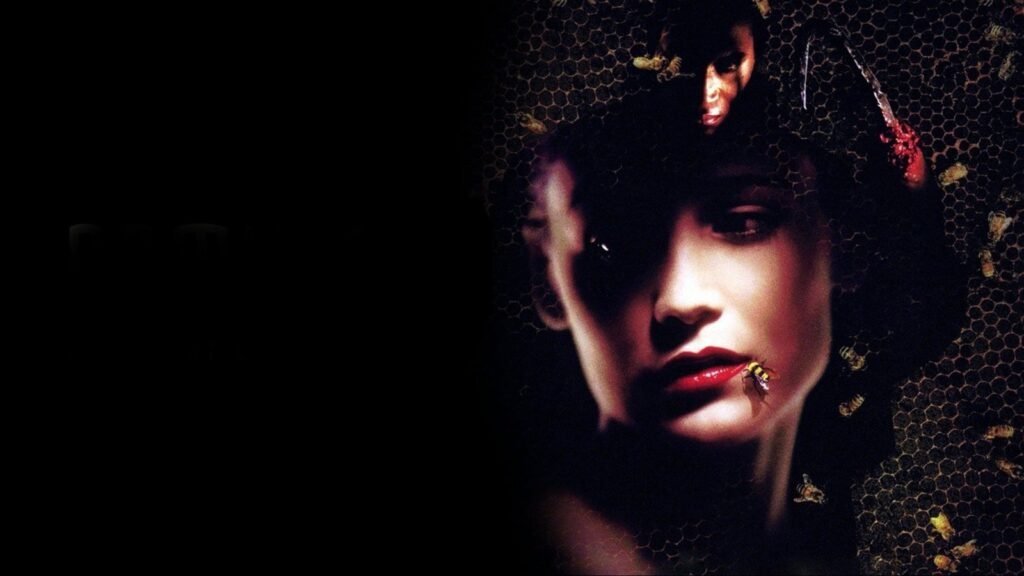
Here is a career shape you do not see often. A Canadian actress spends a decade climbing through television, lands the lead in a major horror sequel in her late twenties, stares down one of the genre’s great monsters — and then becomes genuinely famous playing a Newport Beach mom on a teen drama. If you know Kelly Rowan’s face, it is probably from The O.C. If you know her name from horror, it is because of one film, one mirror, and the very bad idea of saying a certain name five times.
Kelly Rowan is a former Canadian actress and model who played Annie Tarrant, the protagonist of Candyman: Farewell to the Flesh (1995). Her horror record is real but narrow — exactly one horror lead, one small part in a cult favourite, and a scatter of supporting genre work across twenty-four years — and it will be written here at exactly that weight. No inflation. She earned the lead. She just didn’t stay in the genre.
Quick Specs
- Born: October 26, 1965, Ottawa, Ontario, Canada
- Occupation: Actress and model (former)
- Known for: Kirsten Cohen on The O.C.; Annie Tarrant in Candyman: Farewell to the Flesh
- Years active: 1984–2016
Ottawa to New York: the training years
Rowan was born in Ottawa and graduated from Toronto’s Northern Secondary School. She left the University of Western Ontario to pursue acting, studied at the British American Drama Academy in the United Kingdom and at the Neighborhood Playhouse in New York City, and worked as a model in New York while she studied. One account of those years has her leaving university at twenty after being cast in the Canadian series Mount Royal, which shot in Paris.
Her first listed credit is Canadian television: Hangin’ In in 1984, an episode called “The Party,” playing Karen. Her first film credit followed in the mid-1980s — the direct-to-video My Pet Monster, as Stephanie, a few years before the film that tends to get mislabelled as her debut. Listings argue about whether My Pet Monster belongs to 1985 or 1986; the order is secure even if the year isn’t, and the order is what matters: she was a working actress before the backyard gate ever opened.
The Gate: fourth-billed
The Gate (1987) is a genuinely beloved piece of Canadian horror — Tibor Takács directing Michael Nankin’s script, two kids, a hole in the backyard, and a small army of demons. It also belongs, entirely, to its three young leads: Stephen Dorff as Glen, in his film debut, Christa Denton as his older sister Alexandra “Al,” and Louis Tripp as Terry Chandler. The film’s starring line names those three and nobody else.
Rowan is fourth-billed, as Lori Lee, one of the older girls at Al’s party on the weekend the parents are away; Jennifer Irwin plays her sister Linda Lee. That is the true size of it. The film’s own plot summary never names her character, because Glen, Al and Terry carry the picture. She was twenty during the Toronto shoot in the spring of 1986 and twenty-one when the film reached American screens in May 1987 — a working actress picking up a supporting part in somebody else’s breakthrough film. One notice rated it three out of five and called it “surprisingly effective,” and it holds 42% on Rotten Tomatoes from 12 reviews — a cult reputation built slowly, the way cult reputations usually are.
Two points worth nailing down. First: The Gate was an early film role, not her debut — My Pet Monster and 1984 television both precede it. Second: she did not come back for The Gate II: Trespassers; Louis Tripp was the only original cast member who returned. Her connection to The Gate is real, and it gives her horror story a cult anchor. It is just not a starring one.
Candyman: Farewell to the Flesh — the lead
This is the load-bearing credit. Candyman: Farewell to the Flesh (1995) moved the legend from Chicago to New Orleans, with Bill Condon directing from Rand Ravich and Mark Kruger’s script, from a story by Clive Barker, and Gramercy Pictures releasing it on March 17, 1995. Rowan plays Annie Tarrant, a New Orleans art teacher whose brother Ethan stands accused of murdering Professor Phillip Purcell — a killing actually done by the Candyman. To discredit the legend, Annie invokes his name herself. Her husband Paul is among the victims. And she uncovers the thing the film has been burying: she is a descendant of Daniel Robitaille and Caroline, down the daughter Isabel’s line, and it is Caroline’s mirror — the object holding part of Robitaille’s soul — that she destroys to annihilate him. Five years on, in the epilogue, she is teaching her young daughter, named Caroline, the family history.
Tony Todd holds the title role and top billing as the Candyman. Rowan is the film’s heroine and its point of view — the protagonist, opposite Todd, never the title character and never a replacement for him. She was twenty-eight during the New Orleans and Los Angeles shoot in the late summer and autumn of 1994, and twenty-nine at the release.
And be clear about the borders of the credit. She is not in Candyman (1992) — Helen Lyle was Virginia Madsen, and Rowan enters the series with the sequel. She did not return for Candyman 3: Day of the Dead (1999) or Candyman (2021). Annie Tarrant appears in exactly one film, and this is it.
The notices, as preserved in the film’s reception record, were rough — rougher than the original ever faced. Leonard Klady called it “a case of diminishing artistic returns but not, thankfully, a victim of the terrible twos.” Caryn James went colder: “sluggish, predictable, low-rent sequel.” Roger Ebert gave it two of four stars, and Marc Savlov was a dissenting positive voice. It holds 21% on Rotten Tomatoes from 33 reviews. Harper’s honest take: the sequel is a lesser machine than Bernard Rose’s original, but Rowan is not the weak part of it — she plays Annie as a believer dragged backwards into belief, and the film asks her to carry its grief as well as its fear. She carries both.
Ghosts, vampires and the anthology circuit
Around the lead, there is a scatter of supporting genre work, and it deserves its true weight too — no more, no less.
Grave Secrets: The Legacy of Hilltop Drive (1992) is a CBS ghost-story television film, aired March 3, 1992, dramatising the events in Jean and Ben “Shag” Williams’s book The Black Hope Horror: residents of new houses built on land once used as a cemetery start experiencing supernatural phenomena — “said to be based on fact.” Rowan, twenty-six at the airdate, plays Gayla Williams, in the family orbit around the leads, Patty Duke’s Jean and David Selby’s Shag. Supporting, not lead — but a genuine ghost story, on network television, three years before the mirror.
Rufus (2012), also released as Hunted, is her last horror credit: a Canadian feature directed and written by Dave Schultz, premiered at the Calgary International Film Festival on September 21, 2012, with a general theatrical release in 2013. A mysterious young man arrives in a small town with an elderly companion and is eventually revealed to be a vampire, with a pharmaceutical company’s agent hunting him. Get that word right — vampire. Werewolf descriptions of this film circulate and they are wrong. Rowan, forty-six at the premiere, plays Jennifer Wade, wife of Sheriff Hugh Wade (David James Elliott); the Wades take Rufus (Rory J. Saper) in as a houseguest. Supporting again — the sheriff’s wife who opens the door, which in a vampire film is never a small decision.
Television filled in the rest of the genre column. She played Isabelle Pierce in The Outer Limits episode “Virtual Future” (1995) and Kristin in “In Another Life” (1998) — eleven and fourteen years, respectively, into a career that began in 1984, which is the correct arithmetic and the correct weight: two guest spots in the SF/horror anthology revival, not a genre career. Add Kim in the War of the Worlds episode “Goliath Is My Name” (1988) and a single episode of The Burning Zone in 1997, and the column is complete.
Kirsten Cohen: the role that actually made her famous
Now the plain truth: Kelly Rowan’s fame is not horror. From 2003 to 2007 she played Kirsten Cohen — Newport Beach real-estate developer, wife of Peter Gallagher’s Sandy, mother of Seth — as a main cast member across the whole run of The O.C. on Fox: 92 episodes, from her late thirties into her early forties, and the role that made her internationally famous. It is a teen and family drama. She won a Prism Award for it in 2006. Any page that buries this under the horror credits to justify its own existence is lying to you about the shape of her career, and this one won’t.
The road there ran through a decade of solid, varied work. In 1991 she turned up briefly in Steven Spielberg’s Hook as Peter’s Mother — a brief appearance, exactly that size. In 1993 came the performance Canadian television remembers her for: Eliza Terrio in the survival-at-sea television film Adrift, opposite Bruce Greenwood, for which she won a Gemini Award for best actress. Adrift is a thriller, not horror — its weight here is the award, and the award is considerable. In 1995, her genre peak year, she also played Jennifer in Assassins — a minor part, Electra’s neighbour, in a film whose female lead is Julianne Moore — and took the series lead of Mattie Shaw (spelled “Matty” in some listings), a funeral-parlour operator and gunsmith, on Lonesome Dove: The Outlaw Years (1995–1996, 22 episodes). Then One Eight Seven (1997), as Ellen Henry opposite Samuel L. Jackson; Three to Tango (1999), as Olivia Newman; a CSI: Crime Scene Investigation episode in 2001; and four episodes of Boomtown (2002–2003) as Marian McNorris, immediately before Orange County called.
Producer, Perception, and the last credit
After The O.C., Rowan stepped behind the camera as well as staying in front of it: executive producer on the television films Eight Days to Live (2006), In God’s Country (2006/2007, also acting, as Judith Leavitt), She Drives Me Crazy (2007) and The Good Times Are Killing Me (2009, also acting, as Kate Derby). One biography adds that the first two were Gemini-nominated for Best Television Movie in 2007 and that she and producing partner Graham Ludlow won a CFTPA indie award for outstanding independent producers for In God’s Country.
Her last series lead was Perception (TNT, 2012–2015), and it comes with a reveal you are not allowed to strip off: Rowan plays Natalie Vincent, the imaginary best friend of Eric McCormack’s Dr. Daniel Pierce — a hallucination — and Dr. Caroline Newsome, the real psychiatrist the hallucination was based on. Natalie is not Pierce’s girlfriend or his colleague; she is the shape his mind gives to Caroline. It is a crime procedural, listed here because it is a series lead, not because it is genre. Around it, the final stretch runs CSI: Miami (2009), Flashpoint (2010), Cyberbully (2011), Rufus (2012), a Castle episode in 2015 with the horror-pun title “PhDead,” a Murdoch Mysteries Christmas episode the same year — and then the last credit on the record: the 2016 television film Tulips in Spring, as Caroline.
Her personal life, briefly: she announced her engagement to David Thomson, 3rd Baron Thomson of Fleet, in late June 2007; the engagement was broken off before she gave birth to their daughter on April 28, 2008, in Los Angeles. That is the whole of it here.
Where she stands
Kelly Rowan is a former actress. That word — former — does a lot of work here, because her record ends in 2016 and any suggestion that she “continues to work” is simply out of date. What the record holds is this: a Gemini-winning Canadian television career, a turn as producer, the defining mom of a defining 2000s drama, and — for our purposes, at 2 AM, with the mirror covered — one true horror lead. Annie Tarrant, who said the name to prove it meant nothing, and found out it meant everything. One film was enough. It just has to be the right film, at the right weight: not the lead of The Gate, never Helen Lyle, and no crown this site has any business handing out. The protagonist of Candyman: Farewell to the Flesh, opposite Tony Todd. That is Kelly Rowan in horror — narrow, real, and hers.