
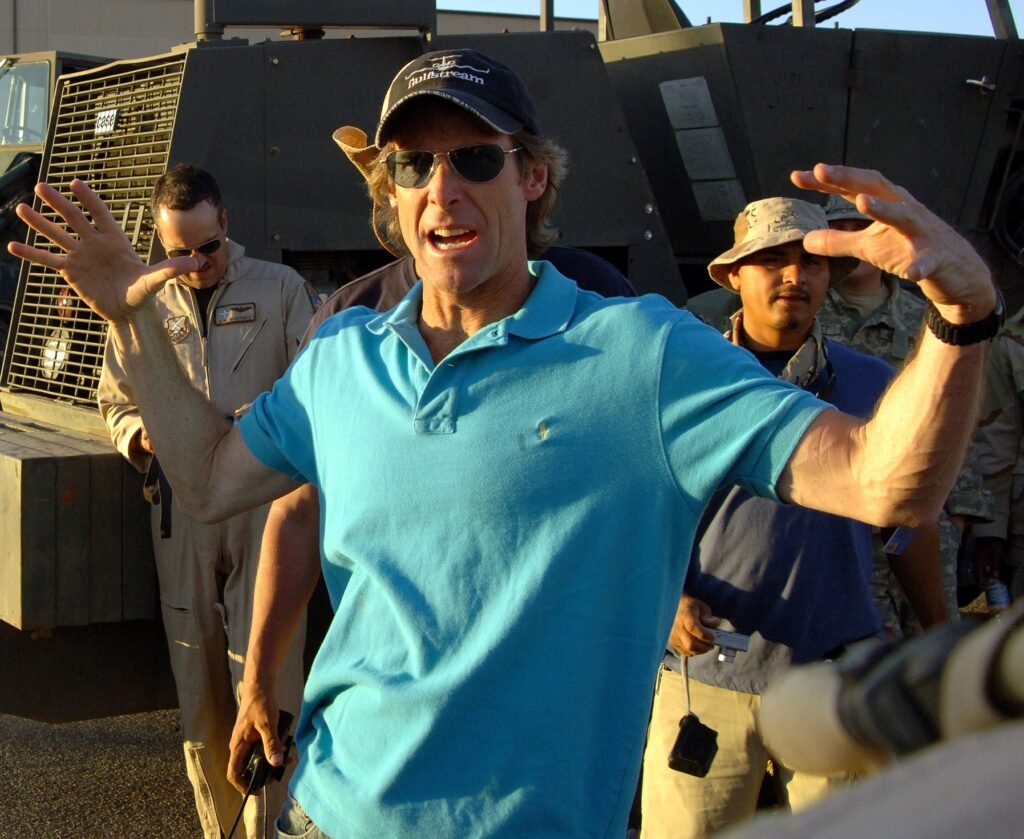
Michael Bay is an American director and producer behind Bad Boys, Armageddon and Transformers, and co-founder of horror remake house Platinum Dunes.
Quick Specs
| Born | February 17, 1965, Los Angeles, California |
| Education | Wesleyan University (class of 1986, English and Film), Art Center College of Design |
| Before features | Propaganda Films commercials and music videos, including the first “Got Milk?” ad |
| Directed | Bad Boys (1995), The Rock (1996), Armageddon (1998), Pearl Harbor (2001), Transformers (2007-2017), Pain and Gain (2013), Ambulance (2022) |
| Horror as producer (Platinum Dunes) | The Texas Chainsaw Massacre (2003), Friday the 13th (2009), The Purge (2013) |
| Platinum Dunes | co-founded 2001 with Andrew Form and Brad Fuller |
| Nickname for his style | Bayhem |
Who He Is
Michael Bay was born in Los Angeles on February 17, 1965. As a boy he set off firecrackers on his toy train set and filmed it, setting his bedroom curtains on fire. The fire department came, and he was grounded for two weeks.
At 15, interning at Lucasfilm, he was given the storyboards for Raiders of the Lost Ark to file. He decided from the boards that the movie was going to suck. Then he saw it at Grauman’s Chinese Theatre with his parents and decided on the spot to become a director. Years later, at 27, he told Steven Spielberg the story to his face, and Spielberg laughed.
He went to Wesleyan University, class of 1986, as a double major in English and Film, and was a favorite student of film historian Jeanine Basinger. His senior film, My Brother Benjamin, won the Frank Capra prize. After graduate film study at the Art Center College of Design in Pasadena, he joined Propaganda Films two weeks after graduating.
The Work, and What He Did in It
Bayhem was built in commercials and music videos. His first national commercial, for the Red Cross, won a Clio in 1992. In 1993 he directed “Aaron Burr,” the first “Got Milk?” ad, in which a history obsessive with a mouth full of peanut butter can’t answer a radio quiz question: “Who shot Alexander Hamilton?” It won three Gold Clios and a Gold EFFIE, earned Bay the 1995 DGA Award for commercial directing and entered the Clio Hall of Fame in 2009. He also directed Meat Loaf’s “I’d Do Anything for Love (But I Won’t Do That),” shot by Daniel Pearl, the cameraman of the 1974 Texas Chain Saw Massacre, plus Tina Turner’s “Love Thing.”
Jerry Bruckheimer and Don Simpson hired him off his video work for Bad Boys (1995), a script first written for Dana Carvey and Jon Lovitz before Will Smith and Martin Lawrence were cast. “Sony didn’t believe in the movie,” Bay has said. “They had no faith in it… they shut the power off.” When the studio refused to pay for the climactic hangar explosion, Bay paid $25,000 of his own money to shoot it. The studio paid him back after the film turned a profit, and he shows off the check in the DVD extras. The low, circling shot of the two stars rising into frame, improvised on the drive to set one morning, became the image he has repeated ever since. The film cost $19 million and made $141 million worldwide.
The Bruckheimer run followed. The Rock (1996) cost $75 million and made $335 million. Armageddon (1998) was the highest-grossing film of 1998, at $553.7 million, and got a Criterion Collection release with a famous commentary track. Then came Pearl Harbor (2001) and Bad Boys II (2003).
For Think Horror, the key chapter is Platinum Dunes, which Bay co-founded in 2001 with Andrew Form and Brad Fuller. Fuller met Bay in a Wesleyan film class. The company was built to make low-budget genre films, horror first. Its first film was The Texas Chainsaw Massacre (2003), directed by Marcus Nispel, which made $107 million and set off the remake wave. The Friday the 13th remake followed in 2009. The Purge (2013), co-produced with Blumhouse, cost $3 million, grossed about $91 million and launched a franchise.
The Island (2005), with Ewan McGregor and Scarlett Johansson, was his first outright flop, a reported $126 million budget against about $163 million worldwide.
Transformers (2007) was a movie he tried to refuse. When Spielberg, the executive producer, pitched it, Bay says, “I hung up and went, ‘I’m not doing that silly movie because it sounds like a toy movie.'” A crash course at Hasbro headquarters convinced him he could make it “real and edgy.” The first film made $709 million; Revenge of the Fallen, co-written by Ehren Kruger, made $836 million; Dark of the Moon and Age of Extinction each passed $1.1 billion; The Last Knight made $570 million. In 2022 he admitted, “Steven Spielberg said, ‘Just stop at three.’ And I said I’d stop. The studio begged me to do a fourth… I should have stopped.”
Pain and Gain (2013) was his self-described small movie, adapted from Pete Collins’s Miami New Times articles about the Sun Gym gang, made for $26 million and grossing $86 million. He used his Transformers leverage to get it made: “I told them, ‘I’m going to make this movie.’ They said, ‘Why do you want to make it?’ They were scared of it.” 13 Hours (2016) was his lowest grosser but earned an Oscar nomination for Best Sound Mixing. Ambulance (2022), a leaner $40 million film, built its action around aggressive FPV drone shots diving down buildings and passing under jumping cars.
Cool Verified Facts
- His cousin is Susan Bay, Leonard Nimoy’s widow.
- On the Armageddon commentary, Ben Affleck recalls asking why it was easier to train oil drillers as astronauts than astronauts as drillers. Bay told him to shut up.
- Entertainment Weekly named his “Aaron Burr” ad the 11th best commercial of all time.
- Spielberg didn’t give him his first film. Bruckheimer and Simpson did.
Signatures, Habits and Behind the Scenes
- Bayhem. The circling hero shot, low angles against golden-hour skies, military hardware as production design and constant motion, in embryo in Bad Boys and fully formed by The Rock.
- Paying his own way. The $25,000 check for Bad Boys started his reputation for getting the shot no matter what.
- Arm’s length from Spielberg. He thought Raiders would suck, hung up on the Transformers pitch and ignored the “stop at three” advice, all in his own telling.
- Not a fan. He wasn’t a Transformers fan, and he credits that for making the films accessible.
Why He Matters
His visual grammar, the circling camera, sunset steel and cut-on-impact editing, became the default setting of 21st-century action cinema, copied even by his critics. For horror, the legacy is Platinum Dunes. A company founded on a Wesleyan friendship turned the 2003 Texas Chainsaw Massacre remake into a business model for a decade of horror remakes, from Leatherface to Friday the 13th, and then, with The Purge, into the cheap original-horror model Blumhouse scaled up. Bay the producer reshaped horror’s economics more than most horror directors did.