
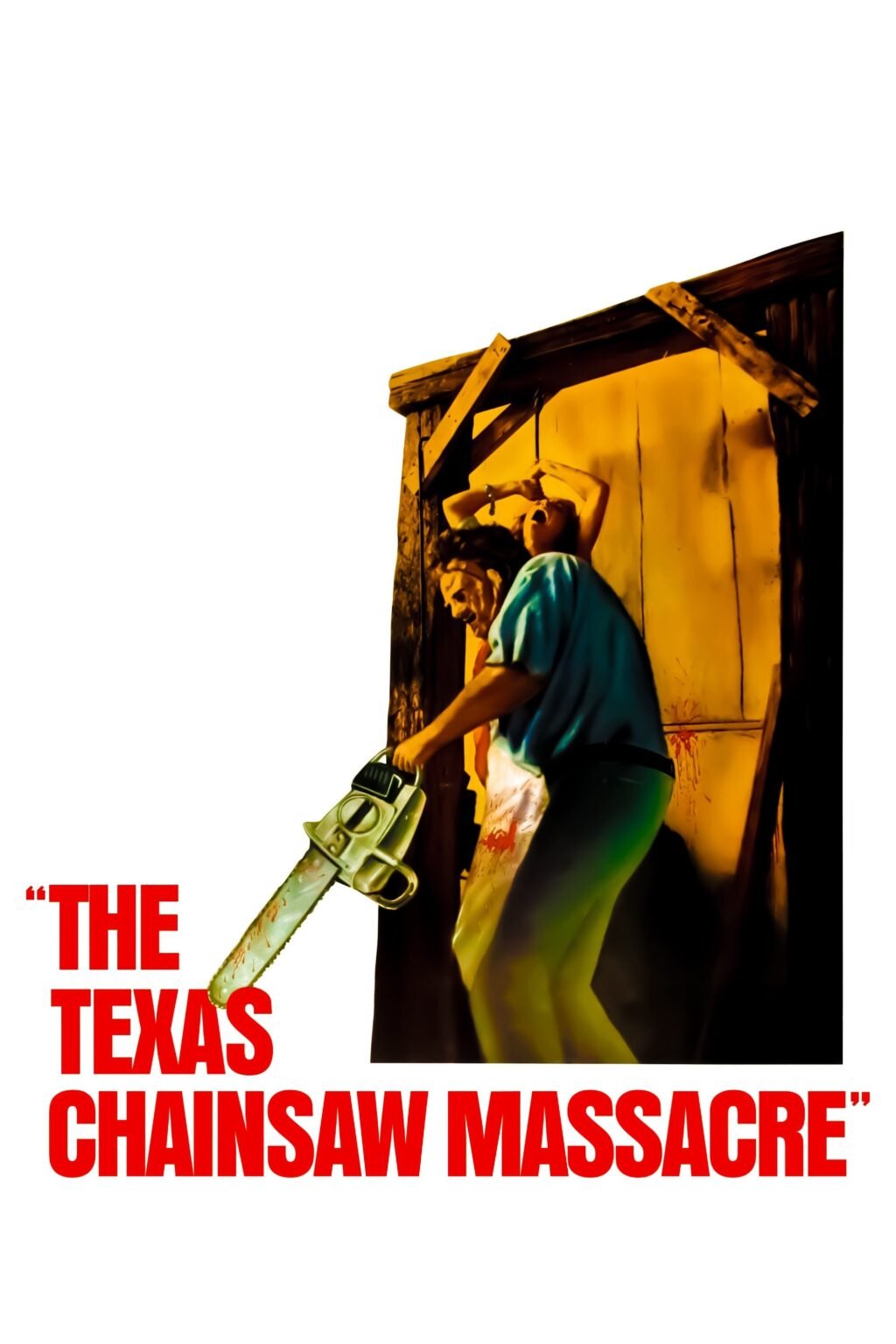
The Texas Chainsaw Massacre franchise is Tobe Hooper and Kim Henkel’s Sawyer saga — nine films, three continuities, one chainsaw.
Start with the lie the posters told: “based on a true story” was marketing. The plots are fiction. Ed Gein inspired specific elements only — the skin mask, the house of human remains and bone furniture — and Gein was convicted of one murder and never used a chainsaw. The saga itself runs in three lanes that this page keeps separate: the original Sawyer continuity, the 2003–2006 remake continuity (where the family is named Hewitt, never Sawyer), and a string of direct sequels to the 1974 film that each ignore everything between. Money figures carry their trackers, and where trackers disagree, both figures are printed.
Quick Specs
- Creators: Tobe Hooper (director), Kim Henkel (co-writer)
- First film: The Texas Chain Saw Massacre (1974)
- Films: 9 (1974–2022)
- Family names: Sawyer (original continuity) · Hewitt (remake continuity only)
- Rights today: Exurbia Films (Henkel) — A24 slate announced February 2026
1974: How the Original Was Made
Tobe Hooper directed the 1974 film and co-wrote it with Kim Henkel — Henkel was never its co-director, whatever older copy on this site once said. They shot in the summer of 1973 around Austin and Round Rock, Texas, through their company Vortex, and released the film in October 1974. Hooper had heard Gein stories as a small child from Wisconsin relatives without knowing the name — “a man who lived in the next town… digging up graves and using the bones and skin in his house… to me he was like a real boogeyman.” The chainsaw came from Hooper himself, stuck in a crowded department store at Christmas, eyeing a chainsaw display and thinking starting one would clear a path; the face mask was reinforced by a doctor acquaintance who claimed to have worn a skinned cadaver’s face to a Halloween party in pre-med. Leatherface wears three different masks of human skin in the film, each tied to a persona — the mask dictates how he acts — and the family around him, ex-slaughterhouse workers in a region of closing slaughterhouses, is the Cook (Jim Siedow), the Hitchhiker (Edwin Neal) and Grandpa (John Dugan). The shoot’s centrepiece hardship was the dinner scene, filmed in a single marathon session of 26 to 27 hours — accounts conflict on the exact count — because Dugan did not want to sit through a second full Grandpa makeup application. The budget has no settled figure: it was shot for well under $300,000, with most trackers listing around $140,000, and any single hard number is wrong by omission. Even its gross is a standing conflict: $26,705,825 worldwide by The Numbers against $30,860,378 in the Box Office Mojo lineage, which counts later reissues more fully — over $30 million worldwide per Box Office Mojo, around $26.7 million per The Numbers.
The Bryanston Saga and the Bans
Distributor Bryanston Pictures took the film in a deal dated 28 August 1974: a $225,000 advance plus 35 percent of profits. Bryanston was a front connected to the Colombo crime family, its money earned by Deep Throat, and after investors, lawyers and accountants were fed, roughly $8,100 remained to split among some twenty cast and crew — the reason this cast famously saw almost no money. The producers sued and won a $500,000 award Bryanston could not pay before going bankrupt; New Line Cinema acquired distribution rights in 1983 and paid the producers a larger share. Hooper had cut the film aiming for a PG; the MPAA required cuts and released it R. Abroad it fared worse: Britain’s BBFC refused it a certificate in the 1970s and did not pass it uncut, with an 18 certificate, until 1999; Australia refused classification in 1975 and again in 1981 before passing it R in 1984; Ottawa police in February 1976 advised two theatres to withdraw it or face morality charges; and it was banned for periods in Brazil, Chile, Finland, France, Iceland, Ireland, Norway, Singapore, Sweden and West Germany.
The Sequels and the Remake Continuity
The Texas Chainsaw Massacre 2 (1986), again directed by Hooper for Cannon Films — and dated 1986, not 1983 as one studio press release later misprinted — was written by L.M. Kit Carson; Henkel has no writing credit on it, his concept of a whole town of cannibals having been rejected. Dennis Hopper’s Ranger “Lefty” Enright hunts the Sawyers alongside radio DJ Stretch, who recorded one of their murders live on air, in a deliberate turn toward the black comedy Hooper felt audiences had missed the first time, with effects by Tom Savini. The MPAA gave it an X; Cannon released it unrated. Budget $4.7 million; worldwide gross just over $8 million. Leatherface: The Texas Chainsaw Massacre III (1990), directed by Jeff Burr from David J. Schow’s script for New Line, relocates and rebuilds the family around a couple detouring off a closed highway; initially rated X, it was among the last films ever given that rating before the MPAA replaced X with NC-17, and was cut to secure an R. Its gross is a small tracker conflict: $5,697,588 domestic by The Numbers against $5,765,562 in the Box Office Mojo lineage. The Texas Chainsaw Massacre: The Next Generation has no single year — shot in 1993–94 as Henkel’s directorial debut, premiered at SXSW on 12 March 1995 as The Return of the Texas Chainsaw Massacre, then acquired, re-cut and retitled by Columbia TriStar for release on 29 August 1997. It stars Renée Zellweger and Matthew McConaughey, both shot before they broke out in 1996, with uncredited cameos by three 1974 originals — Marilyn Burns, Paul A. Partain and John Dugan. Why it sat for years is contested: one account holds the stars’ new representation pressured the studio to bury it, while the litigation record has Henkel and producer Robert Kuhn suing Columbia alleging deliberate withholding; this page prints both and settles neither. Its full-release gross, on which both trackers agree, is $185,898. The Texas Chainsaw Massacre (2003) opens the separate remake continuity: directed by Marcus Nispel in his feature debut, written by Scott Kosar, and the first production of Platinum Dunes — with Hooper and Henkel as producers, and 1974 cinematographer Daniel Pearl back behind the camera. The family here is the Hewitts; Leatherface is Thomas Brown Hewitt (Andrew Bryniarski); Jessica Biel’s Erin leads the victims and R. Lee Ermey is Sheriff Hoyt. Its budget is a conflict — $9 million by The Numbers against $9.5 million in most secondary sources — and it is the franchise’s top earner: domestic $80,571,655, agreed by both trackers, and worldwide $107,967,319 by The Numbers against $107,385,515 by Box Office Mojo, with a franchise table giving a third figure of $107,363,905. The Texas Chainsaw Massacre: The Beginning (2006), a prequel set in 1969, was initially rated NC-17, and producer Brad Fuller has said 17 scenes were trimmed to reach an R; its budget is $16 million by The Numbers and its worldwide gross a conflict — $59,028,046 against $51,764,406 in the franchise-table lineage, the split sitting in international reporting.
The Direct-Sequel Era: 3D, Leatherface, Netflix
Texas Chainsaw 3D (2013), directed by John Luessenhop, ignores every sequel and the remake to continue the 1974 film directly: a young woman inherits a Texas mansion from a grandmother she never knew and finds her cousin Leatherface living in it. Budget $20 million by The Numbers; worldwide $47,666,013 by The Numbers against $47,340,586 in the franchise-table lineage. Its legacy casting is the story — four original-era players returned: Marilyn Burns as Verna Carson, Gunnar Hansen as Boss Sawyer in what was his final film, John Dugan reprising Grandpa, and Part 2’s Bill Moseley taking over Drayton Sawyer from the late Jim Siedow. Leatherface (2017), directed by Julien Maury and Alexandre Bustillo, is a prequel in the same direct-sequel line: a young Sawyer escapes an institution with three inmates and a kidnapped nurse, hunted by the father of a girl who died in the family’s care. Shot in Bulgaria in 2015, it sat shelved for roughly two years — the delay that cost Millennium and Lionsgate the franchise rights in December 2017 — premiering at FrightFest on 25 August 2017 ahead of a DirecTV and VOD-led release; its $1,629,173 worldwide by The Numbers is international only, with no meaningful US theatrical run. Hooper was an executive producer: his final film credit, premiered the day before he died. Texas Chainsaw Massacre (2022), from Legendary for Netflix, is another direct sequel to 1974 only, set some fifty years later: four young entrepreneurs buy a ghost town to flip it and evict the elderly woman whose grown “son” is Leatherface, while a surviving Sally Hardesty returns for revenge. Its first directors, Ryan and Andy Tohill, were fired one week into filming in Bulgaria and replaced by David Blue Garcia, who reshot the film. It is a streaming release: no box office exists, and any dollar figure attached to it as a “gross” is a data artifact, not earnings. For the record, and naming the tracker as required: Box Office Mojo’s franchise page counts eight theatrical releases with a domestic lifetime of $199,267,695, the 2003 remake at number one — The Numbers’ per-film worldwide figures sum differently, because of the 1974 and 2003 conflicts above.
The Leatherfaces, and Sally
Nine actors have worn the mask, and the count is verified: Gunnar Hansen (1974), Bill Johnson (Part 2), R.A. Mihailoff (Part III), Robert Jacks (Next Generation), Andrew Bryniarski (2003 and The Beginning — the only actor to play the role twice), Dan Yeager (3D), Sam Strike (Leatherface, as the young Jed Sawyer), and Mark Burnham (2022). Hansen — born in Reykjavík in 1947, a UT Austin graduate student and bartender when he auditioned, in his first film role — played Leatherface in 1974 only; his single franchise return is Boss Sawyer in 3D, his final film before his death on 7 November 2015, aged 68, of pancreatic cancer. He was primarily a writer, and his memoir Chain Saw Confidential remains a primary source for the shoot. Marilyn Burns likewise played Sally Hardesty in 1974 and never again — her later appearances are an uncredited Next Generation cameo and Verna Carson in 3D — and the hardships behind her performance are documented rather than legend: her finger was actually cut during the dinner scene when the prop blood tube clogged and the knife’s safety guard came off, the shoot ran in extreme heat with rotting meat as set dressing, and a slipped pulley rope in the meat-hook rigging wrenched her leg and back. Hooper’s own summary stands attributed to him: “Everyone hated me by the end of the shoot.” Burns died on 5 August 2014, aged 65, and Sally in 2022 is played by Olwen Fouéré. John Dugan, a young man under heavy old-age makeup in 1974 — accounts conflict on his exact age, so none is printed — returned as Grandpa in both 3D and Leatherface (2017).
Status: The Rights Now Sit With A24
The rights timeline is the current story, and any page still calling this a Legendary franchise is stale. Millennium and Lionsgate lost the rights in December 2017 after the Leatherface shelving; Legendary acquired them in 2018 and made the 2022 Netflix film, after which the rights reverted to Henkel’s Exurbia Films. Verve auctioned them, announced in March 2025, with more than half a dozen parties in pursuit; in September 2025 A24 was reported in pole position, explicitly not final — coverage from that window, including a supposed “Legacy” title, is pre-deal speculation and superseded. On 3–4 February 2026, A24 won. Its slate, in order: a television series first — the franchise’s first series ever — directed and showrun by JT Mollner, a long-form exploration of the world and explicitly not a remake of the 1974 film, with Glen Powell as an executive producer only, not starring, and Henkel executive-producing; and a feature reimagining in development, for which Curry Barker was hired in April 2026 to write and direct. Henkel, on choosing A24: “It was a difficult decision, but A24’s embrace of boundary-testing genre film… made them a compelling choice.” Both projects are in development as of October 2026 — no casting, no network or streamer, and no dates have been announced in trade coverage for either, and the series is not in production whatever any headline has claimed. Hooper, who directed exactly two franchise films — 1974 and Part 2 — and later produced the Platinum Dunes pair and executive-produced Leatherface (2017), died on 26 August 2017, aged 74, the day after that film’s premiere.
Why This Franchise Matters
No American horror film did more with less: a regional production shot for well under $300,000, kneecapped by its own distributor, banned across half the world, and still the genre’s permanent reference point for dread — achieved, famously, with very little gore actually shown. Its afterlife is just as instructive. The franchise contains multitudes that refuse to merge — two family names, three continuities, Leatherfaces numbering nine — and its ownership history, from a mobbed-up distributor through Cannon, New Line, Platinum Dunes, Millennium and Legendary to an auction won by A24, is a fifty-year tour of how horror gets financed. Through all of it, two names recur because their companies held the underlying rights: Hooper’s and Henkel’s. The saw, as the posters promised, is family — and the family, legally speaking, is theirs.
Keep it locked on Think Horror.