
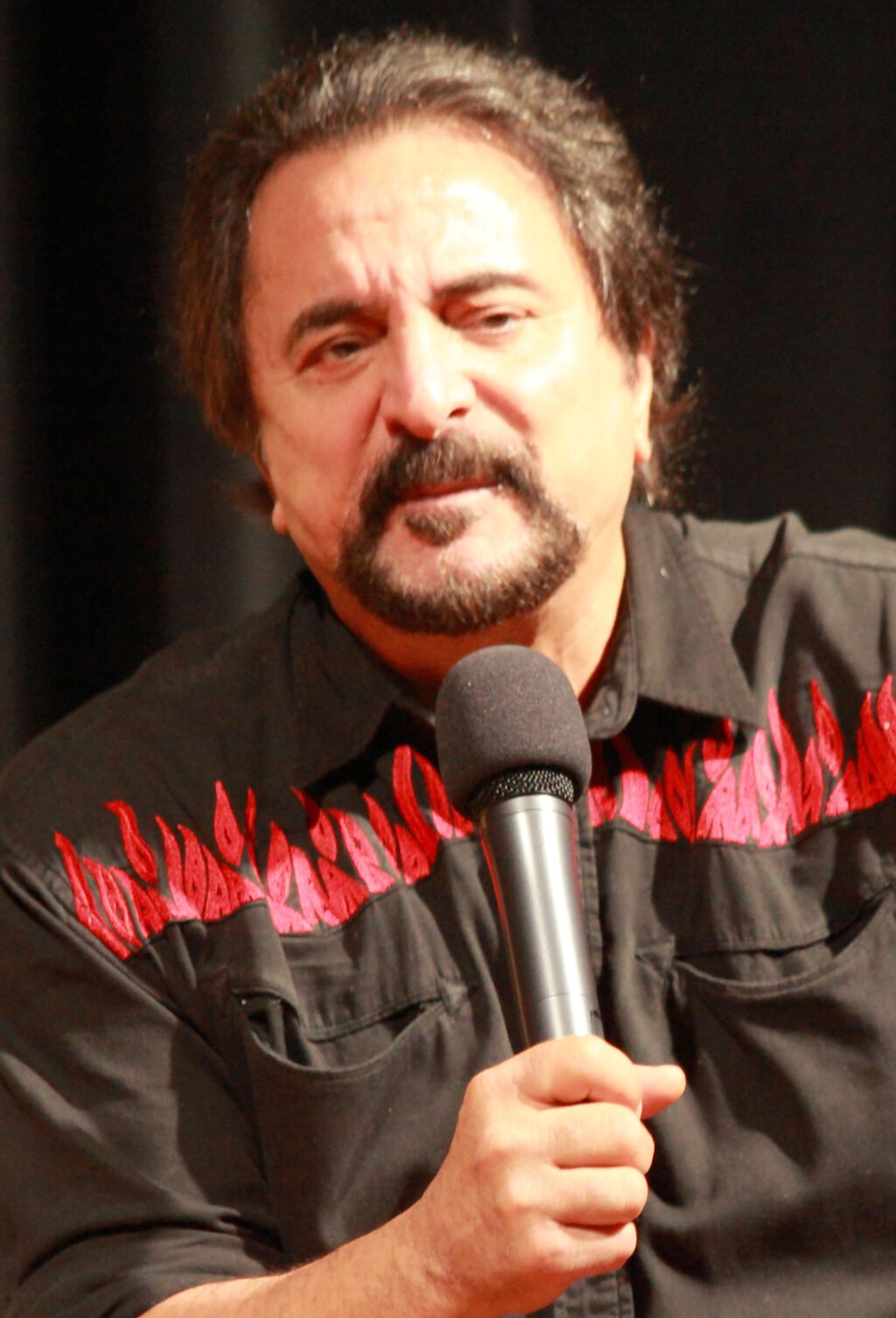
Tom Savini (born 1946) is the Pittsburgh special make-up effects artist behind Dawn of the Dead and Friday the 13th, and a character actor.
Before Tom Savini ever built a wound, he photographed real ones. The Army sent him to Vietnam with a camera, and his job was to record what weapons did to machines and to people. He came home to Pittsburgh, picked up the latex and the stage blood he had been playing with since boyhood, and by the end of the 1970s he was the man horror directors called when the effect had to look like the real thing.
Quick Specs
| Born | November 3, 1946, Pittsburgh, Pennsylvania (as Thomas Vincent Savini) |
| Home | The Bloomfield neighbourhood of Pittsburgh, in the house he was born in |
| Known for | Special make-up effects on Martin, Dawn of the Dead (1978), Friday the 13th (1980), Maniac, The Prowler, Creepshow and Day of the Dead |
| Jason Voorhees | Designed and built the child Jason’s face in 1980 and the adult Jason’s in Friday the 13th: The Final Chapter (1984) |
| Key collaborator | George A. Romero |
| Director | Night of the Living Dead (1990); episodes of Tales from the Darkside; Creepshow on Shudder (2019) |
| Acting | Blades in Dawn of the Dead, Sex Machine in From Dusk Till Dawn (1996), Morgan in Knightriders (1981) |
| Honours | Saturn Award for Best Make-Up for Day of the Dead; earlier Saturn nomination for Dawn of the Dead |
| School | Tom Savini’s Special Make-Up Effects Program, Douglas Education Center, Monessen, Pennsylvania (since 2000) |
| Books | Grande Illusions (1983) and Grande Illusions II (1994) |
| Military service | US Army, combat photographer in Vietnam |
| Marriage | Nancy Hare, 1984; three children |
Who He Is
Thomas Vincent Savini was born on November 3, 1946, in Pittsburgh, Pennsylvania. He is of Italian descent, was raised Catholic, and grew up in Bloomfield, the city’s Little Italy, in a house that passed from his grandfather to his father to him. He never really left it. “I’ve been in the same house I was born and raised in for 77 years,” he told Pittsburgh Magazine in July 2024.
The spark was Lon Chaney. As a boy Savini saw Man of a Thousand Faces (1957), the Chaney biopic, and decided that making faces was what he wanted to do. He practised on himself, then talked his friends into sitting for him, and paired the make-ups with homemade costumes to scare them.
He also trained his body: tournament fencing, gymnastics, the bullwhip and motorcycle stunts, which is why directors kept putting him in front of the camera too.
He graduated from Central Catholic High School in Pittsburgh and spent three years at Point Park University before enlisting in the US Army. The Army made him a combat photographer in Vietnam. He described the job to the Pittsburgh Post-Gazette in 2002: “When I was in Vietnam, I was a combat photographer. My job was to shoot images of damage to machines and to people. Through my lens, I saw some hideous [stuff]. To cope with it, I guess I tried to think of it as special effects.”
After the Army he attended Carnegie Mellon University, and he worked as a freelance photographer and as an actor in regional theatre in North Carolina. He married Nancy Hare in 1984, and he has three children, a son and two daughters. These days he is semi-retired from hands-on feature effects. He still lives in Pittsburgh, still runs his school, and takes selected design work through Tom Savini Studios.
The Work, and What He Did in It
The Apprenticeship
Savini’s first professional effects job was Bob Clark’s Deathdream (1974, also known as Dead of Night), about a dead soldier who comes home from Vietnam wrong. The make-up effects belonged to the writer Alan Ormsby, and Savini worked with him. On Deranged (1974), the Ed Gein-derived shocker directed by Jeff Gillen and Ormsby, Ormsby again ran the effects with Savini helping. He learned the trade inside someone else’s department.
Martin and Dawn of the Dead
The partnership that made him began with George A. Romero’s Martin (1977), a modern vampire film about a young man who may or may not be an 84-year-old vampire, and who kills with a razor and a syringe instead of fangs. Savini built the convincing wrist-slashing effect in the opening scenes. He also acted in the film, as Arthur, and did stunts, which set the pattern for his Romero years: effects, acting and stunt work on the same picture.
Then came Dawn of the Dead (1978), Romero’s shopping-mall siege. Savini’s department had to turn out hundreds of extras as zombies, so he worked out a simple grey assembly-line make-up for the crowds and saved detailed appliances for the “hero” zombies in close-up. On film, the grey came out anywhere from green to blue, and the blood photographed a bright, paint-like red. Savini was unhappy with both. Romero liked the result and compared it to comic-book colour.
The gags are the ones effects students still study. A dummy head was destroyed by a real shotgun blast in the opening tenement raid, after a wired wax head failed. A helicopter blade scalps a zombie, done with a built-up false forehead on actor Jim Krut, torn open by lines pulled off camera. And a machete goes into a zombie’s head, a trick explained below. Savini also played Blades, the machete-swinging biker who loots the mall and goes over a balcony into the fountain. “If there wasn’t Dawn of the Dead I wouldn’t have gotten Friday the 13th,” he has said, “and that one-two punch is what catapulted my career.”
Friday the 13th and the Slasher Years
Friday the 13th (1980), directed by Sean S. Cunningham, gave Savini the slasher template. The credit reads special make-up effects by Tom Savini, assisted by Taso N. Stavrakis, and he also did stunts. The killer in that film is Mrs. Voorhees, not her son, and Savini’s department built her kills: the arrow through Jack’s throat, the axe in Marcie’s face, Annie’s slit throat (performed on camera with Stavrakis’s hands), the throat cuttings, and the beheaded Mrs. Voorhees dummy that later turned up again in Maniac.
The arrow gag, with Kevin Bacon as Jack, was a three-man job. Bacon knelt under the bunk with his real head tilted back while a fake neck and chest appliance sat above him. Savini thrust the arrow up through the appliance. The hand that pins Jack’s head belongs to the still photographer, Richard Feury. When the blood pump failed on the take, it was Stavrakis who blew through the tube and made the geyser audiences remember.
Then there is the boy in the lake. Jason Voorhees was created by the screenwriter Victor Miller, and the idea of a deformed child bursting out of the water at the climax came through Ron Kurz’s uncredited rewrite. What Savini did was give Jason a face. He designed and built the child’s appearance in foam-latex prosthetics on Ari Lehman, modelled on a plaster cast of Lehman’s head: bald, dome-headed, with misaligned features inspired by a child Savini remembered. It is the lasting visual contribution, and it is his.
He did not do the sequel. Savini thought the idea of an adult Jason who had somehow survived in the lake made no sense, and turned Friday the 13th Part 2 down. Carl Fullerton handled that film’s effects after Stan Winston left the production. The hockey mask arrived in Part III, a film Savini had nothing to do with.
Maniac (1980), William Lustig’s Times Square killer film with Joe Spinell as Frank Zito, is the most extreme film on the list. Savini did the scalping effects and the most infamous shot: a man’s head destroyed by a shotgun in a parked car. Savini played the victim, credited as Disco Boy. He built a cast of his own head, filled it with food scraps, pig intestines and fake blood, and fired the shotgun himself, off the car’s hood, with live ammunition, in a guerrilla shoot near the Verrazzano-Narrows Bridge. “The couple is me and an ex-girlfriend,” he has said. “I actually did the firing.”
Instead of the Friday sequel he made two more slashers in 1981. In Tony Maylam’s The Burning he did the burn make-up for the disfigured caretaker Cropsy and the raft massacre, five campers killed in one sustained sequence with garden shears, fingers severed and throats opened. The film was heavily cut by the MPAA. In Joseph Zito’s The Prowler he put a bayonet through a skull, staged pitchfork impalements, and climbed into a swimming pool himself to perform a throat-slitting with a blood-pumping fake knife. The finale is another exploding head, stuffed with apple cores, lunch leftovers and blood-filled condoms, and shot by Savini. He has repeatedly rated The Prowler among his best work. The same year brought another effects credit, Eyes of a Stranger (1981). It is the stretch that got him called the Sultan of Splatter.
Creepshow
Creepshow (1982) reunited him with Romero on a script by Stephen King: five stories in the style of the old EC horror comics. Savini’s department did the creatures and effects for all five, and he has called it the hardest film he ever worked on, because it was “five movies in one.”
The best-loved build is Fluffy, the ape-beast in the crate. The script barely described it, and Savini had never built a fully articulated creature, so he called Rob Bottin, who talked him through it on the phone for an hour and a half. There is the creeping moss of “The Lonesome Death of Jordy Verrill,” the waterlogged dead of “Something to Tide You Over,” and the finale of “They’re Creeping Up on You,” where thousands of live cockroaches pour out of E.G. Marshall’s body.
Back to Crystal Lake, and Day of the Dead
For Friday the 13th: The Final Chapter (1984), Savini came back to the series for Joseph Zito, his Prowler director, on a principle he has stated himself: having designed the child Jason, he should be the one to bring the adult Jason full circle and kill him. He built the adult Jason’s unmasked face on Ted White, working from his own 1980 design and method, and the death scene in which Jason slides down his own machete. The killing held for exactly one film. The series carried on without him.
Romero‘s Day of the Dead (1985) is the film Savini has called his masterpiece. He ran a small basement workshop crew that included Greg Nicotero, paid as his assistant for the first time, along with Howard Berger and others who would go on to found KNB EFX. “I officially was paid to work for him on Day of the Dead,” Nicotero has said.
With months of preparation, Savini moved past Dawn’s uniform grey. He researched with coroners how bodies change depending on where and how a person dies, which he summed up as “you’ll be bloated in the basement and fried in the attic,” and he made every zombie different. He built Bub, the zombie who remembers, played by Sherman Howard, whose subtle make-up had to carry a performance. The climax delivered heads torn off with vocal cords stretching, faces peeled away, and Captain Rhodes torn in half while he shouts “Choke on ’em!” at the zombies eating his intestines, which were real pig intestines. The line was Joseph Pilato’s improvisation, by Romero’s account; the body was Savini’s department. Day of the Dead won him the Saturn Award for Best Make-Up.
Leatherface, a Monkey and Argento
On The Texas Chainsaw Massacre 2 (1986), Tobe Hooper went the opposite way from his 1974 original and hired Savini to show everything the first film had held back. Savini’s credit is special make-up effects creator, and he led a crew of six: Gabe Bartalos, Bart Mixon, Jon Vulich, Shawn McEnroe, Gino Crognale and Mitch Devane. Under his creation they made the Sawyer family looks, including Bill Moseley‘s Chop-Top with his plate-and-wig look, the aged Grandpa and Leatherface’s mask, plus the head-sawing on the bridge at the start and L.G.’s skinned body.
Romero’s Monkey Shines (1988), from Michael Stewart’s novel, is about a quadriplegic man whose trained capuchin helper, Ella, turns murderous. The credit is special make-up effects by Tom Savini, assisted by Greg Nicotero, Everett Burrell and Michael Trcic.
For Dario Argento, who had produced the European version of Dawn, Savini did the effects on Two Evil Eyes (1990), the two-part Edgar Allan Poe anthology Argento and Romero directed, including a woman cut in half by a pendulum and an exhumed corpse with its teeth pulled. He followed it with Argento’s Trauma (1993), built around a decapitation device.
The Director
Savini directed three episodes of Romero’s syndicated anthology Tales from the Darkside. His debut was “Inside the Closet,” first aired in November 1984 and written by Michael McDowell, a story about a student, a professor and a small locked door, often cited as the series’ best episode. The second was “Halloween Candy” (October 27, 1985), also written by McDowell, with Roy Poole as a Halloween-hating old man visited by a goblin.
His only feature as director is the colour remake of Night of the Living Dead (1990), scripted by Romero and made by the original’s principals, Romero with John Russo and Russell Streiner. Savini has said he was meant to do the make-up on the 1968 original and missed it because he was called up for Vietnam. In his version, Patricia Tallman plays a rewritten Barbara who fights back, and Tony Todd plays Ben. The released film is surprisingly restrained for a Savini picture, and that was not his choice: the MPAA threatened an X rating and forced cuts to head shots and gore, on a production made under deadline pressure. The 2025 uncut 4K release restored trimmed frames and the black-and-white opening he wanted. It is a directing credit, not an effects showcase.
Later directing work includes the segment “Wet Dreams” in the anthology The Theatre Bizarre (2011) and a full-circle job: the segment “By the Silver Water of Lake Champlain” for Shudder’s Creepshow series (2019), adapted by Jason Ciaramella from a Joe Hill story. Announcing it, showrunner Greg Nicotero said: “There wouldn’t be a Creepshow without Tom Savini.”
The Actor
Savini’s acting career is a second filmography. His biggest early role was Morgan, the Black Knight, in Romero’s Knightriders (1981), the motorcycle-jousting rival to Ed Harris’s King Billy. He played The Creep in Creepshow 2 (1987), as an actor only, a news photographer in John Landis’s Innocent Blood (1992), and then the part that introduced him to a whole new audience: Sex Machine in Robert Rodriguez’s From Dusk Till Dawn (1996), written by Quentin Tarantino, the whip-carrying biker with a revolver in his codpiece.
The Rodriguez and Tarantino run kept going: Deputy Tolo in Planet Terror (2007), the hitman Osiris Amanpour in Machete (2010) and Machete Kills (2013), and a tracker in Django Unchained (2012). For Romero he came back as Blades, now a zombie, in Land of the Dead (2005), and he played the county sheriff in the 2004 Dawn of the Dead remake. In Pittsburgh he was the shop teacher Mr. Callahan in The Perks of Being a Wallflower (2012).
The Teacher and the Books
In 2000 the Douglas Education Center in Monessen, Pennsylvania, outside Pittsburgh, launched Tom Savini’s Special Make-Up Effects Program. Savini designed the curriculum: 16 months and 1,650 hours, leading to an Associate in Specialized Business degree. Graduates have gone on to KNB EFX Group, Saturday Night Live, Universal’s Halloween Horror Nights, McFarlane Toys and the Smithsonian. When film make-up offers come to Savini now, he passes them to his students and graduates.
He published the craft, too. Grande Illusions (1983) and Grande Illusions II (1994) break down how the famous effects were actually built, with production photographs. Bizarro! is not a third book; it is Grande Illusions reissued under a new title. At the height of his fame he demonstrated effects on Late Night with David Letterman, including fire gel and a gunshot-to-the-head gag performed on Letterman himself.
Masks and the Later Work
His later film effects work is selective. On the Australian film Redd Inc (2012) he supervised the effects rather than creating them. The late reputation is masks, made through Tom Savini Studios with Jason Baker, a graduate of his school, his studio partner and the director of the Savini documentary Smoke and Mirrors.
Corey Taylor told Kerrang! that his Slipknot mask for the We Are Not Your Kind era (2019) was designed by Savini, and Savini said the job started when Baker put them in touch and Taylor came to his house for a life cast. The same year Tom Savini Studios built the mask and head-lantern for Bray Wyatt’s WWE character The Fiend, with Baker supervising construction. The concepts were Wyatt’s own.
Then came the Grabber. For The Black Phone (2022), Savini conceived the mask, and Jason Baker and Callosum Studios brought it to life with him. Scott Derrickson, the director, remembered the moment: “Tom gave me a sketch he had done himself. As soon as I saw it, I was like, ‘Oh, well, this is what we’re doing.'”
Cool Verified Facts
- He has no Oscar nomination. His big award is the Saturn, from the Academy of Science Fiction, Fantasy and Horror Films, for Day of the Dead.
- He was Media Guest of Honor at the World Horror Convention in 1998.
- A large mural of him by Jeremy Raymer covers a wall in Pittsburgh’s Lawrenceville neighbourhood. “To me, it’s just as meaningful as having a star on Hollywood Boulevard,” he said.
- Pittsburgh outlets often call him the Godfather of Gore, a title the director Herschell Gordon Lewis held first.
Signatures, Habits and Behind the Scenes
Savini’s stated method, over forty years of interviews, is that an effect has to carry the feeling of the real injuries he photographed. “I guess Vietnam was a real lesson in anatomy,” he told The Independent in 2020. “This is the reason why my work looks so visceral and authentic. I am the only special effects man to have seen the real thing.” He puts a guardrail on it, too: “I don’t want to give the impression that I do this work because of my Vietnam experience. Not at all. It’s all in the script. Somebody writes this stuff.” The boy in Bloomfield was building make-ups long before he enlisted.
He treats effects as magic tricks. Greg Nicotero put it plainly: “Tom approached everything like it was a magic trick. Tom used every trick in the book to create and craft these illusions.” The machete in Dawn is the textbook case: a hard downward swing on Savini, a cut, then the reverse angle with a real blade, notched to the curve of actor Lenny Lies’s skull, already seated on his head, and Savini straining to pull it free. Sleight of hand, editing and performance, and no single “effect” anywhere in it.
The exploding head is his signature, in Maniac, The Prowler and Day of the Dead: a life-cast dummy filled with organic matter and destroyed by a real shotgun blast, often fired by Savini himself. A prop would look like a prop, so he used the actual physics, and the work photographs wet and heavy because it was. He is usually in the gag, too. “The special effects are the stars of those movies,” he has said. “I can’t say that [this] bothers me.”
For all that, the splatter king argues for restraint. “It’s a lot smarter to leave things to a person’s imagination, let him fill things in for himself,” he has said. “When your mind completes something, it’s much more valuable to you.” He defends how little of Fluffy the final cut of Creepshow shows by comparing it to Alien: “you only saw the full creature when she blew him away.”
Why He Matters
Savini made the violence of the slasher era believable. Between Dawn of the Dead in 1978 and Day of the Dead in 1985 he set the practical-effects standard everyone else was measured against: wounds with anatomy in them, deaths staged as conjuring tricks in front of the camera instead of cutaways, and a zombie population that evolved from grey crowds to individually researched corpses, including one, Bub, whose make-up had to act.
He also turned a secretive trade into a teachable one. Grande Illusions published the mechanisms, and the Monessen programme put them in a classroom. The line runs from Lon Chaney and Dick Smith to Savini, then to Nicotero, who went on to KNB and the zombies of The Walking Dead, then to his own graduates, and through Jason Baker to the Fiend, the Slipknot mask and the Grabber. Much of the second half of Savini’s career is other artists’ first halves.
And he did it from Bloomfield. The Romero films were regional cinema, with Pittsburgh crews and Pittsburgh locations, and Savini is the standing proof that the horror revolution of the 1970s and 1980s was not made only in Hollywood.