
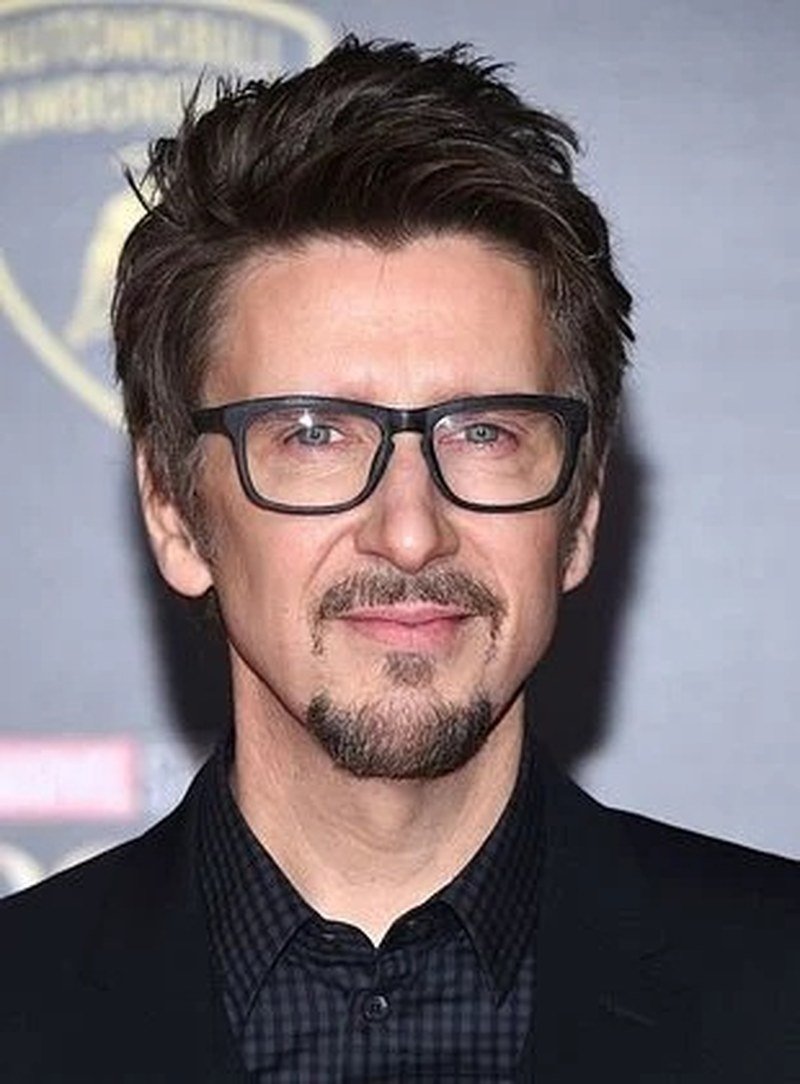
Scott Derrickson (born 1966) is an American director and writer behind The Exorcism of Emily Rose, Sinister, Doctor Strange and The Black Phone.
Quick Specs
| Born | July 16, 1966, Denver, Colorado |
| Education | Biola University (B.A. communication 1989, B.A. humanities 1990); graduate film studies at USC |
| Directing debut | Hellraiser: Inferno (2000) |
| Horror | The Exorcism of Emily Rose (2005), Sinister (2012), Deliver Us from Evil (2014), The Black Phone (2022), Black Phone 2 (2025) |
| Other key films | The Day the Earth Stood Still (2008), Doctor Strange (2016), The Gorge (2025) |
| Key collaborators | Paul Harris Boardman, C. Robert Cargill, Ethan Hawke |
| Company | Crooked Highway (with C. Robert Cargill) |
| Honors | Bram Stoker Award for The Black Phone screenplay, shared with Cargill; Saturn and Chainsaw awards for The Black Phone |
Who He Is
Scott Derrickson was born in Denver, Colorado, on July 16, 1966, and grew up in a blue-collar part of North Denver. He has never dressed up that childhood. “I lived in a violent neighborhood, there was violence in my household; my primary emotional memory of childhood is fear,” he said. The kid answered fear the way future horror directors do: he built haunted houses in his basement and walked the neighborhood kids through them.
The faith story usually gets told backwards. His family wasn’t religious. He converted as a teenager, chose a strict Christian high school on his own, and the crisis of faith came later, in college. That college was Biola University, where he took a B.A. in communication in 1989 and a B.A. in humanities in 1990, studying film, philosophy, literature and theology. “I learned how to think at Biola,” he said. He then did graduate film studies at the USC School of Cinema-Television.
He calls himself an orthodox Christian who believes in the spiritual realm and in possession, and he has also called himself a mystic and a Christian existentialist. He is just as openly critical of fundamentalism. That tension runs through everything he has made.
The Work, and What He Did in It
At USC he wrote, directed, produced and edited the short Love in the Ruins (1995). With fellow USC graduate Paul Harris Boardman he sold the screenplay for Urban Legends: Final Cut (2000) and did uncredited work on Dracula 2000. In 2004 he conceived the story for Wim Wenders’s Land of Plenty. Then came the dry years. “I was paid to write or rewrite 13 screenplays. None of them got made,” he said. “It caused a kind of soul sickness in me.”
Hellraiser: Inferno (2000) was his directing debut, co-written with Boardman: the fifth Hellraiser film and the first to go straight to video, with Craig Sheffer as corrupt detective Joseph Thorne and Doug Bradley as Pinhead. Dimension gave him $10,000 to direct a single scene as a tryout, then hired him for the feature. Where the script came from is still argued by the people who made it. Doug Bradley has said it began as an unrelated script that was reworked into a Hellraiser film; Derrickson has said it was pitched and written as a Hellraiser sequel from the start. Clive Barker, dropped as executive producer over creative disagreements, criticized the result. Derrickson’s answer was that “the only interesting path to take in creating another sequel seemed to be the path of total reinvention.” His own takeaway was about acting: “Your movie can never be better than your lead performance.”
The Exorcism of Emily Rose (2005) was the breakthrough. Derrickson directed and co-wrote it with Boardman, with Laura Linney as defense attorney Erin Bruner, Tom Wilkinson as Father Moore, Jennifer Carpenter as Emily and Campbell Scott as the prosecutor. His goal, in his words, was “to combine two familiar movie genres, courtroom drama and horror. To my knowledge those genres have never been put together in a hybrid film before.” Emily’s story unfolds in flashback through trial testimony, so every event is argued twice, as possession and as epilepsy and psychosis, and the film never settles it. That ambiguity was built in. Derrickson, the believer, picked Boardman as co-writer because Boardman was a skeptic.
The film is loosely based on Anneliese Michel, a young German woman who went through 67 exorcism rites before dying of malnutrition in 1976; her parents and two priests were convicted of negligent homicide. The direct source was anthropologist Felicitas D. Goodman’s book The Exorcism of Anneliese Michel. Derrickson moved the case to America, merged the two priests into one and invented Linney’s lawyer. Asked whether Michel was really possessed, he said: “I’m not entirely sure.”
Carpenter’s audition changed the film. Derrickson cut almost all of the planned visual effects and let her body do the work. It cost $19 million, won its opening weekend with about $30 million, grossed over $144 million worldwide and won the Saturn Award for Best Horror Film. He never made a sequel. “It was based on a real person who lost her life,” he said.
The Day the Earth Stood Still (2008), a remake of the 1951 film with Keanu Reeves as Klaatu and Jennifer Connelly, was his first big studio job, directing a David Scarpa script. It grossed $233.1 million on an $80 million budget, so it was no flop, but critics savaged it and it nearly broke him. “I thought my career was over,” he said. “I found myself at the end of somebody else’s movie.” He promised himself it would never happen again.
Sinister (2012) was his answer. The idea belonged to his new writing partner, critic turned screenwriter C. Robert Cargill, who had a nightmare after seeing The Ring about finding a box of films in his attic, each one recording a murder. Cargill pitched it to Derrickson in Las Vegas. “He drank five White Russians then proceeded to tell me the idea for Sinister. I was hooked,” Derrickson said. They sold it to Jason Blum the next week and had a script five weeks later. Blum’s offer was $3 million and final cut. “It’s the only movie I ever had final cut on,” Derrickson said.
Ethan Hawke plays true-crime writer Ellison Oswalt, who moves his family into a murder house and finds five Super 8 “kill films” in the attic, all tied to a pagan deity called Bughuul. Derrickson’s framing: “It is not found footage, but rather it is about the guy who finds the footage.” The kill films were shot on real Super 8 cameras and stock, and Christopher Young wrote the score. Bughuul is fictional; Cargill built him out of Babylonian story patterns so he would sound like a real ancient god. When the stunt rig for the opening hanging shot failed and a stunt performer came out of his stirrups, Derrickson fired the stunt coordinator on the spot and shut down for three days. The performer was shaken but unhurt, and Derrickson took the blame: “The director is the last and final watchdog for safety on any set.” The film opened on October 12, 2012, and grossed $87.7 million worldwide on that $3 million, a founding proof of the Blumhouse model. He co-wrote and produced Sinister 2 (2015), which Ciaran Foy directed.
He and Boardman also wrote Devil’s Knot (2013) for Atom Egoyan, about the West Memphis Three. Deliver Us from Evil (2014), produced by Jerry Bruckheimer, starred Eric Bana as NYPD sergeant Ralph Sarchie. Bruckheimer’s pitch, as Derrickson recalls it, was “Serpico meets The Exorcist.” The film is based on Sarchie’s book Beware the Night, written with Lisa Collier Cool, and Sarchie advised on set, but the plot is original to Derrickson and Boardman. It made $87.9 million on $30 million.
Doctor Strange (2016), co-written with Jon Spaihts and Cargill, put Benedict Cumberbatch in the Marvel universe. Derrickson flew to London to recruit him, and when Cumberbatch wouldn’t break a stage commitment to Hamlet, Derrickson told Kevin Feige it had to be Benedict. By his account, Disney moved the film from summer to fall to get him. The film stands alone, with no characters from earlier Marvel films, and ends with Strange beating Dormammu by trapping him in a time loop instead of punching him. It grossed $677.8 million and earned an Oscar nomination for its visual effects team.
He signed on for the sequel, worked on it for a year and a half, and left in January 2020, staying on as executive producer while Sam Raimi directed. “We had real creative differences,” he said. “When the producer or the studio and the filmmaker are making different movies, you end up with a monstrosity and, you know, that’s why I had to bounce.” His version would have been “a genuine horror film of sorts,” and he says there’s “no bad blood” with Feige. He has called leaving the hardest decision of his career. He had also directed the original Snowpiercer pilot in 2017; a new showrunner reshot it, and his version has never been shown.
The Black Phone (2022) is the film he made instead, and the one he calls his most personal. He directed, co-wrote with Cargill and produced through their company Crooked Highway, adapting Joe Hill’s short story from 20th Century Ghosts. He came to it after three years of therapy about his childhood and set it in North Denver in 1978, when he was 12. Hill’s story has one ghost on the dead basement phone; the film has five, and Finney’s sister Gwen became, in Derrickson’s words, “really the soul of the movie.” Mason Thames and Madeleine McGraw lead it. Ethan Hawke, who had a rule against playing villains, turned the Grabber down until Derrickson asked him to just read the script. The mask was designed by Tom Savini and built by Jason Baker. It premiered at Fantastic Fest in 2021, opened in theaters on June 24, 2022, and grossed $161.4 million. It won Saturn Awards for Best Horror Film and Best Adapted Screenplay, two Chainsaw Awards and the Bram Stoker Award for screenplay, shared with Cargill.
For V/H/S/85 (2023) he co-wrote and directed the segment “Dreamkill,” about murder tapes that arrive before the murders happen. His son Dashiell plays the teenage dreamer Gunther and his son Atticus scored it.
The Gorge (2025), from Zach Dean’s Black List script, put Miles Teller and Anya Taylor-Joy on opposite sides of a monster-filled chasm. Apple called its February 14, 2025 launch the biggest film premiere in Apple TV+ history, and it earned an Emmy nomination for Outstanding Television Movie.
Black Phone 2 (2025) was his first sequel to one of his own films. Hill got it moving with one line: “The Grabber calls Finn from hell.” Derrickson made The Gorge first so Thames and McGraw would be high schoolers when he came back, and moved the haunting into Gwen’s dreams at a winter camp. It opened on October 17, 2025, and grossed $132.2 million worldwide on a reported $30 million budget. In 2025 he was reported to be developing an adaptation of Christopher Golden’s novel Road of Bones with Cargill, and in October 2026 he, Cargill and Hawke announced the podcast series Midnight Radio.
Cool Verified Facts
- Jennifer Carpenter beat a puppet. The crew built one to perform the dorm-room contortions in Emily Rose. “When Jennifer Carpenter saw the puppet, she said ‘I think I can do that.’ It took her maybe 15 to 20 minutes, but she did it. That is all her,” Derrickson posted.
- Her face nearly got the film an R. The MPAA rated one of her contortions R; Derrickson appealed in writing, lost, and cut it to keep his PG-13.
- Bughuul’s face cost $500. Derrickson found a Flickr photograph titled “Natalie” and bought it from the artist. “And that’s Bughuul.”
- Cargill wrote down “the two dozen most disturbing kills” he could imagine for Sinister. Derrickson’s reply: “What the f--- is wrong with you?” Then he picked his favorites; five made the film.
- Jason Blum pranked him with a black phone. In the house the family moved into after the 2018 Woolsey Fire destroyed their home, Derrickson heard a phone ring in the basement on the first night. Blum had installed one that dials his cell. “It’s still there. I’ll never get rid of it.”
- The Science of Scare Project, a marketing study that measures test viewers’ heart rates across about 50 films, has ranked Sinister its scariest film several times since 2020, after briefly losing the top spot to Host.
Signatures, Habits and Behind the Scenes
- Performance first. Since Inferno he has cast deliberately, because “your movie can never be better than your lead performance.”
- He partners with people who see things differently: the skeptic Boardman on the possession films, the critic Cargill from Sinister on.
- His test for every script: “What is the script if you take out all the genre elements?” If it doesn’t still work as a film about people, it isn’t a film.
- Real darkness on set. On Sinister the benchmark was Caravaggio, and the crew blacked out ceilings so the shadows were real, not added in post.
- Horror as excavation. “Every film I’ve made has been a process of excavating a chunk of the anxiety and fear that I carry,” he said. The center of The Black Phone is a memory from his boyhood: a neighbor friend’s mother was abducted and murdered, her body wrapped in a phone cord and thrown in a lake.
- His formation came from C.S. Lewis’s The Screwtape Letters (“the beacon”), Dario Argento’s Suspiria, which he saw at USC, and Flannery O’Connor’s line about drawing “large and startling pictures” for the blind.
- Make every movie like it’s the last. After The Day the Earth Stood Still he vowed never again to end up at the end of somebody else’s movie, and he says he has walked off films since to keep that promise.
Why He Matters
Derrickson put the possession film back in business three decades after The Exorcist by sending it to court, arguing the supernatural instead of asserting it. Sinister turned found footage inside out, making the horror about the man who watches, and on $3 million and final cut it helped prove the Blumhouse model. Then he walked away from Marvel on a principle he set after his worst year and made The Black Phone, his most personal film and a hit that swept the screenplay awards. A believer who writes about evil with a skeptic beside him, he has spent twenty-five years taking fear seriously, starting with his own.