
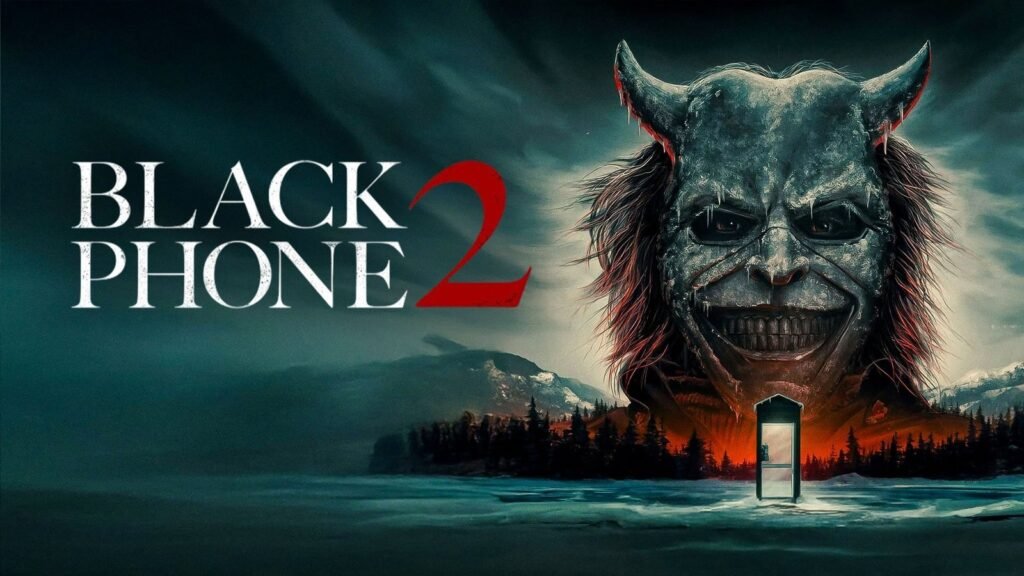
Black Phone 2 (2025) is Scott Derrickson’s supernatural horror sequel, in which the dead Grabber haunts Gwen Blake’s dreams at a snowbound camp. Sit with the problem this film sets itself, because it is a real one. The first film ended the only way it could: a thirteen-year-old boy in a soundproofed basement broke his abductor’s neck with a telephone cord, and walked out alive. The monster was not banished, not imprisoned, not left ambiguous in a doorway. He was dead, by the hero’s own hands, with the ghosts of his victims talking the boy through it. So what does a sequel do? It answers the phone from the other side. The Grabber is still dead — this page will keep saying so, because the film does — and death has only made him more patient, more personal, and considerably harder to hang up on.
Quick Specs
- Director: Scott Derrickson
- Screenplay: Scott Derrickson and C. Robert Cargill
- Producers: Jason Blum, Scott Derrickson, C. Robert Cargill
- Starring: Mason Thames, Madeleine McGraw, Jeremy Davies, Demián Bichir, Ethan Hawke
- Cinematography: Pär M. Ekberg
- Music: Atticus Derrickson
- Production companies: Blumhouse Productions, Crooked Highway
- Distributor: Universal Pictures
- Premiere: 20 September 2025, Fantastic Fest
- US release: 17 October 2025
- Running time: 114 minutes
- Certificate: R — strong violent content, gore, teen drug use, and language
- Budget: $30 million
- Setting: 1982 — Alpine Lake, a winter youth camp
Dead is not the end of him
Universal’s own synopsis pins the premise, and this page pins it the same way: as Finn, now 17, struggles with life after his captivity, the headstrong 15-year-old Gwen begins receiving calls in her dreams from the black phone, and seeing disturbing visions of three boys being stalked at a winter camp known as Alpine Lake. Together, the siblings must confront a killer who has grown more powerful in death — and more significant to them than either could imagine. Note whose film that makes it. The first story belonged to Finney. This one belongs to Gwen, and to the gift she inherited: their mother’s psychic dreams.
The dreams reach back further than the Grabber’s basement. In 1982, four years after Finney killed the Grabber, Gwen’s sleep shows her murders committed at Alpine Lake Camp in 1957 — and in one dream she takes a call from her mother, Hope, who was at that camp in 1957 having dreams of her own. Gwen persuades Finney and Ernesto — a name to hold carefully, and we will come back to it — to travel to the camp, where a heavy blizzard traps them with the camp’s owner, Armando, his niece Mustang, and two employees, Kenneth and Barbara. Snowed in. Cut off. Exactly where a dream-haunting wants its audience.
On the second night, Finney takes a call on the camp’s dead payphone, and the voice on the line is the one he made sure he would never hear again. The Grabber tells him he escaped from Hell, and that he wants revenge twice over: for his own death, and for Finney having forced him to kill his brother Max in that basement. Gwen is attacked inside her dreams, and the injuries follow her out of them — what happens to her sleeping body happens to her waking one. The group works out the shape of the trap: the bodies of the Grabber’s 1957 victims lie somewhere beneath the frozen lake, and finding them may loosen his grip on the dream realm. And they establish the connection that turns a haunting into a family matter — Armando, Hope, and the Grabber all knew each other at this camp, long ago.
Which brings the film to its darkest inheritance. In a dream, the Grabber tells Gwen the truth about her mother — or his version of it, which the film backs: Hope did not kill herself. He killed her, and staged it to look self-inflicted. Hold both layers, because this page insists on both: The Black Phone (2021) presented Hope’s death as a suicide following her disturbing psychic dreams, and that is the story the Blake family lived with for years. The sequel does not erase that account; it reveals the hand underneath it. Their father Terrence — a recovering alcoholic now, fighting his own way back — reaches the camp by borrowed snowplow, and Gwen confronts both father and brother over the drinking and drug use they have used to outrun their pasts. The family decides to stay, and finish it.
The ending, as it is retold
One fence before the ice, stated plainly because this site builds them where they belong: the closing beats of this film rest, in the sources this page was built from, on a single line of plot accounts — one detailed plot summary, whose only mirror is the same lineage repeated, not an independent second source. So what follows is that retelling, attributed as such, and not presented as two-source record. As the plot is retold: at the frozen lake, Gwen locates the boys’ bodies beneath the ice, and finding them breaks the Grabber’s power. Finney, Gwen, and the spirits of the murdered boys turn on him together, and he is dragged down beneath the frozen lake. The next day, as the family leaves, Gwen answers the payphone one last time — and it is Hope, telling her she is proud of her. Retelling ends. What is solid, on firmer ground: the Grabber is defeated, not re-killed — a dead man cannot be killed again, only put down — the three boys of 1957 are put to rest, and Finney, Gwen, and Ernesto all survive.
Who is really back, and as whom
Ethan Hawke is the Grabber again — a serial killer previously killed by Finney, present now as a dead man’s vengeful spirit, working mostly through voice, mask, and dream. He has no other name. Neither film gives him one, and any real name for him circulating online is fan invention; this page prints none. Mason Thames was 18 when the film opened, playing Finn at 17 — the boy who ended the first film by claiming that name for himself, telling his crush she could call him Finn. Madeleine McGraw was 16, playing Gwen at 15: the younger sister promoted, rightly, to lead.
Now the casting trap, and it catches people constantly: Miguel Mora is not back as Robin. Mora played Robin Arellano in the first film — Finney’s friend, one of the Grabber’s victims. Robin is dead, and he stays dead. In Black Phone 2, Mora plays Ernesto, Robin’s younger brother. Demián Bichir is Armando, the camp’s owner and supervisor (some coverage shortens him to “Mando”), and Arianna Rivas is Mustang — Armando’s niece, not his daughter, whatever one review’s error says. Jeremy Davies returns as Terrence Blake, and James Ransone’s Max — the brother the Grabber killed with an axe for trying to free Finney — appears briefly in the sequel’s afterlife. Anna Lore plays Hope, seen in the 1957 strand and in Gwen’s dreams.
An idea, not a second story
Get the source right, because the infoboxes blur it. There is no second “Black Phone” short story. Joe Hill’s story “The Black Phone” was published in 2004 and collected in 20th Century Ghosts (2005), and the first film adapted it. Black Phone 2 is an original screen story: in June 2022, Derrickson said that Hill — protective of his story — had pitched him a “wonderful idea” for a sequel, one Derrickson was open to directing if the first film succeeded; by that August, author, director, and studio were discussing it, with the first film’s success as the catalyst. Hill has said his inspiration was the “iconic imagery” of the Grabber’s masks. The sequel’s credit to Hill is a characters-and-source lineage credit, nothing more — the story on screen is Derrickson’s and Cargill’s.
And get Hill himself right while we are here. He is Joe Hill (born Joseph Hillström King) — his publishing name, shortened from his own middle name in 1997 so his work would be judged on its own merits, a fact he confirmed publicly in 2007. He is the son of Stephen King and Tabitha King, and that is a fact about his family, not a key to his career. The film his story built — The Black Phone (2021), which premiered at Fantastic Fest in September 2021 and reached American theatres in June 2022 — was set in 1978, made for a budget reported only as a range, $16–18 million, and it went on to gross $161.4 million worldwide. Derrickson bolstered Hill’s story with his own suburban-Denver childhood. Four years on, in the story and in the children’s ages alike, the sequel trades that basement for a blizzard.
Shot in the snow
The returning cast and Derrickson’s return as director and co-writer were reported in November 2023, with Bichir joining in September 2024, Rivas that December, and Lore in April 2025. Principal photography ran from 4 November 2024 to 23 January 2025 in Toronto, Mississauga, Hamilton, and Huntsville, Ontario, under the working title Mysterium — the first film shot in North Carolina; the sequel went to Canada and shot the winter for real. The score is by Atticus Derrickson, the director’s son — not Mark Korven, who scored the first film; keep the two Derricksons and the two composers apart. The film also carries Pink Floyd’s “Another Brick in the Wall” and FEX’s “Subways of Your Mind.” Its dream material is shot to look like grainy period home-movie footage, a texture reviewers noted across the board.
The lineage matters to this site: Derrickson and Cargill came to the black phone from Sinister, with Hawke and Ransone in front of the camera there too, and the sequel’s machinery — a dead predator, a gifted child, footage that should not exist — is that film’s DNA in winter clothes. The release, meanwhile, moved: Universal first dated the film for 27 June 2025, then shifted it to 17 October 2025. It premiered at Fantastic Fest on 20 September 2025, four years almost to the day after the first film premiered at the same festival.
The Freddy in the room
Every review said it, so let the coverage own it: a dead killer who now attacks through dreams invites one comparison, and Entertainment Weekly made it early, calling Hawke’s villain a “Freddy Krueger-esque Grabber.” That is the coverage’s frame for what Derrickson is doing with A Nightmare on Elm Street‘s central invention — the killer the grave could not hold, reaching the children where they sleep — and it is a frame, not a derivation. Rotten Tomatoes’ consensus found the sequel’s own ground: “Taking the consequences of its predecessor seriously, Black Phone 2 is a chilling sequel that mines memorable scares and thought-provoking themes from the scars that linger.” Variety’s Peter Debruge credited the dream logic: “It’s remarkably scary, considering the deliberate pace… which I credit to how all bets are off when dealing with dreams.” The Hollywood Reporter’s review found the film wearing its Elm Street borrowings heavily, and forgiving them for the set pieces’ panache. The Los Angeles Times’ Katie Walsh noted, as attributed colour, that it is “a bit surprising that Black Phone 2 turns out to be so pious and deeply Christian.” A sequel about Hell, judgement, and a mother watching over her children was never going to stay purely secular.
The money, in its opening frame
The figures on this page are dated, deliberately: they are the film’s opening frame, as the record stood in late October 2025, eight days into the run — because that is the ground the trackers had actually settled by then. The budget is $30 million, agreed by Variety’s pre-release reporting and The Numbers’ production-budget line. Thursday previews took $2.6 million from 2,900 theatres, folded into the weekend. The opening weekend itself is the firmest number here: $27,332,040 domestic, number one for the weekend of 17–19 October 2025, from 3,411 theatres — identical to the dollar on Box Office Mojo’s weekend chart and The Numbers’ weekend table. You will see $26.5 million quoted as the opening; it was the Sunday estimate in trade coverage, and the actuals came in higher. Trade coverage also reported an estimated $15.5 million from 72 international territories and a $42 million global debut — estimates, printed here as estimates, with Mexico ($4.3 million), the UK and Ireland ($1.5 million), and Brazil ($1.2 million) the reported leaders. And the comparison every trade report led with: the sequel’s opening beat the first film’s reported $23.6 million debut. What this page does not print is any cumulative or lifetime total for the sequel — in its opening frame there was no settled one to print, only a second weekend still being counted, and a number invented to fill that space would be exactly that: invented.
Scores, with their dates on them
Same discipline for the scores: they are stated as they stood at opening, in October 2025, because early numbers move. Rotten Tomatoes had the film at 74%, Certified Fresh, on its opening weekend, with an audience score of 85% at opening — both figures that settle as votes accumulate. Metacritic’s own page read 61, “Generally Favorable,” from 37 critics — 61, not the 68 that has circulated in compiled headers; that figure is not Metacritic’s. CinemaScore, which does not drift, gave it a B. Set them against the first film and the pattern is honest: the sequel runs a step below its predecessor on every shared measure — 81% and 88% on Rotten Tomatoes, 65 on Metacritic, a B+ CinemaScore. A well-received sequel, then, to a better-received original — the oldest story in horror.
A third call?
As of October 2025, there are statements and nothing more. Derrickson said that month that he would develop a third film only if its story could be better than the previous two. Hawke expressed interest in returning, to explore the Grabber’s background and his hauntings. Hill saw potential for further sequels, dependent on this film’s financial success. Cargill, asked the same month, answered: “Would anyone want that? I don’t know.” No third film is announced, greenlit, or dated, and this page will not pretend otherwise. The phone, for now, is quiet. What the sequel proved is that quiet is not the same as disconnected.