
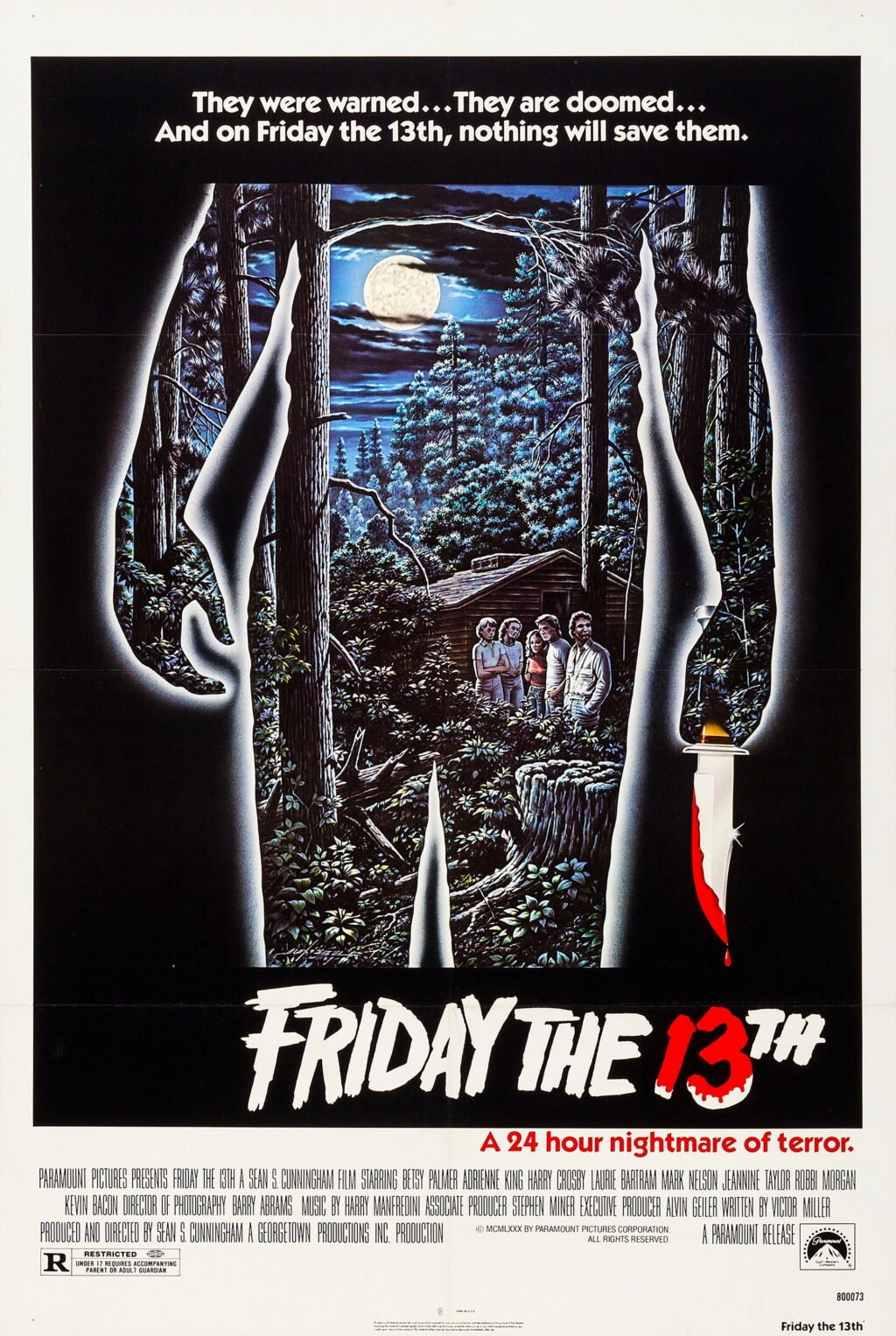
Friday the 13th (1980) is Sean S. Cunningham’s camp slasher whose killer is Pamela Voorhees, not Jason — horror’s most misremembered twist.
State it plainly, because the franchise’s fame obscures it: Jason Voorhees kills no one in this film. He is a drowned child in the backstory and a ten-second shock in the final scene. The murderer reopening Camp Crystal Lake’s body count is his mother — and the hockey mask does not exist yet either (Part 2 gives Jason a sack hood; the mask arrives in Part III). What Cunningham made, for an estimated $550,000, was the independent film that codified the slasher formula and got itself bought by Paramount.
Quick Specs
- Director: Sean S. Cunningham
- Writer: Victor Miller
- Released: 9 May 1980
- Runtime: 95 minutes
- Budget: an estimated $550,000 (final costs reported up to ~$600,000–$650,000)
A Title in Search of a Film
Cunningham had produced Wes Craven’s The Last House on the Left (1972) and wanted distance from it: prompted explicitly by the success of John Carpenter’s Halloween, he set out to make something shocking and visually striking that would “make you jump out of your seat” — a “roller-coaster ride,” in his own phrase. His Stratford, Connecticut neighbour Victor Miller drafted the screenplay as A Long Night at Camp Blood; during a redraft Cunningham proposed the title Friday the 13th and Miller rebuilt the script around it. Before the script was finished, Cunningham placed a full-page ad in Variety — the 4 July 1979 edition, per the standard accounts — the title in block letters bursting through glass, proclaiming “the most terrifying film ever made.” He has said the ad was partly defensive, a way to learn immediately whether anyone else owned the title and might sue; instead it drew distributor and investor interest. Financing came from the Boston partners behind Georgetown Productions, who covered the full budget after initially offering $125,000. The title itself carried one wrinkle: an earlier, unrelated film called Friday the 13th: The Orphan (1979) existed, and its distributor recalled a threat to sue that was “finally resolved” — he believed Georgetown’s Phil Scuderi may have paid to settle it. When Cunningham screened the finished film for the majors, Paramount, Warner Bros., MGM and United Artists all bid; Paramount won domestic distribution, reported at a $1.5 million bid, with Warner Bros. taking international rights, and Paramount’s marketing spend reached roughly $1 million once the film took off. The film is routinely described as the first independent slasher acquired for US distribution by a major studio.
Shot in September: Camp No-Be-Bo-Sco
The film was shot in September 1979 — autumn, not the “summer 1979” of older references — in and around Hardwick, Blairstown and Hope in Warren County, New Jersey. Camp Crystal Lake is fictional; the camp is Camp No-Be-Bo-Sco, a working Boy Scout camp in Hardwick Township whose name shortens North Bergen Boy Scouts, founded in 1927 and still owned and operated by the Northern New Jersey Council of Scouting America. More than 80 percent of the film was shot on the camp property. The camp is private and closed to the public except on official dates, when Crystal Lake Tours runs guided filming-location tours — daytime, evening and overnight events whose proceeds fund camp maintenance and youth programmes — and the tours were active through the October 2026 season. The location is not a ruin or a museum piece; it is a functioning Scout camp that a horror film happens to live inside.
The Killer Is Pamela
Pamela Voorhees, the camp’s former cook, is avenging her son Jason, who drowned in Crystal Lake in 1957 while the counsellors who should have been watching him were otherwise occupied. Her first victims, counsellors Barry and Claudette, were murdered a year later, in the film’s 1958 prologue; in the present day she works through the counsellors reopening the camp, hearing Jason’s voice command “Kill her, Mommy.” Jason’s total presence is a backstory, a name, and the final shock — the decayed child lunging from the lake to pull Alice from her boat, framed ambiguously, since Alice is afterwards told no boy was found. That ending was not in Miller’s script, which closed with Alice simply floating on the lake; the stinger was effects designer Tom Savini‘s suggestion, in his own words: “The whole reason for the cliffhanger at the end was I had just seen Carrie, so we thought that we need a ‘chair jumper’ like that, and I said, ‘Let’s bring in Jason’.” Miller, who wrote Jason as a normal-looking boy — the altered appearance was Savini’s contribution — has kept his position on the record ever since: “Jason was dead from the very beginning. He was a victim, not a villain. But I took motherhood and turned it on its head and I think that was great fun. Mrs. Voorhees was the mother I’d always wanted — a mother who would have killed for her kids.” Betsy Palmer took the role for the most practical of reasons: her car was failing, the job paid $1,000 a day for ten days — $10,000, exactly a replacement’s price — and she assumed nobody would ever see the film. Her verdict on the script exists in conflicting wordings across her retellings; the contempt is the constant, so this page states the fact — she needed $10,000 for a new car — rather than canonising one wording. The professional underneath it built Pamela a Stanislavsky backstory anyway, and by her own telling, theatre-trained, she landed a real slap on Adrienne King in the climactic fight rehearsal before Cunningham explained that film slaps are missed, not landed. Palmer died on 29 May 2015, aged 88, having spent decades as a fixture of the convention circuit, warmly embraced by the fans of a film she never expected to matter.
The Craft: Savini, the Arrow, and “Ki Ki Ki, Ma Ma Ma”
Savini was hired on the strength of his work on Dawn of the Dead (1978), assisted by Taso N. Stavrakis — who also doubled on screen, including as the killer’s legs in the Annie chase, Palmer having only just arrived. The set pieces are his: Annie’s throat slash, Marcie’s axe, the decapitation — and the era’s most famous throat, Kevin Bacon’s Jack, killed in a lower bunk by an arrow driven up through the mattress from below. The mechanics were a one-take appliance Bacon wore kneeling, head through a hole, prosthetic neck built over him; Bacon has said he held the position for hours and found it torturous. Mid-take, the blood rig failed, and the take was saved by someone blowing the blood through the tube by mouth — producing the famous bubbling arterial spray. Who blew is contested, and this page carries both tellings as its sources give them: Bacon’s account credits “the special-effects person,” identified by him as Savini; Stavrakis’s first-person account corrects the record — “I had to think quick, so I just grabbed the hose and blew like crazy which, thankfully, caused a serendipitous arterial blood spray. The blood didn’t taste that bad either.” The score is Harry Manfredini’s, and its whisper is spelled his way: “ki ki ki, ma ma ma,” from Pamela’s “Kill her, Mommy!” — the fan transcription “ch ch ch, ah ah ah” is a mishearing he has corrected on the record repeatedly. In his own explanation, he took the “ki” from “kill” and the “ma” from “mommy,” spoke them harshly and rhythmically into a microphone and ran them through an Echoplex-type echo; the cue marks the killer’s presence, and pointedly stops to relax the audience before a scare. The young cast was found by open call — the producers had hoped for a name actress they could not afford — giving Adrienne King her Alice, the trained acrobat Robbi Morgan her Annie (she performed the leap from the moving jeep herself), and Bacon one of his earliest screen roles, post-Animal House. Around them: Harry Crosby, Bing Crosby’s son, as Bill; Jeannine Taylor as Marcie, an axe victim in the shower block, in what became essentially her only screen role — she largely left acting after this film; and Walt Gorney’s Crazy Ralph, the town prophet nobody heeds.
Release and Money
Released wide on 9 May 1980 across a first-run footprint of 1,127 theatres, the film opened to $5,816,321 and finished with a domestic gross of $39,754,601 — a figure on which Box Office Mojo and The Numbers agree exactly, from roughly 14.8 million admissions. Worldwide, the honest figure is $59,754,601 by The Numbers, resting on its round $20 million international from the Warner Bros. release; Box Office Mojo’s displayed worldwide total lacks the original international gross entirely and is never quoted bare here, and any source calling $39.9 million the worldwide take is mislabelling the domestic figure. On an estimated $550,000 cost the film sits among the year’s top twenty earners by any of the competing rankings, and is routinely called one of the most profitable slasher films in cinema history — Bracke’s accounting adds that of Paramount’s seventeen 1980 releases, only Airplane! returned more profit. To secure its R and avoid an X, a few seconds of gore were trimmed — about ten, concentrated on Annie’s throat slash and the decapitation; accounts give roughly nine seconds in one telling and eleven restored in the “Uncut” home-video edition in another, and both are printed rather than averaged. The famous 48-second gutting belongs to Part 2, a different film’s story.
Reception: Zero Stars and a Spoiled Ending
Contemporary response was largely hostile, and the current Rotten Tomatoes aggregate — about 58 percent across 50 reviews — reflects decades of reassessment. Variety called it “low budget in the worst sense — with no apparent talent or intelligence to offset its technical inadequacies.” Leonard Maltin rated it “BOMB,” later revising to one and a half stars “simply because it’s slightly better than Part 2.” The era’s most extraordinary review was Gene Siskel’s in the Chicago Tribune: zero stars, and the ending deliberately spoiled as a tactic — “It has been suggested to me that a great way to keep people from seeing a truly awful movie is to tell them the ending. I like that idea a lot” — before he gave away the killer’s identity and closed by calling Cunningham “one of the most despicable creatures ever to infest the movie business.” He then printed where to complain: the corporate headquarters address of Paramount’s parent Gulf+Western, and Betsy Palmer’s home town of Rowayton, Connecticut, with a General Delivery suggestion. Retellings that say he printed her home address are wrong — it was a corporate HQ and a home town, and the distinction is the story. Siskel and Roger Ebert devoted most of a Sneak Previews episode to attacking the film and the emerging slasher cycle for making audiences identify with the killer. Ebert himself never published a print review of this original — none has been found — and his documented pans belong to Part 2 (half a star) and The Final Chapter (“an immoral and reprehensible piece of trash”); attributing a pan of the 1980 film to him is an error this page declines to repeat.
Legacy
The film did not invent the slasher — Halloween precedes it, and Cunningham said so by imitation — but its success codified the commercial formula: an isolated setting, a past tragedy, point-of-view stalking, inventive kills, and a surviving final girl, triggering the early-1980s slasher boom and its summer-camp imitators. It also launched the franchise this site’s Friday the 13th hub maps in full: Part 2 followed in 1981 and did the thing the original never did — it made the adult Jason the killer. The original’s own afterlife is stranger and quieter: a mother with a sweater and a machete, a whispered mishearing corrected by its composer for forty years, a critic who tried to spoil it out of existence, and a working Scout camp in New Jersey where the tours still run every October.
Keep it locked on Think Horror.