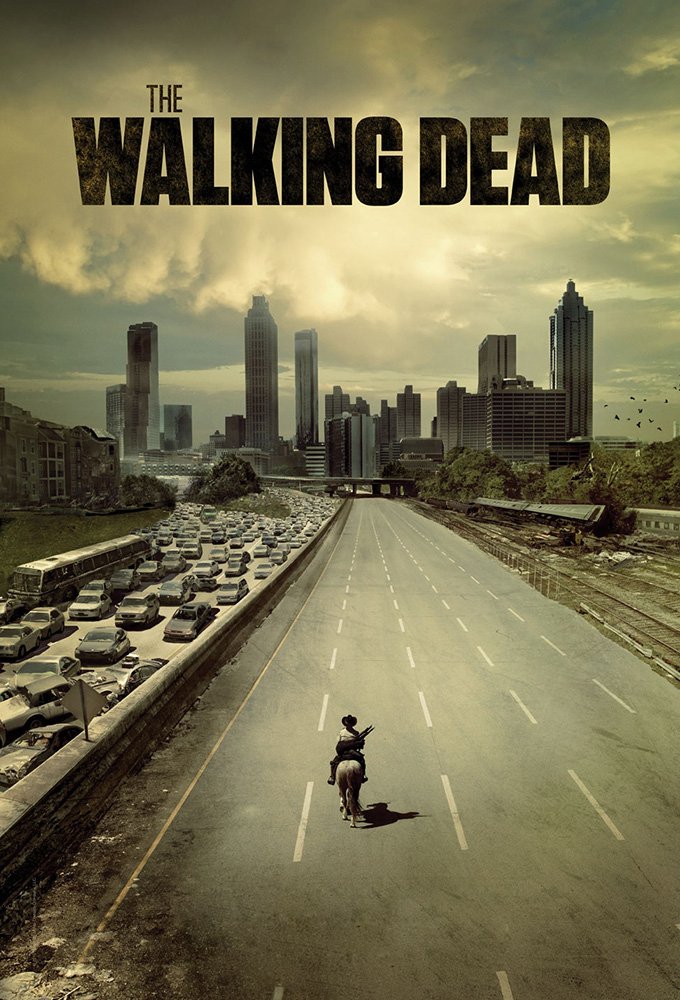
The Walking Dead is an American post-apocalyptic horror franchise built around AMC’s flagship television series, developed by Frank Darabont from the comic book series by Robert Kirkman, Tony Moore and Charlie Adlard. The premise is the genre’s modern founding myth: Georgia sheriff’s deputy Rick Grimes wakes from a coma to find the world overrun by the dead — “walkers” — and spends eleven seasons learning that the living are the more dangerous species. The flagship ran from October 31, 2010 to November 20, 2022: 11 seasons, 177 episodes, and at its peak it was not just the biggest horror show on television, it was the biggest show on television, full stop.
And it never really stopped. Kirkman’s comic ended in 2019, the flagship ended in 2022, and the universe kept walking anyway — six spin-off series and counting, with new episodes still arriving: Dead City aired its third season in the summer of 2026, and Daryl Dixon returns for its fourth and final season in February 2027. This page is Think Horror’s home for the whole shambling empire: the flagship’s story, the spin-offs, the turning points, and the machinery behind them.
At a glance
| Flagship series | The Walking Dead (AMC) |
| Original run | October 31, 2010 – November 20, 2022 |
| Seasons / episodes | 11 seasons, 177 episodes |
| Developed by | Frank Darabont |
| Based on | The Walking Dead comic by Robert Kirkman, Tony Moore and Charlie Adlard (Image Comics / Skybound) |
| Showrunners | Frank Darabont (S1), Glen Mazzara (S2–3), Scott M. Gimple (S4–8), Angela Kang (S9–11) |
| Starring (flagship) | Andrew Lincoln, Norman Reedus, Melissa McBride, Lauren Cohan, Danai Gurira, Jeffrey Dean Morgan |
| Spin-off series | Fear the Walking Dead, World Beyond, Tales of the Walking Dead, Dead City, Daryl Dixon, The Ones Who Live |
| Franchise status | Active — Dead City season 3 aired 2026; Daryl Dixon’s final season premieres February 2027 |
Overview
The flagship follows a widening circle of survivors across Georgia and Virginia as every attempt at safety curdles. A camp outside Atlanta becomes a farm, becomes a prison, becomes Alexandria — a real town with walls, led first by Rick and eventually by a coalition of communities — and every home is eventually tested by the same equation: walkers at the fence, and worse people outside it. The show’s engine was never the dead. It was the argument about what survival permits: Rick’s group against Shane’s ruthlessness, the Governor’s smiling tyranny, Negan’s extortion empire, the Whisperers’ death cult, and finally the Commonwealth, a rebuilt civilization whose price was a permanent underclass.
The series adapted Kirkman’s comic the way weather adapts a coastline — same geography, constant erosion. Storylines were remixed, characters were swapped between fates, and the show invented icons of its own: Daryl and Merle Dixon exist nowhere in the comic. By the end, the two versions had diverged completely — in the comic, Carl Grimes survives to inherit the story; on television, Carl dies in season 8, and the future belongs to his sister Judith. What never changed was the comic’s founding rule, carried over intact: every living human carries the infection, everyone turns when they die, and there is no cure coming. The apocalypse is not a problem to be solved. It is the world now.
Seasons and story arcs
Seasons 1–2 (2010–12) — Atlanta and the farm. Rick reunites with his wife Lori, son Carl and partner Shane in a camp outside Atlanta; a CDC stop confirms there is no cure. Sheltering at the Greene farm, the group fractures over Shane’s affair with Lori and his escalating violence, and the search for Carol’s missing daughter Sophia ends in the show’s first great gut-punch. Rick kills Shane; the farm burns; the survivors take the road.
Seasons 3–4 (2012–14) — The prison and the Governor. The group fortifies a prison just as Andrea washes up in Woodbury, a walled town run by the Governor — courteous, photogenic and murderously insane. Lori dies in childbirth. The war for the prison ends with the Governor beheading Hershel and the prison in flames, scattering everyone toward a promised sanctuary called Terminus.
Seasons 5–6 (2014–16) — Terminus and Alexandria. Terminus turns out to be a cannibal trap, escaped in the show’s most explosive hour. Recruited into Alexandria, a walled suburb whose residents have been sheltered from the apocalypse, Rick’s people clash with softness, survive a herd invasion, and begin trading with the Hilltop — which brings them into conflict with the Saviors, extortionists led by a man named Negan. The season ends on his terms: the group on their knees, and Lucille swinging.
Seasons 7–8 (2016–18) — Negan’s reign and All Out War. Negan murders Abraham and Glenn and installs himself as the coalition’s taxman. The communities — Alexandria, Hilltop under Maggie, the Kingdom under Ezekiel — unite for war. Carl is bitten and dies after writing his father a vision of peace; Rick honors it by sparing the defeated Negan and locking him in a cell to watch the world rebuild without him.
Seasons 9–10 (2018–21) — The Whisperers and the missing Rick. Eighteen months of fragile rebuilding end when Rick, gravely wounded, blows a bridge to stop a herd and vanishes — presumed dead, actually carried off by a CRM helicopter. Six years on, the communities face the Whisperers, who wear the skins of the dead and herd walkers like cattle; after their leader Alpha is assassinated by an infiltrating Negan, the survivors turn her own horde against her successor Beta. Michonne, finding proof Rick survived, leaves to find him.
Season 11 (2021–22) — The Commonwealth. The coalition encounters the Commonwealth: 50,000 people, functioning cities, and a rotten class system under Governor Pamela Milton. Exposing it costs Rosita her life and nearly costs everyone everything, but the Commonwealth falls to its own people. The finale, “Rest in Peace” (November 20, 2022), closes the flagship with Daryl riding out alone — and a coda confirming what the faithful suspected: Rick Grimes is alive, and Michonne is still looking for him.
Spoiler section: the turning points
Five moments bent the whole series. Sophia walks out of the barn (season 2): the missing girl the group had searched for all season emerges as a walker from Hershel’s barn — the show announcing that hope itself was on the menu. Rick kills Shane (season 2): the love triangle ends with a knife beside a moonlit field, and Carl putting down Shane’s reanimated corpse — the franchise’s thesis in one scene: the dead are a problem, the living are the tragedy. “The Day Will Come When You Won’t Be” (season 7 premiere, October 23, 2016): Negan beats Abraham and then Glenn to death in front of Maggie, in the most debated hour of television horror ever aired — a ratings summit and, for many viewers, an exit door. Carl’s death (season 8) severed the show from its comic spine and handed the future to Judith. And Rick’s vanishing (season 9) — the bridge, the explosion, the helicopter — turned the lead character into the franchise’s longest-running mystery, one the flagship itself never solved: that answer was saved for a spin-off.
Production and behind the scenes
Frank Darabont — the filmmaker behind The Shawshank Redemption, The Green Mile and The Mist — spent years developing Kirkman’s comic for television, wrote and directed the pilot, “Days Gone Bye,” and set the show’s visual grammar: filmic, sun-bleached, pitiless. Read our Frank Darabont profile for the man himself. His tenure ended almost immediately: AMC fired Darabont during production of season 2, and the ensuing profit-participation lawsuits ran for a decade before AMC settled with Darabont and CAA in 2021 for $200 million. Glen Mazzara, then Scott M. Gimple, then Angela Kang steered the flagship home.
The series was produced by AMC Studios in Georgia, filming largely around the town of Senoia and Riverwood Studios — Senoia doubled as Woodbury, and Alexandria’s walls stood there for years. The walkers themselves were a practical-effects institution under Greg Nicotero, whose team turned decomposition into a decade-long art project, with Bear McCreary’s score doing the dread. Behind everything sat Skybound Entertainment, Kirkman’s company, and chief content officer Scott M. Gimple, who expanded one series into a universe. The source material bowed out first: Kirkman ended the comic with issue #193 in July 2019 — no announcement, fake solicitations for issues that would never exist — and the flagship ran three more years on its own momentum.
Release and reception
The flagship premiered on Halloween night, October 31, 2010, and grew like the horde. From its third season it attracted the most 18-to-49-year-old viewers of any series on cable or broadcast television. Its fifth-season premiere, “No Sanctuary,” drew 17.3 million viewers in October 2014 — at the time the highest-rated non-sports broadcast in cable history. Awards followed the ratings: a Golden Globe nomination for Best Television Series – Drama, and an Emmy win for the pilot’s prosthetic makeup, the first of a long run of genre-award seasons. Viewership cooled in the later years — the season 7 premiere’s brutality is still argued about as the inflection point — but the show remained AMC’s flagship to its final night, and its afterlife in streaming and syndication has kept it in the culture long after “Rest in Peace.”
The wider universe: the spin-offs
Fear the Walking Dead (2015–2023) began as a prequel — the outbreak’s first days in Los Angeles, through the Clark family — then rebooted around Morgan Jones, the flagship’s first survivor, who crossed over in season 4. It closed on November 19, 2023, after eight seasons and 113 episodes, outliving most of the shows it shared a network with.
The Walking Dead: World Beyond (2020–2021) was built as a closed story: two seasons, 20 episodes, following the first generation raised behind walls — and quietly introducing the Civic Republic Military, the shadow army holding Rick Grimes. Tales of the Walking Dead (2022) took the anthology route: six standalone episodes, including the origin of Alpha. Then the flagship ended, and the sequels took over.
The Walking Dead: Dead City (2023– ) pairs the unlikeliest duo in horror: Maggie and Negan, the widow and the man who killed her husband, thrown together in a Manhattan severed from the mainland. Its third season aired on AMC from July to September 2026, with Maggie and Negan attempting to build the city’s first real community since the fall; AMC has not announced a fourth season as of October 2026. The Walking Dead: Daryl Dixon (2023– ) washed Daryl up in France, brought Carol across the Atlantic after him in season 2, and moved on to Spain for season 3. At New York Comic Con in October 2026, AMC confirmed the endgame: a fourth and final season of eight episodes premieres in February 2027. The Walking Dead: The Ones Who Live (2024) was the event the flagship withheld: six episodes reuniting Rick and Michonne, closing the loop on the helicopter, the CRM, and the franchise’s central love story.
Legacy and influence
The Walking Dead did for zombies what Romero invented and a generation of films could not sustain: it made the apocalypse a permanent address. It proved horror could anchor a cable network, top broadcast ratings, and sustain a franchise television universe on the franchise model years before that became the industry’s default setting — complete with its own aftershow, Talking Dead, turning weekly horror into a talk-sport. Its grammar is everywhere now: the community-of-the-season structure, the villain-arc season, the mid-season massacre, the finale coda that launches a spin-off. And the universe is still generating horror careers: Lauren Cohan — Maggie herself — is currently headlining Prime Video’s Stillwater, which we covered in Lauren Cohan checks into Stillwater. Sixteen years after Rick Grimes woke up in that hospital, the dead are still walking, still working, and still ours.
Trivia
- The show’s biggest star isn’t in the comic: Daryl and Merle Dixon were invented for television. Norman Reedus originally auditioned for Merle; Frank Darabont liked him so much he created a younger brother for him instead — and Kirkman has always refused to import Daryl into the comic, calling him a pure TV fabrication.
- Nobody says “zombie”: the dead are walkers, biters, lurkers, rotters — every community has its own word, and the z-word is essentially never one of them.
- Everyone is already infected: the show’s quiet apocalypse rule, confirmed at the CDC in season 1 — bite or no bite, everybody who dies comes back. The only cure is the brain.
- The pilot won the Emmy: “Days Gone Bye” took home the Primetime Emmy for Outstanding Prosthetic Makeup, with Greg Nicotero’s walker work becoming the franchise’s signature craft.
- The comic ended as a surprise attack: Robert Kirkman closed the book with issue #193 in July 2019 without telling readers — or retailers — it was the finale, complete with fake solicitations for issues #194 and #195 to protect the secret.
- Two originals still standing: of the entire Atlanta camp from season 1, only Carol and Daryl made it to the end of the flagship — and both were still headlining the franchise a decade and a half later, Carol having originally been scripted to die in season 3.
- The town that plays the apocalypse: Senoia, Georgia hosted the production for years — Woodbury’s main street and Alexandria’s walled streets both lived there, and the town has leaned into its undead fame ever since.
- The record that stood for years: the season 5 premiere’s 17.3 million viewers made it, at the time, the most-watched non-sports broadcast in the history of US cable television.
Related links
- Horror Franchises — every franchise in our chamber, from Elm Street to the Conjuring Universe
- Frank Darabont — the filmmaker who brought Kirkman’s dead to television
- Lauren Cohan — Maggie Rhee herself: her full profile in our Actors wiki
- Lauren Cohan checks into Stillwater — Maggie Rhee’s new horror chapter on Prime Video
- George A. Romero — the godfather whose dead made all of this possible
- Night of the Living Dead (1968) — where the modern zombie begins, in our wiki
- Shaun of the Dead — the apocalypse with jokes, from our wiki