
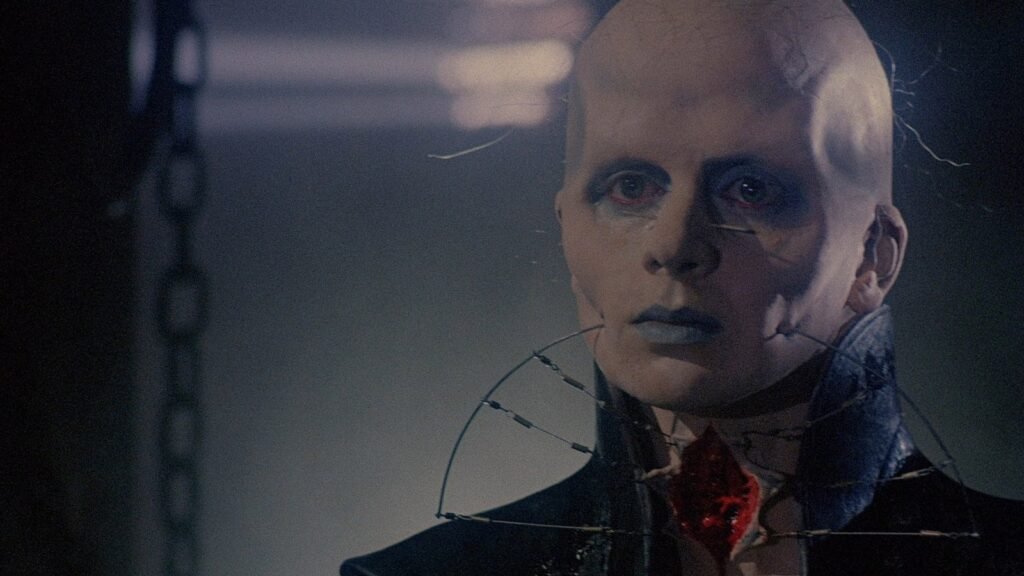
Somebody had to teach Pinhead how to preach. Barker built the priest, Bradley put on the pins and delivered the lines like scripture — but for three sequels running, the words in that cold, reasonable voice were written by a Liverpool theatre man who had never written a screenplay before Barker recommended him for the job.
Peter Atkins is the Liverpool screenwriter who wrote the first three Hellraiser sequels and Wishmaster. He is also a novelist and short-story writer of standing, a former theatre actor, and — — a Cenobite in a film he wrote himself.
One clarification belongs at the top. This Peter Atkins is not Peter W. Atkins, the Oxford physical chemist born in 1940 — a different man, yet catalogue systems have repeatedly merged them, shelving this Atkins’s horror fiction beside chemistry texts. The screenwriter has no middle initial, no Oxford post and no science books.
Quick Specs
- Born: 1955, Liverpool, England
- Occupation: Screenwriter, novelist, short-story writer; earlier a theatre actor and writer
- Known for: Hellbound: Hellraiser II (1988), Hellraiser III: Hell on Earth (1992), Hellraiser: Bloodline (1996), Wishmaster (1997)
- Years active: Liverpool theatre from the mid-1970s; screenwriting from 1988
Liverpool, theatre and the Dog Company
His author biography names Heygreen Road County Primary School, the Liverpool Bluecoat School and the University of Liverpool. The Bluecoat detail matters for one reason: it is not Clive Barker’s school. Barker and Doug Bradley were classmates at Quarry Bank, and Bradley is the schoolfriend in this story. Atkins is not — any account calling him Barker’s schoolfriend or childhood friend has transferred Bradley’s biography onto the wrong man.
Atkins met Barker through Liverpool fringe theatre in the mid-1970s, when Atkins was about nineteen and Barker about twenty-two. In his own words in a 2007 convention question-and-answer: “By the mid-1970s, of course, I’d joined the group that eventually became The Dog Company and we were making our own ‘arthouse’ movies like THE FORBIDDEN.” His biography dates the joining to 1974 and names Barker and Bradley among the members; his membership is confirmed in his own account.
What the Dog Company was needs the same care. Barker’s biography describes it as an avant-garde Liverpool theatre troupe from Barker’s circle. It was a theatre troupe, not a band, and it did not make the Hellraiser films as a company; its members carried into Barker’s film circle — Bradley to Pinhead, Atkins to the scripts. Its founding year is unsettled. Atkins’s band was a separate thing, and it comes later.
The working bond is verified in Atkins’s own words: “Clive and I had worked together in live theatre for five years and he’d read my fiction. He was well aware of my talent and abilities, and his recommendation wasn’t based exclusively on friendship.” Five years of theatre, plus a director who had read his prose. That — not school, not childhood — is the Liverpool connection.
Hellbound: the first script he ever wrote
The credit split on Hellbound: Hellraiser II is exact, pinned by a primary document: the second draft’s title page, dated 1 November 1987, reads “Screenplay by Peter Atkins, Based on a story by Clive Barker.” So: screenplay Atkins, story Clive Barker, directed by Tony Randel — not “Randall.” Do not upgrade Atkins to the story or hand Barker the screenplay. The title page settles it.
How he got the job is his own account. Barker introduced him to producer Christopher Figg with a recommendation. “Chris and I had dinner and a nice chat and I got the job immediately. I’d never written a script in my life. Not even sure I knew what one looked like.” Genre coverage reports that Michael McDowell, the Beetlejuice writer, had first been approached and stepped away amid rewrites and ill health.
Hellbound is where the mythology was built out — the Labyrinth, the god Leviathan, and Pinhead’s human origin as Captain Elliott Spencer all arrive in Atkins’s screenplay working from Barker’s story.
Reports place a Toronto festival premiere on 9 September 1988. The US release followed on 23 December 1988, when Atkins was 33. A single franchise table puts the US and Canada gross at $12,090,735. None of it was Atkins’s personal money.
Hell on Earth — and the writer becomes a Cenobite
For Hellraiser III: Hell on Earth, Anthony Hickox directed; screenplay by Peter Atkins, story by Peter Atkins and Tony Randel, based on characters by Clive Barker, US release 11 September 1992, when Atkins was 36. The shared story credit matters — do not hand Atkins the whole film — and Randel was also the director first attached, removed before shooting.
Atkins’s own published account — his 1993 essay, with a later post-script — is a primary source, and blunter than most making-of pieces. The version the producers first wanted, he wrote, “was the picture that was made. Almost.” The road ran through, in his phrase, “seven drafts and two directors.” His post-script records that Randel was fired during development, Hickox eventually filmed the screenplay, Miramax picked the film up after filming in North Carolina, and Barker returned as executive producer during editing. The reference account agrees Randel was removed over worry his vision was too bleak.
Then there is the cameo — a cast-list fact, not fan lore. Atkins took the role of Rick, the barman at J.P. Monroe’s Boiler Room club, and the Barbie Cenobite Rick becomes after Pinhead is freed and remakes his victims. Two caveats stand around the role. Some listings mark it uncredited. And Barbie and the CD Cenobite were introduced in rewrites of Atkins’s draft, so the monster he plays is a character his first draft did not contain. He did not write himself the part; the rewrite process handed the writer a monster, and the writer put it on.
Bloodline: sole credit, not sole hands
Hellraiser: Bloodline (1996) gave Atkins sole screenplay credit — his post-script says so in terms: “I received sole writing credit.” He was 40 when it opened in the US on 8 March 1996, his last Hellraiser screenplay and the last series film released theatrically until the 2022 reboot. The direction is credited to Alan Smithee, the Directors Guild pseudonym — Smithee is not a person; the director behind the credit was Kevin Yagher.
The conception, in Atkins’s account, echoes Hellbound: “as with Hellbound, Clive and I beat out a story together and I then wrote the screenplay.” The premise ran across three periods — 18th-century France and the box’s maker, Le Marchand; the present; and a 22nd-century space station — with Barker suggesting the three-period structure and Atkins adding the Le Marchand storyline from Barker’s novella. The two men plainly developed the sequel stories together in conversation; that working method does not convert into a shared story credit on Hellbound, where the credit is Barker’s alone.
What happened in post-production is a live conflict. Atkins’s post-script says Yagher was fired, Joe Chappelle shot additional scenes in spring 1995, Miramax offered Atkins the new sequences, and he declined, leaving them to Rand Ravich, uncredited. The standard franchise history, drawn from Paul Kane’s history of the films, differs in sequence: Miramax demanded Pinhead appear earlier, Atkins wrote three new scenes, and Ravich came in on Barker’s recommendation when Atkins became unavailable. Whether Yagher was fired or walked away is likewise split. What is settled: sole credit Atkins; Chappelle’s additional scenes written by Ravich; the accounts differ on the rest. Atkins’s verdict on the credit he kept is the driest line in the saga: in retrospect, he should probably have followed Yagher’s example and taken refuge behind an invented name. His original screenplay was published as a book in 2022 — the unfilmed shape of the draft, between covers at last.
Outside Hell: Fist of the North Star and Wishmaster
The Atkins–Randel partnership did not end with Hell. The live-action manga adaptation Fist of the North Star was, by its reference listing, directed by Tony Randel, who also co-wrote the script with Peter Atkins — a credit a second listing agrees with. Based on the manga by Buronson and Tetsuo Hara, it was released in Japan on 21 April 1995, when Atkins was 39, and in the US on 2 February 1996, direct to video there. Those details rest on that listing.
Wishmaster (1997) is the other pillar. The credits are exact: directed by Robert Kurtzman, the effects artist; screenplay by Peter Atkins, sole; executive producer Wes Craven. “Wes Craven Presents” was a marketing line, not a credit: Craven was executive producer only, the only series film with his name attached. Never call it a Wes Craven film in any sense implying he directed or wrote it. Atkins was 41 when it opened on 19 September 1997.
The film’s plot, as its reference listing carries it: a djinn, played by Andrew Divoff, is freed from a fire opal by gemologist Alexandra Amberson, played by Tammy Lauren; he grants wishes that damn their makers while seeking the three wishes that will free his kind. Atkins’s own verdict: of his films, he names Hellbound and Wishmaster as the two that “are still fun, I think.”
Three sequels followed; he did not write them. For Wishmaster 2: Evil Never Dies (1999), written and directed by Jack Sholder, a national library catalogue records Atkins as the adapted or source author — a characters credit, not a screenplay. He has no screenplay credit on the later films either: the sequels rest on his characters only. In 2021 a novelization by Christian Francis, based on Atkins’s screenplay, was finally published.
The prose: novels, collections and stories
Prose is where he started, and by his own account it is his focus. In 2007 he put it this way: “I still write and play music, I still work occasionally in the theatre, and I still of course write screenplays, which is where I actually make a living.”
Three novels anchor the shelf — the three named in every author biography. Morningstar was first published in the UK in 1992, a San Francisco serial-killer novel whose killer signs his work “Morningstar”; its later US edition carried jacket praise: Barker called it “vividly imagined and stylishly realized,” Neil Gaiman “the best first novel I’ve read in a long time.” Big Thunder followed in 1997 — “my second novel — BIG THUNDER — holds up okay,” Atkins has said. Moontown arrived in 2008, about a psychic graduate student and a pattern of supernatural harassment.
The collections fill out the record: Wishmaster and Other Stories (1999), Rumours of the Marvelous (2011 — British spelling “Rumours,” though US mirrors print “Rumors”), Cemetery Dance Select: Peter Atkins (2015) and All Our Hearts Are Ghosts (2022). His stories have appeared in The Museum of Horrors, Dark Delicacies II and Hellbound Hearts — his story in the last is “Prisoners of the Inferno” — and have been selected eight times for “Year’s Best” anthologies. He is a three-time British Fantasy Award nominee, most recently for Rumours of the Marvelous. His own favourites are “Aviatrix,” “Doctor Arcadia” and “The Cubist’s Attorney.” A prose career that would justify a page apart from any Cenobite.
Music and later years
Remember: the Dog Company was the theatre troupe; the band was separate. His biography records that in 1980 he founded the band The Chase, which played Liverpool venues, had tracks from its cassette EP played on a Radio Merseyside show, and played its final performance at The Cavern. The claim underneath is independently his own: “I still write and play music.”
He was a Special Media Guest of Honour at the World Horror Convention in 2007 and his own words on it were, “I’m far from sure that I deserve it, but I couldn’t be more flattered or delighted.” When the 2022 Hellraiser reboot and its new Pinhead casting were announced, Atkins — by then the senior surviving screenwriter of the original run — commented publicly and supportively on both in December 2021 coverage.
Where he stands
Stand back and the shape is unusual: a theatre actor who had never written a script talked his way, on a friend’s recommendation over dinner, into the sequel to a defining horror film — then wrote the two that followed, then Wishmaster, then went back mostly to the prose, where his heart gives every sign of having been all along.
The Hellraiser franchise remembers Barker first, and Bradley’s face is on the posters. Fair enough. But the voice — the cold theology, the sermons about flesh and desire, Hell as a system with a liturgy — was sustained across three films by one writer, working inside Barker’s world in a voice enough his own that the films hold together as a run. Peter Atkins wrote Pinhead’s sermons. When the lines come back to you, they are his.