
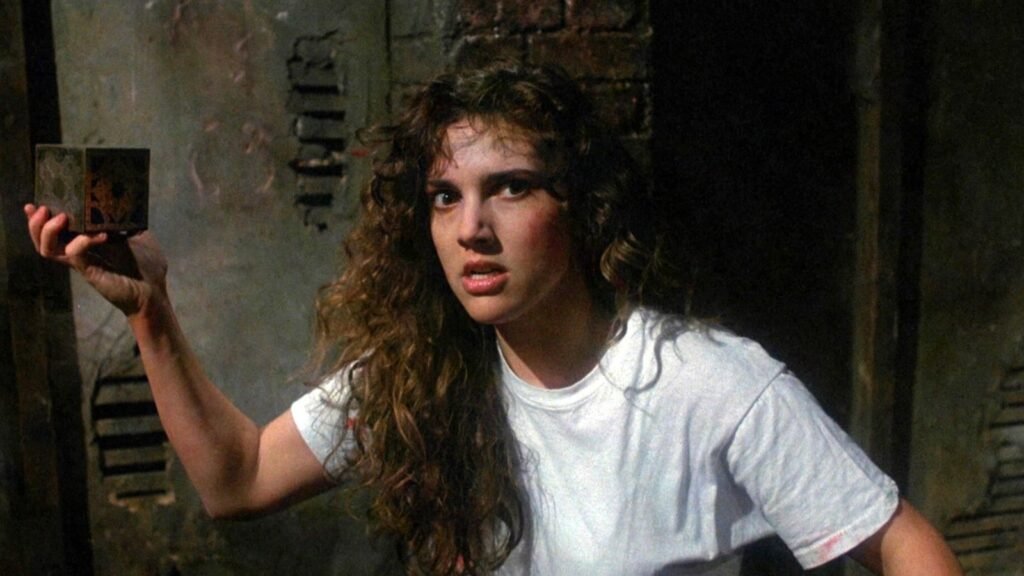
Hellraiser is Clive Barker’s eleven-film horror franchise about a puzzle box that summons the Cenobites, an order that cannot distinguish pain from pleasure.
Quick Specs
- Creator: Clive Barker
- Based on: The Hellbound Heart, Barker’s novella, first published in the 1986 anthology Night Visions 3
- Films: Eleven, 1987–2022 — four theatrical, the rest direct-to-video or streaming
- The box: The Lament Configuration. Solve it, and the Cenobites come to collect
- The Lead Cenobite: Doug Bradley in eight films; Stephan Smith Collins, Paul T. Taylor and Jamie Clayton (as the Priest) after him
- The survivor: Kirsty Cotton, played by Ashley Laurence in four films
- Status: Barker’s US rights in the novella and the first screenplay reverted to him in 2021. No new film has been announced
The box and the order
Start with the book. Clive Barker published The Hellbound Heart in 1986, in the anthology Night Visions 3, and then did what defines this franchise: unhappy with earlier adaptations of his work, he directed the film of it himself. Hellraiser (1987) was his feature directorial debut — and the moment he signed away the story and character rights, before the film was even released, not anticipating its success. Almost everything that happens to this series over forty years flows from that signature.
The engine is a puzzle box, the Lament Configuration. Solve it and you open a gateway to the Cenobites’ realm — the Labyrinth, ruled by the entity Leviathan, first seen in Hellbound. The Cenobites are extra-dimensional beings who describe themselves, in the first film’s most quoted line, as “explorers in the further regions of experience — demons to some, angels to others.” They cannot distinguish pain from pleasure, and they collect whoever opens the box. The original four: the Lead Cenobite (Doug Bradley), Chatterer (Nicholas Vince), Butterball (Simon Bamford), the Female Cenobite (Grace Kirby).
About that name. In Barker’s early drafts the lead Cenobite was “Priest.” In the finished film he is credited only as “Lead Cenobite.” The name Pinhead started in the make-up studio, coined by the crew to tell the Cenobites apart; Barker disliked it as undignified but never regained control of it. It is not spoken on screen until Hellraiser III. Hellbound revealed the man underneath: Captain Elliot Spencer. Barker’s 2015 novel The Scarlet Gospels renames him the Hell Priest, who resents “Pinhead.”
The films
Eleven films, four of which saw the inside of a cinema. The whole run in order, each linked to its full page on this site — Barker’s era, the theatrical era, the long video winter, the streaming return.
Hellraiser (1987)
Barker wrote and directed; Christopher Figg produced; New World Pictures backed and distributed in the US. Premiered in London on 10 September 1987, US release 18 September, 93 minutes. Andrew Robinson is Larry Cotton, Clare Higgins is Julia, Sean Chapman is Frank, Ashley Laurence debuts as Kirsty. Made for about $1 million, it grossed $14,564,027 in North America and $30,011,148 worldwide — the right way round; half the internet swaps them. Frank solves the box and is torn apart; escaped and skinless, he hides in his brother’s house while Julia, his former lover, lures men home so their blood can rebuild him. Kirsty steals the box and bargains: Frank’s return for her soul. Barker wanted Coil to score it; New World refused — Christopher Young‘s orchestral score launched his career instead.
Hellbound: Hellraiser II (1988)
Tony Randel, an uncredited editor on the first film, made his directorial debut; Peter Atkins wrote it, Barker supplied the story and executive-produced. US release 23 December 1988. Laurence and Higgins return; Kenneth Cranham is Dr. Philip Channard, Imogen Boorman is Tiffany. Budget estimated at $3 million (some sources say £3 million); tracked gross $12,090,735, North America only. Kirsty, held in the Channard Institute, watches Channard resurrect Julia on a blood-soaked mattress. He uses Tiffany, a mute puzzle prodigy, to open the box, and Kirsty follows them into the Labyrinth — learning the Lead Cenobite was once Captain Elliot Spencer. Greenlit while the first film was still in post-production; Barker declined to direct again but fed in ideas cut from the original for budget.
Hellraiser III: Hell on Earth (1992)
Anthony Hickox directs, Atkins writes, Barker executive-produces but was largely uninvolved until post-production. The first Dimension Films entry, and the first shot outside the UK — Greensboro and High Point, North Carolina. US release 11 September 1992. Terry Farrell is reporter Joey Summerskill; Bradley plays both Pinhead and Spencer; Laurence cameos in a recorded institute interview. Budget $5 million; North American gross $12,534,961. Pinhead, trapped in the Pillar of Souls statue, feeds through nightclub owner J.P. Monroe and raises new Cenobites; Joey must reunite him with his buried human half to destroy him. “Pinhead” is first spoken on screen here — the pivot where Barker’s amoral priests start becoming a conventional slasher villain.
Hellraiser: Bloodline (1996)
The director credit reads “Alan Smithee,” which tells you where the series stood by 1996. Atkins wrote it. Bruce Ramsay plays three roles across three centuries, Valentina Vargas is Angelique, Bradley returns, and a young Adam Scott appears in 1796. US release 8 March 1996; budget $4 million; North American gross $9,336,886 — the last Hellraiser film released in theatres. Three centuries, one bloodline: toymaker Philip Le Marchand builds the box and summons Angelique; in 1996 his descendant John Merchant builds its opposite, the Elysium Configuration; in 2127 Paul Merchant lures Pinhead aboard the space station Minos to destroy him with it. The director was Kevin Yagher, until the studio demanded Pinhead earlier and more prominently, a framing narration and a happier ending. Yagher refused the new material and walked; Joe Chappelle shot it in spring 1995; the released cut runs 85 minutes against Yagher’s roughly 110; Yagher took his name off.
Hellraiser: Inferno (2000)
The direct-to-video era starts here, 3 October 2000. Scott Derrickson made his feature directorial debut, co-writing with Paul Harris Boardman. Craig Sheffer is Detective Joseph Thorne; Nicholas Turturro, James Remar and Bradley support. No reliable budget, no tracked gross — anyone quoting figures for this one is inventing them. Thorne, a corrupt detective, pockets the box from a murder scene and opens it, then hunts a killer called the Engineer until he understands the murders are his own sins, itemised. One caution: whether Inferno began as an unrelated script is disputed. Franchise lore says the video sequels were retrofits; Derrickson disputes it for this film, and franchise histories say it was conceived as a Hellraiser picture, then heavily rewritten.
Hellraiser: Hellseeker (2002)
Rick Bota directs; Carl V. Dupré and Tim Day write; the selling point is a homecoming — Ashley Laurence returns as Kirsty Cotton. Dean Winters is Trevor Gooden, Bradley returns, released 15 October 2002; no reliable budget, no tracked gross. Trevor survives the crash that apparently killed his wife Kirsty and, amnesiac, pieces together that he had plotted her death for an inheritance. Too late he learns Kirsty survived the marriage the Kirsty way — her own deal with Pinhead: five souls for hers, Trevor and his lovers as the payment. It remains her final live-action series appearance, replaying Inferno‘s device of a dead man auditing his own damnation.
Hellraiser: Deader (2005)
Bota again, from Neal Marshall Stevens’ script rewritten by Tim Day. Kari Wuhrer is journalist Amy Klein, Paul Rhys is Winter, Bradley present as always in this era. Shot in Romania in 2002, shelved roughly three years, released 7 June 2005. No reliable budget; no tracked gross. Amy investigates the Deaders in Bucharest, a cult whose leader Winter resurrects members after suicide. Winter, a Le Marchand descendant, wants Amy — a “chosen one” who can open the box — to help him seize the Cenobites’ power. No dispute attaches to this one’s origins: it began as an unrelated spec script by Stevens and was rewritten into a Hellraiser film, the clearest documented case of the method.
Hellraiser: Hellworld (2005)
Bota’s third in a row, written by Dupré from “Dark Can’t Breathe,” a short story by Joel Soisson — an unrelated story, not a written sequel. Filmed in Romania back-to-back with Deader in autumn 2002, shelved until 6 September 2005. Lance Henriksen is the Host, Katheryn Winnick is Chelsea, Henry Cavill appears in an early role, Bradley plays Pinhead for the last time on film. Five players of the Hellworld MMORPG are invited to Leviathan House by a man who blames them for his son’s suicide. The Cenobite attacks prove to be his drugged hallucination — then, alone afterwards, he opens a real box.
Hellraiser: Revelations (2011)
The first film without Bradley. Víctor García directs Gary J. Tunnicliffe’s script — Tunnicliffe being the franchise’s own make-up effects veteran — and Stephan Smith Collins steps into the pins. One California theatre screened it on 18 March 2011; DVD followed on 18 October. Budget reported at $300,000; shot in under three weeks. Nick Eversman and Jay Gillespie play two friends who vanish in Mexico after opening the box; found footage intercuts with a family-dinner siege as one returns wearing the other’s skin. It was reported at the time that the film existed so the studio would not lose the rights ahead of a planned remake; it remains the franchise’s lowest-regarded entry.
Hellraiser: Judgment (2018)
Tunnicliffe writes and directs, and plays the Auditor. Lionsgate, 13 February 2018; budget reported at about $350,000. Damon Carney is Detective Sean Carter, Paul T. Taylor the third screen Pinhead, John Gulager the Assessor, Heather Langenkamp cameos as the Landlady. Hunting the Preceptor, a killer staging the Ten Commandments, detectives find a second infernal bureaucracy: the Stygian Inquisition, whose Auditor and Assessor process sinners before the Cenobites see them. Carter is himself the killer, already damned. Bradley’s absence was not a script rejection: by his own published statement, he was required to sign a three-page confidentiality agreement — his phrase, “gagging order” — before being allowed to read the script. He refused, and never read it.
Hellraiser (2022)
The streaming resurrection. David Bruckner directs; Ben Collins and Luke Piotrowski wrote the screenplay, from a story by David S. Goyer with Collins and Piotrowski; the producers include Barker — his first production credit on a series film since Bloodline. Premiered at Fantastic Fest on 28 September 2022; Hulu, 7 October; shot in Belgrade; 121 minutes; budget $14 million. Odessa A’zion is Riley McKendry, a recovering addict who steals the box. Goran Višnjić is Roland Voight, who took the box’s “Lament” gift years earlier, lives with a torture rig in his chest, and engineers sacrifices to trade his prize for an audience with Leviathan. Jamie Clayton plays the lead Cenobite — called, in the film itself, the Priest, a return to Barker’s draft word; Clayton has said nobody on set called the character Pinhead at all. A streaming release — it has no box-office story to tell.
The money, without the mythology
Every number this franchise can honestly stand behind: the 1987 film, $14,564,027 in North America and $30,011,148 worldwide. Hellbound, $12,090,735 — North American tracked only; no international figure is tracked. Hell on Earth, $12,534,961 in North America. Bloodline, $9,336,886 in North America. The video and streaming years: no tracked grosses at all, budgets only where reported — roughly $300,000 for Revelations, roughly $350,000 for Judgment, $14 million for the 2022 film. And never a franchise total: with eight films’ money untracked and the trackers’ “worldwide” equalling the domestic figure on three of the four theatricals, any grand sum would be fiction wearing a spreadsheet’s clothes. We would rather leave the cell empty.
The priest, the actor, the survivor
Doug Bradley played Pinhead in eight films, 1987 to 2005 — and he was Barker’s before he was ours: a Liverpool school friend, in Barker’s circle since he was fourteen, a Barker theatre actor who played a Pinhead precursor in the 1973 play Hunters in the Snow. His two absences are different stories, kept separate here on purpose. Revelations: he made, in his own words, “a conscious decision not to do the movie based on the motives for making it and the poor quality of the script.” Judgment: no rejection happened — he refused the confidentiality precondition and never read the script. The late chapter nobody predicted: in Clive Barker’s Hellraiser: Revival, launched 8 October 2026, Bradley voices Pinhead again, his first time in the role since 2005. Barker’s verdict: “Doug is Pinhead and Pinhead is Doug.”
Ashley Laurence is the other constant: Kirsty headlines the first two films, appears in Hell on Earth in a recorded interview, and returns as co-lead in Hellseeker — four films across fifteen years. Her character page is here. Jamie Clayton‘s Priest closes the line for now: Bruckner has said the production wanted the character reimagined as a woman, and Clayton won the role on performance.
Barker, by era
1987–88, the creator era: writer-director of the first film; executive producer and story on the second. 1992–96, the Dimension theatrical era: executive producer on Hell on Earth, largely hands-off until post-production, and on Bloodline, informally consulted on the rescue, where he recommended the reshoot writer. 2000–2018, the video era: no involvement at all, Inferno through Judgment — a “characters created by” credit and nothing more. He publicly disowned Revelations in 2011, and in an October 2026 interview he put the era plainly: many Dimension-era sequels, he said, were created simply to hold onto the rights. 2022 to now, the return: producer on the 2022 film, collaborator on the Revival game, and holding rights of his own again.
Where the franchise stands
The legal ground shifted on 19 December 2021: Barker’s US copyright interests in The Hellbound Heart and the original Hellraiser screenplay reverted to him under the Copyright Act’s termination provisions, via a settlement with Park Avenue Entertainment after contested federal litigation. The limits matter: the novella and first screenplay only, US rights only — the sequel films did not revert. What comes next: no sequel to the 2022 film has been announced or greenlit as of October 2026. In that same October 2026 interview Barker said he has several Hellraiser film ideas in note form, “waiting in the wings,” and wants another go — an intention, not a production, reported as exactly that. The Revival game is out now; we covered its launch here. The HBO series announced in April 2020, David Gordon Green attached to direct the pilot and several episodes, Barker executive producing, stands where it stood: announced in 2020, no production, casting or release news since. Not cancelled. Not in production.
Barker’s other immortal creation lives here too: Candyman (1992). This hub is part of our full franchise index — every series we cover, each with sights to show you.