
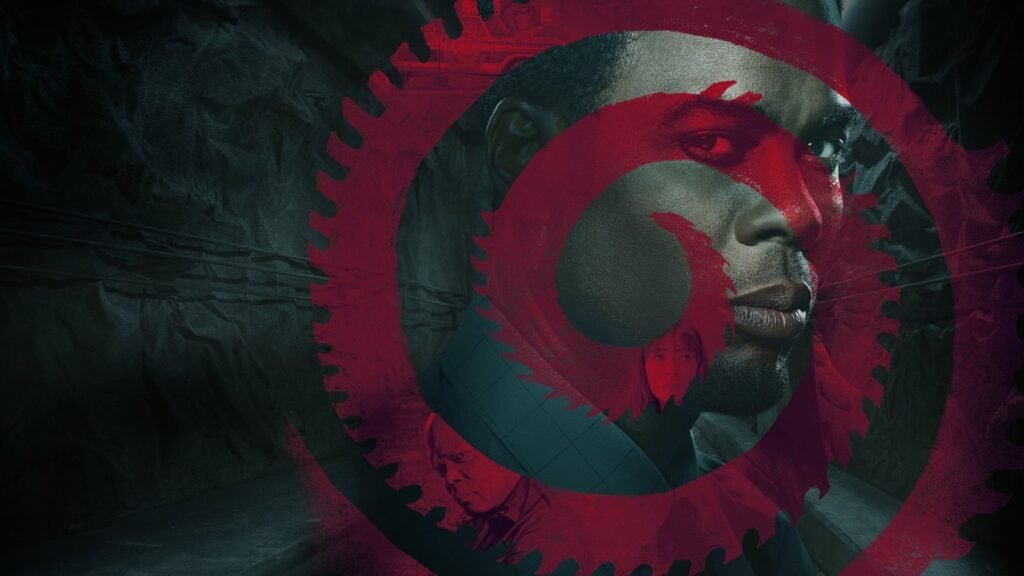
Spiral: From the Book of Saw (2021) is the Saw franchise’s only spin-off, a copycat case with John Kramer present only as a photograph. Sit with how strange that is. Every other film in this series is a machine built around a dead man — Kramer died in Saw III in 2006, and the franchise spent seven more films keeping him at the centre of it anyway, through tapes, flashbacks, photographs and games he set running before the end. Spiral is the one that asks what happens when you take the dead man out entirely. No flashback performance. No voice from beyond. Just his methods, his reputation, and a new killer spending both like a borrowed name — while one of the most famous comedians alive walks into the middle of it playing a detective, and playing him dead straight.
The branding tells you what this is before the first scene does. Not Saw IX — never Saw IX. Spiral: From the Book of Saw: a chapter from the book, not the next page of the story. It is the ninth film the series released, and the only spin-off it has ever produced, floating in the timeline an undated number of years after Kramer’s death, in a world where the Jigsaw Killer is history that somebody has decided to repeat. For the full ten-film series — where this side chapter sits, and how the dead man stayed central to all the others — see the Saw franchise hub.
Quick Specs
- Full title: Spiral: From the Book of Saw
- Director: Darren Lynn Bousman
- Screenplay: Josh Stolberg & Peter Goldfinger, from Chris Rock’s initiative
- Starring: Chris Rock, Max Minghella, Marisol Nichols, Samuel L. Jackson
- Music: Charlie Clouser
- Production company: Twisted Pictures
- Distributor: Lionsgate
- Producers: Mark Burg and Oren Koules
- US release: 14 May 2021
- Running time: 93 minutes
- Position in the series: ninth film released (2004–2023); the franchise’s one spin-off, not a numbered entry
- Budget: $20 million
- Box office: about $40 million worldwide; $23.2 million domestic (US & Canada) — the lowest gross of the ten films
The case
Years after John Kramer’s death, somebody starts killing police. Not random police — corrupt ones, picked off one by one in games built in Kramer’s format: the recorded instructions, the rules, the clock, the price of walking away. A Jigsaw copycat, working in a dead man’s style. “Jigsaw” was never even Kramer’s own name for himself — it is the nickname the police and the press coined for him while he was alive, and the man who wore it is long dead by the time this film’s killer picks it up. The murders are not his work. They cannot be. He died in Saw III, and this series, whatever else it plays with, has never once brought him back.
Detective Zeke Banks takes the case, and the department pairs him with a rookie: Detective William Schenk, keen, watchful, always half a step behind Banks and learning. The two of them work the scenes while the body count of dirty cops climbs, and the investigation keeps circling the same uncomfortable shape — the killer knows the department from the inside, knows its rot personally, knows exactly which officers have something buried. He does. He is standing next to Banks. The copycat is Schenk himself, the rookie partner, running Kramer’s game format against the corrupt officers of his own force.
And then the film does the thing the mainline series, for all its cruelty, rarely does: it lets him go. Schenk is not caught. He is not killed. He escapes, and the case closes with him at large — a Jigsaw copycat loose in the world, unpunished and unfinished, in a franchise that usually seals its endings in blood. Kramer, meanwhile, neither appears alive nor directs a single event. His presence in this film is a photograph and a reputation: the picture on the wall, and the shadow every character in it is standing in.
The cast — and the geometry
Chris Rock plays Detective Zeke Banks, and he is not a guest in somebody else’s sequel — the film exists because of him, and he executive-produces it as well as leading it. Max Minghella plays Detective William Schenk, the rookie partner at Banks’s elbow. Marisol Nichols plays Captain Angie Garza, Banks’s commanding officer. And Samuel L. Jackson plays Marcus Banks — hold the geometry of that casting carefully, because the posters blur it: Jackson is not the partner. The partner is Minghella’s Schenk. Jackson stands elsewhere in Banks’s life and in the case, a separate weight in the film, and the distinction matters every time the story turns.
Then there is the name that is not on the call sheet. Tobin Bell plays John Kramer in nine of the ten Saw films — every one except this one. In Spiral he does not perform at all. Kramer appears only as an on-screen photograph, which makes this the single film in the franchise with no Bell performance in it: no voice on a tape, no flashback, no presence in the room. Even the copycat’s messenger is not Kramer’s — the puppet in this film is not Billy, the ventriloquist dummy who delivers Kramer’s instructions across the series. (Billy is not even his screen name: no character in any film speaks it. It is the name James Wan gave the puppet on the production side, and it belongs to Kramer’s games, not to this imitator’s.) Everything the mainline films use to keep their dead man in the room has been deliberately left out of this one. That absence is the film’s whole design.
How it got made
Most sequels exist because a studio looked at a gross and ordered another. This one exists because Chris Rock wanted it. The project originated with Rock: the screenplay was written from his initiative by Josh Stolberg and Peter Goldfinger — the writing team behind Jigsaw (2017), the series’ previous revival — and Rock starred and executive-produced. Never credit him as the film’s writer or director; he did neither. He is the reason it exists, which is a different and rarer thing.
Behind the camera, the series went home. Darren Lynn Bousman directed Spiral, and he is the closest thing this franchise has to a house director: Saw II, Saw III and Saw IV were his before this, making Spiral his fourth film in the series. James Wan, who co-created the franchise, directed only the first Saw (2004) and never another entry — he remains an executive producer across the series, which is not the same as having left it. The production kept the series’ spine intact: a Twisted Pictures production, distributed by Lionsgate, produced by Mark Burg and Oren Koules, the producers of all ten films. Charlie Clouser, who has scored every film in the series, scored this one too — his theme “Hello Zepp,” reprised at the climax of every Saw film, is the series’ musical signature, and it closes this side chapter on the same note as all the others. The traps, as ever, were practical builds rather than computer effects — production designer David Hackl’s standing account of the series’ method, summed up by writer Marcus Dunstan: “It’s built to function there on the day.”
The release is the pandemic’s doing. Spiral was originally dated for 2020 — including an October 2020 slot, in the series’ old Halloween-season tradition — and was delayed by COVID-19, finally opening in the US on 14 May 2021. Date the film 2021, always; the 2020 release never happened.
The money
Here is the film’s headline: Spiral is the lowest-grossing film in the Saw franchise, and it did it on the series’ joint-highest budget. The budget was $20 million, which ties for the most the series ever spent on a single film. The return was $23.2 million domestic (US & Canada) and about $40 million worldwide: the exact worldwide figure is reported as both $40,608,894 and $39,579,140. Either way, it ranks last of the ten. A franchise that began with a film costing about $1.2 million and grossing about $104 million had, seventeen years later, spent more than it ever had to earn less than it ever had. The spin-off with the biggest star names in the series’ history finished at the bottom of its own table.
The verdicts
The critics were not kind, though by this series’ standards they were not at their cruellest either. Spiral stands at 37% on Rotten Tomatoes across 229 reviews, 40 on Metacritic from 33 critics, and a B− CinemaScore from opening audiences. Set against the franchise’s own response table, that is the familiar middle of a mostly hostile range — this is a series whose scores bottom out at Saw 3D’s 9%, and whose only generally well-reviewed film would arrive two years later. Spiral’s numbers say the experiment landed the way the series usually lands: the audience that came was lukewarm, the critics were cooler, and nobody involved got the reinvention the budget had paid for. What the film never got was time — a May release, a reopening theatrical market, and a franchise that had already been quiet for four years. The verdicts and the grosses tell the same story from two directions.
Its place in the franchise
Spiral remains what it was built to be: the side chapter. Ninth of the ten films released between 2004 and 2023, the one spin-off, the one film with no number, no living Kramer, no Bell. The series that followed it went the opposite way — Saw X (2023) folded the timeline back between the first two films to put a living Kramer centre-frame again — which makes Spiral the road the franchise tried once and has not taken since. Its loose end is still loose: Schenk escaped, and no later film has picked him up. Whether that makes it a failed experiment or the series’ most honest ending depends on how much of Saw you think needs Kramer in the room. The book of Saw has ten chapters, and exactly one of them is written by somebody else, in the margins, with the author reduced to a photograph. That is worth having on the shelf — filed, precisely, under spin-off. Start with the Saw franchise hub if you want the whole shelf.