
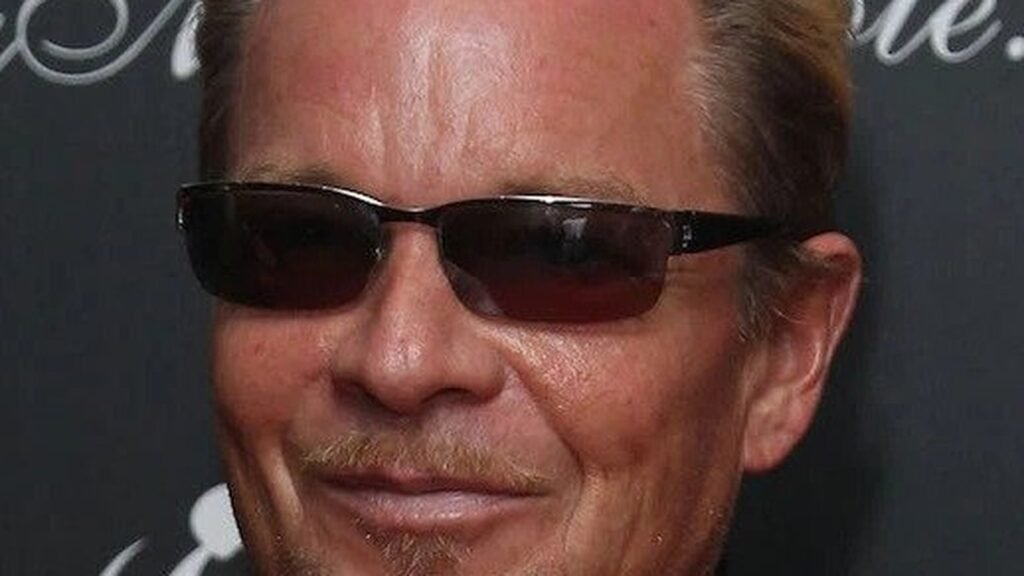
Some directors claw their way into the business. Anthony Hickox was born standing in the middle of it — the son of a director and an Oscar-winning editor — and then, being Anthony Hickox, he went and financed his first short out of a nightclub till anyway. That contradiction is the whole man: film royalty who worked like an outsider, and who spent five incandescent years making horror comedies as if the genre had issued him a personal challenge.
Anthony Hickox was the British director behind Waxwork and Hellraiser III: Hell on Earth, the twin peaks of horror-comedy’s wildest five-year run. Between 1988 and 1993 he directed five horror features back to back — a wax museum that ate its visitors, a vampire western, a time-hopping sequel, a werewolf cop movie for HBO, and the film that picked up Pinhead and moved him to America. Nobody else in that era was making horror that moved this fast or grinned this much while the blood was flying.
Quick Specs
- Born: London, England, 1959
- Died: Bucharest, Romania, October 2023 (aged 64)
- Occupation: Director, screenwriter, producer, actor
- Known for: Waxwork (1988); Hellraiser III: Hell on Earth (1992); Warlock: The Armageddon (1993)
- Years active: Early 1980s–2020
Born Into the Business
Hickox’s father was Douglas Hickox, the director of Theatre of Blood. His mother was Anne V. Coates, the editor who won an Academy Award for cutting Lawrence of Arabia — one of the most celebrated pieces of editing in film history. His sister Emma E. Hickox became an editor herself, his brother James D. R. Hickox worked in the business too, and if you climb the family tree a little further you reach his great-uncle J. Arthur Rank — Lord Rank, the man whose name sat atop the Rank Organisation, one of the great engines of British cinema. Movie royalty is not a metaphor here. It is a family tree.
He was born in London in 1959. You will also find him across plenty of credits as plain “Tony Hickox”; same man, shorter name, and not a separate collaborator however the listings shake out. The fuller form is reportedly 30 January 1959, in Hampstead. He reportedly attended Aiglon College in Switzerland.
What the record does show is a young man who did not simply wait for the family business to hand him a camera. By the early 1980s Hickox was working as a club promoter in London, and he financed his first short, Rock-a-bye-baby, out of the door money from those club nights. In 1986 he came to Los Angeles. The dynasty may have given him the accent and the instincts, but the hustle was his own — and the hustle is what got him his first feature, in the most Anthony Hickox way imaginable.
Door Money and a Dented Car
The Waxwork origin story is an anecdote — a story Hickox himself told, repeated by his obituarists — so take the dollar figure as legend rather than ledger. The legend goes like this: broke in Los Angeles, Hickox crashed into producer Staffan Ahrenberg’s car. Unable to pay for the damage, he offered to settle the debt by writing Ahrenberg a script instead — for $3,000. Then he wrote Waxwork in three days.
Three days. Sit with that. The film that launched a five-year run, that horror fans are still passing hand to hand nearly four decades later, came out of a fender-bender and a long weekend. Whether every detail survived the retelling is beside the point; what is documented is the result — a first-time director, a script written at sprint speed, and a producer, Ahrenberg, who said yes.
The Horror Run: 1988–1993
Waxwork (1988) was his feature directorial debut, written and directed by Hickox, produced by Ahrenberg and distributed by Vestron Pictures; it opened on 17 June 1988. A group of students is lured to a midnight showing at a mysterious wax museum, where the displays — Dracula, the Marquis de Sade, a werewolf, a mummy — are not displays at all but traps that swallow visitors whole. Mark (Zach Galligan) and Sarah (Deborah Foreman) have to fight the museum’s owner, played by David Warner, to get their friends back. The cast around them is pure genre catnip: Michelle Johnson, Dana Ashbrook, Patrick Macnee, John Rhys-Davies. The film tips its hat to Waxworks, the 1924 German silent picture — an inspiration, not the same film, whatever the similar titles suggest. Look closely and you will also spot the director himself, popping up in a cameo as an English prince.
Sundown: The Vampire in Retreat (1989; US video release 1991) is the strangest swing of the run: a western comedy horror, written by John Burgess and Hickox, in which vampires led by Count Mardulak (David Carradine) try to live peacefully in the desert town of Purgatory on artificial blood — until a vampire civil war erupts and a descendant of Van Helsing, played by Bruce Campbell in a supporting role, rides into the middle of it. Morgan Brittany, Jim Metzler, John Ireland, Deborah Foreman and M. Emmet Walsh round out the town. The film screened at Cannes in May 1989 but never had a US theatrical run; American audiences got it on VHS in 1991, and on DVD in 2008.
Waxwork II: Lost in Time (1992) brought Galligan’s Mark back and swapped the museum for a tour of horror history itself, the survivors journeying through the genre’s greatest hits. Monika Schnarre, Martin Kemp, Bruce Campbell, Marina Sirtis and Alexander Godunov fill out the trip, with a Drew Barrymore cameo along the way. Reviewers noted the sequel ups the number of horror homages — where the first film was a haunted house with eighteen doors, the sequel is a joyride, Hickox loosening his grip on plot and doubling down on homage, momentum and gore.
Then came the assignment that defines him for most horror fans. Hellraiser III: Hell on Earth (1992) took Clive Barker’s very British nightmare across the Atlantic. Doug Bradley returned as Pinhead, with Terry Farrell as the reporter standing in his way — and Hickox himself in the credits as an actor, playing Soldier 2. Retrospectives on the film consistently mark it as the pivot point: the entry that moved the series away from its British roots into an American-made, action-oriented shape, with Pinhead recast as a more conventional slasher-style monster stalking nightclubs and city streets instead of Gothic shadows. You can argue about whether that trade served the series — fans have, for thirty years — but you cannot argue it was timid. It is the loudest, fastest, most metal entry in the Hellraiser franchise, and it is unmistakably his.
The run closed with a double bill in 1993. Full Eclipse took the werewolf to television: an action-horror TV movie made for HBO, starring Mario Van Peebles. Warlock: The Armageddon, the sequel to 1989’s Warlock, brought Julian Sands back in the title role, hunting ancient runes that could unleash hell on earth, with Chris Young and Paula Marshall standing in his path as the young heirs of a druid-warrior line. Five horror features in five years, every one of them recognisably his — propulsive, effects-happy, and played with a grin that never once undercut the gore.
Pilots, Princes and Payback
Horror made his name, but it was never the whole CV. The mid-1990s turned Hickox toward action and television: Payback (1995) on the feature side, and a run of TV pilots on the other — he created the ABC/Universal series Extreme (pilot, 1995), directed pilots for Two (1995) and Martial Law (1998), and helmed a 1994 episode of New York Undercover. He also produced: executive producer on Children of the Corn III: Urban Harvest (1995) and co-executive producer on Carnival of Souls (1998). And in 1993 he had slipped into someone else’s horror sequel as an actor, playing Dr. Hickox in Return of the Living Dead III — a wink from one genre craftsman inside another’s film.
Prince Valiant (1997) was the family-sized swerve: Hickox directing from the classic comic strip, with a young Stephen Moyer as Valiant and Katherine Heigl alongside — and Hickox on both sides of the camera again, co-writing the film and playing Prince Gawain. The action features kept coming after that: Storm Catcher (1999), Jill Rips (2000), Contaminated Man (2000), Last Run (2001), Blast (2004) and Submerged (2005), which put him behind the camera directing Steven Seagal. It is a working director’s filmography — not a recluse’s, not a one-hit wonder’s. The man simply kept shooting.
The Last Reel
The later years quietened without ever quite stopping. The ghost story Knife Edge arrived in the late 2000s — sources disagree on whether it was 2008 or 2009. Exodus to Shanghai followed in 2015, and Infamous 6 closed the feature list at the turn of the decade — 2019 or 2020, depending on which source you trust. His final years reportedly included a Federico Fellini biopic and a Spanish-shot film called Zombie Bride. The obituary coverage adds one more title that never got its chance: a film called Perfect Day, which he had been in London planning when the end came.
Hickox married Romanian actress Madalina Anea — her first name also appears as “Madeline Anea”. In October 2023 he was found dead at his house in Bucharest; according to his close friend Jonathan Shalit, friends who had not seen him for some time raised the alarm, and police found him. He was 64 — born in 1959, gone in the autumn of 2023, and the arithmetic is as cruel as it is simple. No cause of death has ever been made public.
What remains is the run. Critics and retrospectives tend to reach for the same cluster of words when they write about Hickox — horror and comedy fused at speed, a craftsman’s enthusiasm for practical effects, genre-mashup energy, a “rule of cool” that put momentum and invention ahead of solemnity. Those verdicts are remarkably consistent, and the films make the case on their own. In five years he built a wax museum, emptied a vampire town into a civil war, walked Mark Loftmore through the whole history of horror, dragged Pinhead into the neon of New York, and sent Julian Sands rune-hunting across America — then spent another quarter-century working steadily in the trenches of action and television. Directors with twice the prestige have left half the fun behind. The museum is still open, reader. Mind the exhibits — some of them bite.