Child’s Play (1988) Review
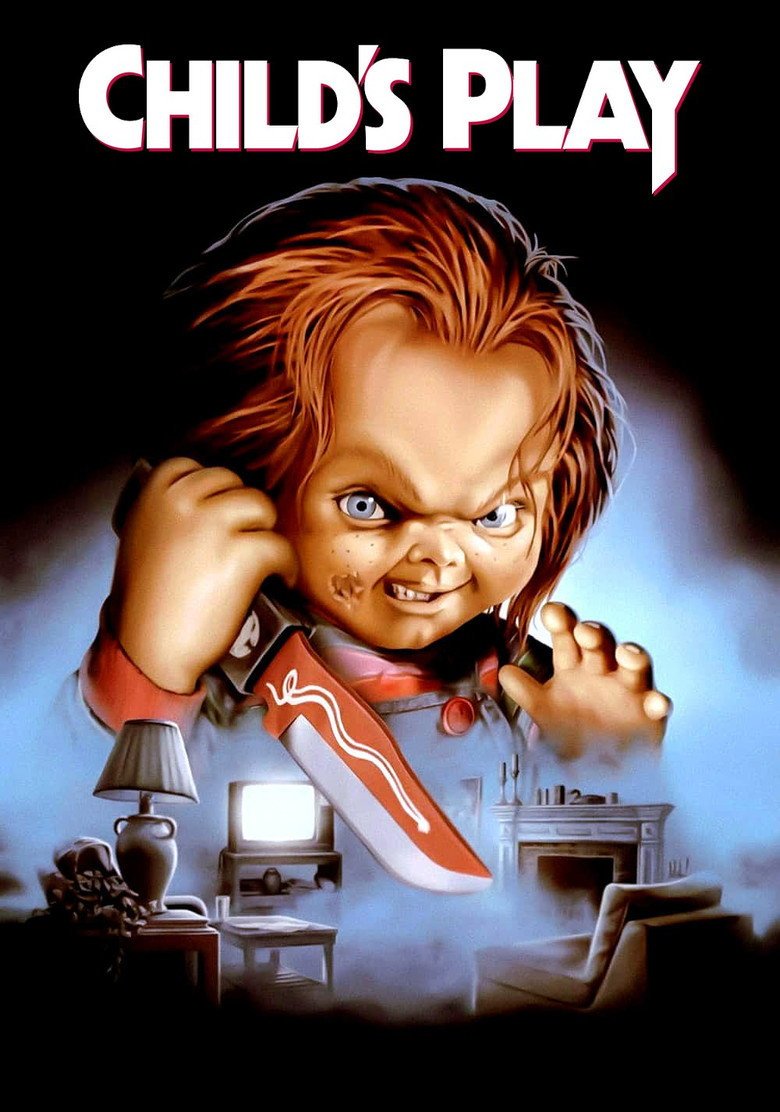
Theatrical poster for Child's Play (1988). United Artists.
It’s your birthday morning, and you’re six years old. The wrapping paper is everywhere, your mom is smiling with that look she gets when she really nailed the gift, and there it is — the toy every kid on the block has been begging for. A Good Guy doll. Overalls, red hair, freckles, and a voice box that says “Hi, I’m Chucky! Wanna play?”
You hug it tight. It hugs you back — a little too tight. And that night, when the house goes quiet and the hallway light clicks off, you hear it. Not the voice box. Something else. Something lower, meaner, with a laugh that doesn’t belong in a toy: “Hi-dee-ho.” You squeeze your eyes shut and tell yourself dolls can’t move. Dolls can’t talk. But when you open your eyes, it’s closer to the bed than it was. And it’s smiling.
Sweet dreams, horror lover. Your new best friend is here to play.
The Review
Okay, maybe that’s a little dramatic. But Child’s Play takes one of the most primal childhood fears — the toy that comes alive — and turns it into a genuinely nasty little horror film. Tom Holland’s 1988 killer-doll classic could have been a joke. A talking doll with a knife? Come on. But thanks to a mean streak a mile wide, jaw-dropping practical puppetry, and one of the great voice performances in horror history, it’s anything but.
Here’s the setup, spoiler-light: Charles Lee Ray, a Chicago strangler known as “the Lakeshore Strangler,” is gunned down in a toy store. Dying, he uses a voodoo chant to transfer his soul into the nearest vessel — a Good Guy doll on the shelf. That doll ends up as a birthday gift for six-year-old Andy Barclay. And when the bodies start piling up, nobody believes Andy’s story about his doll being alive. Because why would they? It’s a doll. But Chucky’s on a mission: the longer he stays in the doll’s body, the more human he becomes — and the only way out is to transfer his soul into the first person he revealed himself to. Andy.
What makes Child’s Play work is that it plays the premise completely straight. There’s no winking at the camera, no “can you believe this?” irony. The film treats Chucky as a real threat, and that commitment sells everything. The kills are brutal and inventive — a hammer to the head, a voodoo doll used as a torture device, a shock-therapy electrocution that still makes you wince. This doll doesn’t just kill; he enjoys it, and that sadism gives the film an edge that most killer-toy movies never find.
And then there’s Brad Dourif. Oh, Dourif. His voice work as Chucky is a masterclass — he takes what could have been a cartoon and makes it genuinely menacing. The profanity-laced rants, the manic laughter, the moments of eerie calm before the violence — Dourif gives Chucky a personality that’s equal parts terrifying and darkly funny. He’s the reason the character survived six sequels, a TV series, and nearly four decades of pop culture. Take Dourif out, and you’ve got a puppet. With him, you’ve got an icon.
The practical effects deserve their own standing ovation. In an era before CGI, the filmmakers used a combination of animatronics, puppetry, forced perspective, and a little-person stunt performer in a Chucky suit to bring the doll to life. The result is tactile and convincing in a way that still holds up — you can feel the weight of that little body moving through a scene. When Chucky’s face contorts with rage, it’s not pixels. It’s engineering. And it shows.
Catherine Hicks as Andy’s mother Karen gives the film its emotional anchor. She’s a working single mom who just wants to make her kid happy, and watching her slowly realize the truth — that the doll is alive, that nobody believes her, that her son is in danger — is the film’s real horror. Alex Vincent as young Andy is solid too, selling the terror of a kid who knows the truth but can’t make the adults listen. It’s a nightmare every child understands.
Is it perfect? Not quite. The voodoo mythology is thin — the film gestures at rules without fully explaining them — and the third act leans hard into action-movie territory. But these are quibbles. Child’s Play knows exactly what it is: a lean, mean, 87-minute nightmare about the toy that wants you dead. It doesn’t overstay its welcome, and it doesn’t pull its punches.
Harper’s Rating: 4.5 out of 5. The rare horror film that’s as fun as it is frightening — and proof that the scariest monsters come in the smallest packages. Wanna play?
Frequently Asked Questions
Is Child’s Play (1988) scary?
Yes — it plays the killer-doll premise completely straight, and Brad Dourif’s gleefully sadistic voice work plus the practical effects make Chucky genuinely menacing. It’s as fun as it is frightening.
Who directed Child’s Play (1988)?
Tom Holland — the Fright Night director, not the Spider-Man actor. He co-wrote the script with Don Mancini and John Lafia.
Where can I watch Child’s Play (1988)?
It’s a streaming regular — it pops up on Peacock, Shudder, and Amazon Prime depending on the month, and it’s widely available to rent or buy digitally. Check JustWatch for current options in your region.
Is Child’s Play (1988) worth watching?
Absolutely — 4 out of 5 skulls. It’s the rare horror film that’s as fun as it is frightening, with practical effects that still hold up and a villain for the ages.
Harper Recommends
If Child’s Play has you side-eyeing your childhood toys, do yourself a favor and grab the Chucky: The Complete Collection Blu-ray set — all seven original films, from the 1988 classic through Cult of Chucky, with commentary tracks and behind-the-scenes features. Watching Chucky evolve from straight horror villain to foul-mouthed antihero across one box set is a wild ride. The first film is the scariest; the rest are the most fun you’ll have with a killer doll.
Harper’s Extras
Every Think Horror review comes with a little something extra rattling around in the goodie bag. Dig in:
- The name: Charles Lee Ray is named after three real-life killers: Charles Manson, Lee Harvey Oswald, and James Earl Ray. The filmmakers wanted the name to sound instantly sinister — and it does.
- The doll: The Good Guy doll was inspired by the My Buddy and Cabbage Patch Kids crazes of the 1980s. The film’s writer, Don Mancini, has said the idea came from the aggressive marketing of children’s toys — and what happens when that commercialism turns sinister.
- The voice: Brad Dourif recorded all of Chucky’s dialogue in post-production, often improvising the doll’s profanity-laced rants. Director Tom Holland has said Dourif’s energy in the recording booth was so intense it genuinely unsettled the crew.
- The effects: Nine different Chucky puppets were built for the film, each designed for specific movements — walking, talking, holding weapons. A little-person actor in a Chucky costume handled the full-body shots. The total effects budget was a significant chunk of the film’s $9 million cost.
- Want the full Chucky deep dive? Check out our Chucky wiki page — backstory, iconic moments, trivia, and everything that makes the killer doll tick.
Where to Watch
Child’s Play (1988) is a streaming regular — it pops up on services like Peacock, Shudder, and Amazon Prime depending on the month. Check JustWatch for current streaming options in your region. It’s also widely available to rent or buy on Apple TV, Amazon Video, Google Play, and YouTube.
Playtime’s over, horror lover. But Chucky will be waiting by the birthday cake… just don’t blame us for the nightmares.
Trailer
Meet Chucky
Say hello to everyone’s favorite killer doll in this classic clip from Child’s Play (1988), straight from MGM: