
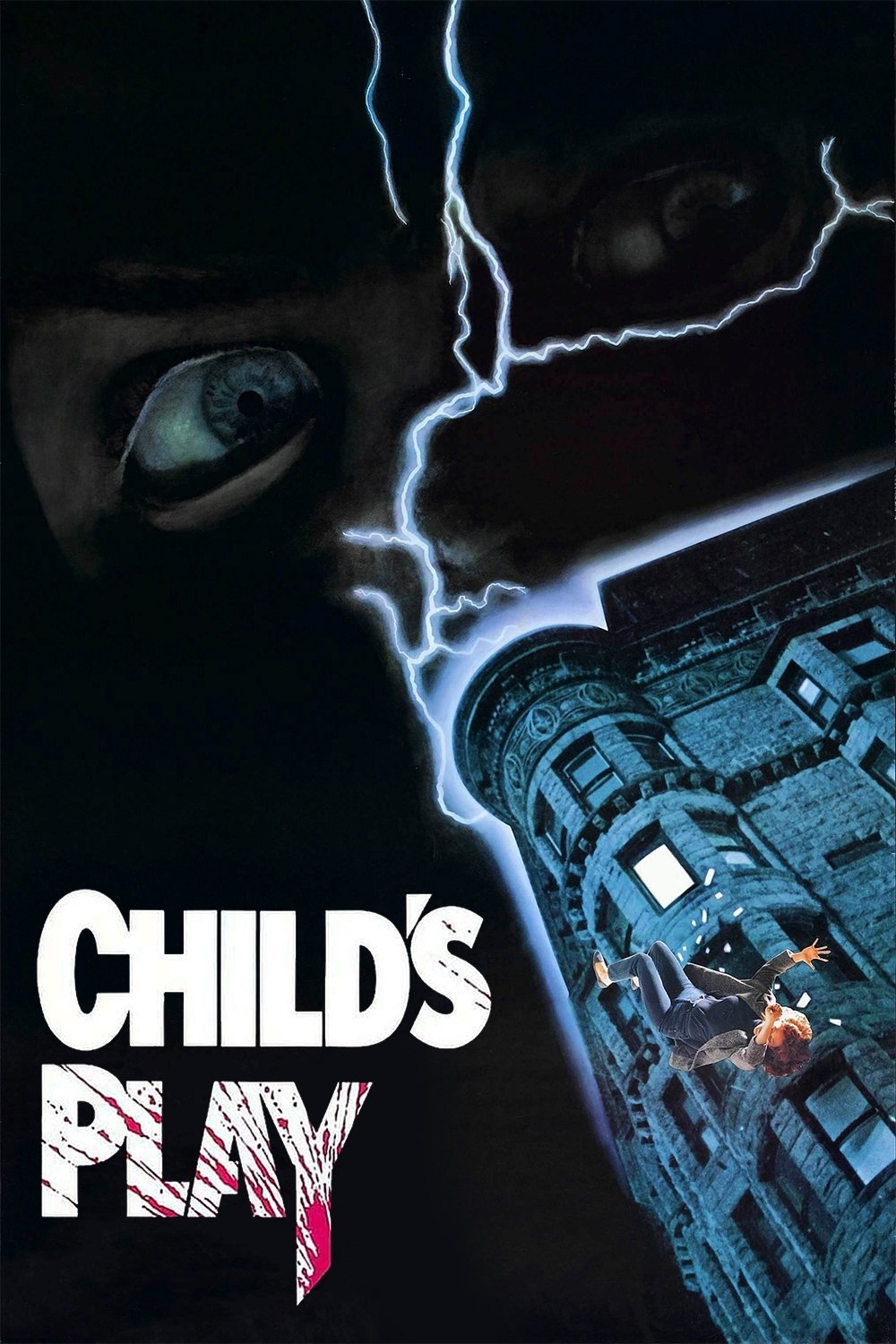
The Child’s Play franchise is Don Mancini’s Chucky saga — seven films, a TV series, and one remake living in a separate continuity.
Two franchises share one doll, and this page keeps them apart. The Mancini continuity — the voodoo killer Charles Lee Ray, voiced by Brad Dourif, running from 1988 through the Chucky television series — belongs to Universal after its first film. The 2019 remake, in which the doll is a malfunctioning AI toy voiced by Mark Hamill, belongs to MGM and shares nothing with it but the name and the silhouette. Money figures below carry their trackers, and where the trackers disagree, both figures are printed — never averaged, never merged.
Quick Specs
- Creator: Don Mancini
- First film: Child’s Play (1988)
- Films: 8 — seven in Mancini’s continuity, plus the 2019 remake
- Television: Chucky (2021–2024) — 3 seasons, 24 episodes
- Studios: MGM/UA (1988 film, remake rights) · Universal (sequels and TV)
Blood Buddy: The Script That Wasn’t
Don Mancini wrote the original script while at UCLA, and his Child’s Play was not the film that got made. His draft, titled Blood Buddy, had no possessed doll and no serial killer: the doll — then called Buddy — was an embodiment of lonely Andy’s subconscious rage, killing only while Andy slept. Andy and the doll cut their thumbs and mixed blood, “friends ’til the end,” and the Good Guy dolls of Mancini’s satire on advertising to children contained fake blood as a marketing gimmick — rough play broke the latex skin, the doll “bled,” and parents had to buy official Good Guy Band-Aids. It was a whodunit that kept it ambiguous longer whether Andy or the doll was the killer. Producer David Kirschner requested extensive rewrites; John Lafia rewrote for sympathy and structure; and director Tom Holland’s version produced the filmed story — the serial-killer possession and the voodoo soul transfer. Mancini is on record, plainly: “the voodoo was not part of my original script.” The final screenplay credit is Mancini, Lafia and Holland — which is why the site’s standing line survives fact-checking: Mancini wrote the original, he did not direct it; Holland did. The doll himself was described in Mancini’s script as two and a half feet tall, red hair, freckles, blue eyes, red sneakers, blue overalls; Kirschner, also an artist, drew him from that description, and Kevin Yagher designed and built him — nine Chucky dolls of different functions for the 1988 shoot, with Ed Gale performing in-suit for wide and action shots. The killer inside him is Charles Lee Ray, nicknamed Chucky, the “Lakeshore Strangler” — Lakeshore, one word — his name assembled from Charles Manson, Lee Harvey Oswald and James Earl Ray. Mortally wounded fleeing Detective Mike Norris, Ray invokes the voodoo god Damballa in a toy store and transfers his soul into a Good Guy doll, which is bought for Andy Barclay. His goal across the early films is to transfer back into a human body — initially Andy’s — before he is trapped in doll form permanently.
The Rights Split: Why There Are Two Franchises
The 1988 film was made by MGM/UA — the only MGM entry in the original continuity. When Christopher Skase’s Qintex moved to acquire MGM/UA, Skase opposed horror production; UA handed the series to producer Kirschner, five studios bid, and Universal won. Every Mancini-continuity sequel and the TV series therefore sits at Universal. But MGM retained remake rights to the first film only — and that single retained right is the entire legal basis of the 2019 remake: MGM and Orion could remake the 1988 film while Mancini’s continuity continued, undisturbed, at Universal. Mancini and Kirschner were offered executive-producer credits on the remake and declined; Mancini explained, on the record, that they said no because they had “our ongoing thriving business with Chucky (at Universal).” The remake was also legally barred from replicating kills from the Mancini sequels. Two studios, two dolls, two continuities — any account that treats the 2019 film as the eighth entry in one series has the law of the franchise wrong.
The Mancini Films
Child’s Play (1988), directed by Tom Holland for United Artists, opened 9 November 1988: Catherine Hicks as Karen Barclay, Chris Sarandon as Norris, Alex Vincent — in his child debut — as Andy, and Brad Dourif as both the dying Ray and the voice of Chucky. Its budget is a conflict inside a single tracker — The Numbers lists $9 million on the film’s own page and $13 million on its franchise table, so both are printed and neither stands alone. Its gross is the rare clean figure: $44,196,684 worldwide, on which both trackers agree exactly. Child’s Play 2 (1990), directed by Lafia and the first Universal entry, opened exactly two years later, 9 November 1990: Andy, in foster care after his mother is institutionalised, is hunted by a Chucky reassembled by the toy company to disprove the bad publicity, in a climax set in the Good Guy doll factory — a setpiece recycled from Lafia’s unused assembly-line draft for the first film. Budget $13 million and worldwide gross $35,763,605, both single-tracker figures from The Numbers. Child’s Play 3 (1991), directed by Jack Bender, arrived only nine months after its predecessor — Mancini has repeatedly called it his least favourite entry, made too fast; he was writing it before Child’s Play 2 was even released. Eight years on, a teenage Andy (Justin Whalin — Vincent does not appear) at military school is targeted again, and Chucky pivots to a new child, Tyler. Its money is a two-lineage conflict, printed unmerged: The Numbers gives $14,250,380 domestic and $19,850,380 worldwide; the Wikipedia lineage gives $14,960,255 domestic, $20,560,255 worldwide and a $13 million budget. Bride of Chucky (1998), directed by Ronny Yu, is the pivot: the first entry branded “Chucky” rather than “Child’s Play,” introducing Jennifer Tilly as Tiffany Valentine — Charles Lee Ray’s former girlfriend, who stitches his destroyed remains together, resurrects him, and is murdered into a bride doll for her trouble — and establishing Chucky’s stitched, scarred look as the character’s default for the rest of the continuity. Budget $25 million, both trackers agree; the worldwide gross is $50,692,188 by The Numbers and $50,688,658 by Box Office Mojo, a $3,530 tracker discrepancy carried honestly. Seed of Chucky (2004) is Mancini’s directorial debut, shot in Romania for Rogue Pictures: Glen, the gentle orphaned child of Chucky and Tiffany, resurrects his parents on the set of a film-within-the-film about them. Its budget is the franchise’s largest conflict — $29 million by The Numbers against $12 million in the Wikipedia lineage — and its worldwide gross $25,266,043 against $24,829,644 by the other tracker. It is also the last theatrical release in Mancini’s continuity; everything after in his line is direct-to-video or television. Curse of Chucky (2013), written and directed by Mancini for Universal’s direct-to-video line — VOD 24 September 2013, disc 8 October 2013; it is not a Netflix film and has no box office, because no theatrical run exists — returns the series to straight horror. A Chucky doll is mailed to the Pierce home, and paraplegic Nica Pierce (Fiona Dourif, in her franchise debut) realises the doll is settling Ray’s old score with her family: the black-and-white flashbacks, with Brad Dourif on screen as Ray for the first time since 1988, reveal he knew her mother and caused Nica’s paralysis before her birth. Its post-credits scene returns Alex Vincent as adult Andy, shooting the mailed Chucky head — his first franchise appearance in 23 years. Cult of Chucky (2017), premiered at FrightFest on 24 August 2017 and released direct-to-video that October — again, no box office exists — institutionalises Nica, gaslit into believing she committed the Curse murders, and confronts her with multiple Chucky dolls after Chucky splinters his soul. It ends with Nica herself possessed by Chucky, driven away by Tiffany, and a post-credits return for Christine Elise’s Kyle, torturing the captive Chucky head at Andy’s cabin. Its budget is the firmer of the two direct-to-video figures: $5 million by The Numbers.
The 2019 Remake: A Separate Continuity
Child’s Play (2019), directed by Lars Klevberg and written by Tyler Burton Smith for Orion and MGM, is not a sequel, a reboot of the continuity, or a Mancini film — he holds only a “characters” credit. There is no voodoo, no Charles Lee Ray and no soul transfer. The doll is a Buddi, a Kaslan Corporation AI companion whose safety protocols were disabled by a mistreated factory worker; given to Andy (Gabriel Bateman) by his mother Karen (Aubrey Plaza), it imprints, learns violence from its environment, and kills to protect its “best friend.” Mark Hamill voices Chucky — his casting announced at WonderCon on 30 March 2019 — not Brad Dourif. The film cost $10 million, on which both trackers agree, and grossed $29,208,403 domestic, also agreed; its worldwide total is a standing conflict, $47,042,493 by The Numbers against $44,902,237 in the Box Office Mojo lineage, printed as both. The horror is technological, and the film’s existence is a rights artifact, not a creative verdict on the series it parallels.
Television: Chucky (2021–2024)
The Chucky series, created by Mancini for Syfy and USA Network, continues the film continuity after Cult: three seasons, 24 episodes, premiering 12 October 2021 and ending 1 May 2024, its third season split in two halves around the 2023 strikes. Cancellation was confirmed on 27 September 2024; Mancini’s public response thanked fans for “three killer years” and promised, “Chucky will return! He ALWAYS comes back.” The series braids returning film cast — Dourif‘s voice, Fiona Dourif’s Nica, Tilly’s Tiffany, Vincent’s Andy, Elise’s Kyle — with new young leads led by Zackary Arthur’s Jake Wheeler. One casting fact is garbled so often that this page states it exactly: Fiona Dourif does not play young Charles Lee Ray in Cult of Chucky — in Cult she is Nica, including Nica possessed. She plays young adult Charles Lee Ray in flashbacks in the television series’ first season, from its fifth episode, in prosthetics, with her father’s voice.
The People: Verified Counts
Brad Dourif voices Chucky in all seven Mancini-continuity films and all three television seasons — and is not in the 2019 remake; “Dourif in every Child’s Play film” without that exception is false. On screen as Charles Lee Ray he appears in exactly three productions across 36 years: the 1988 opening, Curse‘s flashbacks, and the TV series’ third season, where the spirit of Charles Lee Ray also voices the god Damballa. His daughter Fiona’s Nica anchors the modern continuity from Curse onward. Jennifer Tilly’s Tiffany enters in Bride — live-action human first, then the doll’s voice after her soul transfers; in Seed she plays both Tiffany and “Jennifer Tilly,” herself — and she appears in every Mancini-continuity entry from 1998 onward. Alex Vincent originated Andy at six years old, played him again in Child’s Play 2, and was absent from the third film and the Tilly era before returning in Curse‘s post-credits scene; he has been part of the franchise again ever since. Catherine Hicks and Chris Sarandon headline the 1988 film only — Sarandon’s Norris is referenced in the sequels, never reprised. And Mancini’s own ledger is the franchise’s spine: writer or co-writer on every Mancini-continuity entry, creator and showrunner of the series, and director of exactly three films — Seed, Curse and Cult. He did not direct the original, the second, the third or Bride.
Status: October 2026
A new theatrical Chucky film is in development, written by Mancini — announced by him at Steel City Con on 12 April 2026 as a feature intended for theatrical release, modelled on Curse‘s back-to-roots approach and tying into both the films and the television series. The sequence behind it: in March 2024 Mancini said a new film was in early development alongside the then-running series; the series was cancelled that September; in October 2024 he stated publicly that the franchise continues with continuity intact — “You WILL see your favorites again”; and in April 2026 came the writing announcement. What has not been announced is everything else: no title, no cast, no director confirmation beyond Mancini writing, no release date and no studio date-lock exist in any source, and this page invents none of them. No fourth season of the series is announced anywhere; it remains cancelled. The old talk of a Child’s Play and Elm Street crossover is not an active project and is not presented as one.
Why This Franchise Matters
Chucky is the slasher era’s most durable survivor because the franchise was never a studio’s assembly line — it is one writer’s continuous authorship, rare in horror: the same hand wrote or co-wrote every entry in the main continuity across thirty-six years, steered it from theatrical slashers through a self-aware comedy pivot and back to straight horror, then carried it to television without rebooting it, keeping one voice actor, one mythology and one accumulating cast of survivors throughout. The doll himself inverted the genre’s physics — a killer two and a half feet tall, whose menace is persistence, profanity and the obscenity of a childhood toy that wants your body — and the rights split that produced two simultaneous Chucky franchises is itself a horror-history document: a series so valuable that its creator’s continuity and a remake of its first film could run in parallel, owned by rival studios, neither cancelling the other out. He always comes back. The record, unusually, supports the slogan.
Keep it locked on Think Horror — friends ’til the end.