
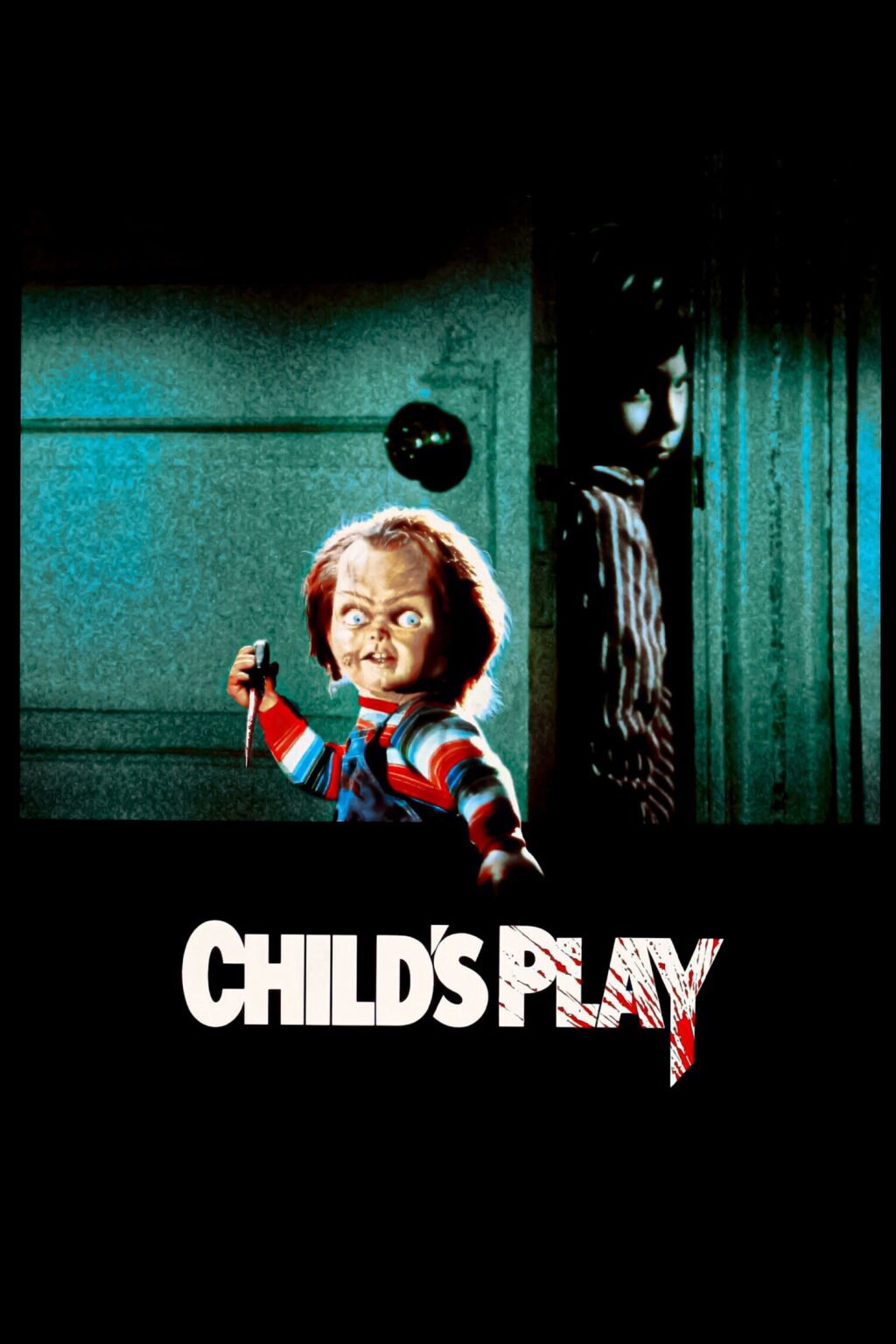
Child’s Play (1988) is Tom Holland’s killer-doll film — the Lakeshore Strangler’s soul in a Good Guy doll, and a two-foot icon is born.
Misremember it the way the culture does and it is a toy with a knife. Watch what was actually made and it is two films in one: a dark satire on marketing to children, and a possession thriller that changed the doll’s nature draft by draft. United Artists held it past Halloween on purpose, positioning Chucky as “the new terror icon” — and on $33 million domestic and 200,000 cassettes, the bet paid. This is the film where Chucky stops being a whodunit device and becomes a murderer with a name of his own: Charles Lee Ray.
Quick Specs
- Director: Tom Holland
- Writers: Don Mancini, John Lafia, Tom Holland
- Released: 9 November 1988
- Runtime: 87 minutes
- Budget: $9 million [The Numbers film page] vs $13 million [franchise table; reported by the Hollywood Reporter in 1987]
From Blood Buddy to Possession
Don Mancini‘s original script was called Blood Buddy — a whodunit and a satire on marketing to children, in which the doll “came alive” through Andy’s blood rite. Mancini’s target was the Cabbage Patch Kids hysteria, parents fighting over dolls; his father worked in advertising, and in his words, “I wanted to write a dark satire about how marketing affected children.” John Lafia’s rewrite rebuilt the script for sympathy and structure, and director Tom Holland’s version introduced the element that defines the film: the serial-killer possession. The voodoo was not in Mancini’s script — his own words — and the design influence was a different doll entirely: Holland has affirmed the My Buddy doll (Hasbro, 1985) played a role in Chucky’s physical design. Satire target and design model are two separate attributions and this page keeps them separate. Producer David Kirschner pitched the tale to the Hollywood Reporter in October 1988 as “the dark side of Pinocchio,” and the killer got a name assembled from three real ones: Charles Manson, Lee Harvey Oswald, James Earl Ray. The doll itself was designed and built by Kevin Yagher — nine Chucky dolls of different functions, per the production record.
The Good Guy Machine
The product world is built to be believed. The dolls are made by Play Pals — the shop Charles Lee Ray breaks into in the opening is Playland Toys, a different name, and the two are never swapped here. Every Good Guy has his own individual name and speaks three stock lines; the franchise’s named Good Guys include Tommy, Paulie, Larry, Oscar, Charlie, Billy and Joseph, and the example line runs: “Hi, I’m Tommy, and I’m your friend till the end. Hi-de-ho, ha ha ha.” Behind the doll sits the full apparatus the satire aimed at: an animated Good Guy television show with animation by Ruby-Spears Enterprises, watched by Andy in Good Guy pajamas over Good Guy cereal, with the doll commercial airing inside it, and merchandise down to a Good Guy tool kit. The famous child’s plea — “I want a Good Guy” — is the marketing working exactly as designed, which is the point Mancini started from.
Production: Chicago in January
Principal photography began 7 January 1988 in Chicago; a contemporary account records eight outdoor locations shot at 20°F below zero with wind chill fifty below, the production renting “warm centers” for the crew, and Chris Sarandon’s vocal cords freezing mid-take on a sub-zero exterior. After four weeks the production moved to Los Angeles, finishing at Chicago Studio City and the Culver Studios; the Barclays’ building is the Brewster Apartments at Diversey and Pine Grove in Lincoln Park, the building on the poster. The doll was a crew unto itself: Brad Dourif‘s Chucky voice was recorded in advance and played back on set, puppeteers syncing the doll to the playback, sometimes at half-speed. How many puppeteers operated the hero doll is a genuine conflict, printed as such: Kirschner says roughly eleven; other production accounts describe the radio-controlled animatronic as controlled by up to nine at once. Holland’s difficulty report survives via production coverage — puppeteers working underneath, watching monitors whose image was reversed, the knife aluminium and wired to a hand that could not grip: “it’s costing $30,000 an hour.” Ed Gale performed the in-suit Chucky work with sets built 30 percent larger for forced perspective and zero visibility in the costume, rehearsing with his eyes closed; the fire sequence was his — performed in segments of about 45 seconds, flames graduated from arm to chest to both arms, an oxygen mask between takes, burns to his wrists. The charred Chucky of the finale, by contrast, is the animatronic’s work on the record. And the voice had a trail of its own: John Franklin recorded Chucky’s dialogue first, then Jessica Walter recorded a full version; both were discarded when Dourif returned — Walter’s audio went entirely unused, and Franklin survives in the film as the human Good Guy television presenter. While Dourif recorded the burning screams, his daughter Fiona, then seven, fled the booth area frightened and was found crying under a table; as an adult she would co-star opposite him as Nica in Curse of Chucky.
The Performances
Catherine Hicks is first-billed — and that billing is a story: Chris Sarandon was to be top-billed and insisted Hicks take it instead, as she was the lead character, a gesture carried by two production accounts. Holland cast Sarandon immediately, having worked with him on Fright Night (1985). Hicks met Chucky’s designer Kevin Yagher on this set and married him a year later; they remain married. No sourced account of a preparation method for her performance exists, and none is invented here. Alex Vincent’s Andy came from an open casting call — a Daily Variety notice for a six-year-old lead at a Hollywood church — after Holland considered hundreds of children; Vincent, with a couple of weeks on As the World Turns at age five as his prior screen work, won at his second audition. He had no twin — the record holds a credited “Andy” photo double, Joshua Krippner, and nothing else. His account of the crying scene is pure working actor: “they ran out of film… I told them, ‘Don’t worry, I’ll keep crying.'”
Release and Money
United Artists deliberately held the film past Halloween to the Wednesday before Veterans Day, to avoid being “another Halloween horror film,” running a short campaign to “position Chucky as the new terror icon.” It opened 9 November 1988 — the 9th, a Wednesday; the “November 11” in some oral histories is the Friday of its first weekend frame. The opening weekend was $6,583,963, on which both trackers agree to the dollar, from 1,377 theatres opening and 1,490 at widest; the legs were the story — that opening was under twenty percent of the final domestic total, a roughly five-times multiplier to $33,244,684 domestic, $10,952,000 international, $44,196,684 worldwide, with both trackers in exact agreement. It finished the second-highest-grossing horror film of 1988 behind A Nightmare on Elm Street 4, and per Kirschner, UA’s second-highest grosser of the year after Rain Man. Home video followed on 25 April 1989 and sold 200,000 cassettes — the performance, with the box office, that MGM-UA cited when it ordered the sequel.
Reception
The notices were better than a killer-doll film had any right to expect. Roger Ebert gave it three of four stars: “a cheerfully energetic horror film of the slam-bang school, but slicker and more clever than most,” with “a truly malevolent doll. Chucky is one mean SOB.” Caryn James in the New York Times — James, not Janet Maslin, whatever other copy says — called it “a clever, playful thriller”: “It’s the deft wit and swift editing that keeps us off guard, no matter how predictable the plot.” Variety dissented politely, a “near-miss” whose novelty “is not buttressed by an interesting story,” while conceding Holland’s “impressive technical skill.” Leonard Maltin gave three of four stars, “a scary and clever horror thriller.” The contemporary BFI notice was the cold one: the toy-marketing satire “briskly discarded,” leaving “a weak and woolly observation about the vulnerability of infants to the cynicism of hard-sell television advertising.” The film stands now at 65 percent on Rotten Tomatoes (96 reviews), consensus: “occasionally stumbles across its tonal tightrope of comedy and horror, but its genuinely creepy monster and some deft direction by Tom Holland makes this chiller stand out on the shelf” — with a Metacritic of 58 and a CinemaScore B, and Scream Factory Collector’s Edition and 4K restorations keeping the reappraisal warm.
The Controversy: Claims and Conclusions
This section is written exactly on the record: claims attributed to their claimants, official conclusions attached, because the tabloid version of this story has been told wrong for thirty years. In 1993, after the murder of two-year-old James Bulger by two ten-year-olds, UK tabloids claimed the killers had imitated a scene from Child’s Play 3. At sentencing the trial judge said he suspected exposure to violent video films “may in part be an explanation” — and later clarified those remarks were not based on any evidence heard at the trial. What the investigation itself concluded: the detective superintendent who directed it reported that one of the boys was unlikely to have seen the film at all, disliked horror films per psychiatric reports, and that the investigation “specifically looked for a video link [and] concluded there was none.” A Home Office minister confirmed police found no evidence linking the case to violent videos; officers reviewed some 200 titles rented by the family and found, in one detective’s words, “nothing — no scene, or plot, or dialogue — where you could put your finger on the freeze button and say that influenced a boy.” Parliament was told the same: the reports did not support the theory. Child’s Play 3 was never banned in the UK — the BBFC passed it uncut at 18; retailers withdrew the series voluntarily amid the panic, and one chain burned its copies while a tabloid ran a public video-burning campaign. The second case pressed into the same coverage, the 1992 torture and murder of Suzanne Capper, involved not a screening of any film but a rave track sampling Chucky’s voice played through headphones; the investigating officer stated there was “no suggestion that the reason Suzanne was killed had anything to do with Child’s Play.” Broadcaster David Elstein called the video connection “a false story… branded into the consciousness of the media.” Holland’s reported response to both cases was that viewers could only be influenced by a horror film’s content if they were “unbalanced to begin with.” The legislative aftermath was real — the Criminal Justice and Public Order Act 1994 tightened rules on video availability to children — but it stands on a panic the investigators themselves had already ruled out.
Legacy
The sequel machinery moved instantly and then nearly died: UA initiated a sequel immediately, Mancini was writing by Christmas 1988, and MGM-UA formally ordered it on the grosses and cassette sales — before UA’s sale to Qintex, which wanted only prestige and family fare, killed it in pre-production to applause from child-advocacy groups. UA returned the rights to Kirschner, Steven Spielberg urged him to give Universal first shot, and Universal acquired the sequel in March 1990; Child’s Play 2 opened at number one that November. The full rights story lives on this site’s franchise hub, and Harper’s take is the Child’s Play (1988) review. The doll’s standing needs no inflation: Chucky ranks sixth on one major list of iconic horror villains and tenth on a 2025 list of the scariest horror characters of all time. Alex Vincent’s own story closes the circle — crushed when the third film recast Andy, out of acting by choice after 1993, a recording-engineering graduate who opened his own Clearwater studio in 2014 — before the franchise brought him home in Curse and Cult, the boy from the Good Guy commercials returning to face the doll as a man. What Holland shot in a freezing Chicago January became, as UA intended and then some, the new terror icon: two feet tall, three stock lines, and a soul that would not stay in the doll.
Keep it locked on Think Horror.