
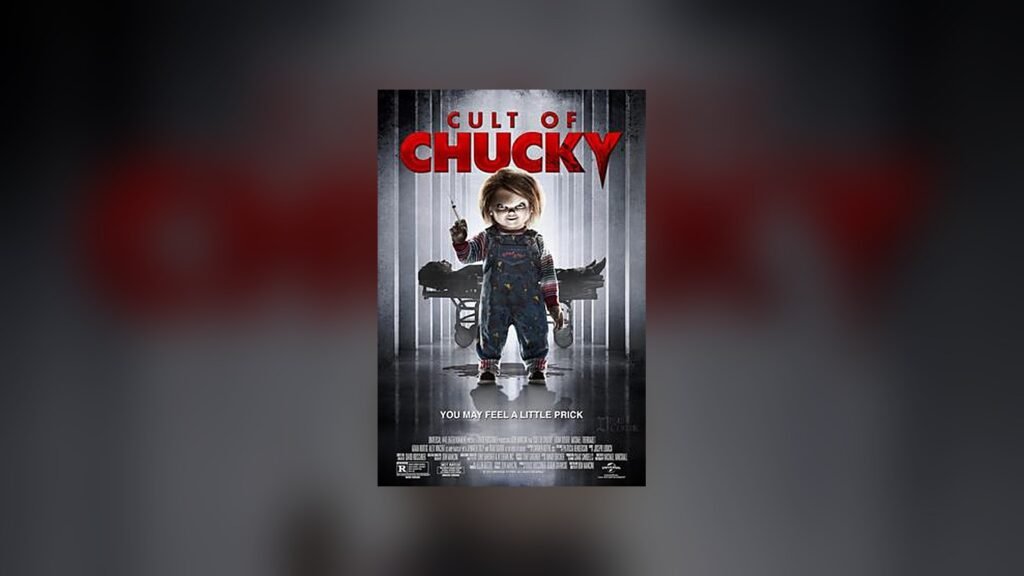
Cult of Chucky is the 2017 direct-to-video sequel where Chucky splits his soul across many dolls — and ends it inside Nica Pierce.
Twenty-nine years into the Child’s Play franchise, Don Mancini did the thing he had been waiting since 1991 to do. Cult of Chucky is the seventh film in his continuity — a direct sequel to Curse of Chucky, not a reboot, not a remake — and it takes the series’ oldest rule, one soul in one doll, and breaks it on purpose. The result is the strangest, most divisive, and by several critical measures best-reviewed entry the franchise ever produced, released straight to home video with an ending that was never an ending at all: it was a door, aimed squarely at television.
House rules before we begin, because this film’s errors breed fast: there is no box-office figure (no theatrical run — the money figures attached to this title are disc sales); Nica is not cured of anything at the end; and the asylum patient file you may have seen floating around fandom wikis belongs to a man named Malcolm, also called Michael. Adjust your notes accordingly.
Quick Specs
Director: Don Mancini
Written by: Don Mancini
Producers: David Kirschner, Ogden Gavanski
Starring: Fiona Dourif, Alex Vincent, Jennifer Tilly, Michael Therriault, Adam Hurtig, with Brad Dourif as the voice of Chucky
Production company: Universal 1440 Entertainment
World premiere: August 24, 2017, London FrightFest
Released: October 3, 2017 (Blu-ray, DVD, VOD), Universal Pictures Home Entertainment
Runtime: Listed variously at 91, 90 and 97 minutes — no single figure is settled
Rated: R
Budget: Reported at $5 million
The Cast
Fiona Dourif returns as Nica Pierce, four years institutionalized and gaslit into believing she invented Chucky — the performance the whole film hangs on, and she plays both the broken version and, eventually, something much worse. Brad Dourif voices Chucky, as ever. Alex Vincent is back as Andy Barclay in his first principal franchise role since he was a child in Child’s Play 2, and Christine Elise returns as Kyle, Andy’s foster sister from the same film, in the closing credits scene. Jennifer Tilly plays Tiffany Valentine in the flesh — note that a Tiffany doll also walks through this film, alive and carrying a portion of Tiffany’s soul; the woman and the doll are not the same character. Michael Therriault is Dr. Foley, Nica’s abusive psychiatrist; Adam Hurtig plays Malcolm, a patient with dissociative identity disorder who also answers to Michael; and Elisabeth Rosen, Grace Lynn Kung and Marina Stephenson Kerr play Madeleine, Claire and Angela, with Zak Santiago and Ali Tataryn as nurses Carlos and Ashley, and Summer H. Howell, credited as Alice Pierce.
The Plot
Four years on, Andy Barclay keeps the original Chucky’s severed head — the one he shot in Curse’s post-credits scene — and tortures it for information it will not give. Nica, meanwhile, has been moved through institutions since her conviction, and has been persuaded she hallucinated the doll and murdered her family herself. Her psychiatrist, Dr. Foley — who, as the film makes plain, abused her in their private sessions — transfers her to a medium-security facility, where she joins a therapy group: Angela, who believes she has already crossed over; Claire, brittle and frightened; Malcolm, whose personalities include one who claims to be Charles; and Madeleine, institutionalized for smothering her infant son, who is handed a Good Guy doll as a therapy tool and immediately begins treating it as her baby.
Then Tiffany Valentine arrives, as Alice’s legal guardian, with two gifts: the news that Alice has died — Tiffany’s version is that the girl died of a broken heart — and a second Good Guy doll, which is very much alive. Madeleine, meanwhile, smothers her own therapy doll with a pillow in a grim little ceremony of confronting what she did to her son; the orderlies bury it in the grounds to placate her. It will not stay buried, because nothing in this place is what it is pretending to be. That night Nica slits her wrists with a broken wheelchair spoke. She wakes to find the wounds stitched and Angela dead by the same method, staged to look self-inflicted, and understands the only sane thing anyone concludes in this film: she was never crazy. The deaths mount in Mancini’s most baroque register — Claire decapitated by falling skylight glass after Chucky shatters it with a compressed-air canister; Madeleine killed by her own doll, its arm forced down her throat; Nurse Carlos stabbed and drilled by three Chuckys at once in Foley’s office; an asylum guard’s throat slit by Tiffany with a nail file.
Twice along the way, Foley attempts to assault a hypnotized Nica, and twice a doll puts him on the floor for it — Chucky even tries coaxing Nica into finishing the job herself, an offer whose refusal tells you everything about who the monster in the room actually is. Because that is the reveal the film has been building: the original Chucky found a spell that lets him copy his soul into multiple hosts — his own explanation for where he found it is delivered as a punchline: online. One soul, many vessels — the dolls are not separate people, they are a hive of one. Alice was one of those hosts after Curse’s interrupted transfer, and she was killed when one of his intended victims fought back; “died of a broken heart” is Tiffany’s cover story, delivered to the aunt she is busy destroying. Andy, learning Nica is in danger, commits himself into the facility by assaulting a guard — having first mailed himself a Good Guy with a gun hidden inside its chest cavity, a doll that frees him from his cell and dies for the effort, shot by Andy with its own smuggled weapon. Nurse Ashley is found drilled through the stomach; Malcolm is drilled through the head after admitting his “Charles” was only ever a personality, not a possession.
The ending, stated plainly because summaries keep bending it: one of the dolls transfers its soul into Nica. Possessed — not cured, possessed — her body walks for the first time in her life, in high heels she has never worn, and she stomps Dr. Foley to death with them after he makes one assault too many; the killer is Nica-Chucky, not Tiffany, whatever you may have read. Andy, locked in his cell by the thing wearing his friend, is left behind to be found with the bodies. Nica-Chucky walks out, reunites with Tiffany, and the two drive away together — with the Tiffany doll riding along. And in a credits scene, Kyle arrives at Andy’s house, sent to mind the severed head in his absence: to keep torturing it. The head, notably, survives. Everyone in this film is somebody’s unfinished business.
The Idea Mancini Waited 26 Years to Use
The multiple-Chuckys concept is older than most of the cast. In an October 2013 interview, Mancini explained that since Child’s Play 3 he had always wanted to introduce multiple Chuckys — the original conception had his blood mixing into the molten plastic on the factory line, possessing every doll that came off it — but budget constraints killed it every time. Cult, twenty-six years later, is where he finally spent it, reworked as a soul-copying spell rather than a factory accident. Not everything he wanted survived the edit: a reference to Glen and Glenda from Seed of Chucky was cut, though Mancini has said it was something he definitely wanted to keep — a thread the television series would later pick up for him.
Mancini confirmed a seventh film was planned in December 2013, weeks after Curse landed, and was writing it by February 2015; he, Tilly and Fiona Dourif confirmed the shoot a year after that. The production office opened in Winnipeg in December 2016, and on January 5, 2017 the premise, cast and distribution plan were formally revealed, with shooting set to commence four days later — the same Manitoba base as Curse, with that film’s cinematographer Michael Marshall returning, Joseph LoDuca scoring and Randy Bricker editing. Principal photography began on January 9, 2017, wrapping in mid-to-late February (sources put the last day on the 18th or the 20th; the start date is the one that agrees everywhere). Tony Gardner returned to build and perform Chucky, and took a producer credit on this entry as well. The budget is reported at $5 million — reported, note, not trade-confirmed.
Release and Reception
Cult premiered at London’s FrightFest on August 24, 2017, and went to Blu-ray, DVD and VOD on October 3, with Netflix carrying it in the US. There was no theatrical release and there is no box office; what the film earned, it earned on disc — over $2 million in DVD and Blu-ray sales in its first weeks by The Numbers’ count (snapshots put it at $2.2 million, then $2.3 million), sales figures that should never be dressed up as a theatrical gross.
The reviews startled people who had not been paying attention to Curse. As of this page’s publication, Rotten Tomatoes lists the film at 81% from 26 critics — older snapshots read 78 to 83 percent, because aggregates drift — with a critics consensus that runs: “Old Dolls can learn new tricks: This little murderer with a facelift is sillier and better than ever thanks to Don Mancini’s Cult of Chucky.” The audience score sits at 62%, and Metacritic has it at 69, generally favorable. Stephen Dalton praised how “the bratty quips and cheerfully nasty murders come thick and fast,” with Mancini’s style shifting “up a gear… like Brian De Palma on an indie-movie budget,” calling the result “part self-spoofing slasher, part lowbrow bloodbath and all guilty pleasure.” Its reputation has only consolidated since — a 2022 assessment put it plainly: the seventh installment “wound up landing the best reviews of the bunch.” Scott Mendelson wrote that the film “is either the Final Chapter or a New Beginning. Either way, this most tenacious of horror franchises can walk on with its head held high.” And William Bibbiani, scoring it 7.4 of 10, concluded: “Too many horror sequels feel like cheap and soulless cash-ins. Cult of Chucky has big ideas, strong performances and some moments that rank among the best in the series.”
The Performance at the Center
Everything the film attempts lands or dies on Fiona Dourif, and it lands. Her Nica spends most of the runtime doubting her own memory in rooms full of people paid to doubt it for her — the sanest person in the asylum, believed by no one, not even herself. Then the possession turns her body into the film’s final special effect: the walk she never had, the posture, the grin that belongs to her father’s most famous character wearing her face. It is a daughter playing her father’s role inside her own, and the film knows exactly how strange and sad that is. The series that followed is built on this performance, and so is this page’s patience with the film’s excesses.
A Door, Not an Ending
In February 2018, a Child’s Play television series was announced as in the works, with Mancini and Kirschner involved, explicitly continuing this film’s story. It arrived as Chucky in October 2021 — Brad and Fiona Dourif, Vincent, Elise and Tilly all returning — and ran three seasons before its cancellation in September 2024. Read the ending again with that in mind and its shape is unmistakable: Nica possessed and at large, Andy caged, the head alive in Kyle’s keeping. It was built as a handoff. In the series, Nica remains possessed by her piece of Chucky’s soul, spends a year as Tiffany’s captive, escapes in season two with Glen and Glenda’s help — the twins Cult never got to mention — and by season three is revealed to have set up Tiffany’s arrest. The asylum was not the end of Nica Pierce. It was her origin story, told by the villain, in her own body.
That is Cult’s real standing: the film where a 29-year-old slasher franchise stopped trying to end and started trying to multiply — dolls, souls, formats. One soul, many vessels, indeed.