
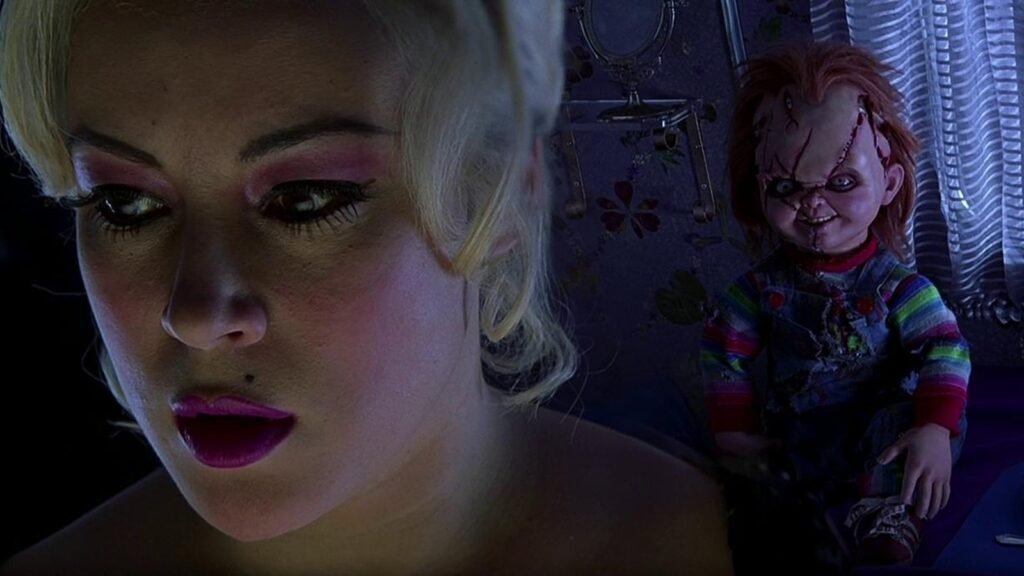
Jennifer Tilly is the Oscar-nominated actress who became Tiffany Valentine — and the poker champion who nearly turned the role down.
Quick Specs
- Born: Jennifer Ellen Chan, 16 September 1958, Harbor City, Los Angeles, California
- Occupation: Actress and poker player
- Years active: 1983–present
- Known for: Tiffany Valentine in the Child’s Play franchise; Violet in Bound (1996); the voice of Bonnie Swanson on Family Guy
- Honors: Academy Award nomination, Best Supporting Actress (Bullets Over Broadway, 1994); World Series of Poker bracelet (2005); Women in Poker Hall of Fame (2022)
- Sister: Meg Tilly, actress and writer
- Partner: Phil Laak, professional poker player (since 2004)
From Chan to Tilly
She was born Jennifer Ellen Chan — the Tilly is her mother’s maiden name, adopted professionally by both sisters — in Harbor City, Los Angeles, the second of four children of Harry Chan, a used-car salesman, and Patricia Tilly, a Canadian schoolteacher and former stage actress. Her parents divorced when she was five, and she was raised largely on rural Texada Island in British Columbia, her mother’s native province, moving to the Victoria area at sixteen and finishing school there before heading to Missouri for a theater degree at Stephens College. The origin story explains the two careers she would eventually stack on top of each other: the stage actress mother, and a father who was a gambler and poker player — the man who handed her a World Series of Poker video game, a detail that reads like trivia until 2005.
The climb, and the Oscar year
The screen career started on television: a recurring turn on Hill Street Blues as Gina Srignoli, a mobster’s widow, a date with Frasier Crane on Cheers, a film debut in No Small Affair (1984). The breakthrough came in 1989, twice over — Let It Ride opposite Richard Dreyfuss, and The Fabulous Baker Boys, where Steve Kloves wrote the tone-deaf singing waitress Blanche “Monica” Moran specially for her, and critics noticed the comic gifts: the breathy voice, the timing, the daffiness that conceals a working brain. A Theatre World Award followed for the off-Broadway One Shoe Off in 1993, and the stage has kept calling her back — Broadway revivals of The Women in 2001, as Crystal Allen, and Don’t Dress for Dinner in 2012. Then 1994 made her, in the industry’s ledger, legitimate: as Olive Neal, the hopelessly bad actress of Woody Allen’s Bullets Over Broadway, Tilly was nominated for the Academy Award for Best Supporting Actress. Print it the way it happened, because the myth has inflated it since: she did not win — her co-star Dianne Wiest did — and she has exactly one Oscar nomination, whatever the poker press has occasionally claimed about two. The nomination was the credential. What she did with it, four years later, is the reason this page exists.
Bound
Between the nomination and the doll came the performance critics still reach for first: Violet in Bound (1996), the Wachowskis’ feature directorial debut — a lesbian femme fatale in a fur coat and a plan, opposite Gina Gershon’s ex-con Corky, the two of them scheming to steal two million dollars of Mafia money from Violet’s mobster boyfriend. The film was no hit: roughly $7 million at the box office on a $6 million budget, by the accounting of its anniversary retrospectives. What it became instead is the story — critical acclaim on release, then a cult following that has only grown, particularly among LGBTQ audiences, a GLAAD Media Award for Outstanding Film, and a permanent place in the neo-noir canon. Tilly’s Violet is the hinge of it: a woman every man in the film underestimates because of the voice, which is, of course, the con.
Tiffany
When the Chucky series needed a new direction for Bride of Chucky (1998), the filmmakers built it around a bride — and Tilly, by her own account, fought it: “Tiffany was a totally iconic role. I really fought tooth and nail against doing it, because I had come off my Oscar nomination and my career was coming along quite well… In the beginning, I did not want to do Bride of Chucky.” She has spent the decades since thanking heaven she lost that argument: “thank God I did, because it’s given me job security for over 27 years… I never thought 27 years later I would still be playing Tiffany.” In Bride she plays one character — Tiffany Valentine, Chucky’s old flame, human for the first act and then, her soul transferred into a doll, the voice of the franchise’s second icon. Keep the arithmetic right, because summaries garble it: the famous doubling starts later. In Seed of Chucky (2004) she plays both Tiffany (voice) and a fictionalized, exaggerated Jennifer Tilly — the dolls’ favorite actress, and their intended new host body — and that dual role, Tiffany-in-Tilly’s-life, becomes the series’ longest-running joke and its strangest asset. Her Curse of Chucky (2013) appearance is a cameo only, the end-credits reveal of who has been shipping Chucky around; Cult of Chucky (2017) restores her fully, Tiffany now possessing the body of a Hollywood actress and styled like a classical femme fatale. The Chucky television series (2021–2024, three seasons and 24 episodes before its 2024 cancellation) kept both roles running in the franchise’s original continuity — the 2019 remake is a separate continuity, and she is not in it — and even found room for sister Meg to appear as herself in season two. Tilly’s own explanation of the character’s hold is the sharpest one on record: “Tiffany is such a fun character because she’s very complicated. She’s funny and snarky. She has [a] fabulous fashion sense. But she also feels bad after she kills people. She’s a murderer, but she has a conscience.” The role has established her, in the reference books’ phrasing, as a pop culture icon and scream queen — a status she shares, on this site, with the doll on the Chucky page and the franchise that began with Child’s Play in 1988.
The voice
The instrument that made Violet a con and Tiffany immortal has had a second career of its own. Since Family Guy‘s premiere in 1999, Tilly has voiced Bonnie Swanson, the Griffins’ neighbor — a quarter-century and counting in a role most viewers have never attached to a face. She is Celia Mae, the one-eyed receptionist of Monsters, Inc. (2001), reprised in Monsters at Work; Madame Leota, the head in the crystal ball, in The Haunted Mansion (2003); Grace the cow in Home on the Range (2004); and a voice in Stuart Little (1999), alongside live-action turns from gossip columnist Louella Parsons in The Cat’s Meow (2001) to Terry Gilliam’s Tideland (2005). Live-action television kept a seat for her too — a starring role in the sitcom Out of Practice, cancelled in 2006, and a single guest appearance as herself on The Simpsons in 2012, a show whose money reaches her by a stranger route than acting (below). In 2024 she added the surreal footnote her résumé seemed to be building toward: joining The Real Housewives of Beverly Hills as a friend of the housewives — playing, at last, a fictionalized Jennifer Tilly in a franchise with no dolls at all.
The other career: poker
Her father taught the game by video game; a boyfriend taught her the real one when she moved to Hollywood; and on June 27, 2005, Jennifer Tilly won a World Series of Poker bracelet and $158,625 in the $1,000 Ladies’ No-Limit Texas Hold’em, outlasting 600 other players — reported, at the time and since, as the first celebrity to win a WSOP tournament, a superlative this page carries as reported rather than records. That September she won the World Poker Tour Ladies Invitational as well, and the television game made her a fixture — Celebrity Poker Showdown, Poker After Dark, High Stakes Poker — an actress who was not playing at playing. The nicknames came with the territory: “The Unabombshell” — she has been with professional Phil “The Unabomber” Laak since 2004 — and “J Tilla the Killa.” In December 2008 she announced her retirement from poker as a career, in her magazine column: “I love poker but greatness in poker is an elusive dream… I’m just going to treat it more like a hobby and less like a career.” By January 2010 she was back in the saddle — the retirement lasted thirteen months, and she has never retired from acting at all. The later record: a Bellagio Cup win in 2010 worth $124,455, a 29th-place run in the 2017 Aussie Millions Main Event, four WSOP cashes in 2019, and induction into the Women in Poker Hall of Fame in 2022. The money, scoped honestly, because the figures are not interchangeable: her WSOP-only tournament earnings stand at $486,633 across 24 cashes by the WSOP’s own profile, while her all-tournament total across databases runs past $1 million as of early 2026 — and the cash-game money, as every honest accounting notes, is untracked and private.
The Simpsons money, and what it bought
From 1984 to 1991 Tilly was married to Sam Simon, co-creator of The Simpsons, and the divorce settlement included a piece of his interest in the show — reported as 30 percent of the net proceeds his estate receives from it, a figure this page carries as reported: after Simon’s death in 2015 she asserted in court filings a decree-guaranteed community-property interest of one-half, and the press’s base figures for the show’s income have never agreed, so no yearly number for her is printed here. What the money bought, in her own words, is taste: “I used to do a lot of movies because the roof was leaking or to pay for the plumbing, and now I don’t have to.” It is the Rosetta Stone of the whole career — the Oscar nomination she followed into a killer-doll franchise, the noir she made for love, the bracelet she won at a game her father taught her. Jennifer Tilly did the work, and then arranged her life so she only had to do the work she wanted. The dolls, she wanted. Start with Bride of Chucky, or browse the whole family on the Child’s Play franchise hub.