
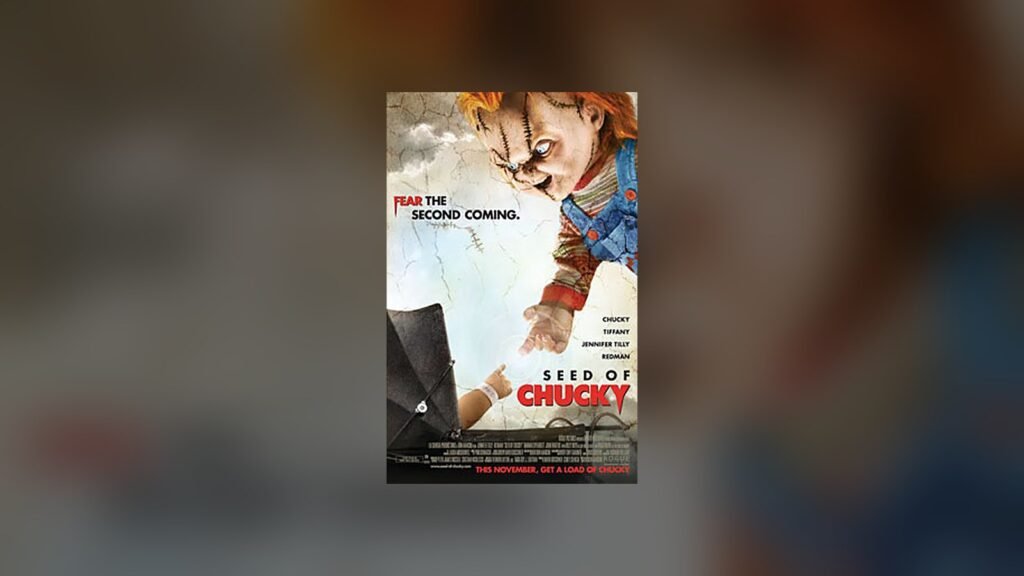
Seed of Chucky is the 2004 sequel where Don Mancini takes the director’s chair, brings Chucky to Hollywood, and gives him a child.
Of all the films on this site, this is the one its studio called “too gay,” its director calls his experiment, and its fans have spent twenty years arguing about. Seed of Chucky is the fifth film in the Child’s Play franchise, the directorial debut of series creator Don Mancini, the last original-continuity Chucky film released in theaters, and the strangest family drama ever built out of two killer dolls and a turkey baster. It flopped, it vanished, and then — slowly — it became the entry a generation of viewers calls ahead of its time. This page tells it straight: both budget figures, both worldwide grosses, and the plot exactly as the film reveals it.
Three clarifications before anything else, because this film generates more errors than the rest of the series combined: Mancini DID direct this one (the ones he didn’t direct are listed on his page). Jennifer Tilly plays two roles — herself, and the voice of Tiffany. And Glen/Glenda is not one soul with a split personality; the film’s own reveal is two separate souls sharing one body.
Quick Specs
Director: Don Mancini (directorial debut)
Written by: Don Mancini
Producers: David Kirschner, Corey Sienega
Starring: Jennifer Tilly, Redman, Hannah Spearritt, John Waters, with Billy Boyd and Brad Dourif as the voices of Glen/Glenda and Chucky
Released: November 12, 2004 (Rogue Pictures, the Focus Features genre label)
Runtime: 86 minutes (87 in the unrated version)
Rated: R
Working title: Son of Chucky
Story setting: Six years after Bride of Chucky
Budget: Reported two ways — $12 million and $29 million (see below)
The Cast
Jennifer Tilly does double duty, and the film is unthinkable without both halves of it: she plays Jennifer Tilly — a vain, scheming, cheerfully self-parodying version of herself — and she voices Tiffany Valentine, the doll who wants her body. Brad Dourif voices Chucky, as he has in every film of this continuity. Billy Boyd, fresh off The Lord of the Rings, voices Glen/Glenda with a softness that makes the doll the franchise’s first genuinely gentle soul. Redman plays himself, the rapper-turned-director whose film-within-the-film sets the plot’s machinery turning. Hannah Spearritt plays Joan, Jennifer’s disgusted assistant. John Waters — the Pope of Trash himself — plays Pete Peters, a tabloid paparazzo, in the film’s most inspired piece of casting. Keith-Lee Castle is Psychs, the ventriloquist who cages the child; Steve Lawton (listed in some credits as Steve West) plays Stan, the chauffeur whose love for Jennifer costs him his life. Effects designer Tony Gardner appears as himself, and Jason Flemyng appears as himself playing Santa — because in Mancini’s Hollywood, even Father Christmas is a working actor.
The Plot
Six years after Bride of Chucky, Chucky and Tiffany’s child — a gentle, gender-fluid living doll — is being held by “Psychs,” an abusive British ventriloquist who has mockingly named them “Shitface” and works them as a dummy. The doll dreams of murder and wants none of it. Then a TV preview for Chucky Goes Psycho — a Hollywood film built around the original Chucky and Tiffany dolls, repaired from their remains — tells the child who their parents are. Shitface escapes, tracks the dolls to a Hollywood prop room, and resurrects them with the Heart of Damballa amulet. Chucky is stunned to have a child at all. Tiffany is overjoyed. Neither can agree what the child is: Chucky renames them Glen, Tiffany renames them Glenda, and the doll wears both names from then on.
Within a day the family is back to work: Chucky and Tiffany decapitate an effects technician with a wire — the technician is played by the film’s own effects designer, Tony Gardner, as himself, the first of the film’s inside jokes about its own making — and Glen/Glenda — horrified at watching their parents kill — asks the question the whole film hangs on: why do you kill? Tiffany, feeling the weight of parenthood, tries to force Chucky to quit; Chucky falsely promises. Meanwhile the family’s real plan forms. Jennifer Tilly — the actress, playing herself, who is scheming to land the Virgin Mary role in rapper Redman’s directorial debut by seducing him — will be Tiffany’s new body. Redman will be Chucky’s. Tiffany knocks both humans out and inseminates Jennifer with Chucky’s semen by turkey baster, intending the baby to host Glen/Glenda’s soul.
It falls apart the way everything in this family falls apart: in blood. Chucky takes Glen/Glenda on a secret joyride and the paparazzo Pete Peters dies in a sulfuric-acid accident Glen/Glenda accidentally causes. Redman, learning Jennifer is pregnant, fires her — announcing he had a vasectomy and that pregnant women don’t fit his vision — and Tiffany guts him for the misogyny of it. The voodoo pregnancy accelerates overnight. Jennifer’s assistant Joan is killed trying to help, and her death exposes the film’s central secret: Glen and Glenda are two souls, not one — Glen the pacifist, Glenda the psychopath.
Jennifer gives birth to twins, a boy and a girl — one body for each soul. And at the summit of his plan, Chucky backs out of it: he has made his peace with being a doll and no longer wants to be human at all. Disgusted, Tiffany leaves him. Chucky throws a knife at Jennifer to stop her going; chauffeur Stan takes it for her and dies. Police scatter the dolls. In hospital, Tiffany drugs Jennifer and begins to transfer herself into her — and Chucky breaks in and kills Tiffany with an axe. Glen takes up the axe, and when Chucky assumes the killer in front of him is Glenda, Glen corrects him: it’s him. The pacifist dismembers his father, who praises him for it before the head comes off. Five years later, Jennifer Tilly raises the twins (the human children are played by Beans El-Balawi — also credited as Jordan El-Balawi — and Kristina Hewitt) — and a birthday-party rage reveals the last twist: Tiffany’s transfer succeeded, and the woman raising Glen and Glenda is Tiffany wearing Jennifer Tilly’s life. Then Glen opens a present, and finds Chucky’s severed arm inside. It grabs him. Some families never really end.
The Movie Universal Wouldn’t Make
The film had a long birth. Development on a follow-up — then called Son of Chucky — began within days of Bride of Chucky‘s October 1998 release; Ronny Yu, Bride’s director, couldn’t return for scheduling reasons, which eventually put the writer in the director’s chair for the first time. The script itself started from an unlikely ancestor: Glen or Glenda, the 1953 cult film, by way of a question Mancini has stated plainly — “what if Chucky had a gay kid?” Mancini, who is gay and wanted to explore those themes inside his own franchise, wrote Chucky’s child as an innocent person struggling with gender dysphoria, and leaned the series further into comedy on a deliberate theory: killers like Michael, Jason and Freddy get less scary the more familiar they become, and with Chucky “it’s already absurd. But that distance allows you to experiment.”
Universal — home of the previous three films, and expecting a conventional slasher with a murderous son — rejected the script with a note that has followed the film ever since: “This is too gay.” Tilly has told her version of the same wall: “The studio said, ‘It’s too gay, it’s too funny, and there’s too much Jennifer Tilly.'” The project sat until Focus Features approved it after Cabin Fever‘s success in 2003, releasing it through the Rogue Pictures label — the only film in the series not produced by Universal, though Universal handled home video. Mancini shot it almost entirely at Castel Studios in Romania to save money, working mostly on sound stages under the influence of Brian De Palma and Dario Argento, with all animatronic and makeup effects by Tony Gardner’s Alterian, Inc. Gardner appears in the film as himself — and supplies one of its first corpses.
Release, Reviews and the Money, Both Versions
Seed of Chucky opened November 12, 2004 at number four, taking $8,774,520 on its first weekend across 2,059 screens. The domestic total is one of the few numbers nobody argues about: $17,083,732, agreed across trackers, with the run closing December 23, 2004. The worldwide total comes in two versions — $24,829,644 in the Box Office Mojo lineage and $24,741,977 in a second reference lineage — and this page prints both rather than inventing a merger. The budget is worse: $12 million in most references, $29 million at The Numbers, with even summaries now reduced to printing the range “$12–29 million.” (Mancini himself jokes that they were given $10 million to make it; that’s a fond remark, not a figure, and it isn’t printed here as one.) The film rolled out internationally into 2005, reaching Australia that February, and the DVD followed June 7, 2005, with an unrated extended edition in 2007 — the home-video shelf where this film quietly built the audience that would later reclaim it.
Critics split down the middle of the film’s own split personality. Roger Ebert, at two stars, wrote the line everyone quotes: “Seed of Chucky is actually two movies, one wretched, the other funny.” Variety found it “simply isn’t funny or frightening enough to expand its appeal beyond core fan base,” and The Hollywood Reporter faulted “a lack of suspense and shocks.” But Marc Savlov in the Austin Chronicle gave it three of five and called it “the most engaging, and, dare I say, emotionally honest” of the series, and Scott Brown in Entertainment Weekly landed on the performance at its center: “By far, the most shocking carnage is Tilly carving up her persona. What a doll.” On Rotten Tomatoes the film stands at 36% from 80 reviews as of October 2026 — the score drifts as reviews accumulate; an older snapshot read 34%. Metacritic has it at 46, mixed to average.
The Nine-Year Silence, and the Return
Underwhelming money and split reviews bought the series its longest sleep: no new Chucky film appeared until Mancini returned with Curse of Chucky in 2013, and that film and Cult of Chucky went direct-to-video — leaving Seed, for all its troubles, as the last original-continuity Chucky ever released in theaters. The twins were left in limbo with it: Mancini has said that while making Curse and Cult he wanted to allude to Glen and Glenda and was forbidden from doing so.
The television series finally set them free. Glen and Glenda return in Chucky season two (2022) — first glimpsed in “The Sinners Are Much More Fun,” then centered in “Death on Denial” — played as adults by non-binary actor Lachlan Watson, not by the film’s child actors. The twins’ hair lengths were deliberately reversed from the film’s ending, Mancini has explained, so the characters wouldn’t fall into stereotypical gender boxes. Mancini’s hope for the return is on the record: “it was really important to us that we honor the trans experience with these characters.” And the film itself has undergone the reassessment its defenders always promised: retrospective critics now praise its performances and its themes of sexuality and self-acceptance, often calling it ahead of its time, and it is increasingly described as a camp cult classic — even while it still ranks at or near the bottom of many franchise lists and holds the series’ lowest audience scores in some databases. Both verdicts survive on this page, because both are honestly held: the flop of 2004 is also, twenty years on, the Chucky film that took the biggest swing. It is the hinge of the whole series, too — everything Mancini made afterward, from Curse’s straight-horror reset to the television show’s continuity weave, is in some way an answer to the swing he took here. It missed plenty. It was aiming at something none of the others even attempted.